LiveRamp and Scowtt bet on CRM signals to fix ad optimization
LiveRamp partners with Scowtt to integrate predictive AI models using first-party CRM data, promising 40%+ ROAS gains across major ad platforms and programmatic destinations.


LiveRamp partners with Scowtt to integrate predictive AI models using first-party CRM data, promising 40%+ ROAS gains across major ad platforms and programmatic destinations.
LiveRamp (NYSE: RAMP) announced on February 20, 2026, a partnership with Scowtt, a Kirkland, Washington-based AI advertising optimization platform founded in 2024, to integrate Scowtt's predictive models directly into LiveRamp's data collaboration platform. The deal, described by both companies as the first of its kind, targets a persistent gap in how advertising systems process business outcomes: the disconnect between what happens inside a company's CRM and what ad platforms actually see.
The announcement lands at a moment when the industry has been reckoning with the limits of web-based optimization signals. Reporting from PPC Land has tracked the growing urgency around first-party data activation as third-party identifiers erode and privacy regulation tightens. The LiveRamp-Scowtt deal tries to address this at the signal layer - not by building new data infrastructure, but by making existing CRM records do work they previously could not.
Scowtt's platform operates on the premise that most advertising systems optimize against a thin and delayed slice of reality. Clicks and website conversions capture only a fraction of commercial activity for businesses where growth depends on calls, appointments, quotes, and repeat relationships. According to Eduardo Indacochea, CEO and Founder of Scowtt, who previously served as Sr. Director of Ads at Google and VP, Ads at Meta - roles that gave him direct exposure to how automated campaign systems like Performance Max were designed - the core problem has been structural.
In a November 2025 essay published on Scowtt's website, Indacochea described the gap: "Only a small percentage of customers ever convert, and it often takes weeks for that to happen. The learning loop is slow and thin, and it's built entirely around web signals that represent a fraction of a company's reality."
What Scowtt built in response is a set of proprietary sequential models that learn directly from CRM data to generate real-time predictive signals. These signals represent predicted purchase probability and customer value, derived from 50+ input variables, and are fed back into Google and Meta bidding systems before a conversion actually happens. The result, according to the company, is an optimization loop that runs ahead of the purchase rather than reacting to it.
Scowtt reports that its AI Marketing module has produced a 59% improvement in ROAS on Search campaigns and an 80% improvement on Performance Max and Meta campaigns for existing clients. The February 20 announcement cites a figure of 40%+ ROAS improvement specifically in the context of the LiveRamp integration, reflecting the layered effect of combining Scowtt's predictive models with LiveRamp's identity infrastructure.
LiveRamp's core infrastructure is built around deterministic identity resolution - the ability to connect individual consumer data across touchpoints using pseudonymized identifiers called RampID. Rather than relying on probabilistic guessing or third-party tracking, LiveRamp maps customer records deterministically, which gives its platform unusual stability in a cookie-constrained environment. LiveRamp reported revenues of $194.8 million in the first quarter of fiscal 2026, representing 10.7% year-over-year growth, with over 500 ecosystem partners across publishers, advertisers, and data providers.
Under the partnership, Scowtt's predictive models become available inside the LiveRamp platform. Advertisers can activate predictive optimization scores alongside their existing audience segments, effectively giving their campaign bidding strategies a forward-looking signal rather than a backward-looking one. The mechanism combines two things that have historically remained separate: the identity-level precision LiveRamp provides and the conversion-value prediction Scowtt generates from CRM patterns.
According to the February 20 press release, Scowtt's integration with LiveRamp will power a unified conversion value model. This model then enables continuous dynamic optimization - meaning bid adjustments based on predicted customer value happen in real time, not as a one-time configuration. LiveRamp customers who have limited CRM data of their own will also be able to supplement with third-party data on targeting intent, broadening the integration's potential reach beyond large enterprises with mature CRM programs.
Dave Eisenberg, Chief Strategy Officer at LiveRamp, stated in the announcement: "LiveRamp customers can be assured they're maximizing media performance via Scowtt's proven AI models, built by experts that know the major platforms inside and out."
That framing matters. Scowtt's founder spent years inside both Google and Meta designing the very bidding systems that advertisers now try to optimize against. Indacochea was at Google as Sr. Director, Ads and then moved to Meta as VP of Ads from January 2023 to December 2023, where he was responsible for Meta Business Suite, Business Manager, Ads CRM, and Ads Manager. He founded Scowtt in March 2024 in the Greater Seattle Area.
The gap that Scowtt targets is well-documented. Ad platforms have built their automation around deterministic web signals - purchases, form fills, page views - because those signals are consistent and scalable. For industries like financial services, real estate, automotive, and professional services, the actual purchase happens offline or weeks after initial digital contact. The standard learning loop sees only a fragment of the story.
PPC Land's coverage of Meta's profit-based ROAS optimization from June 2025 showed how platforms themselves have been trying to address this through value-based bidding features. Meta's June 4, 2025 expansion introduced Value Rules, Incremental Attribution, and profit-margin optimization tools to allow advertisers to feed richer outcome signals back into campaign systems. But these tools require advertisers to configure and supply the value data themselves - a process that puts technical burden on the marketing team.
Scowtt's approach offloads that configuration. Its models integrate directly with existing CRM systems, site analytics, and product catalogs without requiring platform changes or new organizational workflows. According to the company's description, its AI agents engage with prospects around the clock and surface conversion opportunities, routing non-ready prospects to human sales appointments when necessary. This positions Scowtt as infrastructure rather than a tool that marketers must actively manage.
The broader industry context is one where first-party data has become strategically central but technically difficult to activate at scale. LiveRamp's October 2025 launch of agentic AI tools reflected this, introducing autonomous agents capable of accessing identity resolution, segmentation, and measurement tools through governed API access. The Scowtt partnership extends that architecture further by adding a predictive layer that transforms CRM records into live optimization signals.
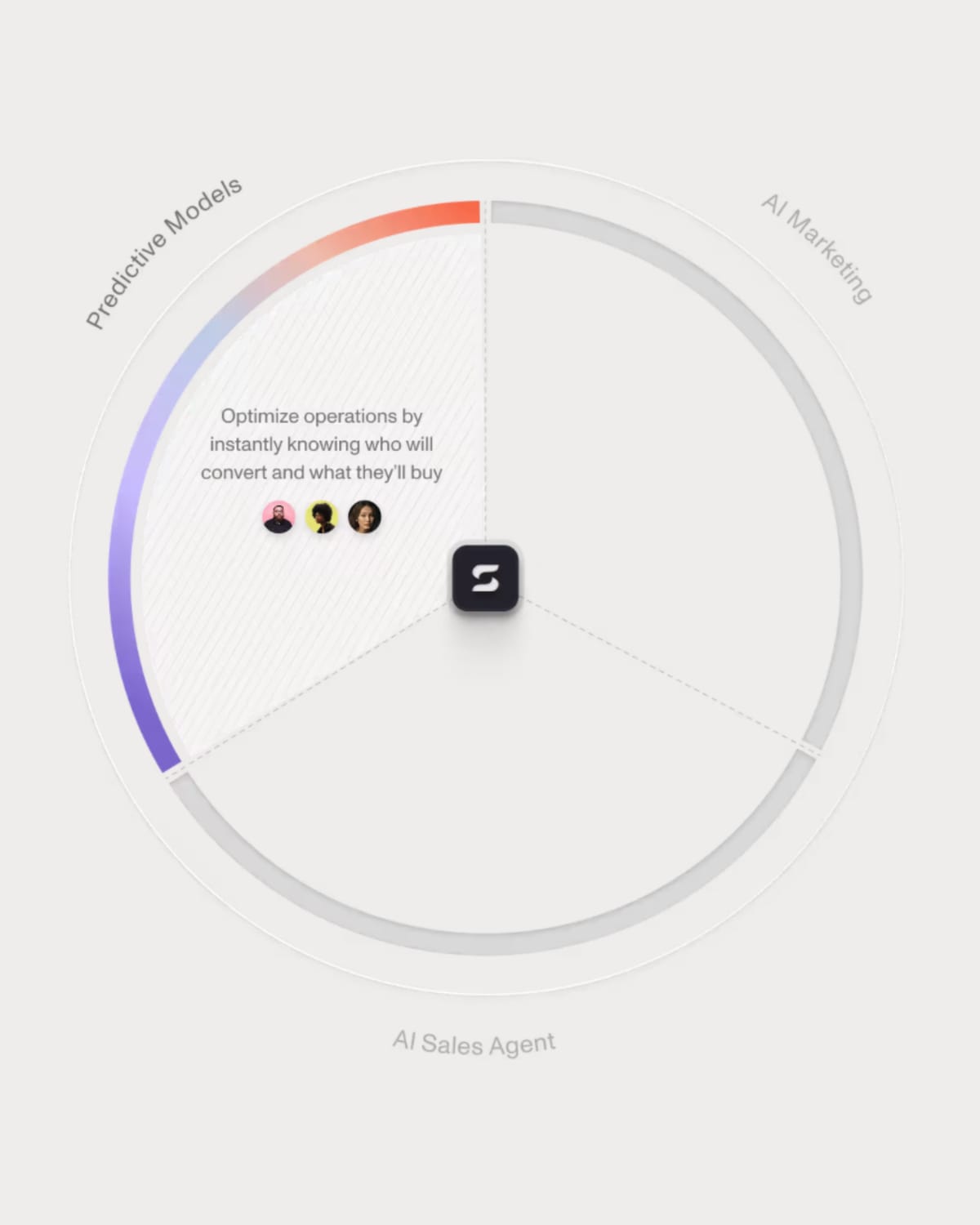
Scowtt was founded in 2024 and employs between 11 and 50 people, according to its LinkedIn profile. Its headquarters are in Kirkland, Washington. The company operates across three core product areas: Predictive Models built from CRM data; AI Marketing that pushes predictions into Google, Meta, and TikTok bidding systems; and AI Sales, which uses generative AI agents to engage leads and convert missed sales opportunities.
The team includes Arnav Kamra as Founding ML Engineer, who holds an M.S. in Computer Science with an AI specialization. Sales and client-facing functions include Alex Berg, Jason Daron, and Matthew Stern. Scowtt's approach differs from co-pilot or overlay tools by integrating fully into a client's existing technology stack rather than sitting on top of it.
The company describes its target verticals as eCommerce, Financial Services, Automotive, Travel, and any industry with rich CRM signal density. The February 20 partnership announcement positions LiveRamp as the first platform to combine data collaboration infrastructure with Scowtt's CRM-driven prediction models - a distinction the companies emphasize, though LiveRamp's data collaboration network already includes a wide range of AI-powered partners and integrations.
LiveRamp has been building toward this kind of predictive signal integration for some time. In January 2026, the company expanded its Data Marketplace to include AI model licensing and training data, allowing marketers and data scientists to access pre-built models and license first-party datasets through a governed infrastructure. The Scowtt partnership adds a new dimension to this - not just accessing models, but integrating partner models that process a marketer's own CRM data to produce real-time bidding signals.
One of the more concrete aspects of the Scowtt product is its onboarding structure, which the company has detailed in technical documentation. The process takes approximately 30 days and runs in two phases. Weeks one and two cover data onboarding - integrating web and CRM signals - while weeks three and four are dedicated to model development and campaign setup. Scowtt states that incremental results typically appear within two weeks of launch.
The data requirements are deliberately minimal by enterprise standards. The CRM must include at least three data points: funnel stage information - for example, booking or showing status - and engagement signals such as call time. Standard CRM integrations cover Salesforce and HubSpot directly through an OAuth-style authorization, where the customer grants Scowtt's application access through a Connected Apps interface. Non-standard CRMs have three options: sharing data as a BigQuery table (Scowtt's preferred path), providing API credentials for Scowtt to pull data, or pushing data directly to Scowtt's API endpoints.
Google Analytics data feeds into the model through BigQuery as well. Scowtt provisions a customer-specific account and provides a security group address in the format <customer>[email protected], which the customer uses to share their BigQuery table. This user-level and site-level behavioral data combines with CRM records to generate the predictive model.
The ads integration follows a separate track for each platform. For Meta, the customer creates a new dataset ID and integrates it with Meta Pixel events, specifically excluding purchase events from that dataset. An access token is generated for the dataset and connected through Scowtt's app, which then pushes offline conversions via Meta's Conversions API as purchase events into that dataset ID. For Google, the customer authorizes Scowtt's app to push offline conversions through Google Ads' Connected Apps flow. Scowtt then creates a primary conversion action named "Scowtt Conversion Values" under the Submit Form category, which becomes the campaign's target conversion signal.
This four-stage data flow - CRM data in, predictive score out, score fed to platform, results written back to CRM - is central to how Scowtt differs from standard offline conversion import tools. According to the company's product documentation, traditional tools like Google's Enhanced Conversions or Meta's Conversions API rely on deterministic data: they wait for a confirmed event such as a Marketing Qualified Lead, Sales Qualified Lead, or purchase before sending it to the ad platform. This creates campaigns that optimize after conversions happen, often weeks later, based on a limited set of binary outcomes.
Scowtt's models work on a different timeline. The predictive signal is sent to ad platforms in approximately 15 minutes from the triggering CRM or behavioral event, allowing Google, Meta, or TikTok to optimize before the actual purchase occurs. The company states this delivers 10 times richer data to the bidder and enables value-based bidding weeks earlier than deterministic imports.
Scowtt's pricing model is structured differently depending on business type, according to product documentation. For lead generation businesses, the company charges a percentage of incremental revenue driven by its predictive models plus a CPL (Cost per Lead) processing fee based on the number of leads analyzed monthly. For eCommerce and retail businesses, pricing consists of a percentage of incremental ROAS directly attributable to Scowtt, a percentage of media spend optimized through its predictive engine, and a CPA (Cost per Acquisition) performance-based component. The model ties cost directly to measurable, incremental growth rather than charging a flat platform fee.
Incrementality measurement uses a 50/50 controlled experiment run through the Google Ads platform. A control group runs business as usual on Search or Performance Max. The Scowtt test group runs the same campaign type with identical configurations, with one change: the conversion action is replaced by Scowtt's predictive value signal. This structure allows the company to isolate the effect of its predictive layer from other campaign variables.
Scowtt states that customers typically see incremental revenue increases of 50% to 120%, powered by predictive intelligence that enriches ad platform bidders. When AI Sales Agents are deployed alongside the marketing integration, the company reports an additional 30% incremental revenue gain, which it attributes to better alignment between sales and marketing outcomes. The platform claims a greater than 50% incremental revenue range as a headline figure, alongside a claim of delivering 10 times more data into campaign bidders than standard conversion signals.
The SOC 2 Type II certification is noted in Scowtt's product materials as part of its compliance and security posture. The platform uses end-to-end encryption and is described as enterprise-grade in its scalability. Integrations cover Salesforce, HubSpot, Google Ads, Meta, TikTok, Snap, and Google Calendar, with flexibility noted for unstructured data formats across all of these.
The significance for performance marketers lies in what this combination targets: the measurement and optimization gap between online touchpoints and offline or delayed business outcomes. PPC Land has covered inflated ROAS reporting and the structural attribution problems that cause campaign dashboards to tell a different story from actual business performance. A tool that feeds predicted customer value back into bidding systems before the conversion happens could reduce how much weight campaigns place on shallow, fast web events like page views and micro-conversions.
The technical risk is in model quality. Predictive models trained on CRM data can overfit to historical customer patterns, particularly when CRM records are inconsistent or biased toward segments that were previously easier to close. LiveRamp's addition of third-party data on targeting and intent - available to customers with limited CRM depth - partly addresses this by broadening the signal set. But the 40%+ ROAS improvement figure cited in the announcement reflects client outcomes rather than controlled experiment results, a distinction worth noting when evaluating performance claims in this category.
For advertisers using Performance Max or Meta Advantage+ campaigns, where bidding is highly automated and the platform already uses value-based signals, the integration could be significant. These campaign types are designed to accept conversion value signals and weight spend toward higher-value predicted outcomes. Scowtt's predictive layer, delivered through LiveRamp's identity infrastructure, would feed those systems with CRM-derived value scores rather than raw conversion events - a more granular and business-aligned signal.
LiveRamp's December 2025 work with Uber Intelligence and its October 2025 partnership expansions with retail media networks and Meta measurement point to a platform building dense connectivity across the advertising stack. Adding Scowtt creates a link between that identity graph and a predictive optimization layer that did not previously exist in this combination.
Who: LiveRamp (NYSE: RAMP), headquartered in San Francisco, California, and Scowtt, an AI advertising optimization platform founded in 2024 and based in Kirkland, Washington, led by CEO and Founder Eduardo Indacochea.
What: A partnership integrating Scowtt's predictive AI models - trained on advertisers' first-party CRM data using 50+ signals - into LiveRamp's data collaboration platform, enabling real-time conversion value optimization across major advertising platforms and programmatic destinations. The companies describe it as the first partnership combining data collaboration infrastructure with CRM-driven predictive optimization.
When: Announced on February 20, 2026, via Business Wire.
Where: The integration is available within the LiveRamp platform, which operates globally from its San Francisco headquarters. Scowtt operates from Kirkland, Washington, with a team of 11-50 employees.
Why: Standard advertising optimization systems learn from web signals - clicks and conversions - that capture only a fraction of business outcomes, particularly for industries where growth depends on offline interactions such as calls, appointments, and quotes. The partnership attempts to close the gap between CRM-held business intelligence and the signals that automated campaign bidding systems use to allocate spend, using LiveRamp's deterministic identity layer to connect individual consumer data with Scowtt's predictive value scores.