Media experts embrace AI advertising cautiously amid brand safety concerns
IAS survey reveals 61% of media professionals excited about AI-generated content opportunities while 53% cite unsuitable adjacencies as top 2026 challenge.

Media professionals approach artificial intelligence advertising with cautious optimism, balancing innovation opportunities against content quality risks that threaten brand safety across digital channels. Integral Ad Science released its 2026 Industry Pulse Report on December 8, showing industry sentiment toward AI-generated content reflects both enthusiasm and concern as advertisers redefine media quality standards.
The research surveyed 290 U.S. digital media experts in October 2025, including 98 advertisers, 78 agency professionals, 58 publishers and platforms, and 56 ad tech representatives. IAS partnered with YouGov to examine how programmatic advertising professionals plan to navigate emerging technologies, platform shifts, and measurement challenges throughout 2026.
Subscribe PPC Land newsletter ✉️ for similar stories like this one
Digital video and social media platforms dominated priority rankings among respondents. Eighty-eight percent identified digital video as a top format priority, exceeding digital display at 85 percent and digital audio at 62 percent. Social media captured 84 percent of respondents as the leading digital environment, followed by influencer marketing at 61 percent and video livestreaming at 56 percent.
The convergence of AI content generation and social video creates complex brand safety requirements. According to the report, 87 percent of media experts consider brand safety and suitability of the social influencer or creator an important consideration when advertising adjacent to digital video content. This concern extends to AI-generated material, with 83 percent stating that increasing levels of AI-generated content on social media require monitoring.
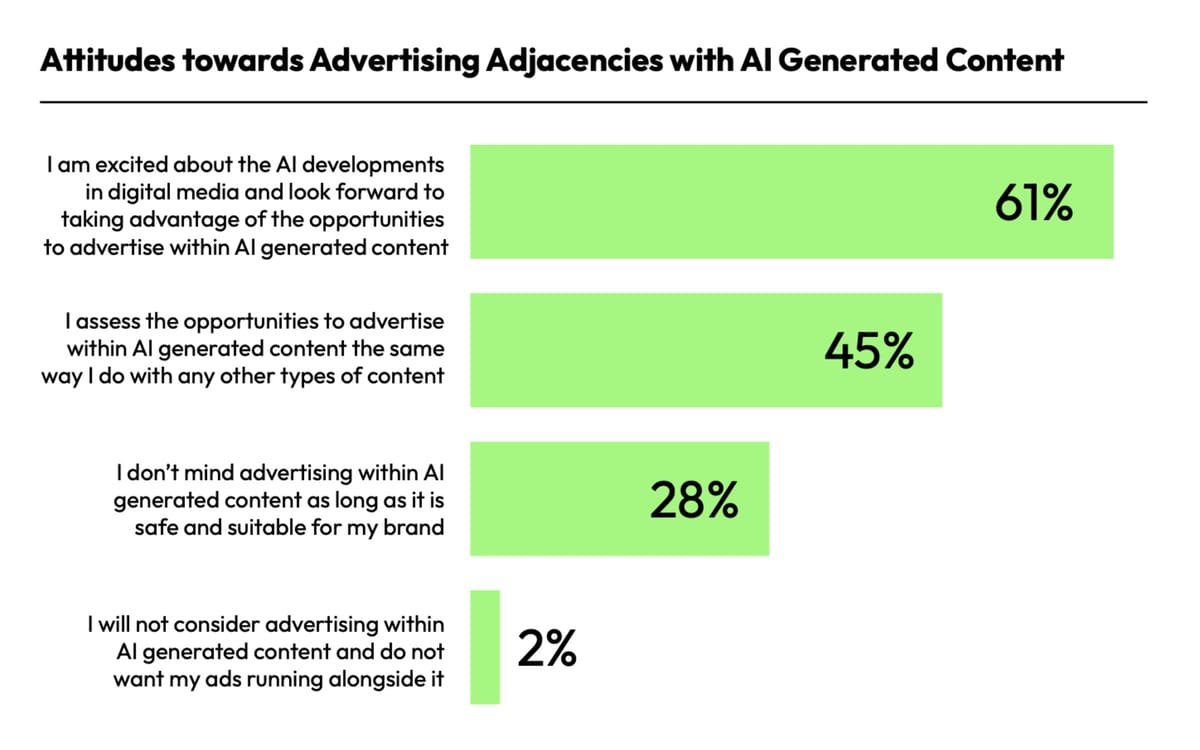
AI adoption patterns reveal industry ambivalence toward machine-generated content adjacencies. Sixty-one percent of respondents expressed excitement about AI developments in digital media and opportunities to advertise alongside AI-generated content. However, 53 percent simultaneously cited ad adjacency to content generated by AI as a top media challenge for 2026. This contradiction reflects uncertainty about content quality as AI production scales.
The research identified specific categories of AI-generated content that media experts would avoid. Content containing inaccurate information or hallucinations ranked highest at 59 percent avoidance, followed by content providing ad-spammy or cluttered user experiences at 56 percent. Fifty-two percent would avoid content from unknown or recently registered domains with no verifiable editorial team, while 51 percent expressed concern about content attracting non-human bot traffic.
Brand safety and suitability measurement capabilities have expanded significantly across major platforms throughout 2024 and 2025, with verification providers introducing content-level controls for Facebook, Instagram, and other social networks. The Media Rating Council restricted property-level ad verification services from claiming "brand safety" capabilities unless they analyze images, videos, and audio at the content level in October 2025.
Thirty-six percent of respondents indicated they are cautious about advertising within AI-generated content and will take extra precautions before doing so. Forty-six percent cited that increasing levels of AI-generated content not suitable for brands and ad adjacency to this content represents a serious threat to media quality. Forty-five percent assess opportunities to advertise within AI-generated content the same way they do with any other content types.
Social media faces mounting challenges despite its priority status among advertisers. Fifty-two percent of media experts identified social media as facing serious challenges across the industry during the next 12 months. Digital video followed at 39 percent, digital display at 36 percent, and influencer marketing at 31 percent. These percentages reflect concerns about ad content adjacencies with potentially increasing risky content on platforms.
For brands and agencies, ad content adjacency emerged as the top digital media challenge at 69 percent. This category encompasses deepfakes at 32 percent, AI-generated content at 31 percent, and influencer or creator content at 27 percent. Ad fraud and made-for-advertising sites ranked second at 50 percent, while ability to assess measurement and outcomes captured 40 percent.
Publishers and platforms prioritized different challenges. Thirty-nine percent cited ads delivering alongside risky content as their top concern, tied with providing scaled audience extension while minimizing overhead. High carbon emissions of programmatic advertising registered at 38 percent among publisher concerns.
Artificial intelligence integration accelerated throughout 2025, with major technology companies introducing AI-powered campaign optimization tools affecting both search advertising and display inventory. McKinsey data indicates $1.1 billion in equity investment flowed into agentic AI during 2024, with job postings related to the technology increasing 985 percent from 2023 to 2024.
Media quality metrics maintained prominence across digital environments. Eighty-five percent of respondents identified viewability as important when assessing social media campaigns, while 77 percent cited attention metrics as important for evaluating campaign performance. Seventy percent indicated that insufficient transparency in media quality metrics within social platforms would negatively impact media spend.
Influencer marketing emerged as an increasingly important component of social media advertising strategies according to 78 percent of respondents. Eighty-two percent said brand safety and suitability of the influencer or creator will be an important consideration when advertising adjacent to social content. This concern reflects rapid growth in creator advertising spending, which reached $37 billion in 2025 according to Business Insider estimates, growing four times faster than the overall media industry.
Third-party measurement capabilities received strong support for addressing AI content challenges. Eighty-four percent agreed that third-party measurement and optimization will be important in identifying and classifying AI-generated content within social media platforms. Eighty-six percent said the ability to identify, classify, target, and avoid AI-generated content will be needed as this content becomes more prevalent within digital video platforms.
The research examined attitudes toward advertising adjacencies with AI-generated content through multiple response categories. Twenty-eight percent said they don't mind advertising within AI-generated content as long as it is safe and suitable for their brand. Only 2 percent indicated they will not consider advertising within AI-generated content and do not want ads running alongside it.
Digital video brand safety concerns paralleled social media patterns. Eighty-four percent of respondents agreed that accelerating consumption of social video platforms will continue driving programmatic video ad spend. Eighty-three percent stated brand safety will be a growing concern as the volume of digital video ads grows. Eighty-two percent indicated third-party measurement and optimization will be important to avoid digital video advertising adjacent to deepfakes.
Buy ads on PPC Land. PPC Land has standard and native ad formats via major DSPs and ad platforms like Google Ads. Via an auction CPM, you can reach industry professionals.
Connected television advertising presented distinct quality challenges as inventory volumes expand. Eighty-three percent cited ad fraud including bots, malware, and spoofing as concerns growing with ad-supported CTV inventory. An equal percentage agreed brand safety in CTV environments will be a growing concern as the volume of CTV inventory and the number of sellers increase. Seventy-five percent believe CTV ads are vulnerable to particularly low viewability rates.
Retail media networks prioritize media quality metrics as the sector expands beyond traditional e-commerce advertising. Eighty-three percent of respondents agreed measuring ad fraud is important for evaluating campaign performance in retail media environments. An equal percentage cited viewability as important for evaluating campaign performance, matched by brand suitability as an important strategy to boost campaign performance.
AI-generated content concerns extend to retail media networks despite their typically controlled environments. Eighty-two percent indicated brand safety and suitability of an influencer or creator will be important when advertising adjacent to influencer content on retail media networks. Eighty-one percent stated increasing levels of AI-generated content in retail media networks will be a significant concern requiring monitoring.
The report identified social media and digital video as media types holding the most potential for innovation and opportunity. Social media captured 46 percent of respondents, followed by digital video at 34 percent and digital display at 32 percent. Influencer marketing registered at 30 percent, while digital out-of-home, mobile, and livestreaming each scored between 28 and 29 percent.
Lisa Utzschneider, CEO of Integral Ad Science, characterized 2026 as "a turning point in digital advertising" where boundaries between channels blur and AI reshapes content creation, consumption, and measurement. The company emphasized that industry experts are redefining quality standards for this environment where marketing opportunities on social media and digital video come with complexity.
Measurement standardization challenges persist across retail media networks despite sector growth, with 53 percent of stakeholders citing lack of standardization as a significant barrier according to previous IAB Europe research. The retail media sector reached $52.44 billion in the United States during 2024, with projections exceeding $300 billion globally by 2030.
Jeremy Kanterman, Vice President of Research and Insights at IAS, noted that AI and AI-generated content usage surged in 2025, leaving publishers and advertisers balancing opportunities against risks. The research reveals a cautious industry prioritizing oversight of AI in digital media for 2026, with investment flowing into digital video, social platforms, and influencer marketing.
The findings arrive as advertising platforms accelerate AI integration capabilities. Google unveiled comprehensive AI advertising features at Think Week in September 2025, including agentic advisors for Google Ads and Analytics. Amazon added AI agent capabilities for Marketing Cloud analytics queries, translating business questions into executable database queries through conversational prompts.
Platform-specific brand safety tools continued expanding throughout 2025. DoubleVerify launched pre-bid video controls for TikTok in April, enabling advertisers to block ads from appearing alongside unsuitable content before ad serving. Meta introduced comment control capabilities for Facebook and Instagram advertisers in October 2024, addressing brand safety and content moderation concerns.
Measurement verification companies emphasized the importance of content-level analysis over property-level domain checking. The Media Rating Council policy issued in October 2025 required that verification services analyze images, videos, and audio to qualify as brand safety solutions, rather than relying solely on text and keyword analysis.
The research methodology included questions about media priorities, anticipated challenges, attitudes toward AI-generated content, and media quality considerations across different digital environments. Respondents represented diverse organizational types including advertisers, agencies, publishers, platforms, and ad tech vendors working with programmatic advertising.
Made-for-advertising sites and ad clutter avoidance emerged as critical concerns alongside AI content challenges. The Association of National Advertisers defined MFA sites as low-quality inventory designed primarily to generate advertising revenue rather than provide valuable user experiences. IAS developed AI-driven classification technology trained against widely adopted MFA domain lists to detect and block these sites at scale.
Attention measurement gained prominence as a media quality metric beyond traditional viewability standards. Seventy-seven percent of respondents indicated measuring attention on social media ads will be important to evaluate campaign performance. This emphasis reflects industry movement toward metrics capturing actual user engagement rather than simple impression delivery.
The convergence of AI content generation and social platform growth creates unprecedented challenges for content classification systems. Machine learning technologies analyze multimedia content frame-by-frame, combining image, audio, and text signals for accurate categorization. These systems must operate at scale across billions of daily impressions while maintaining sub-second response times required for real-time bidding environments.
Industry collaboration around AI standards continues developing through multiple initiatives. The IAB Tech Lab released an AI in Advertising Use Case Map in September 2025, organizing 84 AI use cases across six categories including audience insights, media strategy and planning, creative and personalization, media buying and activation, owned and earned media, and measurement and analytics.
Ad spending projections indicate continued growth across digital channels despite quality concerns. WARC estimated global advertising spending would rise 7.4 percent with social media reaching $306.4 billion in 2026, representing 14.9 percent growth according to eMarketer data cited in the report. These investment levels underscore the industry's commitment to social and video channels despite measurement and safety challenges.
The research findings suggest that marketers who embrace innovative channels while maintaining strong quality controls will achieve optimal positioning for success in 2026. This approach requires balancing AI-driven efficiency gains against brand protection requirements through comprehensive measurement frameworks spanning fraud detection, viewability verification, and content suitability classification.
Subscribe PPC Land newsletter ✉️ for similar stories like this one
Subscribe PPC Land newsletter ✉️ for similar stories like this one
Who: Integral Ad Science surveyed 290 U.S. digital media experts including 98 advertisers, 78 agency professionals, 58 publishers and platforms, and 56 ad tech representatives who use programmatic advertising.
What: The 2026 Industry Pulse Report examined media priorities, AI adoption attitudes, brand safety concerns, and measurement approaches across digital advertising channels, revealing cautious optimism toward AI-generated content alongside persistent quality challenges.
When: IAS conducted the survey in October 2025 and released findings on December 8, 2025, covering anticipated trends and challenges for 2026.
Where: The research focused on U.S. digital media markets spanning social media platforms, digital video environments, connected television, retail media networks, and programmatic advertising ecosystems.
Why: As AI reshapes content creation and distribution across digital channels while social media and video platforms dominate advertising investment, the industry requires comprehensive understanding of quality challenges, measurement requirements, and brand safety priorities to balance innovation opportunities against reputational risks throughout 2026.