


Google today announced at Google Marketing Live 2026 that it is integrating Meridian - its open-source Marketing Mix Model - directly into Google Analytics 360, while simultaneously introducing Qualified Future Conversions, a new Gemini-powered reporting metric designed to connect current advertising spend to predicted future sales.
The measurement announcements represent the most significant structural change to how Google's tools handle cross-channel performance data since Meridian became globally available in January 2025. Two distinct but interrelated products are involved: a platform-level integration that brings Marketing Mix Modeling inside a widely used analytics interface, and a new predictive signal that eventually feeds back into that same modeling layer.
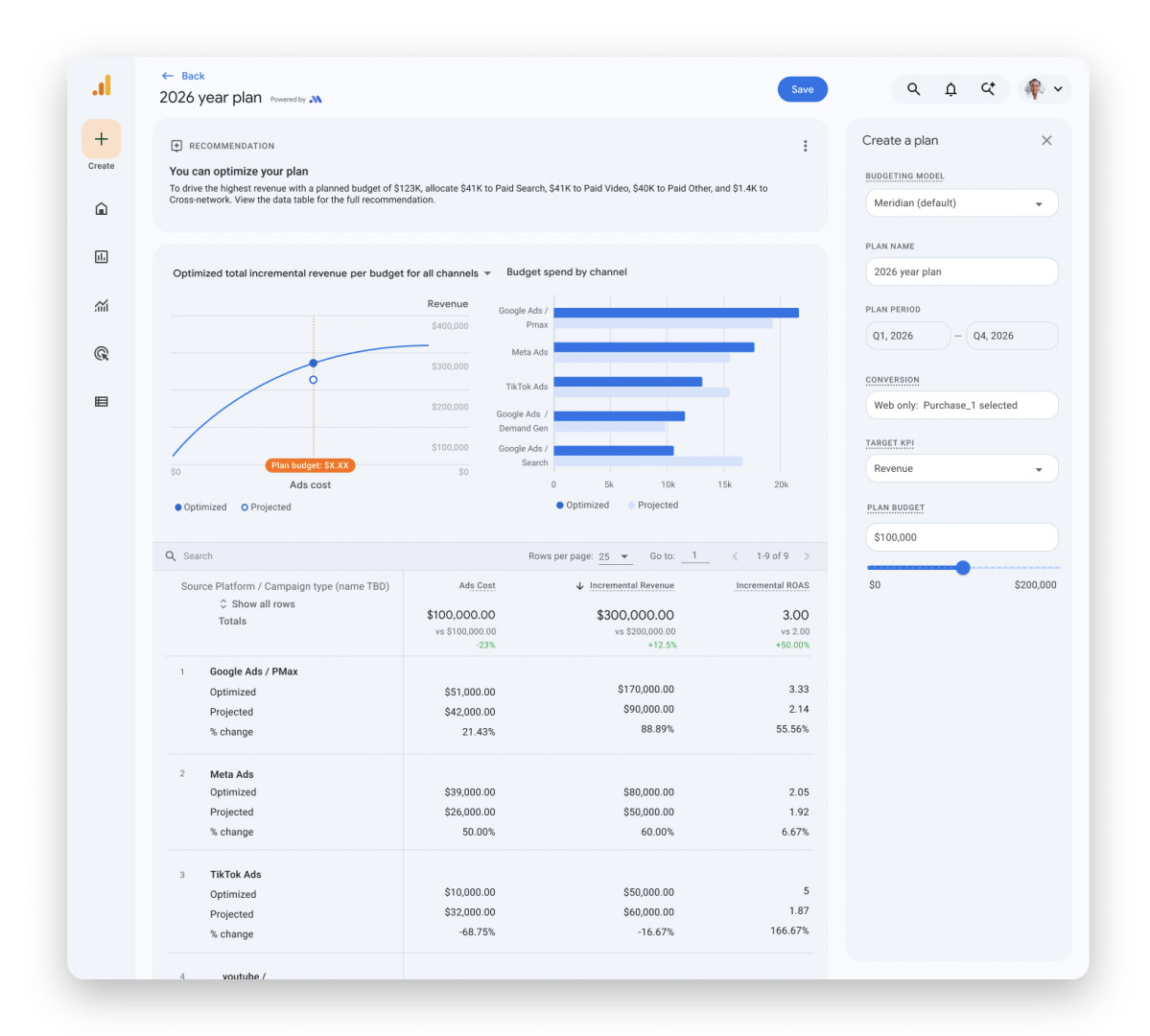
Meridian integration with Google Analytics 360
According to Google, the Meridian integration into Google Analytics 360 will give advertisers the ability to unify first-party, cross-channel data and metric signals in one place, measure causal performance to identify what is driving business results, and use predictive scenarios to guide budget allocation. These three capabilities - data unification, causal measurement, and outcome forecasting - have historically required separate tools, separate teams, and substantial manual effort to connect.
Meridian itself is a Bayesian inference-based Marketing Mix Model framework that does not rely on cookies or user-level data. It first became available globally in January 2025 after testing with hundreds of brands, with Google releasing it as open-source software to allow marketing teams to build and customise their own MMM implementations. The Bayesian approach allows the model to incorporate prior knowledge about causal relationships, then update those estimates as new data arrives - a structural distinction from traditional regression-only MMM methods.
The decision to integrate Meridian into Google Analytics 360, the enterprise tier of the platform, positions MMM not as a specialist data-science workflow running in isolation, but as a component of the same interface that houses campaign reporting, audience data, and attribution analysis. That positioning matters for adoption. A Harvard Business Review Analytic Services report cited in PPC Land's coverage of the Meridian Scenario Planner found that nearly 40% of marketers surveyed said their organisations struggled to connect MMM outputs to real-world business decisions. Placing the model inside an interface that marketing practitioners already use daily is an attempt to close that gap.
The integration is listed as globally available across all languages within Google Analytics 360. No specific date for when the feature will be visible to all advertisers was disclosed beyond the GML 2026 announcement.
Meridian's trajectory to this point
The history of Meridian's development helps explain why today's announcement carries weight beyond a typical product update. Google unveiled the framework in March 2024 as a privacy-centric alternative to cookie-dependent attribution. The model's architecture includes geo-location modeling to measure results at a regional level, Bayesian inference to incorporate prior business knowledge, reach and frequency integration for YouTube campaigns, and budget optimisation recommendations across channels.
After the global launch in January 2025, Google continued building out the toolset. In September 2025, Meridian received significant updates adding support for non-media variables such as pricing and promotions, channel-level contribution priors, and binomial adstock decay functions. Those additions addressed a longstanding limitation in MMM implementations: the tendency for models to attribute sales lifts to media activity when price changes or promotional activity were the actual driver. The September update also expanded Meridian's certified partner network to 30 global providers, including Publicis Media, dentsu, Monks, Adswerve, KINESSO, and Accenture.
In February 2026, Google launched the Meridian Scenario Planner, a non-technical interface designed to make budget planning outputs accessible to people without coding skills. The Scenario Planner sits on top of the existing Meridian model and enables visual exploration of budget allocation scenarios across channels. That launch directly preceded a broader pre-GML measurement push announced on May 5, 2026, which introduced Meridian GeoX - a geo-experimentation product that integrates incrementality experiment results directly into the MMM - and Meridian Studio, an enterprise platform for managing high-volume Marketing Mix Models on Google Cloud.
Each of these additions has moved Meridian from a standalone Python framework toward a more integrated measurement stack. The Google Analytics 360 integration announced today is the latest and most operationally significant step in that progression.
Qualified Future Conversions
The second major announcement in the measurement category is Qualified Future Conversions (QFCs). According to Google, QFCs are powered by Gemini and link today's advertising spend to future sales through signals including brand searches. The stated purpose is to help advertisers uncover missed revenue by surfacing conversion signals that traditional last-click or short-window attribution would not capture.
The mechanism, as described by Google, involves identifying actions that are predictive of eventual conversion - brand search activity being one cited example - and surfacing these as a reportable metric in Google Ads. The relationship between upper-funnel exposure and downstream purchase intent has historically been difficult to quantify in standard reporting interfaces, which tend to attribute conversions to the most recent ad interaction rather than to earlier signals that shaped intent.
QFCs are currently available in a restricted pilot globally across all languages, with plans to launch in beta later in 2026. The interface screenshots attached to the announcement show QFCs appearing in the Google Ads campaigns view alongside standard conversion metrics. Columns visible in the screenshot include "Qualified future conv.", "Cost qualified future conv.", and "Qualified future conv. rate" - suggesting the metric will integrate with cost-per-conversion reporting rather than appearing as a standalone informational column.
The screenshot shows example data across multiple shopping campaigns using Maximize conversions as the bid strategy type. One campaign shows 24,680 qualified future conversions against 20,854 standard conversions, with a cost of $6.12 per qualified future conversion and a rate of 12.44%. Another shows 4,806 qualified future conversions against the same 20,854 standard conversions at $2.02 and 4.44%. The variance between those figures illustrates that QFC rates are not uniform across campaigns or conversion goal types even within the same account, which suggests the Gemini model is applying different predictive weights depending on campaign context and signal availability.
A third example in the screenshot - a campaign targeting bookings rather than purchases - shows 10,202 qualified future conversions against 20,854 standard conversions, at $4.88 per qualified future conversion and a 6.86% rate. That the booking campaign produces a different rate than the two purchase campaigns using identical standard conversion counts points to the metric being sensitive to goal type, not just volume.
The planned integration between QFCs and Meridian
What gives the two announcements structural coherence is the stated plan to eventually integrate QFC signals with the Meridian MMM inside Google Analytics 360. According to Google, these predictive signals will eventually integrate with Meridian to further refine Marketing Mix Model accuracy. That integration, if it materialises, would close a loop that has been a persistent challenge in marketing measurement: MMMs operate on historical, aggregated data, while campaign-level bidding and reporting systems operate on current, event-level signals. Feeding Gemini-generated predictive signals from Google Ads back into the MMM layer could, in theory, improve the model's ability to account for lagged effects and brand-building activity that does not show up in short-term conversion windows.
The practical complexity of that integration should not be understated. Marketing Mix Models are sensitive to the quality and independence of their inputs. Introducing a Gemini-generated predictive signal - itself derived from Google Ads data - as an input into a model that also uses Google Ads spend data raises questions about circularity and what measurement professionals call prior contamination. Google has not published methodological documentation for how the QFC-to-Meridian pipeline would handle these concerns. No timeline was given for when this integration would move beyond the stated intention.
Why measurement confidence matters now
The broader context for these announcements is well-documented. TransUnion and EMARKETER research cited in PPC Land's coverage of the Meridian Scenario Planner found that 54.1% of marketing professionals reported no improvement in measurement confidence year-over-year, while 14.3% said confidence had declined, despite continued investment in measurement tooling. The IAB published a white paper in April 2026 arguing that standard Marketing Mix Modeling is structurally ill-suited for retail media measurement, citing always-on budget patterns that MMMs cannot easily detect and fragmented commerce data that falls outside standard model inputs.
These pressures - eroding measurement confidence, methodological challenges with MMM in new channel environments, and the growing share of advertising on AI surfaces where deterministic attribution is structurally unavailable - form the backdrop against which Google is positioning the Meridian-Analytics 360 integration and QFCs.
Google's internal data cited at GML 2026 adds further context to why predictive signals are being prioritised. AI Mode has surpassed 1 billion monthly users, according to Google, and AI Mode queries have more than doubled every quarter since launch. AI Overviews now has over 2.5 billion monthly users. Measuring the contribution of advertising on those surfaces to eventual conversions is a problem that last-click attribution cannot address, since AI Mode responses do not operate like a standard search results page where a click leads directly to a landing page and a conversion event.
Gemini's role and the first-party data layer
According to Google's internal data covering 2024 to 2025, Gemini improvements to ad quality have led to a 40% reduction in irrelevant ads. That figure establishes the technical baseline from which Gemini-powered features like QFCs are being built. Separately, advertisers who build first-party data strength are seeing an 11% average increase in incremental ROAS, according to Google's internal data covering April 2025 to April 2026, based on Search campaigns bidding to conversion value.
The Meridian integration into Analytics 360 and the QFC launch sit within a broader Google measurement push that has been building through 2026. The Data Manager infrastructure, which routes first-party data through a single API endpoint to Google Ads, Analytics, and Display and Video 360, received updates in May 2026 adding store sales signals. Meridian GeoX, announced on May 5, 2026, adds geographic incrementality testing that integrates directly into the MMM. These pieces are being assembled into what Gaurav Bhaya, VP and GM of Buying, Analytics and Measurement at Google, described ahead of GML as a single measurement playbook where data and causality converge.
The Meridian screenshot attached to the GML announcement shows a 2026 year plan built with the Meridian model as the default budgeting model, spanning Q1 to Q4 2026. The interface displays optimised total incremental revenue per budget across channels including Google Ads/PMax, Meta Ads, TikTok Ads, Google Ads/Demand Gen, and Google Ads/Search. In the example, a $100,000 plan budget produces $300,000 in incremental revenue at an incremental ROAS of 3.0 - compared to a projected $200,000 at ROAS 2.0, representing a 50% ROAS improvement and 12.5% revenue improvement versus the projected baseline. The Google Ads/PMax row in that example shows an optimised allocation of $51,000 driving $170,000 in incremental revenue at 3.33 ROAS, versus a projected $42,000 driving $90,000 at 2.14 ROAS. The multi-platform nature of the example - with Meta Ads and TikTok Ads appearing alongside Google channels - reflects the cross-channel scope of Meridian and its stated independence from Google-specific data inputs.
Vidhya Srinivasan, VP/GM of Google Ads and Commerce, framed the overall GML 2026 direction by noting: "The age-old trade off between a smart decision and fast decision doesn't hold up anymore. As consumers shop smart and shop fast, marketers and retailers need a new playbook to keep pace."
For the marketing and advertising community that follows measurement developments through PPC Land, the GML 2026 announcements represent a shift in where MMM sits in the tooling hierarchy. It is moving from a specialist, data-science-heavy workstream toward a standard component of enterprise analytics platforms - and, if the QFC integration timeline holds, toward a system where predictive signals from live campaign data continuously inform the model rather than requiring periodic manual recalibration. Whether that integration delivers on its stated potential depends heavily on methodological transparency that Google has not yet published.
Timeline
- March 2024 - Google unveils Meridian, an open-source Marketing Mix Model, initially available on a limited basis
- June 2024 - Marketing Mix Modeling sees a resurgence as a privacy-compliant measurement method amid declining reliability of user-level attribution
- January 29, 2025 - Google opens Meridian globally to all marketers and data scientists; certified partner network exceeds 20 providers
- September 30, 2025 - Google updates Meridian with non-media variables including pricing and promotions, channel-level contribution priors, and binomial adstock decay; partner network expanded to 30 certified global providers
- February 19, 2026 - Google launches Meridian Scenario Planner, a non-technical budget planning interface on top of the MMM framework
- April 7, 2026 - IAB publishes white paper arguing standard MMM is structurally ill-suited for retail media measurement
- May 5, 2026 - Google announces Meridian GeoX, Meridian Studio, and Data Manager updates ahead of GML 2026
- May 20, 2026 - Google announces at Google Marketing Live 2026 that Meridian is being integrated into Google Analytics 360 and introduces Qualified Future Conversions (QFCs), powered by Gemini, currently in restricted pilot globally with beta planned for later in 2026
Summary
Who: Google, announced by Vidhya Srinivasan, VP/GM of Google Ads and Commerce, at Google Marketing Live 2026.
What: Two interrelated measurement announcements: (1) Meridian, Google's open-source Marketing Mix Model, is being integrated into Google Analytics 360 to enable data unification, causal performance measurement, and predictive scenario planning within a single platform; (2) Qualified Future Conversions (QFCs), a new Gemini-powered reporting metric in Google Ads, links current ad spend to predicted future sales via signals such as brand searches, currently available in a restricted global pilot with a beta launch planned for later in 2026. Google also stated that QFC signals will eventually be integrated with Meridian to improve MMM accuracy.
When: Announced May 20, 2026, at Google Marketing Live 2026. The Meridian-Analytics 360 integration is available globally for Google Analytics 360. QFCs are in a restricted pilot globally with beta availability planned for later in 2026.
Where: Google Marketing Live 2026 livestream. The Meridian integration applies within Google Analytics 360 globally across all languages. QFCs appear within the Google Ads campaigns interface.
Why: Marketing measurement confidence has stalled - research cited by PPC Land found 54.1% of marketers reported no year-over-year improvement in measurement confidence despite continued tooling investment. At the same time, the growth of AI Mode and AI Overviews creates new surfaces where last-click attribution cannot function. Integrating Meridian into Analytics 360 is intended to lower the barrier for MMM adoption inside enterprise marketing teams, while QFCs are designed to surface revenue signals that short-window attribution misses, particularly for campaigns where brand-building activity precedes conversion.


Discussion