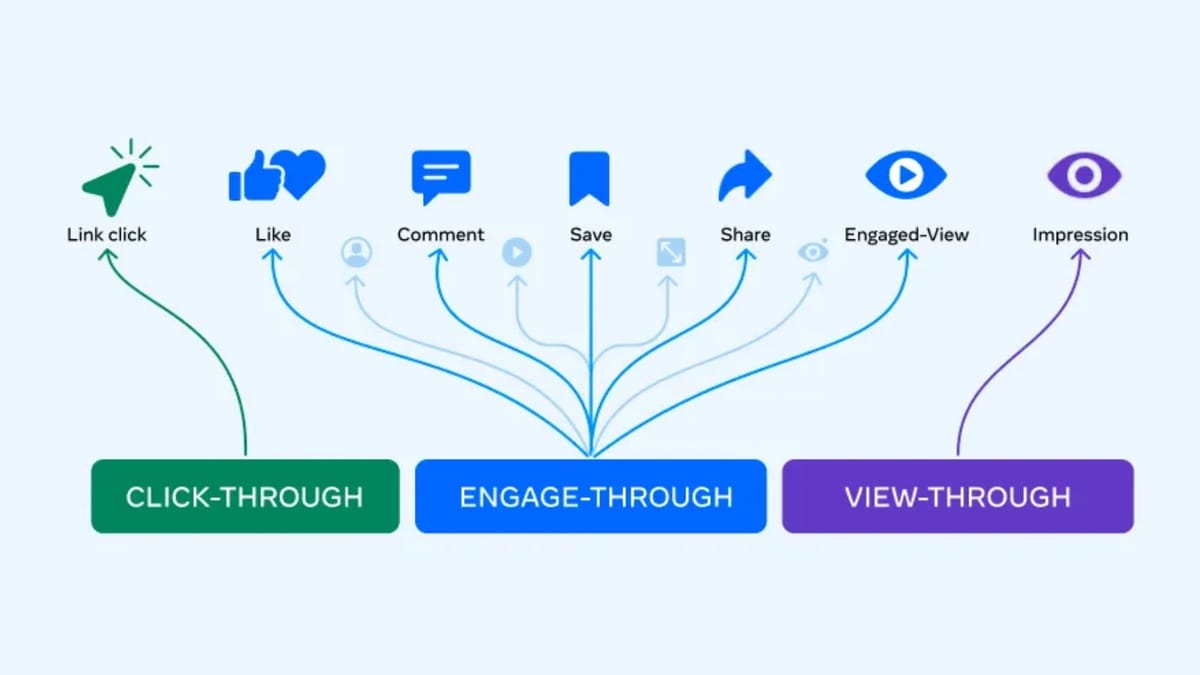
Meta this week announced a structural overhaul of its advertising measurement framework, redefining what counts as a click in click-through attribution and introducing a renamed attribution category for social-specific engagement actions. The announcement, published on March 3, 2026, on the Meta for Business blog under the title "Simplifying Ad Measurement for a Social-First World," addresses a complaint that has persisted for years inside marketing departments: the numbers in Meta Ads Manager and Google Analytics almost never agree.
The changes will begin rolling out later this month for campaigns optimizing for website or in-store conversions. No changes will be made to how advertisers are billed.
A gap years in the making
The core problem is not new. For years, Meta has included a wide variety of interactions - shares, saves, likes, and link clicks - inside its definition of a click for attribution purposes. Third-party platforms, by contrast, have historically tracked only link clicks: instances where a user physically navigates away from Meta's platform to an advertiser's website. That definitional mismatch created persistent discrepancies between Ads Manager and independent analytics platforms.
PPC Land reported in October 2025 that business consultant Barry Hott had surfaced the precise language from Meta's attribution settings documentation, which confirmed that "Clicks may include interactions such as likes, shares and saves." The discovery sparked industry debate about whether advertisers were drawing accurate conclusions from their campaign data. Was a conversion credited to a like actually attributable to advertising exposure? Or would that user have purchased regardless?
The concern extended beyond isolated measurement errors. Industry experts had long warned that attribution methodology flaws - including the crediting of conversions to engagement actions that never drove anyone to a website - were artificially inflating return on ad spend figures across Meta campaigns. Digital marketing specialist Bram Van der Hallen argued at the time that "one marketer showing you a Meta Ads ROAS of 2 is probably doing a better job than that other marketer showing you a ROAS of 10," a position that pointed to the distortions introduced by over-broad attribution definitions.
What is changing in click-through attribution
According to the Meta announcement, the company is changing the definition of click-through attribution for website and in-store conversions "to exclusively include link clicks." Going forward, a conversion will appear in click-through reporting only when a user clicked a link and arrived at an advertiser's website or in-store destination - the same standard applied to search advertising measurement for decades.
The company's explanation acknowledges a structural difference between social and search environments. According to the announcement, measurement systems "were built for a past world of search advertising, where there is only one way to engage with an ad, which is clicking on a link." On social platforms, a person encountering an ad can share it, save it, like it, or navigate to an external site. Each action carries different implications. The World Advertising Research Center (WARC), cited in the announcement, found that social media advertising has overtaken search to become the world's leading channel for ad spend globally - making the measurement gap more consequential than ever before.
For advertisers currently seeing conversions attributed to shares and saves within click-through windows, the change may produce a visible decline in reported click-through conversion volume once the rollout begins. Meta acknowledges that advertisers "may begin to notice changes inside Ads Manager reporting" as the update takes effect. Timing will vary across accounts, as the company is rolling out the changes in stages.
What this means in practice: a user who likes an ad on Monday and then purchases from the advertiser's website on Thursday will no longer appear in click-through conversion data. Under the previous definition, that like could have triggered attribution within the applicable window. Under the new definition, only the link click generates a click-through conversion.
Engage-through attribution: a new home for social interactions
The second part of the announcement addresses what happens to conversions previously counted as click-through but originating from non-link-click actions. These conversions - from shares, saves, likes, and other engagement interactions - will now move into a renamed attribution category.
Meta is renaming engaged-view attribution to engage-through attribution. The existing category, which previously focused on video views, will now also absorb conversions that come from share, save, or other non-link-click actions. Meta is strongly encouraging advertisers to use engage-through attribution alongside click-through data, describing it as the best way to understand the full impact of these social interactions.
PPC Land covered the original launch of Meta's Engaged-View attribution in February 2024, when the setting credited conversions occurring within 24 hours of a video ad being played for at least 10 seconds, or 97% of the video's length. That threshold has now been revised.
According to the announcement, Meta has updated the definition of an engaged view for video ads from 10 seconds to 5 seconds. The rationale is data-driven: "46% of online purchase conversions with Reels now happen within the first 2 seconds of attention on our video ads," the announcement states. Meta argues the shorter 5-second window provides a more accurate indicator of genuine engaged viewing, in line with how quickly users now act after exposure. This is not a trivial change. The reduction from 10 to 5 seconds means a meaningful additional share of video views will now qualify as engaged views, potentially increasing the conversion volume attributed through the engage-through channel.
These shifts reflect broader platform dynamics. Meta reported in January 2026 that Instagram Reels watch time increased more than 30% year-over-year in the United States during Q4 2025, with Facebook video time also growing double digits. The advertising revenue context is significant: Meta generated $58.1 billion in ad revenue in Q4 2025, a 24% annual increase, partly on the back of Reels-driven engagement.
Third-party measurement partners
The announcement also introduces a new dimension to Meta's external measurement partnerships. Meta says it is beginning to partner with third-party analytics providers - specifically naming Northbeam and Triple Whale - to incorporate both clicks and views into their attribution models. The aim is to make it easier for advertisers to understand the full impact of social media ads using tools already embedded in their workflows.
This follows a series of earlier moves in the same direction. Meta had previously integrated with Northbeam, Triple Whale, Adobe Advertising, and Rockerbox as part of its Custom Attribution and value optimization work launched in June 2025, allowing advertisers to share granular click-level data with Meta's optimization system. The current announcement extends that relationship in the opposite direction: rather than feeding external data into Meta's algorithms, Meta is now enabling third-party platforms to incorporate view-level data from Meta into their own attribution outputs.
PPC Land also reported in October 2025 that Meta was testing a GA4 integration at the ad level, connecting Meta Ads directly to Google Analytics 4 for website and shop conversion measurement. The March 3 changes sit within the same broader trajectory: a sustained effort to reduce measurement friction between Meta's proprietary reporting and the external analytics tools that advertisers use as their baseline.
Incrementality as the north star
The announcement opens with a broader philosophical framing. According to Meta, advertisers "should strive to answer the question of 'What outcomes did this ad or campaign cause that would not have happened otherwise?'" The company identifies incrementality experiments - particularly its own Conversion Lift product - as "the gold standard in measurement," while acknowledging that "fully adopting incrementality measurement can take time." The click-through changes are presented as a bridge: tools that help advertisers make better decisions using their existing systems while the industry gradually moves toward more rigorous causal measurement.
That framing matters for context. Meta announced in June 2025 the global rollout of Incremental Attribution, described as a product that "optimizes for and reports on incremental conversions in real time." Testing data showed an average 46% increase in incremental conversions for participating advertisers compared to standard campaigns. The current measurement changes are a complementary effort - improving the reliability of existing click-based reporting while more sophisticated incrementality tools gain broader adoption.
The attribution window restrictions announced in October 2025 and implemented in January 2026 moved in the same direction, eliminating the 7-day and 28-day view-through windows from the Ads Insights API while retaining click and 1-day view options. Taken together, these successive changes represent a clear pattern: Meta is progressively tightening its attribution definitions, pushing the industry toward approaches it considers more defensible.
Advertiser perspectives
Two advertisers are cited in the official announcement. Riyad Ebrahim, Co-Founder and CEO of apparel brand JAKI, said the change "can help determine which campaigns are more effective at driving results from social interactions compared to link clicks." Vinee McCracken, Director of Social at Mpix, offered a more detailed response: "I'm glad that Meta is making this change to help me see customer behaviors more cleanly, as opposed to everything being lumped into one bucket. I understand why click attribution was what it was, but this change makes a ton of sense and gives us a bit more information and granularity to help us understand what we're seeing, which ultimately gives me a stronger level of confidence in understanding the impact of my Meta ads."
On LinkedIn, Simon Whitcombe, Vice President of Global Business Group at Meta, framed the announcement with a question that resonates with any performance marketer: "Why don't my Meta numbers match Google Analytics?" The post received 121 reactions, 3 comments, and 6 reposts. Kevin Simonson, CEO at adMixt, commented: "Great move by Meta. Our team is happy about the change and was talking about it today." Rok Hladnik, CEO and Founder at Flat Circle, wrote: "This is a good move!" Jonathan Snow, co-founder of an Inc. 5000 marketing agency, raised a technical question about whether optimization would also shift to reflect a 1-day engage-through window, and whether advertisers would be able to see a breakdown of conversions across individual engage-through action types.
Why this matters for marketers
The measurement changes carry practical consequences for how performance is evaluated and budgets are allocated. Advertisers who compare Meta Ads Manager data to Google Analytics have long encountered a mismatch that made it difficult to assess the true contribution of Meta campaigns. A conversion credited to a like in Ads Manager generates no corresponding session in Google Analytics, since no user ever landed on the website. That structural gap has made media planning harder and fueled skepticism about reported performance metrics.
By removing likes, saves, and shares from the click-through bucket and placing them explicitly inside engage-through attribution, Meta is creating a cleaner separation between two distinct types of advertising impact: direct response - where a user clicks a link and acts - and social influence - where an ad generates engagement that may eventually contribute to a conversion. Both categories remain visible to advertisers. The key change is that they are no longer blended into a single number.
The change also has implications for campaign optimization. Meta's delivery system uses reported conversions as training signals for its bidding algorithms. If a significant portion of current click-through conversions were credited to engagement actions rather than link clicks, the volume and composition of those signals will change once the update takes effect. Advertisers should monitor cost-per-result and conversion volume carefully in the weeks following implementation - not because campaign performance has necessarily changed, but because the measurement definition has.
The engaged view threshold reduction from 10 to 5 seconds on video ads adds another adjustment. Campaigns using Reels placements may see engage-through conversion counts increase as the shorter threshold qualifies more video views. Meta frames this as a more accurate reflection of actual intent given current viewer behavior, but advertisers will need to account for the change when interpreting performance trends across reporting periods.
Timeline
- February 2024 - Meta launches Engaged-View attribution for video campaigns, crediting conversions within 24 hours of a 10-second video view.
- August 2024 - Meta announces deprecation of over 100 unique metrics from the Ads Insights API, effective October 30, 2024.
- October 4, 2025 - Advertisers discover documentation confirming Meta counts likes, shares, and saves as clicks in attribution windows, sparking industry debate.
- October 13-18, 2025 - Meta announces restrictions on attribution windows in the Ads Insights API, set to take effect January 12, 2026, eliminating the 7-day and 28-day view-through windows.
- October 23, 2025 - Meta tests GA4 integration at the ad level for cross-platform conversion tracking.
- November 30, 2025 - Meta's AI automation draws industry skepticism amid ongoing attribution concerns.
- January 12, 2026 - Meta Ads Insights API attribution window restrictions take effect, removing 7-day and 28-day view-through windows from the API.
- January 28, 2026 - Meta reports Q4 2025 advertising revenue of $58.1 billion, 24% year-over-year growth, with Reels watch time up more than 30% in the US.
- March 3, 2026 - Meta publishes "Simplifying Ad Measurement for a Social-First World," announcing that click-through attribution will be limited to link clicks only; that engage-through attribution replaces engaged-view for non-link-click actions; that the engaged view threshold for video drops from 10 seconds to 5 seconds; and that Northbeam and Triple Whale will incorporate view data into their attribution models.
Summary
Who: Meta Platforms, via its official Meta for Business blog, announced changes affecting all advertisers running campaigns optimized for website or in-store conversions. Simon Whitcombe, Vice President of Global Business Group at Meta, communicated the update publicly on LinkedIn. Third-party measurement providers Northbeam and Triple Whale are introduced as new attribution integration partners.
What: Meta is redefining click-through attribution to count only link clicks - not likes, saves, or shares - for website and in-store conversion campaigns. Non-link-click social actions are being moved into a renamed category, engage-through attribution, which consolidates existing engaged-view attribution. The threshold for a qualifying video engaged view is reduced from 10 seconds to 5 seconds. Billing is unchanged.
When: The announcement was published on March 3, 2026. Changes will begin rolling out later in March 2026, with timing varying across advertiser accounts.
Where: The changes affect Meta Ads Manager reporting for campaigns running across Meta's platforms, including Facebook, Instagram, and related placements. Engage-through attribution updates have particular relevance for Reels and other video placements.
Why: Meta is seeking to reduce the persistent measurement gap between its own Ads Manager reporting and third-party analytics platforms like Google Analytics. By aligning its definition of a click conversion with the link-click standard used by most external tools, the company aims to make its reporting more directly comparable, while preserving visibility into social-specific engagement actions through the separate engage-through attribution framework.
Share this article
The link has been copied!