Microsoft launches checkout inside Copilot as AI commerce battle intensifies
Microsoft introduces Copilot Checkout on January 8, enabling direct purchases through AI conversations with PayPal, Shopify, and Stripe while launching Brand Agents for merchant websites.
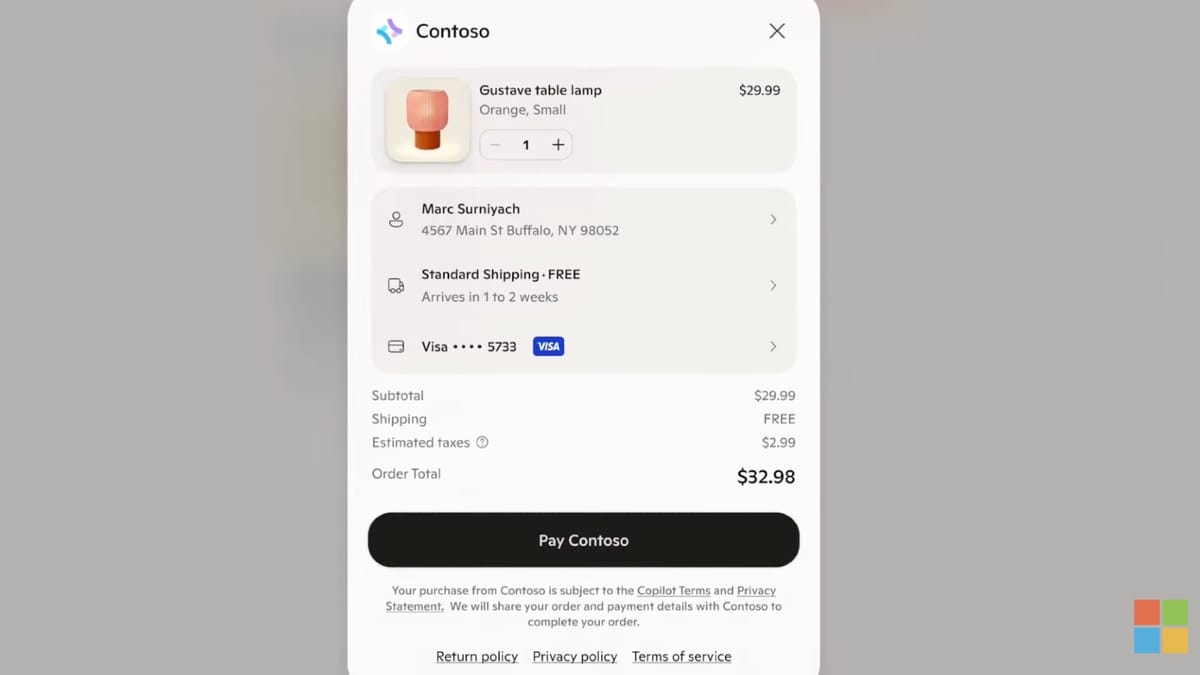
Microsoft announced on January 8, 2026, the introduction of Copilot Checkout, enabling shoppers to complete purchases entirely within the Copilot interface without redirecting to merchant websites. The implementation arrives alongside Brand Agents, AI-powered shopping assistants that merchants can deploy on their own websites to guide customers from product discovery through transaction completion.
According to the announcement from Microsoft's agentic payments and product teams, Copilot Checkout maintains merchants as the merchant of record throughout transactions, preserving ownership of customer data and relationships. Payment processing operates through partnerships with PayPal, Shopify, and Stripe, with additional integrations planned with Mastercard and Visa.
"By teaming up with Microsoft, we're enabling merchants to become AI-ready and enabling scale through Copilot's trusted commerce infrastructure," said Mike Edmonds, VP of Agentic Commerce at PayPal. "This partnership will help our vast ecosystem of tens of millions of merchants grow efficiently, while providing consumers with an enjoyable and intuitive shopping experience when checking out with PayPal."
The implementation begins rolling out in the United States on Copilot.com, with expansion planned across Bing, MSN, Edge, and additional Microsoft properties where Copilot operates. Initial merchant participants include Urban Outfitters, Anthropologie, Ashley Furniture, and Etsy sellers, representing both large retailers and artisan marketplace vendors.
Conversion performance claims and measurement challenges
Microsoft cites internal data indicating that journeys including Copilot led to 53% more purchases within 30 minutes of interaction compared to journeys without the AI assistant. When shopping intent is present, the company claims conversions reach 194% more likely than sessions lacking Copilot engagement. These figures, dated August 2025 in Microsoft's documentation, reflect internal measurement during development and testing periods.
The performance metrics raise questions about attribution methodology and baseline comparisons. Traditional e-commerce measurement frameworks struggle to account for AI-mediated discovery and purchase pathways that compress multiple touchpoints into single conversation threads. Microsoft Clarity's recent agentic web analysis revealed 155% growth in AI referral traffic over eight months, though conversion quality varies significantly across platforms.
The divergent findings suggest measurement complexity rather than definitive performance patterns. Merchants evaluating Copilot Checkout will need to develop attribution models accounting for AI-mediated discovery alongside traditional marketing channels, creating additional analytical burden during implementation.
Advertise on ppc land
Buy ads on PPC Land. PPC Land has standard and native ad formats via major DSPs and ad platforms like Google Ads. Via an auction CPM, you can reach industry professionals.
Technical infrastructure spans payment processors and merchant platforms
Payment processing architecture relies on existing infrastructure from PayPal, Shopify, and Stripe rather than Microsoft building proprietary transaction systems. This approach theoretically enables rapid merchant onboarding while avoiding regulatory complexity associated with becoming a payment processor.
"AI is changing how commerce works, and as with every technology shift, it needs new infrastructure," said Kevin Miller, Head of Payments at Stripe. "Stripe is building that infrastructure, and Microsoft is putting it to use by enabling commerce inside Copilot."
For PayPal and Stripe merchants, Microsoft now accepts applications to enable Copilot Checkout. Shopify merchants will be automatically enrolled following an opt-out window, according to the announcement. This automatic enrollment represents aggressive distribution strategy, potentially enabling millions of product listings without requiring individual merchant decisions.
"Copilot Checkout can move a customer from intent to transaction in seconds, all without leaving the conversation," said Mani Fazeli, VP of Product at Shopify. "It's the merchant's checkout powered by Shopify, seamlessly fitting into the customer's experience."
Platform dynamics remain uncertain. Amazon blocked AI bots from major technology companies in August 2025, preventing product discovery and purchase through competing AI assistants. This fragmentation creates challenges for merchants attempting to maintain presence across multiple AI commerce channels.
Microsoft characterizes its approach as adopting "open standards like the Agentic Commerce Protocol" to ensure merchant onboarding remains seamless and scalable. The protocol, initially introduced by OpenAI and Stripe in September 2025, aims to enable AI agents to coordinate with business systems for purchase completion without requiring backend modifications.
Brand Agents bring conversational commerce to merchant websites
Separate from Copilot Checkout, Microsoft introduced Brand Agents as AI-powered shopping assistants that merchants deploy directly on their own websites. The technology targets e-commerce businesses seeking to capture AI-assisted shopping behavior without ceding discovery and transactions to external platforms.
According to the announcement, Brand Agents speak in merchant brand voices while guiding customers from initial product questions through purchase completion. Alexander Del Rossa, a premium sleepwear retailer, reported over 3x higher conversion rates in Brand Agent-assisted sessions compared to unassisted sessions.
"Integrating Brand Agents into our Shopify store was the best example of AI integration seen to date," said Tony Baldwin, CTO at Alexander Del Rossa. "Brand Agents learned our inventory and provided recommendations that required little engagement from our team."
The system deploys in hours rather than weeks according to Microsoft's claims, suggesting streamlined implementation compared to custom chatbot development. Performance measurement operates through Microsoft Clarity, the company's behavioral analytics platform, providing dashboards with engagement rates, conversion uplift, and average order value metrics.
Brand Agents currently targets Shopify merchants, with availability announced through Microsoft Clarity's interface. Merchants must first install Clarity on their websites, then join a waitlist for Brand Agents access. This distribution strategy leverages Clarity's existing merchant base while controlling rollout pace.
Technical implementation relies on product catalog synchronization and natural language processing to understand customer queries and match them against available inventory. The system supports product comparisons, shipping and returns questions, and complementary product recommendations based on purchase context.
Free weekly newsletter
Your go-to source for digital marketing news.
No spam. Unsubscribe anytime.
Marketing implications and channel economics
The split between Copilot Checkout and Brand Agents creates competing incentives for merchants. Copilot Checkout provides distribution across Microsoft's AI assistant ecosystem but inserts the platform between merchants and customers during discovery and transaction. Brand Agents maintain direct customer relationships but require merchants to drive traffic to their own websites.
This tension mirrors broader platform dynamics in digital advertising. Retail media networks have become critical revenue sources for e-commerce platforms, with projections suggesting the channel will capture 20% of global ad revenue by 2030. AI-mediated commerce threatens these advertising businesses by compressing discovery into conversational threads that bypass traditional sponsored product placements.
Consumer adoption patterns remain uncertain. PSE Consulting research from November 2025 found 85% of UK consumers planning to use AI for holiday shopping would trust it to place orders and execute payments, suggesting emerging comfort with AI-mediated transactions. However, actual conversion data from live implementations remains limited to vendor-provided metrics rather than independent measurement.
Attribution complexity represents practical challenge for marketing teams. Traditional last-click and multi-touch attribution models fail to account for AI conversations that span product research, comparison, and purchase within single sessions. Merchants must develop new frameworks for understanding customer acquisition costs and campaign effectiveness when transactions complete through intermediary platforms.
Mastercard and Visa integration signals payment infrastructure evolution
Microsoft's announcement references partnerships with Mastercard and Visa, specifically mentioning Mastercard Agent Pay and Visa Intelligent Commerce as future integration points. These references suggest payment card networks are developing infrastructure specifically designed for AI agent transactions rather than relying solely on existing card-not-present processing.
The involvement of card networks alongside payment processors indicates industry recognition that AI commerce represents structural change rather than incremental channel addition. Traditional e-commerce checkout flows assume human decision-making at each step, with fraud detection and risk management calibrated accordingly. Autonomous agents executing purchases on behalf of consumers require different security models and liability frameworks.
Privacy implications extend beyond transaction security. When AI assistants make purchase recommendations and complete transactions, they process user preferences, purchase history, and contextual information about shopping intent. Data governance becomes complex when multiple parties—AI platform providers, payment processors, card networks, and merchants—all handle customer information during single transactions.
Microsoft emphasizes that merchants remain merchant of record, suggesting transaction liability and customer service obligations follow traditional e-commerce patterns. However, the announcement does not detail how disputes, returns, or fraud claims will be handled when purchases originate through AI conversations rather than direct merchant website interactions.
Competitive positioning and platform fragmentation
Microsoft's January 8 announcement arrives more than three months after OpenAI launched instant checkout on September 29, 2025. That implementation partnered exclusively with Stripe for payment processing, enabling US Etsy sellers and over one million Shopify merchants to complete transactions through ChatGPT.
Google introduced agentic checkout in November 2025 for the holiday shopping season, leveraging its existing Shopping platform and payment infrastructure. The search giant's implementation integrated with Google Lens for visual product search alongside text-based queries.
Each platform pursues distinct approaches reflecting existing business models and technical capabilities. OpenAI emphasized the Agentic Commerce Protocol as open standard enabling multi-platform compatibility. Google leveraged deep integration with merchant product feeds and Shopping ad infrastructure. Microsoft splits functionality between centralized marketplace through Copilot and distributed commerce through Brand Agents.
This fragmentation creates implementation burden for merchants attempting to maintain consistent presence across AI commerce channels. Each platform requires separate onboarding, product catalog synchronization, and performance monitoring. Large retailers with dedicated e-commerce technology teams can manage multiple integrations, but small and medium businesses face resource constraints.
Platform consolidation appears unlikely given competing strategic priorities. Amazon's bot blocking demonstrates that dominant e-commerce players will prioritize protecting existing business models over enabling AI assistant access. Shopify's participation across multiple platforms reflects its role as merchant infrastructure provider rather than direct commerce competitor.
Etsy embraces AI-mediated discovery for artisan sellers
Etsy's participation in Copilot Checkout extends its earlier involvement with OpenAI's instant checkout. The Brooklyn-based marketplace connects individual artisans and small-scale manufacturers with consumers seeking handcrafted and vintage products, operating distinct business model from mass-market retailers.
"At Etsy, our job is to make it simple for people to discover the special things our sellers create," said Rafe Colburn, Chief Product and Technology Officer at Etsy. "By bringing Etsy's unique inventory to Copilot Checkout, we're meeting buyers at the moment intent becomes action."
For Etsy sellers, AI-mediated commerce potentially addresses discovery challenges in marketplace with millions of unique listings. Traditional search and recommendation algorithms struggle with artisan products lacking standardized specifications and established brand recognition. Conversational AI can theoretically understand nuanced queries like "handmade ceramic bowl with organic glaze in earth tones" better than keyword-based search.
The automatic enrollment through Etsy's marketplace participation creates passive distribution for individual sellers who may lack awareness of AI commerce developments. This differs from Shopify's approach where merchants control their own technical infrastructure and can opt out of automatic enrollment.
Colburn emphasized that Copilot Checkout provides distribution "without extra work" for Etsy sellers, suggesting the marketplace handles technical integration centrally. This centralized approach enables scale but also concentrates control over how products appear in AI assistant conversations.
Microsoft Clarity integration provides performance measurement
Brand Agents performance tracking operates through Microsoft Clarity, positioning the free behavioral analytics platform as essential infrastructure for AI commerce measurement. Clarity provides session recordings, heatmaps, and conversion funnel analysis, with recent enhancements including AI channel groups for tracking traffic from ChatGPT, Claude, Gemini, and other AI platforms.
The integration creates ecosystem lock-in where merchants deploying Brand Agents must use Microsoft's analytics infrastructure rather than alternative platforms like Google Analytics. This consolidation mirrors broader trend of platform providers bundling commerce, analytics, and advertising capabilities into integrated stacks.
Clarity's recent analysis revealed 155% growth in AI referral traffic over eight months, demonstrating rapid adoption of AI-mediated discovery. However, the platform also documented that customer journeys through Copilot measured 33% shorter than conventional search paths, suggesting different user behavior patterns.
For marketing professionals, Clarity dashboards will display Brand Agent performance metrics including engagement rates, conversion uplift, and average order value. These metrics enable comparison between agent-assisted and unassisted sessions, providing visibility into AI commerce effectiveness within merchant-controlled environments.
The announcement states that Brand Agents "deliver higher engagement and stronger conversion than sessions without them" across participating merchants, though specific performance data was not provided beyond Alexander Del Rossa's 3x conversion rate improvement.
Implementation timeline and merchant activation
Copilot Checkout begins rolling out in January 2026 on Copilot.com with partner activation across PayPal, Shopify, and Stripe. The announcement indicates ramping "throughout the month," suggesting phased expansion rather than immediate universal availability.
For PayPal and Stripe merchants, Microsoft now accepts applications to enable Copilot Checkout. The application process was not detailed in the announcement materials, though interested merchants are directed to apply through unspecified channels.
Shopify merchants will be automatically enrolled following an opt-out window, according to Mani Fazeli's statement. This opt-out structure rather than opt-in activation represents aggressive distribution strategy, potentially enabling millions of product listings without requiring active merchant engagement.
The automatic enrollment timeline was not specified, creating uncertainty for Shopify merchants about when their products will become purchasable through Copilot. The announcement's reference to "ramping throughout the month" suggests January 2026 for initial activation, though this may represent limited rollout before broader expansion.
Brand Agents currently operates through waitlist access for Shopify merchants who have installed Microsoft Clarity. The announcement states that merchants can join the waitlist directly through Clarity's homepage, suggesting limited availability during initial phases.
Geographic scope remains limited to the United States for Copilot Checkout, matching OpenAI and Google's initial AI commerce implementations. International expansion timelines were not provided, though Microsoft's statement that merchants will be "automatically there" as Copilot Checkout expands across the Copilot ecosystem suggests eventual broader distribution.
National Retail Federation demonstration planned
Microsoft will demonstrate both Copilot Checkout and Brand Agents at the National Retail Federation conference from January 11-13, 2026, in New York. The timing provides retail executives and technology decision-makers opportunity to evaluate the implementations before broader merchant activation.
NRF represents the retail industry's largest annual conference, attracting tens of thousands of attendees including chief executives, chief information officers, and e-commerce technology managers from major retailers and brands. Microsoft's presence at the event signals priority for retail sector engagement around AI commerce capabilities.
The demonstration follows pattern of major technology announcements preceding industry conference presentations, enabling sales teams to engage prospects with live implementations rather than concept demonstrations. This approach differs from development partnerships where technology companies work with select retailers before public announcements.
Broader implications for digital advertising and marketing
The shift toward AI-mediated commerce creates uncertainty for digital advertising business models built on keyword targeting, sponsored product placements, and conversion attribution. When product discovery and purchase occur within AI conversation threads, traditional ad formats and measurement frameworks become less relevant.
Retail media networks face particular disruption. These advertising platforms, operated by e-commerce marketplaces and retailers, derive value from controlling product discovery and capturing purchase intent data. Amazon's retail media business generated billions in annual revenue by placing sponsored products within search results and category pages.
AI conversations bypass these sponsored placements by responding directly to user queries with product recommendations. The economic model shifts from pay-per-click advertising to potentially commission-based affiliate relationships or subscription fees for AI platform access.
Microsoft's approach of charging merchants nothing for Copilot Checkout participation raises questions about monetization. The company may plan to introduce advertising into Copilot conversations, charge subscription fees for advanced features, or extract value through data collection and consumer relationship control.
For marketing professionals, AI commerce requires developing new competencies around natural language optimization, conversation design, and agent interaction patterns. Traditional SEO and paid search expertise does not directly transfer to optimizing product visibility within AI assistant conversations.
The announcement references a new playbook titled "From Discovery to Influence: A Guide to AEO and GEO," suggesting Microsoft is developing frameworks for Answer Engine Optimization and Generative Engine Optimization. These disciplines focus on ensuring brand and product representation within AI-generated responses rather than traditional search result rankings.
PPC Land Newsletter
Subscribe PPC Land newsletter ✉️ for similar stories like this one
Who: Microsoft, in partnership with PayPal, Shopify, and Stripe, launches Copilot Checkout and Brand Agents. Initial merchant participants include Urban Outfitters, Anthropologie, Ashley Furniture, Etsy sellers, and Alexander Del Rossa. Key executives include Nayna Sheth (Head of Product for Agentic Payments at Microsoft), Ravi Yada (Head of Product for Microsoft Clarity & Brand Agents at Microsoft), Mike Edmonds (VP of Agentic Commerce at PayPal), Kevin Miller (Head of Payments at Stripe), Mani Fazeli (VP of Product at Shopify), Rafe Colburn (Chief Product and Technology Officer at Etsy), and Tony Baldwin (CTO at Alexander Del Rossa).
What: Copilot Checkout enables direct purchases through Microsoft's AI assistant without redirecting to merchant websites, processing payments through PayPal, Shopify, and Stripe partnerships while maintaining merchants as merchant of record. Brand Agents provides AI-powered shopping assistants that merchants deploy on their own websites, speaking in brand voices while guiding customers from discovery through purchase. Microsoft internal data claims journeys with Copilot lead to 53% more purchases within 30 minutes and 194% higher conversion when shopping intent is present. Alexander Del Rossa reported 3x higher conversion rates in Brand Agent-assisted sessions. The implementations support Mastercard Agent Pay and Visa Intelligent Commerce integrations.
When: Microsoft announced both capabilities on January 8, 2026, with Copilot Checkout beginning to roll out on Copilot.com throughout January 2026. Partner activation spans PayPal, Shopify, and Stripe, with Shopify merchants automatically enrolled following an opt-out window. Brand Agents operates through waitlist access for Shopify merchants with Microsoft Clarity installed. Microsoft will demonstrate both capabilities at the National Retail Federation conference January 11-13, 2026. The announcement follows OpenAI's September 29, 2025 instant checkout launch and Google's November 2025 agentic checkout introduction.
Where: Initial rollout occurs in the United States on Copilot.com, with planned expansion across Bing, MSN, Edge, and additional Microsoft properties where Copilot operates. Brand Agents deploys directly on merchant websites for Shopify merchants. Geographic scope remains US-focused initially, matching competing AI commerce implementations from OpenAI and Google. Microsoft states merchants will be "automatically there" as Copilot Checkout expands across the Copilot ecosystem without requiring additional integration.
Why: Microsoft enters intensifying AI commerce competition following OpenAI and Google launches, positioning between centralized marketplace through Copilot Checkout and distributed commerce through merchant-controlled Brand Agents. The dual approach addresses competing merchant incentives: Copilot Checkout provides distribution across Microsoft's AI ecosystem while Brand Agents maintain direct customer relationships on merchant websites. Implementation responds to shifting consumer behavior as AI assistants compress product discovery and purchase into single conversation threads. However, the announcement raises attribution measurement challenges, retail media disruption concerns, and questions about monetization strategies given Microsoft charges nothing for merchant participation. Platform fragmentation creates implementation burden as merchants must maintain presence across multiple competing AI commerce channels with distinct technical requirements and performance measurement frameworks.
Share this article
The link has been copied!
Your link has expired. Please request a new one.
Your link has expired. Please request a new one.
Your link has expired. Please request a new one.
Great! You've successfully signed up.
Great! You've successfully signed up.
Welcome back! You've successfully signed in.
Success! You now have access to additional content.