Nearly half of UK websites exclude disabled customers online
Research finds 48% of UK websites need accessibility improvements, with travel and hospitality sectors worst affected while councils lead in digital inclusion.


Research finds 48% of UK websites need accessibility improvements, with travel and hospitality sectors worst affected while councils lead in digital inclusion.
Around 16.1 million people across the UK live with registered disabilities, yet nearly half of websites could be preventing them from accessing products and services online. Research published on November 25, 2025, by brand communications agency Warbox reveals that 48% of UK websites across 14 sectors require accessibility improvements.
The State of Accessibility Report examined Google's PageSpeed Insights Accessibility Scores for more than 1,200 UK websites. Travel and tourism companies demonstrated the poorest performance, with 79% of websites requiring improvement. This underperformance appears particularly concerning given that experts estimate the disabled community's spending power in this sector reaches £14.6 billion annually in England alone.
Hospitality websites ranked second worst, with 70% requiring accessibility enhancements. Fashion retailers followed at 64%, while the broader retail sector showed 63% needing improvement. Legal sector websites, despite frequently serving vulnerable populations including disabled clients, required improvement in 61% of cases analyzed.
Subscribe PPC Land newsletter ✉️ for similar stories like this one
"When accessibility is poor, customers don't just leave a website, they form a lasting impression of that brand, which can take just seconds," said Tania Gerard, accessible marketing consultant and founder at Tania Gerard Digital. "It tells them the brand hasn't considered their needs, which erodes crucial trust."
The research emerges against a backdrop of significant commercial implications. Disabled consumers and their households represent £274 billion in annual spending power across the UK, commonly referred to as the purple pound. Poor website accessibility creates barriers preventing customers from completing checkouts, accessing service information, or navigating product pages, potentially forcing them toward competitor sites with better accessibility standards.
Issues preventing full website access range from technical problems to design oversights. Small font sizes, insufficient color contrast between text and backgrounds, missing alternative text for images, and navigation challenges all contribute to excluding users who rely on assistive technologies or have visual, hearing, mobility, or cognitive differences.
The government's own testing between 2022 and 2024 found accessibility problems on nearly all of more than 1,200 examined public sector websites. Many issues required only straightforward fixes, such as adjusting color contrast ratios. Public sector organizations face legal requirements to meet accessibility standards under WCAG guidelines, establishing expectations that increasingly extend to private sector websites.
Gerard, who is neurodivergent, explained her personal experiences with inaccessible websites. "I've abandoned the checkout many times if I've found it difficult to make a purchase," she noted in the press release distributed December 3, 2025. The research indicates 80% of UK adults with disabilities feel excluded by poor website accessibility and believe brands miss substantial sales opportunities as a result.
Beyond direct revenue losses, accessibility failures create broader commercial risks. Over half of consumers—55%—report abandoning purchases both in-store and online due to accessibility issues. Industry experts predict retailers could face losses of £120 billion from accessibility barriers. The rapid decision-making process in digital retail leaves companies with minimal time to convert visitors into customers, making smooth user journeys critical to commercial success.
Users relying on accessibility tools encounter difficulties with certain JavaScript implementations, demonstrating how technical choices affect disabled users' ability to navigate websites. These challenges extend beyond obvious accessibility barriers to encompass fundamental technical infrastructure decisions that can inadvertently exclude significant customer segments.
National Rail launched an accessible website redesign during National Inclusion Week 2025, while Apple introduced new features including braille access to help users obtain crucial information. Apple's CEO stated that "Accessibility is part of our DNA," reflecting growing recognition among major technology companies of digital inclusion's importance.
Most of Google's quality signal is derived from the webpage itself, a factor that now includes accessibility metrics. Google's algorithms increasingly prioritize accessibility in 2025, with brands achieving proper accessibility implementation gaining up to 35% better visibility in search results according to the Warbox research.
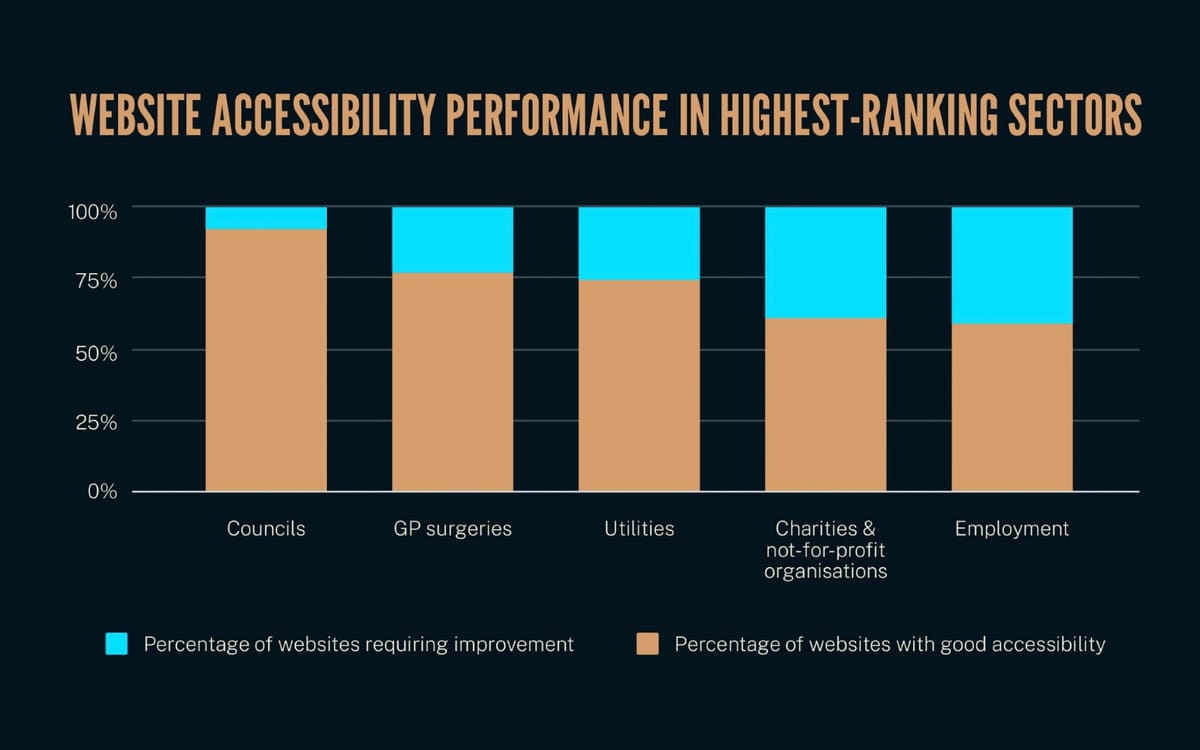
Council websites demonstrated the strongest accessibility performance, with just 8% requiring improvement. Public-facing organizations including the NHS face legal requirements to adhere to WCAG standards, which mandate publishing accessibility statements and ensuring websites function for users with vision, hearing, mobility, and cognitive challenges.
GP surgeries ranked second in accessibility performance with 23% needing improvement, followed by utility companies at 26%, charities at 39%, and employment websites at 41%.
"Charity and government websites are to the point with their content, with clear paragraph structures and call-to-actions," Gerard explained. "They need to get the message to their audience quickly and meet WCAG guidelines. On the other hand, sectors like retail often focus more on making the website look pretty. While visual design is important for user experience, it shouldn't come at the cost of accessibility, otherwise brands risk isolating their audience."
Among council websites specifically, Northern Irish councils achieved 100% of websites scoring between 90-100 on Google's accessibility scale. Scotland followed at 93.5%, England at 91.8%, and Wales at 90.9%. Only one council—Wyre Forest District Council in England—scored below 50, receiving a rating of 44. All remaining councils scored 76 or higher.
The European Union's European Accessibility Act, which became effective in June 2025, requires hotels to offer inclusive digital experiences for all customers. This regulatory framework creates pressure for UK hospitality brands to match or exceed accessibility standards established by European competitors.
Mark Fensom, director at Warbox, emphasized the gap between current practice and potential. "The Website Content Accessibility Guidelines were published over 25 years ago, yet many brands are still struggling to provide an inclusive online experience," he stated. "As more businesses shift to e-commerce and the search landscape evolves, accessibility is even more important to reaching customers and creating memorable, positive experiences."
The research methodology analyzed websites using Google's PageSpeed Insights Accessibility Scores. Scores of 90 or above received "good" ratings, scores between 50-89 indicated improvement needs, and scores below 50 were classified as poor. Warbox calculated the percentage of companies scoring under 89 in each sector to establish industry rankings.
Buy ads on PPC Land. PPC Land has standard and native ad formats via major DSPs and ad platforms like Google Ads. Via an auction CPM, you can reach industry professionals.
Fensom noted that implementing accessibility need not require substantial investment. "Creating an accessible website doesn't have to be expensive and it should be built-in from the start," he explained. "Some simple changes like adding image and video descriptions, making sure buttons are easy to spot and forms have the right labels, are a good place to start."
Senior developer Owen Mumby-Harrison from Warbox outlined three fundamental accessibility improvements. First, color contrast requires sufficient distinction between text and background colors. The recommended ratio stands at 4.5:1, though Mumby-Harrison suggests dark grey text on off-white backgrounds helps prevent glare compared to stark black-on-white combinations.
Second, alternative text for visual content enables screen readers to convey information to users with visual impairments. All images, videos, infographics, and interactive elements should include descriptive captions or alt-text. Forms require clear labels, buttons need obvious identification, and video content should provide transcripts.
Third, plain English ensures content remains accessible to users with varying reading abilities or cognitive differences. WCAG guidelines recommend using bullet points, limiting paragraphs to single topics, and keeping sentences under 25 words. Technical jargon should be avoided or defined, and abbreviations spelled out on first use.
Recent Google algorithm updates have reinforced the search engine's emphasis on comprehensive quality evaluation, which now encompasses user experience factors including accessibility. Marketing professionals face pressure not only from ethical and legal considerations but also from search visibility requirements as algorithms increasingly factor accessibility into ranking decisions.
Social media creates additional risks for brands with poor accessibility. Customers now hold companies accountable through public platforms, meaning accessibility failures can rapidly escalate into public relations crises. A single negative experience shared widely on social media channels can damage brand reputation significantly more than the individual lost sale.
While WCAG guidelines lack mandatory legal status for every website in the UK, they represent widely recognized best practice that should be implemented wherever feasible. Following these guidelines need not compromise visual design, according to Warbox's research, but rather requires finding appropriate balance between aesthetics and functionality to ensure websites meet all customers' needs.
The Equality Act 2010 creates legal obligations for businesses to provide reasonable adjustments for disabled customers, though many legal sector websites themselves fall short of accessibility requirements according to the research findings. This gap between legal standards and actual implementation highlights ongoing challenges in translating regulatory requirements into consistent practice across industries.
The data indicates numerous simple fixes could substantially improve accessibility scores without major website redesigns. Color contrast adjustments, alt-text additions, and clearer navigation structures represent relatively straightforward modifications that would benefit not only users with disabilities but all website visitors through improved usability.
As e-commerce adoption continues expanding and search engines evolve their ranking systems, accessibility emerges as both an ethical imperative and a commercial necessity. Brands that fail to prioritize digital inclusion risk not only excluding 16.1 million potential customers but also falling behind competitors in search visibility and brand reputation.
Subscribe PPC Land newsletter ✉️ for similar stories like this one
Subscribe PPC Land newsletter ✉️ for similar stories like this one
Who: Warbox Creative analyzed 1,200+ UK websites across 14 sectors. The research affects 16.1 million UK residents with registered disabilities and all businesses operating websites. Marketing professionals, web developers, and SEO specialists must respond to these findings. Tania Gerard, accessible marketing consultant, and Mark Fensom, Warbox director, provided expert commentary.
What: Nearly half (48%) of UK websites require accessibility improvements according to Google's PageSpeed Insights Accessibility Scores. Travel and tourism websites performed worst at 79% needing improvement, followed by hospitality (70%), fashion retail (64%), retail (63%), and legal (61%). Council websites demonstrated best performance with only 8% requiring improvement. Issues include small fonts, poor color contrast, missing alt-text, and navigation problems.
When: Warbox published the State of Accessibility Report on November 25, 2025, with data collected in October 2025. The press release distributed December 3, 2025. The European Accessibility Act became effective in June 2025. Government testing of public sector websites occurred between 2022-2024.
Where: The research covered websites across the United Kingdom, analyzing 14 different sectors including travel, hospitality, retail, legal, healthcare, finance, education, IT, employment, charities, utilities, GP surgeries, and councils. Regional breakdown showed Northern Irish councils achieving 100% good accessibility scores, followed by Scotland (93.5%), England (91.8%), and Wales (90.9%).
Why: Poor website accessibility excludes disabled customers representing £274 billion in annual spending power (the purple pound), creates negative brand impressions, potentially violates the Equality Act 2010, and reduces search visibility as Google's algorithms increasingly prioritize accessibility. Retailers face potential losses of £120 billion from accessibility issues, with 80% of disabled UK adults feeling excluded by poor website accessibility and 55% of all consumers abandoning purchases due to accessibility problems.