News publishers lose half their Google search traffic in two years
Google Web Search traffic to news publishers declined from 51% to 27% between 2023-2025 while Discover feed climbed to 68%, creating volatility for content creators.


Google Web Search traffic to news publishers declined from 51% to 27% between 2023-2025 while Discover feed climbed to 68%, creating volatility for content creators.

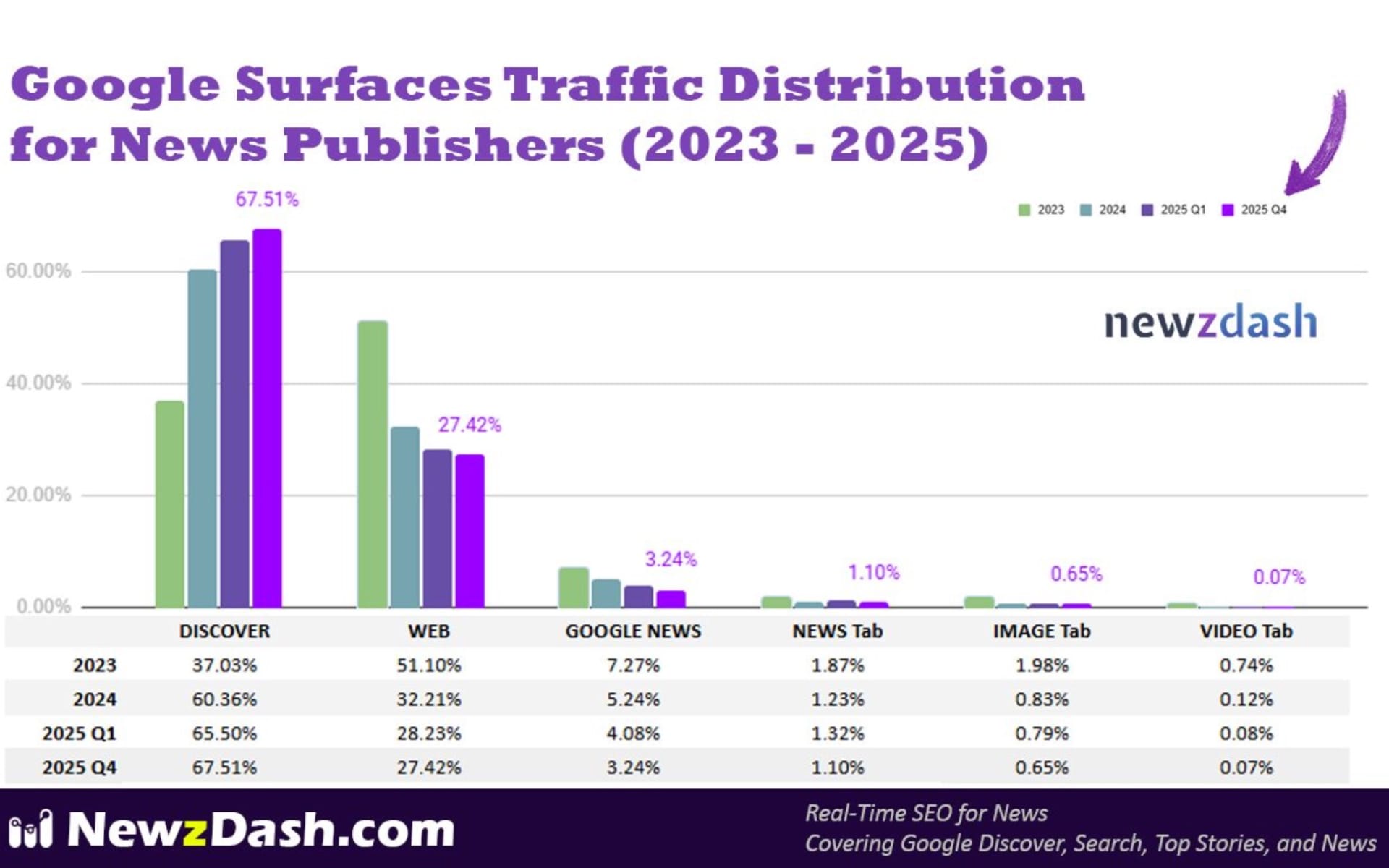
Google Web Search has plummeted from sending 51% of traffic to news publishers in 2023 to just 27% in the fourth quarter of 2025. The shift represents a fundamental redistribution of how audiences discover news content through Google's platforms, with Discover feed now accounting for 67.51% of Google traffic to news organizations.
Analysis of over 400 news publishers worldwide by NewzDash confirms the magnitude of this transformation, announced December 23, 2025, through a LinkedIn post by CEO John Shehata. The data tracking traffic distribution across Google surfaces reveals that traditional Web Search has lost nearly half its share in just two years, dropping 23.68 percentage points during this period.
Google Discover, the personalized recommendation feed primarily accessed on mobile devices, has nearly doubled its traffic share. The platform climbed from 37.03% in 2023 to 60.36% in 2024 before reaching 65.50% in the first quarter of 2025 and hitting 67.51% by the fourth quarter. The trajectory indicates Discover has become the dominant pathway through which readers encounter news content via Google properties.
Subscribe PPC Land newsletter ✉️ for similar stories like this one
"Google Discover's share has nearly doubled in two years, climbing from 37.03% in 2023 to 67.51% today," according to Shehata's LinkedIn post. "Traditional Web Search has plummeted from 51.10% to just 27.42% over the same period."
The figures represent percentage share of total Google mobile traffic rather than absolute click volumes. A publisher receiving 100,000 daily visitors from Google in 2023 might receive the same total in 2025, but the composition would have shifted dramatically from primarily search-driven traffic to Discover-dominated referrals.
This distinction matters for content strategy. Search traffic arrives through active user queries targeting specific information. Discover operates as a passive feed delivering content based on user interests and browsing history, fundamentally different from intentional search behavior.
Publishers face what researchers term asymmetric dependency relationships with Google. Content creators must produce material suited to Discover's recommendation algorithms while having minimal influence over distribution decisions. This contrasts with traditional search, where optimization practices could improve rankings through established techniques.
The remaining Google traffic sources occupy marginal positions. Google News declined from 7.27% in 2023 to 3.24% in the fourth quarter of 2025. The News Tab dropped from 1.87% to 1.10% during the same period. Image Tab traffic fell from 1.98% to 0.65%, while Video Tab plummeted from 0.74% to 0.07%.
These secondary channels contribute minimally to overall traffic distribution, reinforcing the binary shift between Web Search and Discover as primary sources. The decline of specialized tabs suggests users increasingly rely on consolidated interfaces rather than dedicated search categories for finding news content.
The search-to-Discover transition carries operational implications for publishers. Web Search traffic typically converts better for newsletter subscriptions and direct audience relationships because users arrive seeking specific information. Discover users browse passively, making conversion to loyal readers more challenging despite higher overall traffic volumes.
Google Discover has become the dominant traffic source for news and media websites according to research published in August 2025. The inflection point occurred in late October 2024, coinciding with Google's AI Overviews rollout across more than 100 countries. Traditional Google Search traffic dropped from approximately 16% to 10% of total referrals during this period, based on Chartbeat data analyzed by Press Gazette.
The shift extends beyond simple traffic redistribution. Publishers now operate in an environment where smartphone news aggregation determines visibility more than search engine optimization. Discover's growth provides Google with increased leverage over content creators who must align editorial strategies with recommendation algorithm preferences.
Buy ads on PPC Land. PPC Land has standard and native ad formats via major DSPs and ad platforms like Google Ads. Via an auction CPM, you can reach industry professionals.
AI Overviews compound the challenge for publishers. Research from Ahrefs examining 300,000 keywords found that AI-generated summaries reduce organic clicks by 34.5% when present in search results. The study compared clickthrough rates for top positions with and without AI Overviews across identical time periods from March 2024 to March 2025.
For standard informational keywords, average position-one clickthrough rates dropped from 0.056 in March 2024 to 0.031 in March 2025. AI Overview keywords experienced even sharper declines, falling from 0.073 to 0.026 during the same timeframe. The dual impact of reduced search traffic share and lower click-through rates creates compounding pressure on publishers.
The NewzDash analysis notes an important caveat regarding desktop expansion. "While Google previously announced plans to bring Discover to the desktop homepage to expand its reach, a widespread global rollout has not yet been seen as of December 2025," according to the LinkedIn post. "While limited testing has been spotted in specific regions like Australia and New Zealand, Google has not provided specific dates for a full-scale launch."
Google announced Discover expansion to desktop during the Search Central Live event in Madrid on April 9, 2025. Eric Barbera from Google's News Product Planning team demonstrated the feature, which could generate an estimated 10-15% additional Discover traffic for publishers based on current mobile-to-desktop traffic splits.
Desktop expansion would partially offset the search decline by broadening Discover's reach beyond mobile devices. However, the feature remains in limited testing months after the initial announcement, suggesting technical or strategic complications in implementation.
The traffic composition shift creates challenges for revenue forecasting. Discover traffic proves unpredictable, with publishers reporting dramatic fluctuations that complicate budget planning and staffing decisions. Traditional search traffic patterns followed more consistent seasonal variations tied to news cycles and reader behavior.
Multiple publishers experienced complete Discover traffic elimination during Google's December 2025 core update, announced December 11. Some operators managing multi-person teams that previously generated 300,000 daily impressions through Discover reported zero traffic within 48 hours of the update rollout.
The timing proved particularly harsh. Seasonal advertising rates typically peak during December as engagement increases. Instead, hundreds of website operators faced their worst traffic period in years, with some reporting 70-85% declines in daily visitor counts during what should have been peak revenue season.
Publisher frustration reached extreme levels throughout the update period. "From everything I read, one thing is clear. Google's latest update is a blunder. A colossal bug. Thousands of broken destinies just before Christmas," according to a Search Engine Roundtable comment. "If you are not affected yet, don't rejoice. Tomorrow you will be. Google is not a partner you can rely on."
The volatility extends beyond individual update cycles. Publishers operating businesses dependent on Google traffic face existential uncertainty when primary traffic sources can vanish overnight without warning or recourse. The shift from search to Discover amplifies this vulnerability because Discover operates with even less transparency regarding content selection criteria.
Traditional search optimization provided publishers with actionable frameworks for improving visibility. Structured data implementation, content quality improvements, and technical optimizations could demonstrably affect rankings. Discover algorithms remain opaque, offering minimal guidance for publishers attempting to maintain consistent visibility.
Research indicates that strong performance in traditional Google Search remains critical for Discover visibility despite search traffic's declining share. "A strong 'Search' foundation is a primary factor in maintaining stable visibility in the Discover feed for most publishers," according to NewzDash analysis shared in the LinkedIn post.
This creates a paradox. Publishers must invest resources in search optimization even as search traffic diminishes, because search performance determines Discover distribution. The relationship suggests Google's systems evaluate content quality through search signals before surfacing material in recommendation feeds.
The desktop expansion delay compounds strategic uncertainty. Publishers cannot definitively plan for desktop Discover traffic because rollout timing remains unclear. Investment decisions about mobile-first content strategies versus desktop-optimized approaches lack critical information about future traffic sources.
Industry observers note that even if desktop Discover launches globally, it would represent incremental improvement rather than fundamental solution to search traffic decline. A 10-15% increase from desktop would not restore search traffic to 2023 levels, particularly as AI Overviews continue reducing click-through rates across search results.
Google Network advertising revenue declined 1% to $7.4 billion during the second quarter of 2025, according to Alphabet's July earnings announcement. The network includes AdSense, AdMob, and Google Ad Manager programs that place advertisements on publisher websites. The decline reflects reduced monetization opportunities as AI features increasingly retain users within Google's search interface.
Teads, a major advertising technology platform working with thousands of premium publishers globally, reported 10-15% pageview declines during the third quarter of 2025. CEO Bertrand Quesada attributed the decline to "AI summaries and changes in discovery" that keep audiences within search interfaces rather than directing traffic to publisher websites.
The financial impacts extend beyond immediate traffic metrics. Publishers traditionally relied on Google Search traffic to build audience relationships extending beyond individual page visits through newsletter subscriptions, social media follows, and direct website bookmarks. When algorithmic feeds replace active search, users never establish these relationships because they encounter content through passive recommendation rather than intentional discovery.
Content creators face pressure to fragment complex stories into easily digestible segments suitable for smartphone consumption. Discover's emphasis on mobile browsing conflicts with journalism requiring careful consideration and extended reading time. The platform rewards quickly consumable content over comprehensive reporting.
Major publishers condemned Google AI Mode in May 2025, with the News/Media Alliance calling the technology "the definition of theft" that threatens fundamental economics of digital publishing. Google subsequently announced commercial partnerships with select major publishers on December 10, offering financial arrangements to offset potential traffic impacts from AI features.
The partnerships exclude smaller publishers facing similar or greater traffic challenges. Independent outlets lack resources to negotiate individual licensing agreements, leaving them dependent on automated systems they cannot influence. The concentration of commercial relationships with large publishers reinforces advantages for established media organizations while marginalizing independent voices.
Google executives maintain that AI features benefit the broader web ecosystem. Nick Fox, SVP of Knowledge and Information overseeing Search, Ads, and Commerce, stated during a December 15 podcast interview that publishers should optimize for AI search using the same SEO practices they apply to traditional search.
"Ultimately we're a search engine, right? And we're a web search engine and so we depend on the health of the web," according to Fox during the AI Inside podcast appearance. "We deeply believe that the longevity, the vibrance of the web, is critical." Yet this acknowledgment came without concrete proposals for addressing underlying structural issues beyond encouraging publishers to "build great content."
Independent publishers filed antitrust complaints with the European Commission in June 2025 alleging that Google's AI-powered search features caused "significant harm to publishers, including news publishers in the form of traffic, readership and revenue loss." The complaints center on publishers' inability to opt out from AI training and content crawling without losing visibility in Google's general search results.
The European Commission launched a formal antitrust investigation on December 9, examining whether Google violated EU competition rules by using publisher content for AI purposes without appropriate compensation. Investigations must address both massive protected content usage for system training and the economic and structural impact across entire information ecosystems, according to technology analyst Esther Paniagua's framework published December 19 in El País.
United States estimates suggest Google and Meta should pay media companies approximately $12 billion annually, assuming fair division allocating publishers 50% of news-related revenue generated by these platforms. That calculation came from 2023 data, predating generative AI integration in search products and numerous other platform features.
The search-to-Discover shift represents more than tactical adjustment in traffic sources. Publishers face structural transformation in how audiences discover news content, creating dependency on recommendation algorithms rather than active user intent. The change eliminates traditional optimization frameworks while introducing volatility that complicates business planning.
Publishers excluded from commercial partnerships must navigate automated systems that eliminated manual customization controls in March 2025. Google transitioned to automatically generated publication pages, removing publisher ability to control custom sections, logos, publication titles, and geographic distribution settings previously available through Publisher Center.
Traffic distribution patterns increasingly favor larger platforms with existing audience relationships. Reddit benefits from both AI Overview citations and Discover recommendations through its content licensing agreements with Google. Smaller publishers struggle to maintain visibility within algorithmic systems designed for scale and engagement optimization.
Independent website owners report existential challenges as traditional traffic sources become unreliable. The combination of reduced search clicks and unpredictable Discover distribution forces content creators to pursue direct audience relationships through newsletters, subscriptions, and social media presence building.
Platform concentration effects extend beyond individual publisher struggles to impact information ecosystem diversity. Smaller voices and specialized expertise become marginalized when distribution systems favor content from established platforms. The shift threatens journalism sustainability while artificial intelligence features answer user queries without directing traffic to publishers who create original content, investigations, and verification necessary for informed citizenship.
The NewzDash data confirms a transformation in news distribution that creates winners and losers among publishers. Organizations that successfully adapt to Discover's recommendation algorithms while building direct audience relationships may thrive. Those dependent on search traffic face declining visibility and uncertain futures as Google's AI-powered features reshape information access patterns.
Publishers cannot reverse the search-to-Discover migration. The shift reflects Google's strategic priorities around mobile experiences and AI-powered recommendation systems. Content creators must develop strategies acknowledging this reality while advocating for policies that ensure sustainable economics for journalism and independent publishing.
The figures represent percentage share rather than absolute traffic, meaning publishers could theoretically maintain total visitor counts while experiencing dramatic composition changes. However, most evidence suggests both share redistribution and absolute traffic declines as AI features keep users within Google's interfaces rather than directing them to external websites.
Desktop Discover expansion could provide marginal relief if Google completes the global rollout. But the fundamental challenge remains: news publishers increasingly depend on algorithmic recommendation systems they cannot directly influence, creating asymmetric power relationships that threaten long-term sustainability of independent journalism and diverse information sources.
Subscribe PPC Land newsletter ✉️ for similar stories like this one
Subscribe PPC Land newsletter ✉️ for similar stories like this one
Who: News publishers worldwide experienced dramatic traffic redistribution across Google platforms, with NewzDash CEO John Shehata announcing analysis of over 400 news organizations on December 23, 2025, documenting the shift. Google executives including Nick Fox defended the company's AI-powered features while publishers filed regulatory complaints.
What: Google Web Search traffic to news publishers declined from 51.10% in 2023 to 27.42% in the fourth quarter of 2025, representing a loss of 23.68 percentage points, while Google Discover feed climbed from 37.03% to 67.51% during the same period, nearly doubling its share and becoming the dominant traffic source. The figures represent percentage share of total Google mobile traffic rather than absolute click volumes.
When: The transformation occurred over two years from 2023 through the fourth quarter of 2025, with the analysis announced December 23, 2025, through John Shehata's LinkedIn post. The inflection point occurred in late October 2024, coinciding with Google's AI Overviews rollout across more than 100 countries.
Where: The traffic redistribution affects news publishers globally across all markets where Google operates, with the NewzDash analysis covering over 400 publishers worldwide, though desktop Discover expansion remains limited to testing in regions like Australia and New Zealand as of December 2025 despite announced plans for broader rollout.
Why: The shift matters for the marketing community because it represents fundamental transformation in how audiences discover news content, creating dependency on unpredictable recommendation algorithms rather than intentional search behavior, while AI Overviews compound challenges by reducing click-through rates 34.5% according to research, forcing publishers to adapt strategies while facing revenue pressures as Google Network advertising declined 1% to $7.4 billion and major advertising platforms like Teads reported 10-15% pageview declines attributed to AI summaries and discovery pattern changes.