
NYT and Guardian win big as Google's March 2026 core update wraps
SISTRIX data shows nytimes.com and theguardian.com as top winners in Google's March 2026 core update, while usnews.com and finance.yahoo.com fell sharply in VI.

SISTRIX data shows nytimes.com and theguardian.com as top winners in Google's March 2026 core update, while usnews.com and finance.yahoo.com fell sharply in VI.
Google's March 2026 core update finished rolling out on April 8, 2026, at 06:12 PDT, and the first wave of visibility data from SISTRIX is now offering a clearer picture of which news and media publishers came out ahead - and which did not.
Barry Adams, an SEO and audience growth consultant for news publishers and co-founder of Polemic Digital, shared charts from SISTRIX's Visibility Index on LinkedIn shortly after the completion was confirmed, summarizing the update's impact across US and UK news media websites. According to Adams's post, "Google's March 2026 core update has finished rolling out, so it's time to take stock." The post attracted 99 reactions, 3 comments, and 4 reposts.
The update began on March 27, 2026, at 02:14 PDT, following just three days after the March 2026 spam update went live on March 24. Its completion on April 8 put the total deployment window at 12 days and 4 hours - within Google's original two-week estimate, and notably shorter than the December 2025 core update, which ran for 18 days. According to the Google Search Status Dashboard, the completion note read: "The rollout was complete as of April 8, 2026."
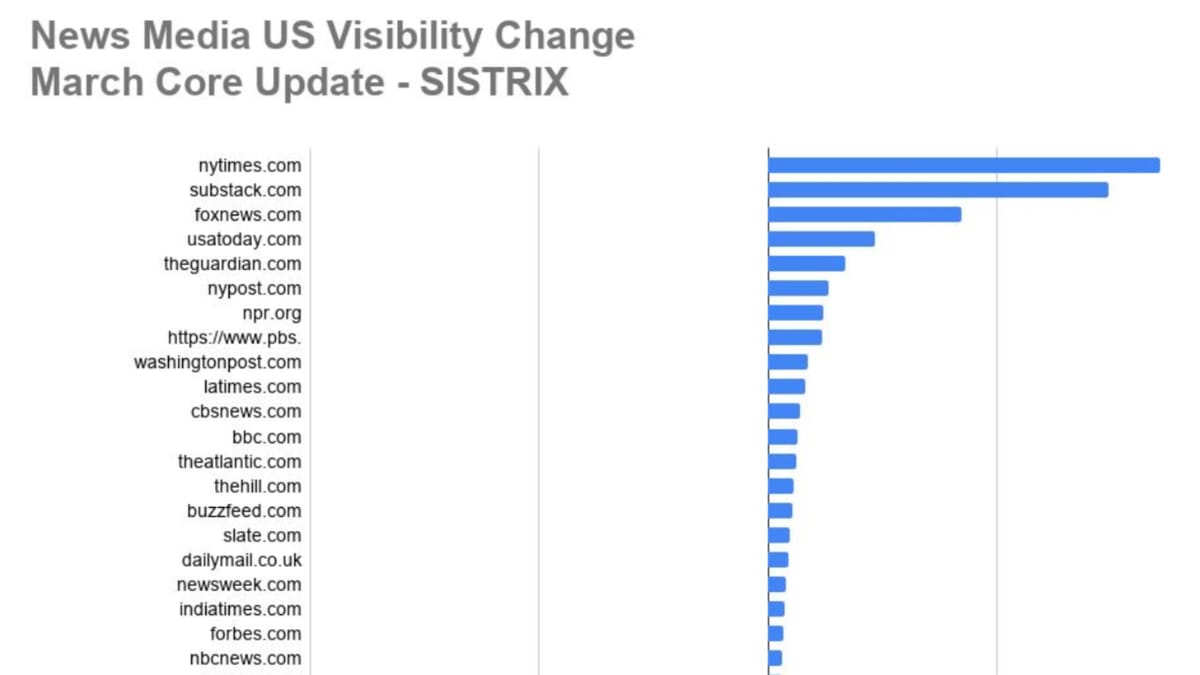
The US-focused SISTRIX chart covers a broad field of news and media domains. At the top, nytimes.com registered the largest positive change in Visibility Index (VI) score, with a bar extending well beyond the +5 mark on the chart. Substack.com came second, with a substantial positive shift, followed by foxnews.com and usatoday.com. The pattern extended through theguardian.com, nypost.com, npr.org, and pbs.org, all recording modest positive gains.
The list of sites with near-zero or negative changes is considerably longer. Dozens of publications across the middle of the chart - including reuters.com, axios.com, nbcnews.com, forbes.com, and cnn.com - show minimal movement in either direction. That flatness is itself informative. According to Adams, "this was a minor update. No huge shifts. No dramatic downgrades." A large cluster of sites sitting at or very near zero suggests that, for many publishers, the update brought no meaningful disruption.
At the negative end of the US chart, the losses are concentrated but notable. finance.yahoo.com recorded a VI change of approximately -7, and usnews.com dropped by a comparable margin, making both the clearest losers among the US news and media cohort tracked by SISTRIX. rollingstone.com also showed a small but visible negative movement. These figures represent changes in organic search visibility only - they do not capture performance in Top Stories, Google Discover, or AI Overviews, which operate on separate systems.
Across the Atlantic, the UK chart tells a different but related story. Theguardian.com posted the largest VI gain in the UK dataset, with a bar extending past the +8 mark - a striking result for a publication that experienced a 30-point drop in the December 2025 core update. That earlier collapse brought The Guardian's VI score down 30 points to 228.9, making the apparent April rebound all the more significant for the publisher.
Moneysavingexpert.com came second in the UK chart, followed closely by substack.com and nytimes.com. Telegraph.co.uk and mirror.co.uk also showed positive movement. A long list of UK regional and national titles registered near-zero or small negative changes - from independent.co.uk and liverpoolecho.co.uk to businessinsider.com, aljazeera.com, and cnbc.com.
At the bottom of the UK chart, thesun.co.uk recorded the largest negative VI change, dropping approximately -4 points. ft.com also showed a small but visible decline. BBC News, represented as https://www.bbc.com/news/, registered a negative shift - a result that SEO consultant Gary Kirwan noted with some surprise in the comments on Adams's LinkedIn post. According to Kirwan's comment, he "was surprised to see BBC News near the bottom in the U.K."
Understanding what these numbers mean requires a brief explanation of the methodology. SISTRIX's Visibility Index is a proprietary metric measuring how prominently a website appears across a tracked keyword set in Google's organic search results. Higher scores indicate more frequent and higher-ranked appearances across those keywords. The index excludes performance in paid results, Top Stories boxes, AI Overviews, and the Google Discover feed. Publishers whose traffic depends heavily on those surfaces may see little correlation between VI changes and actual traffic shifts.
SISTRIX has been publishing VI data for 18 years. Its February 2026 monthly review, which analyzed over 100 million keywords in Germany, documented that AI Overviews now cost German publishers an estimated 265 million organic clicks per month. The same review noted that the Visibility Index had expanded its scope to cover Amazon visibility and AI system presence - reflecting the evolving definition of search itself.
The March 2026 dataset shared by Adams was compiled by Steve Paine, with Adams acknowledging Paine's contribution directly in the comments: "As always, thanks to Steve Paine for collecting this data and sharing it with the industry."
One data point that drew particular attention in the comments was Substack. The platform ranked second in the US chart and third in the UK chart - a dual-market gain that led growth consultant Suman Chatterjee to write: "The one that catches my attention is Substack.com. I think when people are focusing too much on Reddit, this is one platform that people are completely ignoring."
That observation has data behind it. Similarweb's Digital 100 report for 2025 found that Substack achieved a 37% increase in website traffic alongside a 139% growth in mobile app users, adding 5 million monthly website visitors year over year and emerging as the most successful cross-platform performer in the study. In the December 2025 core update, UK analysis showed Substack gaining 4.6 points in VI score, placing it among the few winners in that cycle. The March 2026 result suggests that pattern is now holding across two sequential updates and two geographies.
Substack's gains in organic search visibility are notable given that much of its content sits behind subscriptions or requires direct navigation. That it appears prominently in these charts reflects how much of the platform's public-facing content - author landing pages and open posts in particular - is indexable and actively ranking.
The scope of the March 2026 update's impact matters when set against recent history. The December 2025 core update ran for 18 days and produced some of the most severe ranking disruption documented in recent years. Publishers reported traffic losses of 70-85%. Some sites lost their entire Google Discover traffic within 48 hours. Indian news publishers saw VI scores collapse by more than 65% on SISTRIX, with Hindustan Times dropping from above 6 points to below 2. That update extended a pattern of increasing rollout lengths across 2025's three core updates: 14 days in March, 16 days in June, 18 days in December.
The March 2026 update's 12-day duration breaks that trend. It was, according to Search Engine Roundtable, the second-shortest of the past five broad core updates - only the December 2024 update finished faster. Health sites that had dominated search for years were among the hardest-hit categories in December 2025, with WebMD declining approximately 43% from its peak VI levels. The March 2026 data, by contrast, shows no equivalent collapse in any single category.
That context matters for interpreting the SISTRIX charts. Sites damaged in December may have seen partial recovery embedded in the March numbers. Sites unaffected in December may have remained stable. Disentangling those effects from the March update's own signals is not straightforward, particularly because the March 2026 spam update - which completed in just 19.5 hours, making it the fastest spam update on record - preceded the core update by only three days. SISTRIX VI data does not cleanly isolate those two influences.
John Mueller, from Google's Search Relations team, explained on March 31, 2026 - while the March core update was still rolling out - that these deployments involve multiple components pushed step by step rather than simultaneously. Mueller responded to a Bluesky question from SEO professional Jason Kilgore, who had asked whether different parts of a core update go live at different times. According to the post at 05:28 UTC on March 31, Mueller confirmed that this is indeed how the system works, and that there is no predictable template for the order in which components are deployed.
That technical detail has direct implications for reading SISTRIX data immediately after completion. The VI changes visible in Adams's charts may not be fully stable. Google's own guidance recommends waiting at least one full week after a rollout concludes before drawing conclusions from Search Console data. Rankings can continue to shift as different components settle at different rates. An analysis published in January 2026 based on data from SEO consultant Gagan Ghotra found that confirmed algorithm updates declined from 10 per year in both 2021 and 2022 to just 4 in 2025 - yet perceived volatility increased substantially during the same period. Mueller's March 31 explanation helps account for that apparent paradox: fewer confirmed updates, but each one touching multiple systems across a multi-week deployment window.
For the marketing and media industries that monitor these updates closely, the March 2026 results are notable for what they do not show as much as for what they do. No major publication collapsed. The Guardian's recovery in the UK - if the SISTRIX data holds through the settling period - would represent a meaningful reversal of December 2025 losses. The New York Times extending its already strong VI performance in the US suggests that its content strategy and authority signals remain well-aligned with what Google's updated systems are rewarding.
The persistence of Substack in both charts points to a broader structural factor. Newsletter platforms with significant public-facing content and high reader engagement metrics appear well-positioned under current ranking signals - a finding consistent with SISTRIX's March 2026 newsletter analysis, which concluded that ranking alone "is no longer a business model" in 2026. What content must offer instead, according to that analysis, is uniqueness across formats, depth that AI-generated answers cannot replicate, and authority built from genuine expertise.
The BBC's underperformance in the UK chart is harder to interpret without more granular keyword-level data. The public broadcaster's VI position near the bottom of the UK chart is a notable departure from its historical dominance in UK organic search. Whether this reflects a content strategy issue, a technical factor, or an algorithmic reassessment of newswire-style journalism is not determinable from VI charts alone. Gary Kirwan's reaction in the LinkedIn comments - noting his surprise - reflects a broader sentiment within the UK SEO community.
For publishers still attempting to recover from December 2025 damage, the March data offers some reassurance that the trajectory is not uniformly downward. As Adams put it in the post, "we can breathe easy again. For a while, at least. Until the next one hits." That framing captures the cyclical reality of operating a media property in a landscape defined by recurring algorithmic resets. The next broad core update is currently expected around June-July 2026, based on Google's historical cadence.
Google did not issue new guidance alongside the April 8 completion notice, nor did it publish a companion blog post. Its standing advice remains that ranking drops do not necessarily indicate something is wrong, that recovery often comes with future updates rather than immediate fixes, and that content strategy should focus on what is helpful and reliable for users rather than algorithmic tactics.
Who: Barry Adams, SEO and audience growth consultant for news publishers and co-founder of Polemic Digital, shared SISTRIX Visibility Index data compiled by Steve Paine on LinkedIn following the update's completion. The underlying event is the conclusion of Google's March 2026 core update, which affects all web publishers globally.
What: Google's March 2026 core update completed rolling out on April 8, 2026, after 12 days and 4 hours - within Google's estimated two-week window and shorter than the December 2025 cycle's 18-day run. SISTRIX VI data shows nytimes.com as the largest gainer in the US market, with substack.com second. In the UK, theguardian.com posted the largest VI gain, followed by moneysavingexpert.com and substack.com. The overall update produced minor shifts relative to December 2025. usnews.com and finance.yahoo.com recorded the largest negative VI changes in the US; thesun.co.uk dropped the most in the UK, with BBC News also registering a negative shift.
When: The March 2026 core update began on March 27, 2026, at 02:14 PDT, three days after the March 2026 spam update. It completed on April 8, 2026, at 06:12 PDT. Adams shared the SISTRIX analysis shortly after completion, with the post visible on April 9-10, 2026.
Where: The algorithmic changes affect Google search rankings globally. SISTRIX data covers US and UK news and media domains. The Visibility Index measures organic web search results only; Top Stories, Discover, and AI Overviews are not captured.
Why: Core updates modify Google's broad ranking systems that evaluate content quality, relevance, and reliability. Google describes these updates as efforts to "better surface relevant, satisfying content for searchers from all types of sites." For news publishers and digital marketing professionals, the completion of a core update cycle marks a point at which meaningful data analysis can begin - with the caveat that Google recommends waiting at least one full week after completion before drawing firm conclusions from Search Console data.