PayPal teams with Microsoft to enable purchases inside Copilot
PayPal and Microsoft launch Copilot Checkout on January 8, enabling direct transactions through AI conversations without leaving the platform.


PayPal and Microsoft launch Copilot Checkout on January 8, enabling direct transactions through AI conversations without leaving the platform.

PayPal announced on January 8, 2026, a partnership with Microsoft to power Copilot Checkout, enabling shoppers to discover products, make purchase decisions, and complete transactions entirely within the Copilot experience. The integration marks PayPal's entry into AI-mediated commerce following similar moves by competitors in the rapidly developing market for intelligent shopping assistants.
According to the announcement from the San Jose-based payments company, PayPal will handle merchant inventory surfacing, branded checkout functionality, guest checkout options, and credit card payment processing. The initial implementation launches on Copilot.com, with plans to expand across additional devices and channels where Microsoft's AI assistant operates.
The partnership combines Microsoft's conversational AI capabilities with PayPal's commerce infrastructure, which spans approximately 430 million consumer and merchant accounts across 200 markets. PayPal's role extends beyond payment processing to include what the company describes as "agentic commerce services," recently launched technology designed to position merchants for AI-powered shopping experiences.
"Collaborating with Microsoft marks another step forward in our strategy to support merchants and consumers in AI-powered shopping experiences," said Michelle Gill, GM of Small Business and Financial Services at PayPal. "By integrating PayPal's agentic commerce services with Copilot's intelligent shopping platform, we are enabling seamless, reliable transactions for both merchants and consumers."
The system relies on PayPal's store sync capability, which allows merchant product catalogs to become purchasable through AI interfaces. This technology was introduced as part of PayPal's broader agentic commerce initiative, positioning the company to support merchants across multiple AI platforms and protocols.
Copilot uses contextual understanding to bring intent into shopping journeys. Users can now browse curated, shoppable results and complete purchases with PayPal without navigating away from the conversation. The experience differs from traditional search by incorporating AI-driven product recommendations alongside transaction capabilities.
"PayPal's leadership in commerce, payments and trusted relationships with hundreds of millions of consumers and merchants over 25 years make them an ideal partner," said Nayna Sheth, Head of Product for Agentic Payments at Microsoft. "By integrating PayPal's commerce expertise into Copilot, we're enabling a simpler way to move from discovery to purchase while creating new opportunities for merchants and consumers alike."
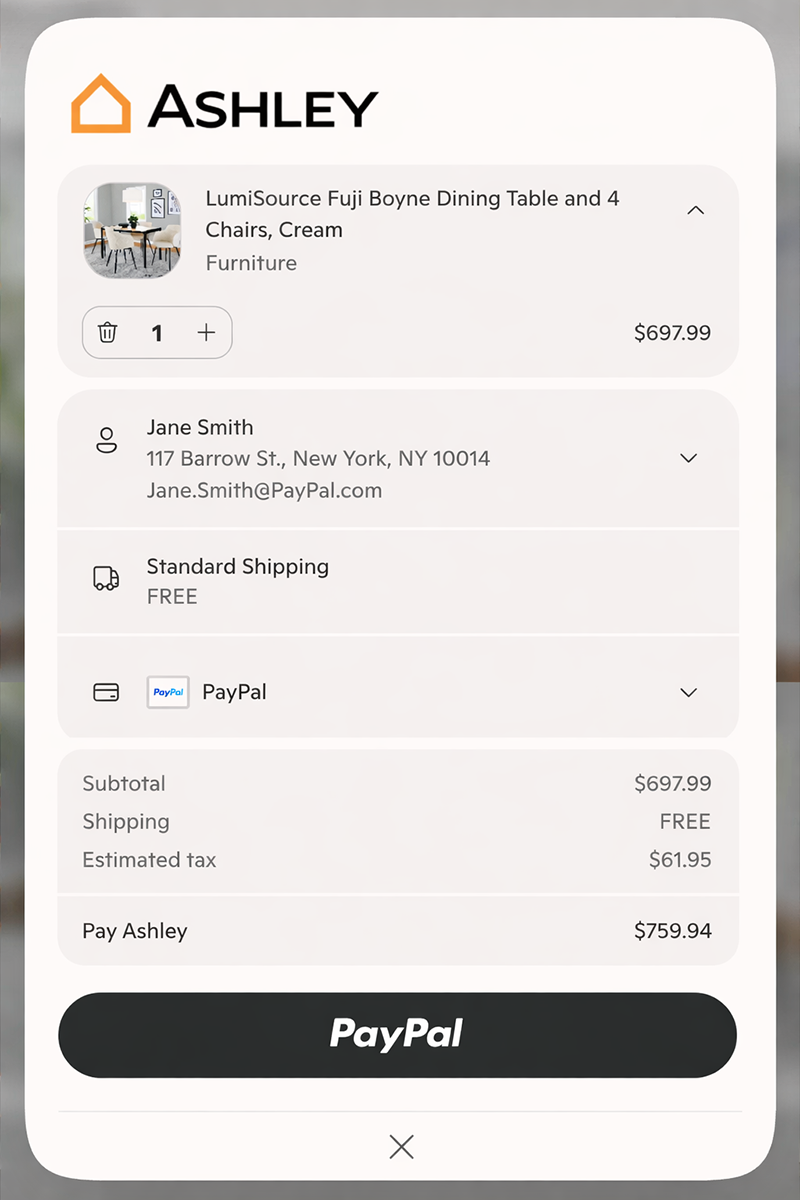
Payment options through Copilot Checkout include PayPal wallet functionality alongside traditional credit card processing. The implementation provides PayPal's seller and buyer protections on eligible transactions, though limits apply and terms vary by transaction type. These protections represent an attempt to address trust concerns that have historically complicated digital commerce.
Microsoft provides internal data indicating that journeys involving Copilot lead to 53% more purchases within 30 minutes of interaction compared to journeys without the AI assistant. When shopping intent is present, conversion rates reach 194% higher than comparable sessions lacking Copilot engagement. These figures, drawn from Microsoft Internal Data dated August 2025, reflect observational insights that may have limited sample representation across certain population segments.
The Copilot shopping experience operates across more than 192,000 retailers, according to Microsoft's announcement materials. This breadth aims to provide consumers with sufficient product variety to match diverse needs and preferences.
Ashley Global Retail, a furniture retailer, represents one of the first companies to embrace the agentic commerce approach through this partnership. The company views AI-powered shopping assistants as transformative technology for customer experiences in the furniture industry.
"As one of the first retailers to embrace agentic commerce, we've seen firsthand how AI-powered shopping assistants can transform the customer experience," said Kyle Dorcas, Head of Product Management at Ashley Global Retail. "Our partnership with PayPal and Microsoft to integrate this technology into Copilot represents the next evolution of furniture retail—empowering customers to discover, design, and purchase home furnishings that reflect their personal style through natural conversation."
The furniture sector presents particular challenges for online commerce given the complexity of spatial planning, style coordination, and long-term purchase considerations. Ashley's early adoption suggests the company sees potential for AI assistants to address some of these friction points through conversational guidance.
PayPal emphasizes an open approach to its agentic commerce capabilities, supporting what the company describes as "leading agentic protocols and AI platforms." This architecture theoretically allows merchants to integrate once with PayPal and gain access across multiple AI ecosystems, though the practical implementation of multi-platform compatibility remains to be demonstrated at scale.
Merchants interested in enabling purchases through Copilot Checkout can register by visiting PayPal.ai, according to the announcement. The onboarding process and technical requirements were not detailed in the press materials.
Buy ads on PPC Land. PPC Land has standard and native ad formats via major DSPs and ad platforms like Google Ads. Via an auction CPM, you can reach industry professionals.
The January 8 announcement positions PayPal within intensifying competition among payment processors and commerce platforms seeking to enable transactions through AI assistants. OpenAI launched instant checkout capabilities for ChatGPT on September 29, 2025, partnering with Stripe to process payments from Etsy and Shopify merchants directly through chat conversations.
That implementation introduced the Agentic Commerce Protocol, an open standard co-developed by OpenAI and Stripe to enable AI agents to coordinate with business systems for purchase completion. The protocol aims to work across payment processors and business types without requiring merchants to modify backend systems.
Microsoft launched its Copilot Merchant Program in April 2025, enabling retailers to connect product catalogs with the AI assistant for discovery and purchase. The January 8 announcement with PayPal represents an evolution of that initiative, adding specific payment infrastructure and commerce capabilities through an established financial services provider.
The competitive landscape includes multiple technology companies pursuing similar AI-mediated commerce approaches. Perplexity shipped "Buy with Pro" functionality in November 2024, though the company has faced legal disputes with Amazon over marketplace access. Google launched agentic checkout and AI shopping tools for the 2025 holiday season.
Payment infrastructure has emerged as a critical component of these commerce experiences. Both Stripe and PayPal position themselves as neutral facilitators enabling transactions across competing AI platforms. This neutrality potentially provides strategic advantages as the market develops, though it remains unclear which payment processors will ultimately dominate AI-mediated commerce.
McKinsey identified agentic AI as the most significant emerging trend for marketing in July 2025, projecting potential market transformation across discovery, consideration, and transaction phases of consumer journeys. The consulting firm's analysis suggested fundamental changes in how brands approach product visibility and customer acquisition.
Despite technology launches and corporate partnerships, some analysts question whether AI shopping agents will achieve widespread consumer adoption. Independent analyst Andrew Lipsman published detailed examination in October 2025 questioning the commercial viability of autonomous shopping systems.
Lipsman's analysis identified eight structural challenges including retailer incentives against AI intermediation, consumer preference for seeing options before purchase decisions, and the complexity of returns in ecommerce environments. The analysis noted that Amazon and Shopify, which collectively control more than 50% of U.S. ecommerce, both block AI agents to maintain control over customer relationships and protect retail media businesses.
Retail media networks have become significant revenue sources for commerce platforms. Retail media is projected to capture 20% of global advertising revenue by 2030, reaching over $300 billion annually. This financial incentive creates tension with AI-mediated shopping models that potentially diminish platform control over discovery and purchase journeys.
The tension between AI shopping assistants and retailer control manifests in technical restrictions. Amazon blocked AI bots from major tech companies in August 2025, preventing OpenAI, Anthropic, and other AI platforms from accessing marketplace data. Amazon cited the need to protect its retail media business and maintain customer relationship ownership.
Consumer adoption patterns remain unclear. While AI shopping adoption has accelerated, with some research indicating 85% consumer trust for autonomous ordering ahead of the 2025 holiday season, actual transaction volumes through AI assistants have not been publicly disclosed by participating companies.
The development carries significant implications for marketing professionals navigating evolving commerce channels. Traditional search engine optimization and paid search strategies may require adaptation as discovery shifts toward conversational AI interfaces.
Product visibility in AI-mediated shopping depends on factors beyond traditional SEO signals. Natural language processing requires structured product data, accurate specifications, and contextually relevant descriptions. Marketing teams must consider how products appear to algorithmic recommendation systems rather than exclusively optimizing for human shoppers browsing websites.
Attribution modeling becomes more complex when AI assistants serve as intermediaries between advertising exposure and transaction completion. The role of various touchpoints in customer journeys may shift as consumers conduct research and make purchases within unified AI experiences.
Shoppable advertising formats have proliferated across digital channels, with PayPal itself launching Storefront Ads in June 2025 that enable direct purchases within display advertising units. These developments reflect broader industry movement toward reducing friction between product discovery and transaction completion.
The integration of commerce capabilities into AI assistants represents another manifestation of this trend, though the ultimate impact on marketing strategies depends on consumer adoption rates and merchant participation levels.
Financial terms of the PayPal-Microsoft partnership were not disclosed in the announcement materials. Questions remain about revenue sharing arrangements, transaction fees, and how costs compare to traditional ecommerce channels for participating merchants.
Merchants must evaluate whether visibility and sales through Copilot Checkout justify the investment in integration and any associated fees. The value proposition depends partly on incremental customer acquisition versus cannibalization of existing direct sales channels.
PayPal's emphasis on an open approach supporting multiple AI platforms suggests the company anticipates a fragmented market rather than winner-take-all dynamics. This positioning could provide flexibility as the competitive landscape develops, though it also introduces complexity for merchants choosing which platforms to prioritize.
The announcement describes PayPal's technology as enabling merchants to "future-proof their business in the new era of AI-powered commerce." Whether AI shopping assistants become dominant commerce channels or remain supplementary options alongside traditional websites and apps will likely become clearer through 2026 as consumer behavior patterns emerge.
Microsoft and PayPal both have substantial resources to invest in developing and promoting Copilot Checkout. Microsoft's existing enterprise relationships and consumer-facing products provide distribution for the AI assistant, while PayPal's payment infrastructure and merchant relationships offer integration pathways.
Success will depend on solving complex challenges around product discovery accuracy, transaction security, returns handling, customer service, and merchant profitability. The partnership announced on January 8 represents infrastructure for addressing these challenges, though actual market validation requires measurable consumer adoption and merchant satisfaction.
Subscribe PPC Land newsletter ✉️ for similar stories like this one
Subscribe PPC Land newsletter ✉️ for similar stories like this one
Who: PayPal partnered with Microsoft to launch Copilot Checkout, enabling transactions through Microsoft's AI assistant. Ashley Global Retail participated as an early merchant adopter. Michelle Gill, GM of Small Business and Financial Services at PayPal, and Nayna Sheth, Head of Product for Agentic Payments at Microsoft, represented their respective companies in the announcement. Kyle Dorcas, Head of Product Management at Ashley Global Retail, provided merchant perspective.
What: Copilot Checkout delivers a complete commerce experience within Microsoft's AI assistant, allowing users to discover products, make purchase decisions, and complete transactions without leaving the Copilot interface. PayPal provides merchant inventory surfacing, branded checkout, guest checkout, and credit card payment processing. The system includes PayPal wallet options, seller and buyer protections on eligible transactions, and operates through PayPal's agentic commerce services and store sync capabilities. Microsoft's data indicates journeys with Copilot lead to 53% more purchases within 30 minutes of interaction and 194% higher conversion rates when shopping intent is present.
Where: The service launched on Copilot.com with plans to extend across additional devices and channels where Copilot operates. PayPal's infrastructure spans 200 markets with 430 million consumer and merchant accounts, though the Copilot Checkout implementation focuses initially on the Microsoft platform. The Copilot shopping experience includes more than 192,000 retailers, according to Microsoft.
When: PayPal announced the partnership on January 8, 2026. Microsoft's internal data cited in the announcement comes from August 2025, suggesting prior testing and development. The announcement follows Microsoft's April 2025 launch of the Copilot Merchant Program and occurs amid intensifying competition in AI-mediated commerce following OpenAI's September 2025 instant checkout launch with Stripe.
Why: The partnership positions both companies within the emerging AI-powered commerce market as shopping discovery and transactions shift toward conversational interfaces. For PayPal, the collaboration extends its commerce infrastructure beyond traditional website checkout to AI assistant environments, supporting what the company describes as helping merchants "future-proof their business in the new era of AI-powered commerce." For Microsoft, PayPal's payment processing expertise, merchant relationships, and buyer/seller protections add credibility and functionality to Copilot's shopping capabilities. Merchants gain a new channel to reach customers making purchase decisions within AI conversations, though adoption depends on consumer behavior shifts and the economic viability of the channel compared to traditional ecommerce.