PayPal's transaction graph shows what competitors can't see across merchants
PayPal launched Transaction Graph Insights & Measurement on January 6, giving advertisers cross-merchant purchase data that platform-specific tools miss entirely.


PayPal launched Transaction Graph Insights & Measurement on January 6, giving advertisers cross-merchant purchase data that platform-specific tools miss entirely.
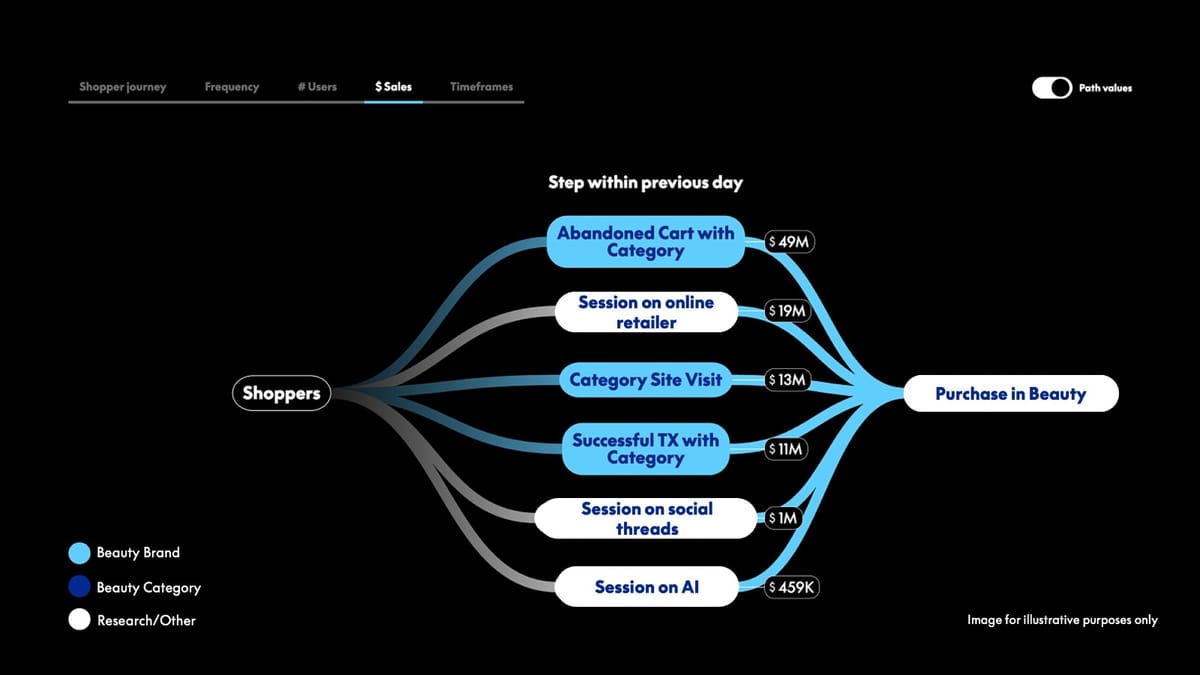
PayPal announced the launch of Transaction Graph Insights & Measurement on January 6, 2026, providing advertisers with cross-merchant visibility into actual purchase behavior rather than fragmented data limited to individual retail platforms. The San Jose-based payment giant positions the offering as addressing critical measurement gaps in an advertising landscape where platforms report clicks and impressions within their own ecosystems while missing the complete consumer journey.
The program draws from PayPal's transaction graph connecting more than 430 million consumer accounts and tens of millions of merchants to identify high-intent shoppers before conversions occur elsewhere. This data infrastructure spans search, shopping, and sharing signals across PayPal's brand portfolio including Venmo and Honey, creating visibility into consumer behavior that traditional advertising platforms cannot access.
"The era of the empowered shopper demands advertising solutions built on real commerce data, not modeled intent," said Mark Grether, Senior Vice President and General Manager of PayPal Ads, in the announcement. "Unlike walled-garden platforms that only see activity within their own ecosystem, or measurement solutions that rely on modeled data, PayPal's Transaction Graph connects verified purchases across tens of millions of merchants."
The distinction between verified purchase data and modeled estimates represents a fundamental measurement challenge facing marketers. Platform-specific attribution tools report performance within contained environments, requiring advertisers to piece together fragmented views of consumer behavior across multiple touchpoints. PayPal's approach connects actual transactions regardless of where purchases occur, providing what the company describes as "full sales signal integrity and accuracy."
Traditional advertising measurement operates within platform boundaries. Search engines track queries and clicks on their properties. Social networks monitor engagement within their feeds. Retail media networks observe shopping behavior on specific merchant sites. None of these platforms see the complete consumer journey when shoppers compare products across channels before converting elsewhere.
PayPal's transaction graph addresses this fragmentation by tracking payment activity across participating merchants. When consumers search for running shoes on one retailer, compare prices on a marketplace, consult an AI assistant for recommendations, read reviews on social platforms, send money to friends via Venmo for race entries, and purchase gear through PayPal checkout, the company maintains visibility across these discrete touchpoints that other platforms observe in isolation.
This cross-merchant perspective enables identification of high-intent shoppers before final purchase decisions occur. Advertisers can target consumers based on verified purchase patterns across categories and merchants rather than relying on behavioral signals limited to single platforms. The methodology differs substantially from attribution models that assign credit to specific touchpoints without establishing causal relationships between advertising exposure and purchase behavior.
The measurement challenge has intensified as marketing professionals report stalled confidence in attribution accuracydespite increasing data availability. Research published in October 2025 found 54.1% of marketers reported unchanged measurement confidence compared to the previous year, while 14.3% said confidence actually declined. Most marketers maintain confidence in their performance metrics, but that confidence stopped growing precisely when tools improved and data became more abundant.
PayPal's Transaction Graph Insights & Measurement comprises three distinct components addressing different measurement needs across the advertising workflow. Transaction Graph Insights provides an interactive analytics experience visualizing cross-merchant, cross-surface shopper journeys to deliver brand-specific recommendations. This tool helps advertisers understand purchase patterns that extend beyond individual retail environments.
Transaction Graph Measurement represents PayPal's first-party measurement suite built specifically on the transaction graph and deterministic-driven identity. The system delivers campaign reporting, insights, attribution, and incrementality analysis using actual purchase data rather than probabilistic models. This approach aligns with industry movement toward incrementality testing as the gold standard for measuring advertising effectiveness.
The Transaction Graph Measurement Partnership Program enables independent campaign validation through certified third-party partners including AppsFlyer, Cint, Experian, iSpot, Kantar, Kochava, and LiveRamp. This partner ecosystem provides advertisers with measurement verification beyond PayPal's own reporting, addressing concerns about platforms grading their own homework that have plagued advertising measurement for years.
Third-party measurement validation has become increasingly critical as advertisers recognize attribution methodology limitations. Research from Kochava published in September 2025 demonstrated that marketing mix modeling revealed 35% higher incremental impact for TikTok campaigns compared to last-touch attribution reporting. This measurement gap illustrates how methodology selection directly impacts perceived channel effectiveness and subsequent budget allocation decisions.
Ulta Beauty deployed PayPal Transaction Graph to reach high-intent beauty audiences across premium web inventory through Offsite Ads. The nation's largest specialty beauty retailer measured a 20% increase in transaction spend via PayPal during the campaign period compared to the weeks preceding campaign activation. This lift represents incremental spending captured through PayPal's measurement framework.
The beauty retailer validated brand impact using Lucid, a Cint company designated as a PayPal Ads Measurement Partner. The independent validation showed brand favorability increased 136% above the Lucid benchmark, demonstrating both short-term transaction lift and longer-term brand perception improvements. This dual measurement approach addresses marketing objectives spanning immediate conversion goals and sustained brand building.
Blizzard Entertainment's CMO Monica Austin highlighted the strategic alignment between transaction intelligence and gaming industry measurement needs. "When PayPal Ads showed us their Transaction Graph insights, we immediately saw the potential," Austin stated in the announcement. "The ability to leverage commerce intelligence across game releases, performance media, and attribution measurement aligns perfectly with how we think about continually improving player engagement."
The gaming industry presents particular measurement challenges given the extended customer journeys between initial awareness and eventual purchase, compounded by complex pricing models including free-to-play mechanics with in-game purchases. Cross-merchant transaction visibility provides gaming publishers with intelligence about consumer spending patterns across entertainment categories that inform targeting and creative strategies.
PayPal's measurement launch occurs within rapidly expanding commerce media infrastructure that positions transaction data as competitive advantage. Mastercard launched its commerce media network in October 2025, establishing a dedicated digital advertising platform leveraging permissioned transaction data from more than 160 billion annual payments processed in 2024. The platform reaches 500 million enrolled consumers across owned channels, bank outlets, and publishing partners worldwide.
Commerce media represents one of the fastest-growing advertising sectors, with spending projected to approach $100 billion by 2028 according to eMarketer forecasts. The growth trajectory reflects advertiser demand for transparent measurement and direct attribution to actual purchase outcomes rather than proxy metrics like clicks and impressions. Retail media achieved 22.1% growth in 2024, significantly outpacing the broader advertising market's 6.1% expansion.
PayPal's approach differs from retail media networks operating within single merchant ecosystems. While Amazon, Walmart, and Target leverage shopping behavior data from their own platforms, PayPal's transaction graph spans tens of millions of merchants across diverse categories. This cross-merchant visibility creates different targeting and measurement capabilities compared to retail-specific networks limited to activity within their own properties.
The measurement ecosystem has consolidated around several technical standards facilitating commerce media growth. IAB and IAB Europe released comprehensive guidelines in November 2025 establishing measurement frameworks for commerce media campaigns, addressing fragmentation challenges that complicated budget allocation as spending accelerated. These guidelines define incrementality as "the causal impact of marketing by identifying the additional business outcomes directly driven by a campaign or tactic, compared to what would have occurred in the absence of marketing activity."
Transaction Graph Measurement operates on deterministic identity resolution rather than probabilistic matching methods that introduce error rates into attribution calculations. Deterministic approaches connect user identities through verified login credentials and payment information, providing higher confidence in attribution accuracy compared to cookie-based or device fingerprinting techniques that rely on probabilistic inference.
The distinction between deterministic and probabilistic identity matters substantially for measurement precision. Probabilistic methods estimate which devices belong to individual users based on behavioral patterns and technical signals, accepting error rates in exchange for broader reach. Deterministic approaches sacrifice some scale for accuracy improvements, connecting only users with verified credentials across touchpoints.
PayPal's payment infrastructure provides natural deterministic linkage opportunities. Consumers authenticate identities when processing payments regardless of merchant or device, creating consistent identification across shopping journeys. This authentication occurs at the moment of purchase decision, providing verified purchase signals rather than behavioral proxies that may not convert to actual transactions.
The company processes payment transactions across hundreds of millions of consumer accounts and tens of millions of merchant relationships. This scale creates network effects where data quality improves as adoption increases, similar to dynamics observed in other two-sided marketplace models. Each additional merchant participation enhances consumer journey visibility, while expanded consumer usage increases merchant targeting precision.
PayPal emphasizes operating within privacy frameworks that have constrained advertising effectiveness across digital channels. The announcement references "respecti[ng] consumer privacy" while leveraging transaction insights for advertising purposes, though specific technical implementations governing data usage, consent mechanisms, and opt-out procedures remain undisclosed beyond general privacy commitments.
Payment data carries heightened sensitivity compared to behavioral browsing information typically used for advertising targeting. Financial transaction records reveal detailed consumer spending patterns, category preferences, purchase frequencies, and price sensitivity that extend beyond traditional advertising datasets. This sensitivity creates both opportunity for precision targeting and obligation for privacy protection.
The advertising industry has experienced significant privacy-related disruptions that reshaped measurement capabilities. Meta announced in October 2025 it would deprecate 7-day and 28-day view-through attribution windows effective January 12, 2026, eliminating measurement options advertisers relied upon for awareness campaigns. Historical data retention limits were set at 13 months for unique-count fields and six months for frequency breakdowns.
These platform restrictions reflect broader tension between measurement needs and privacy protection as regulatory frameworks including GDPR, CCPA, and emerging AI governance legislation impose constraints on data processing for advertising purposes. PayPal's deterministic approach based on authenticated payment data potentially sidesteps some cookie deprecation challenges affecting probabilistic targeting methods, though regulatory scrutiny around financial data usage for advertising continues evolving.
Transaction Graph Insights & Measurement launched immediately for US-based advertising programs following the January 6 announcement. International expansion will extend availability to the United Kingdom and Germany, though specific timing for these markets remains unspecified beyond general commitments to follow after domestic implementation.
The phased geographic rollout reflects operational considerations around data governance requirements that vary across jurisdictions. European markets operate under GDPR frameworks imposing specific constraints on data processing, consent mechanisms, and cross-border data transfers that differ from United States regulatory environments. Payment data carries particular sensitivity under financial services regulations that govern consumer protection.
PayPal directs advertisers to https://www.paypal.com/us/advertiser for brand access to cross-merchant insights and personalized demonstrations of category-specific shopper behavior patterns. The Transaction Graph Measurement Partner Program maintains separate documentation at undisclosed locations for third-party measurement providers seeking certification.
The company launched Offsite Ads in April 2025, exactly eleven days after appointing Mark Grether as SVP and General Manager of PayPal Ads. That initial offering expanded PayPal's advertising capabilities beyond owned properties to reach consumers across the open web through display and video advertising. Shoppable Storefront Ads followed in June 2025, transforming traditional display advertisements into fully functional storefronts enabling direct purchases within ad units.
The Transaction Graph launch aligns with broader industry recognition that traditional attribution models systematically misrepresent advertising effectiveness. Research published in October 2025 found 67.4% of marketers identified proving incremental ROI as their most pressing measurement challenge, followed by aligning marketing metrics to business outcomes at 66.3% and improving cross-channel attribution accuracy at 55.1%.
Platform-provided attribution remains the most common methodology at 65.8% usage among marketers. However, supplementation with advanced approaches has accelerated dramatically, including incrementality testing and experiments at 52.0% adoption and marketing mix modeling at 49.5% implementation. Investment plans reflect this methodological diversification, with 46.9% of marketers planning to increase marketing mix modeling investment over the next 12 months.
Google reduced incrementality testing budget requirements to $5,000 minimum during May 2025's Google Marketing Live, utilizing Bayesian methodology to deliver insights with substantially less data than traditional approaches required. This democratization of causal measurement techniques previously accessible only to advertisers with substantial budgets addresses barriers that prevented smaller brands from implementing rigorous effectiveness testing.
The measurement infrastructure supporting commerce media continues maturing beyond experimental phases. AppsFlyer announced in November 2025 eight new products including Incrementality for User Acquisition quantifying true incremental contribution of touchpoints across marketing funnels. The system operates cross-network alongside attribution to deliver lift measurement without manual setup requirements.
PayPal's transaction graph measurement addresses the fundamental question that attribution models cannot definitively answer: what would have happened without advertising intervention? Attribution assigns credit to touchpoints along customer journeys but cannot isolate advertising's causal impact from organic conversions that would occur regardless of marketing activity.
This causal measurement challenge has plagued digital advertising since platforms began offering self-reported performance metrics. Advertisers optimizing toward platform-reported conversions may inadvertently shift spending toward channels claiming credit for purchases that would have occurred through other touchpoints or organically without any advertising exposure. The economic consequences of this misallocation compound over time as budgets flow toward channels with favorable attribution rules rather than genuine incremental effectiveness.
Cross-merchant transaction visibility provides advertisers with comparative intelligence about consumer behavior across competing platforms and retail environments. When consumers search for products on Google, browse reviews on Amazon, engage with social media recommendations, and ultimately purchase through different merchants, single-platform measurement tools cannot connect these discrete activities into coherent journey analysis.
PayPal's position spanning payment processing across diverse merchants creates structural advantages for journey reconstruction that platform-specific measurement tools cannot replicate. The company processes transactions at the point of purchase regardless of which marketing channels influenced the decision, providing verified conversion data that extends beyond individual platform boundaries.
The Transaction Graph launch intensifies competition within commerce advertising as payment networks, retail media platforms, and traditional advertising technology providers compete for attribution credibility and measurement authority. Each player brings different data assets, measurement capabilities, and strategic advantages to increasingly contested terrain.
Search engines enhanced lifecycle targeting with expanded capabilities distinguishing new customer acquisition from repeat purchases, win-back campaigns, and high-value segment identification. These segmentation improvements acknowledge that not all conversions carry equal strategic value and that customer acquisition costs differ substantially from retention marketing investments.
Social platforms developed cross-platform attribution capabilities previously absent between competing ecosystems. Meta began testing Google Analytics 4 integration in October 2025, allowing advertisers to measure website and shop actions in third-party analytics platforms after users interact with Meta advertisements. This integration operates in the opposite direction from earlier cost data imports, pushing conversion data from Meta Ads into external analytics systems.
Retail media networks have embraced programmatic access through real-time bidding integrations that reduce operational friction for advertisers managing campaigns across multiple commerce platforms. Pentaleap and Teads announced RTB capability for onsite Sponsored Product Ads in July 2025, enabling standardized access through unified programmatic interfaces rather than fragmented direct relationships with individual retailers.
The Trade Desk partnered with Koddi in October 2025 to enable programmatic purchase of onsite retail media inventory including sponsored product ads through consolidated campaign management interfaces. This collaboration provides unified workflows for full-funnel advertising strategies rather than requiring separate platform management for retail media and broader digital campaigns.
Who: PayPal announced the program through Mark Grether, Senior Vice President and General Manager of PayPal Ads, from its San Jose, California headquarters. Early adopters include Ulta Beauty and Blizzard Entertainment, with measurement validation provided through partners including AppsFlyer, Cint, Experian, iSpot, Kantar, Kochava, and LiveRamp.
What: Transaction Graph Insights & Measurement provides merchants and advertisers with cross-merchant visibility into actual purchase behavior, campaign effectiveness, and data-driven recommendations. The program comprises three components: Transaction Graph Insights for interactive analytics, Transaction Graph Measurement for first-party measurement using deterministic identity, and the Measurement Partnership Program for independent validation.
When: PayPal announced the launch on January 6, 2026, with immediate availability for US-based advertising programs. International expansion to the United Kingdom and Germany will follow, though specific timing remains unspecified.
Where: The program draws from PayPal's transaction graph connecting more than 430 million consumer accounts and tens of millions of merchants globally. Initial availability focuses on United States markets with planned expansion to United Kingdom and Germany.
Why: Traditional measurement platforms report performance within their own ecosystems, creating fragmented views of consumer journeys that span multiple touchpoints before purchase. PayPal's cross-merchant transaction visibility addresses this measurement gap by connecting verified purchases regardless of where conversions occur, providing what the company describes as superior alternative to platform-specific attribution and modeled estimates.