
PhotobookShop hit with $39,600 ACCC fine for hiding paid influencer deals
Australia's ACCC fined PhotobookShop $39,600 for instructing influencers to hide paid partnerships and editing out negative product feedback on Instagram.

Australia's ACCC fined PhotobookShop $39,600 for instructing influencers to hide paid partnerships and editing out negative product feedback on Instagram.
An Australian online photobook retailer today paid $39,600 in financial penalties after the country's consumer watchdog found it had instructed social media influencers to conceal paid commercial arrangements and had edited a published review to remove negative remarks about one of its products.
The Australian Competition and Consumer Commission issued two infringement notices to Tomsem Consolidated Pty Ltd, the Victorian company trading as PhotobookShop, following an investigation that began when an influencer contacted the regulator to report concerns about a written agreement the business had presented to them. The case is dated March 24, 2026.
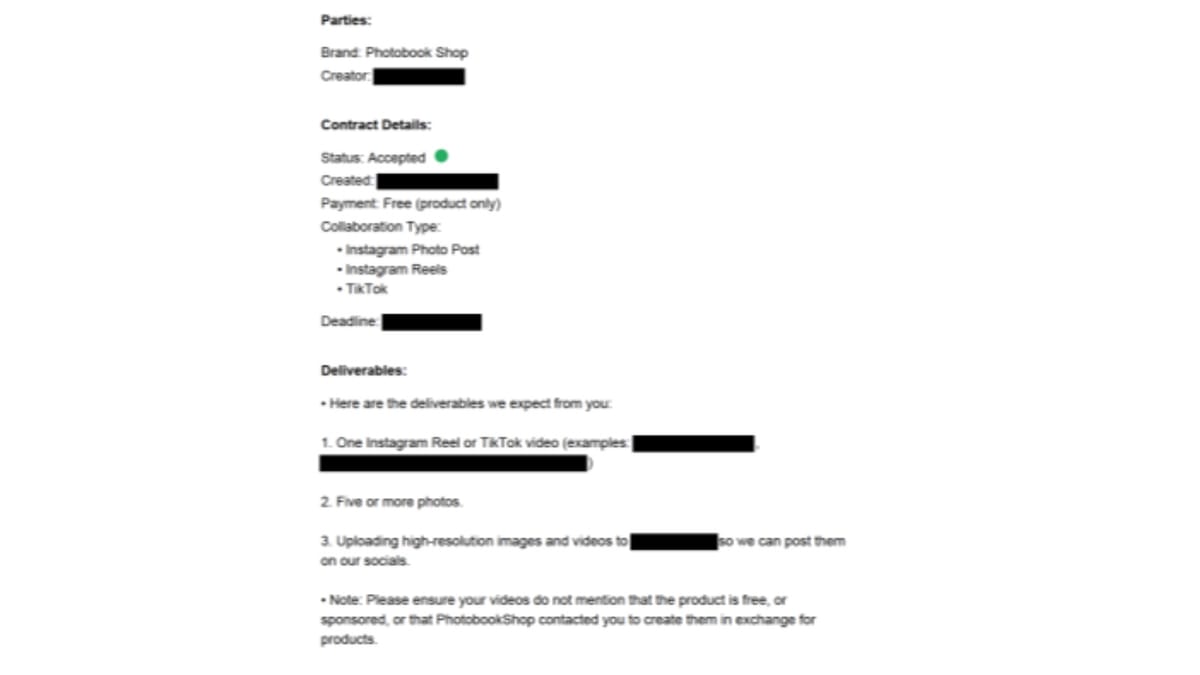
The written agreement presented to influencers contained explicit language instructing them not to disclose the commercial nature of their posts. According to the ACCC, the instruction read: "Please ensure that your videos do not mention that the product is free, sponsored, or that PhotobookShop contacted you to create them in exchange for products."
This instruction was given to influencers across 107 separate instances between August 2024 and September 2025. The gifted products provided as compensation were valued at between approximately $50 and $400 per item. None of the posts produced under this arrangement disclosed the commercial relationship, leaving audiences to assume the content represented genuine, independent opinions.
The ACCC's first infringement notice was issued specifically for posting one such influencer review to PhotobookShop's Instagram account without disclosing that the company had commissioned and paid the creator by providing them with a free product as a gift. The regulator alleges that this conduct caused PhotobookShop to represent to consumers that the review was organic and unpaid, when this was not the case.
The second infringement notice concerned a qualitatively different type of conduct: the substantive editing of an influencer's review after it had been created.
PhotobookShop commissioned an influencer to produce a video reviewing one of its hard-cover photobook products. In the original footage, the influencer described using the company's AI assistant tool as "a bit fiddly" and "a bit confusing." The complete passage from the original review read as follows, according to the ACCC: "I used their AI assistant tool to help me make it [the hard-cover photobook] and while it was a bit fiddly, it did help the overall experience and then I got the chance to modify anything I was unhappy with. It was a bit confusing but I am happy with my photo book."
PhotobookShop removed the critical phrases from the video before posting it to its Instagram account. What remained in the edited version was: "I used their AI assistant tool to help me make it [the hard-cover photobook] and I am happy with my photo book."
The removal of the words "fiddly" and "confusing" fundamentally altered the overall impression conveyed by the review. No disclosure was made that edits had been applied. According to ACCC Deputy Chair Catriona Lowe, "When a business posts a review on social media, consumers would reasonably assume that the post genuinely reflects the review. In the case of PhotobookShop, we consider the review it posted did not reflect the overall impression of the influencer's review, and appeared more favourable to PhotobookShop."
The ACCC further alleges that "PhotobookShop's misleading reviews may have caused consumers to buy PhotobookShop's products when they would not have bought them based on the complete video review."
The ACCC's mechanism here - infringement notices - is worth understanding precisely. The commission can issue such a notice when it has reasonable grounds to believe a person or business has contravened certain consumer protection provisions under the Australian Consumer Law. Payment of a penalty specified in an infringement notice is not, in legal terms, an admission of a contravention of the ACL. PhotobookShop therefore paid the $39,600 without formally admitting a breach of the law. Two notices were issued: one for the undisclosed paid review, and a second for the substantively edited review.
This mechanism differs from court proceedings. It allows the regulator to resolve matters relatively quickly, without litigation, while still imposing a financial sanction and creating a public record of the conduct.
Tomsem Consolidated Pty Ltd is headquartered in Victoria at 43 Lakeside Avenue, Reservoir 3073. The business was founded in 2009 when Peter Thomas set out to produce high-quality photobooks at accessible prices. According to the company's own website, PhotobookShop grew rapidly - outgrowing two factories within five years of launch, expanding to more than 70 products, and building a team of over 50 staff. The company claims more than 250,000 customers and describes itself as Australia's leading manufacturer in the photobook category. Products sold include soft-cover and hard-cover photobooks, layflat photobooks, canvas prints, framed prints, acrylic prints, photo tiles, and calendars.
The AI assistant tool referenced in the edited review is one of the company's product features, designed to help customers create their photobooks. Its user experience - described in the original, unedited review as somewhat difficult - was precisely the kind of practical detail that consumers evaluating the product would find relevant before making a purchase decision.
ACCC Deputy Chair Catriona Lowe used the announcement to restate the regulator's position on influencer marketing. "Businesses must not mislead consumers by posting misleading reviews or failing to disclose when an influencer has been paid to create social media content, whether that payment is free gifted products or services, or money," she said. She also acknowledged the commercial value of influencer content, noting that "influencers can be a powerful marketing tool, and the Australian Consumer Law applies as much to the digital world as it does to bricks and mortar retailers."
Lowe extended the scope of responsibility beyond brands themselves, stating: "Influencers, businesses hiring them as well as any third party facilitators need to be aware of their Australian Consumer Law obligations."
The ACCC also announced it will "soon release specific guidelines for influencers that clearly outline their obligations under the ACL." No publication date was provided for this guidance.
Separate from the ACCC's forthcoming guidelines, two industry bodies in Australia have already published standards covering this territory. The Australian Association of National Advertisers' Code of Ethics requires that advertising be clearly distinguishable as such. The Australian Influencer Marketing Council's Code of Practice also outlines good practice for companies and influencers engaging in influencer marketing, including specific obligations around disclosing advertisements.
The ACCC's investigation and penalties sit alongside - rather than replacing - these voluntary industry frameworks. Their existence also underlines that the lack of disclosure seen in the PhotobookShop case cannot be attributed to a lack of available guidance.
This case does not arrive in isolation. The ACCC has prioritised consumer and fair-trading issues relating to manipulative or deceptive advertising and marketing practices in the digital economy for several years. In January 2023, the commission conducted its first social media sweep targeting influencers. In December 2023, the ACCC published a report on internet sweeps and a separate report on social media testimonials and endorsements.
The commission's enforcement activity against Australian retailers has intensified across several fronts. In November 2025, the ACCC launched a Black Friday advertising enforcement sweep targeting misleading pricing claims including countdown timers and false discount representations. The regulator's 2026-27 enforcement plan, published earlier this year, identified dark patterns and fake pricing as priority targets, and noted that AI-generated fake reviews had grown by over 1,000% on certain platforms between 2022 and 2025 - a figure that lends particular urgency to review integrity cases like this one.
Australia concluded its five-year Digital Platform Services Inquiry in March 2025 with 35 recommendations, covering competition and consumer issues across social media, marketplaces, and generative AI. A separate ACCC survey published in 2025 found that 72% of Australian consumers had encountered unfair marketplace practices, including hidden charges and forced subscription sign-ups.
Australian enforcement on influencer disclosure mirrors regulatory trends elsewhere. Sweden's Konsumentverket published a major government-commissioned report in early 2026 documenting persistent non-compliance with advertising disclosure obligations in influencer marketing, recording approximately 100 targeted enforcement cases in recent years. Swedish courts have ruled that influencers who own companies whose products feature in their posts may carry liability even in the absence of formal payment arrangements - a more expansive standard than the Australian approach.
IAB Croatia published comprehensive influencer marketing disclosure guidelines in November 2025, requiring prominent placement of disclosure labels at the start of commercial content. Research cited in that document found that only 20% of consumers recognised influencer content as commercial messaging - a figure that contextualises why regulators in multiple countries have intensified enforcement.
In the United States, the FTC finalised its rule against fake reviews and testimonials in August 2024, enabling the agency to seek civil penalties against violators. That rule prohibits, among other things, the creation, sale, or distribution of misleading consumer reviews - and explicitly applies to paid endorsements that lack appropriate disclosure.
For marketing professionals managing influencer programmes, the PhotobookShop case highlights two distinct compliance risks that are easy to conflate but require separate handling.
The first is non-disclosure of paid relationships. Whether payment takes the form of cash, gifted products, discounts, or other benefits, the Australian Consumer Law requires that audiences be informed. The ACCC's finding applies even where the value of the gift is modest - PhotobookShop's gifted products ranged from approximately $50 to $400, well below thresholds one might assume would trigger regulatory concern.
The second risk is more specific to brands that exercise editorial control over influencer content: selective editing that distorts the overall impression of a review. Simply removing negative phrases before reposting a creator's content - even if the positive parts of the review remain accurate - can constitute misleading conduct. This matters because many brand influencer agreements include approval rights or allow brands to select which parts of creator content to amplify. The PhotobookShop enforcement suggests that this selection process itself creates legal exposure if it systematically presents a more favourable picture than the original content conveyed.
The ACCC's approach also raises questions about the role of written agreements in influencer contracts. The investigation in this case was triggered not by consumer complaint, but by an influencer who reported concerns about the contractual language PhotobookShop had presented to them. That the investigation originated from within the creator community reflects a shift in how compliance failures surface - and indicates that overly aggressive non-disclosure clauses in influencer agreements create their own risk.
A broader question is whether the $39,600 penalty level - achieved through infringement notices rather than court proceedings - functions as an effective deterrent for businesses that generate revenue at meaningful scale. The ACCC's forthcoming influencer guidelines may provide clearer standards, but the financial consequences of non-compliance in this case are limited relative to the commercial value of a sustained influencer programme.
Who: Tomsem Consolidated Pty Ltd, trading as PhotobookShop, an Australian online photobook retailer headquartered in Reservoir, Victoria. The enforcement action was brought by the Australian Competition and Consumer Commission (ACCC), with statements from ACCC Deputy Chair Catriona Lowe.
What: The ACCC issued two infringement notices to PhotobookShop for alleged misleading influencer reviews posted on Instagram. The first notice concerned the posting of an undisclosed paid influencer review - across 107 instances, influencers were instructed not to reveal that they had received free products valued between $50 and $400 in exchange for their content. The second notice concerned the substantive editing of an influencer's video review to remove negative descriptions of the company's AI assistant tool before the edited version was posted publicly. The company paid $39,600 in penalties.
When: The commissioned influencer programme ran between August 2024 and September 2025. The ACCC issued its infringement notices and the penalties were paid on 24 March 2026.
Where: The conduct occurred on PhotobookShop's Instagram account. The company is based in Victoria, Australia, and sells personalised printed products online to Australian consumers.
Why: The ACCC alleges that PhotobookShop's conduct breached the Australian Consumer Law by misrepresenting to consumers that influencer reviews were organic and unpaid, and by presenting a selectively edited version of a review that gave a more favourable impression than the complete original. The regulator's position is that consumers rely on reviews to make purchasing decisions, and that hidden commercial relationships or doctored content undermine that reliance.