Amazon blocks AI scrapers while deploying autonomous shopping agents. Publishers scramble for survival as traffic evaporates. Google routes complex queries to Gemini 3 as search landscape fractures. The advertising industry's Thanksgiving week exposed deepening faultlines between platform dominance and publisher desperation.
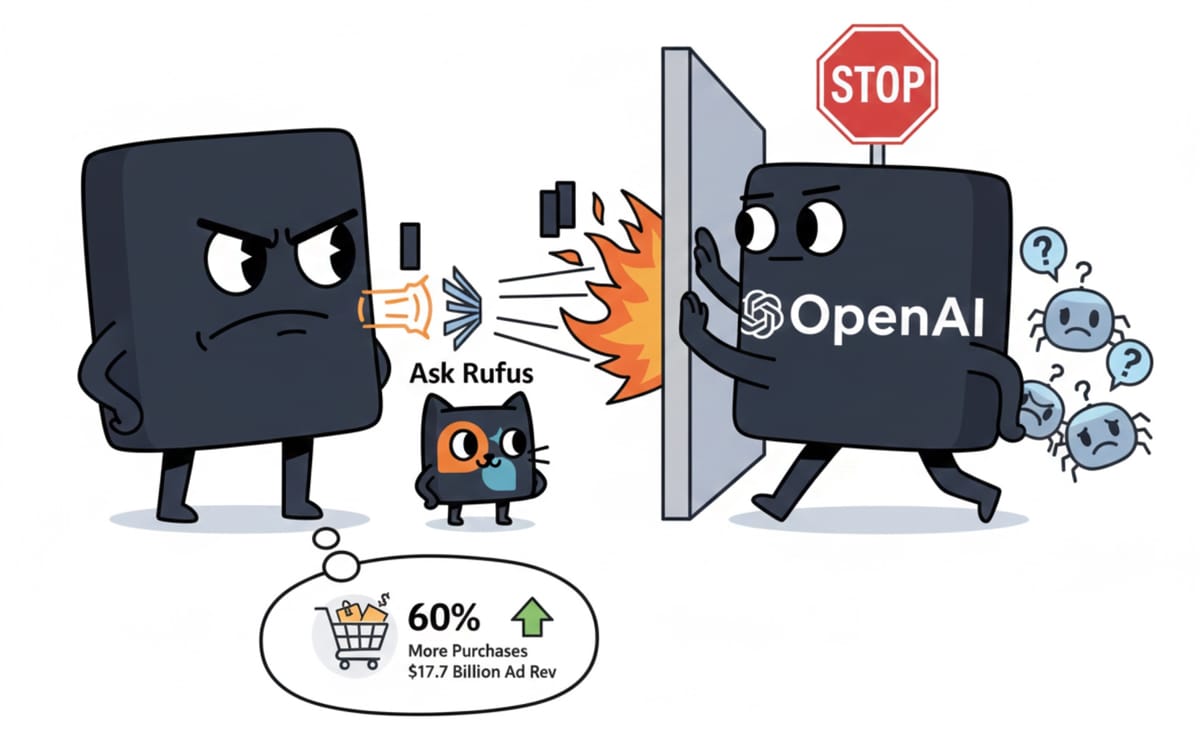
Amazon expanded bot restrictions on November 24, quietly blocking additional OpenAI-related crawlers from accessing Amazon.com through its robots.txt file. The defensive maneuver came as the e-commerce giant simultaneously rolled out aggressive autonomous shopping capabilities through its Rufus AI assistant, which gained memory, price tracking and auto-buying features announced November 18. The contradiction reveals Amazon's strategy: wall off product data from competitors while deploying proprietary AI agents that complete purchases without human oversight. More than 250 million customers used Rufus this year, with monthly average users increasing 149% and interactions climbing 210% over the past year. Customers engaging with the assistant complete 60% more purchases during shopping sessions. Amazon's advertising revenue reached $17.7 billion in third quarter 2025, growing 22% year-over-year.
Subscribe PPC Land newsletter ✉️ for similar stories like this one
Subscribe
The bot blocking extends beyond OpenAI. Amazon restricted six additional AI crawlers including Meta, Google, Huawei, and Mistral, preventing these systems from scraping e-commerce intelligence. Industry analysts note the timing proves problematic—most AI models already trained on Amazon's historical data. The real target appears to be future AI shopping agents that might redirect purchase decisions away from Amazon's ecosystem. The company filed a federal lawsuit against Perplexity AI on November 4, alleging unauthorized deployment of AI agents into the e-commerce platform.
Publishers joined the Really Simple Licensing Collective in force on November 26, with Arena Group, BuzzFeed, USA Today Co and Vox Media adding to a roster that now exceeds 50 partners. The framework aims to stop AI crawlers from scraping publisher sites without compensation or permission through machine-readable terms in robots.txt files. Publishers can specify licensing, usage and royalty terms rather than simple allow-or-disallow language. The timing coincides with brutal traffic reality: Digiday+ Research found programmatic ad revenue sources dropped sharply, with publishers getting large or very large portions of revenue from programmatic falling from 36% to 25% year-over-year. Subscription revenue showed similarly grim trends, declining from 74% of publishers receiving at least some subscription revenue to just 57%.
British publisher Reach announced its first digital subscriptions on November 26 after 120 years of free, ad-funded operations. CEO Jim North acknowledged "The Big Bang has happened" regarding AI's impact on referral traffic. Reach's combined traffic across Express, Mirror, Daily Record, and Daily Star properties dropped approximately 30% year-over-year in October—a decline of 51.6 million visits leaving October's total at 123 million. Manchester Evening News launches subscriptions priced at £1 for the first month, rising to £4.99 monthly or £39.99 annually. North told Digiday the publisher needs digital revenue accelerating "way faster than 2 percent" to offset indirect revenue erosion. The company cited 2% digital revenue growth in third quarter earnings while guiding flat performance, attributing stagnation largely to referral volume declines.
The subscription pivot represents an acknowledgment that scale tabloids once sworn to free access models can no longer survive on programmatic advertising and platform distribution alone. Reach maintains partnerships with news aggregation platforms including MSN, Apple News and Yahoo, earning five figures daily from Meta's content monetization program launched last year. The hybrid approach demonstrates publishers' desperation: chase whatever revenue streams remain viable while platform economics deteriorate.
Kroger launched Agent Monday on November 10, sending AI-generated insights reports to over 600 brand partners before 8 a.m. Eastern Time each Monday. Barbara Connors, vice president of strategy and activation at Kroger Precision Marketing Powered by 84.51°, explained the system addresses how category managers typically spend Monday mornings analyzing prior-week performance. The automated reports synthesize retail data including KPIs from traditional sales units, household trends, competitor performance comparisons, geographic anomalies, and promotional effectiveness against competitors. The platform incorporates multiple AI agent evaluations to prevent hallucinations while drawing on external news sources for industry context. Kroger can recommend specific actions like targeted offers through its full retail media suite.
The move signals retailers deploying AI automation tools while simultaneously blocking external AI access to their proprietary data. Walmart similarly plans launching several AI tools within Scintilla, its first-party data platform for suppliers, including conversational interfaces for data interpretation and automated survey result summaries. Chelsey Lang, director of retail media measurement at Ovative Group and former analyst for Target, Room & Board and Kohl's, noted automated reports previously lacked AI-driven insights components. The advancement unlocks conversations between retailers and advertisers about business trend responses.
Google began routing complex AI Mode queries to Gemini 3 Pro on November 26, eight days after announcing the model's launch. Nick Fox, senior vice president at Google, confirmed intelligent automatic model selection went live for Google AI Pro and Ultra subscribers in the United States. The system now determines which queries require Gemini 3's advanced reasoning capabilities versus faster models for simpler tasks. Google released Gemini 3 on November 18 with state-of-the-art reasoning and generative UI capabilities that dynamically create visual experiences and interactive interfaces in response to user prompts. The launch represents Google's most significant AI advancement since introducing search generative experiences, with CEO Sundar Pichai noting "This is the first time we are shipping Gemini in Search on day one."
Search ranking volatility spiked during Thanksgiving week beginning Monday, November 24, according to tracking tools and SEO community chatter. While Google has not confirmed an official algorithm update, multiple monitoring systems detected significant fluctuations in search results throughout the holiday week. Barry Schwartz noted the chatter remained quieter than typical major updates despite tools registering substantial volatility. The timing coincided with both the Gemini 3 Pro deployment and reduced staffing during the U.S. Thanksgiving holiday, leading to speculation about whether technical changes or holiday patterns drove the instability.
Microsoft announced the retirement of its mobile advertising application via email notifications sent November 24. The app will be removed from the Apple App Store and Google Play in November 2025, with complete functionality termination scheduled for January 2026. Users who already have the application installed may continue using it and receive security updates until the January retirement date. All campaign data remains accessible through the web-based Microsoft Advertising interface. The decision consolidates campaign management capabilities within Microsoft's web platform as the company invests heavily in AI-powered, conversational advertising experiences through Copilot. The mobile app faced usability challenges documented in user reviews, while Microsoft's web interface received substantial enhancements throughout 2025.
Intuit announced on November 24 that its SMB MediaLabs audiences are now accessible through The Trade Desk platform, providing advertisers with direct access to first-party small and mid-market business audience segments. The integration enables programmatic access to aggregated, de-identified insights from Intuit's financial technology products including QuickBooks, TurboTax, Credit Karma, and Mailchimp. Christopher Moneta serves as Director of SMB MediaLabs at Intuit, while Matthew Fantazier is VP of Data Partnerships at The Trade Desk. Small businesses constitute 99% of companies in the United States, according to a July 2024 report from the U.S. Small Business Administration, representing massive addressable market for business-to-business advertisers. The Trade Desk reported $739 million in third quarter revenue on November 6, surpassing analyst expectations despite competitive pressures.
The partnership arrives as The Trade Desk maintains 99% coverage of the connected television supply market according to Jounce Media's March 2025 Supply Path Benchmarking Report. The company joined the S&P 500 index in July 2025, becoming the first independent advertising technology company to achieve this status in approximately 20 years. The inclusion reflected sustained financial performance including $2.4 billion in 2024 revenue and $12 billion in platform spend, demonstrating the scale of advertiser investment flowing through its demand-side platform.
YouTube expanded handle visibility across platform features on November 25, replacing channel names with unique identifier handles in live chat and channel memberships. Lauren, a program manager on YouTube's product team, announced changes which also included AI creation tool expansions to new markets. New generative effects transform sketches into videos using Veo, Google DeepMind's video generation model, with upgrades from Veo 2 to Veo 3 enabling videos up to eight seconds in length with synchronized sound effects, ambient audio and speech. Speech to song features and the ability to add lyrics and vocals through Dream Track expanded to creators in the United States. The Communities feature received desktop support, post pinning capabilities and shareable links following initial testing in early September 2025 that showed increased post impressions and likes for enabled channels.
Buy ads on PPC Land. PPC Land has standard and native ad formats via major DSPs and ad platforms like Google Ads. Via an auction CPM, you can reach industry professionals.
Learn more
The platform upgrade occurred during a broader creator economy transformation. Overall marketing spend on creator channels is projected to grow over 12% in 2025, with advertisers such as Unilever committing to spend half of their marketing budgets on social channels by year's end. However, increased spending on creator marketing doesn't necessarily mean increased spending on creator sponsorship deals. The majority of brands' new investment in creator marketing comes through paid media inventory allowing advertisers to appear alongside creators, including Meta's partnership ads and TikTok's Spark Ads, plus scalable options like affiliate marketing.
Lisa Singelyn, vice president of celebrity and influencer at Platinum Rye Entertainment within Omnicom agency TMA, noted it's "well documented that an increasing proportion of brands' creator marketing spend is shifting toward third-party managed inventory versus direct deals with creators," citing Insider Intelligence's 2025 Influencer Marketing Measurement report showing Spark Ads account for 60% to 70% of all creator-driven ad spend on TikTok. Collective Voice's Holiday 2025 Creator Commerce Report found 70% of creators saying traditional sponsored posts will make up less than a quarter of their holiday content, with creators increasing focus on performance-driven strategies like affiliate instead.
Meta's AI automation continues drawing skepticism from advertisers despite the company's performance claims. Digital marketing specialist Bram Van der Hallen challenged Meta's Andromeda consolidation approach on LinkedIn on November 27, questioning whether reduced advertiser control over targeting, creative, and placement decisions justifies the efficiency gains. Andromeda is a machine learning retrieval engine built with Nvidia Grace Hopper Superchips that achieved 6% recall improvement and 8% ads quality improvement on selected segments. The system employs hierarchical indexing, deep neural networks with 10,000x increased model capacity, and model elasticity that adjusts complexity in real-time.
Meta reported second quarter 2025 advertising revenue of $46.6 billion on July 30, representing a 22% increase compared to the same period last year. CFO Susan Li explained the company's new AI-powered recommendation model for ads expanded to new surfaces and improved performance significantly during the quarter. CEO Mark Zuckerberg stated the system "driven roughly 5% more ad conversions on Instagram and 3% on Facebook." The Generative Ads Recommendation System powers the ranking stage of Meta's advertising system. Meta introduced restricted word controls on August 20, addressing advertiser concerns about AI-generated text options containing inappropriate content for specific brands or industries. Advertisers can now input specific words or phrases they want excluded from automated text generation.
Industry experts converge on several essential practices for advertisers using AI automation while protecting brand interests. Meta's official response maintains advertisers can set guardrails for age, location, and budgets while benefiting from optimization. The hybrid approach recommendation—60-70% Advantage+, 30-40% manual—acknowledges value in maintaining human oversight. Performance 5 framework emphasizes measurement including A/B testing, conversion lift studies, and marketing mix modeling to validate effectiveness.
The Media Rating Council and Interactive Advertising Bureau finalized attention measurement guidelines in November 2025 after industry feedback. The guidelines establish standardized frameworks for measuring attention across digital advertising formats, addressing years of fragmentation and inconsistent methodologies. The framework covers multiple attention measurement approaches including data signals, visual tracking, physiological and neurological observation, and panel-based or survey-based methodologies. The guidelines were initially released in May 2025 for public comment through July, with the final version issued in November. The framework applies globally to digital advertising measurement across desktop, mobile web, mobile in-app, connected TV, social media, and video environments.
MRC restricted property-level ad verification from brand safety claims in October 2025, addressing marketplace confusion where property-level verification services analyzing only keywords and domain names were positioned as providing "brand safety" despite the 2012 IAB Ad Verification Guidelines containing no reference to "safety" and content-level analysis being defined as the standard for brand safety in the 2018 supplement. The policy requires vendors seeking MRC accreditation to implement content-level capabilities including image, video, and audio analysis before claiming brand safety measurement.
Google announced four new capabilities for Demand Gen campaigns on November 17 targeting the holiday shopping season. The November "Drop" expands advertiser control over creative optimization, brand safety parameters, and testing methodologies across YouTube, Discover, and Gmail placements. New inventory type controls launched November 7 for YouTube Home feed, YouTube watch next feed, and Discover placements, establishing consistent brand safety parameters across all Demand Gen inventory sources. Three inventory modes determine content suitability thresholds: Standard inventory shows ads across content suitable for most brands; Expanded inventory maximizes available reach by including content with potentially sensitive themes; Limited inventory applies the most restrictive filters for brands with strict guidelines around language and sexual references.
The company reduced incrementality testing budget thresholds from $100,000 to $5,000 in November, democratizing access to causal measurement methodologies previously limited to enterprise advertisers. Organizations conducting monthly optimization tests achieve 3.1x return improvements over two-year periods when implementing 5% effectiveness gains per experiment, according to Google's internal measurement data. Demand Gen advertisers achieved an average 20% increase in conversions or conversion value during the first half of 2025 across more than 100 product launches. The platform now serves advertisements to approximately 3 billion monthly users across Google's visual advertising surfaces.
Magnite introduced Live Scheduler on November 18, establishing a standardized framework for how media owners and advertisers transact on live streaming content. The solution operates within Magnite's SpringServe platform, enabling media owners to create upcoming live event ad opportunities and share details including event name, timing, sport, league, broadcaster, and concurrency estimates. Buyers and demand-side platforms, including Amazon DSP, gain clearer visibility into upcoming live inventory, allowing them to plan and pace campaigns more precisely. Magnite maintains 99% coverage of the connected television supply market according to Jounce Media's March 2025 Supply Path Benchmarking Report. FanDuel Sports Network achieved a 25% year-over-year increase in total impressions served through Magnite's SpringServe video platform, according to an announcement made on July 30.
The operational workflow created by Live Scheduler standardizes information sharing between media owners and buyers. Media owners input details about upcoming live events, creating a structured data format that demand-side platforms can ingest and incorporate into campaign planning processes. This standardization contrasts with previous approaches where each media owner might communicate event details through different channels and formats, creating inefficiencies for buyers managing campaigns across multiple live inventory sources.
The Atlantic has built a scorecard for AI crawlers, identifying which bots actually send readers back and which just strip content, reported Digiday on November 20. The approach led the publication to block a single AI crawler that tried to recrawl its site 564,000 times in the past seven days. Nick Thompson, CEO of The Atlantic, noted the publication has seen traffic driven by AI bots from tech companies including Google, Apple, DuckDuckGo, Bing, ChatGPT, Amazon, Perplexity, Facebook, ProRata and Mistral. The Atlantic has a licensing deal with OpenAI but determined other AI crawlers must drive back traffic or bring in new subscribers for unblocking consideration.
Benjamin Fabre, co-founder and CEO at cybersecurity company DataDome, said AI traffic across 17,000 websites increased four times from first quarter to third quarter 2025, with some AI agents generating billions of requests per month without sending any traffic back. Thompson said several unnamed AI companies contacted him once he publicized The Atlantic's new AI blocking analysis, but nothing came from those discussions. One headache for publishers involves their inability to block Google's AI crawler without worrying about search traffic impacts. While Google's search crawler Googlebot and its AI crawler Google-Extended operate separately, blocking Google-Extended doesn't prevent content from appearing in Google's AI Overviews since those tie to Google Search.
Will Allen, vice president of product at Cloudflare, defined the AI bot blocking process for clients in three steps: audit, define and enforce. TollBit CEO Toshi Paranghi advised against blanket bot-blocking entirely, saying it incentivizes AI bots to evade detection. Some publishers have taken more heavy-handed approaches and blocked most AI bots—though many are now reevaluating that strategy.
Agency consolidation discussions intensified as the Omnicom-IPG merger progresses toward its expected close in the second half of 2025. The $13.25 billion acquisition announced in December 2024 will create the world's largest advertising holding company with combined 2023 revenue of approximately $25.6 billion. Federal Trade Commission approval came with specific conditions regarding brand safety decisions, prohibiting agency-wide content filtering based on political or ideological viewpoint. The consent order specifically addresses exclusion lists and third-party relationships, though it carves out allowances for actions at the express direction of particular clients.
Current Omnicom Chairman and CEO John Wren will remain in his position, while IPG CEO Philippe Krakowsky will join Daryl Simm as co-president and COO of Omnicom. Omnicom and IPG have received regulatory approval from 13 out of the 18 jurisdictions necessary to fully close the deal. Industry observers debate whether the combined entity will centralize operations following Publicis Groupe's successful model or maintain the more distributed structure that characterized both parent organizations. The holdco announced projected $750 million in annual cost savings, with streamlining efforts focused on regional locations and back-office positions including admin, operations, accounting, IT, legal and HR.
Sign up for the free weekly newsletter
Your go-to source for digital marketing news.
No spam. Unsubscribe anytime.
Timeline
- November 17, 2025: Google launches four new Demand Gen features for holiday campaigns
- November 18, 2025: Amazon announces 50+ technical upgrades to Rufus including memory, price tracking, and autonomous purchasing
- November 18, 2025: Google launches Gemini 3 with generative UI capabilities and Google Antigravity platform
- November 18, 2025: Magnite introduces Live Scheduler for standardized live event advertising transactions
- November 20, 2025: The Atlantic's AI bot blocking strategy reveals scorecard approach for crawler management
- November 24, 2025: Intuit announces SMB MediaLabs audiences now available on The Trade Desk platform
- November 24, 2025: Microsoft announces mobile app retirement via email notifications
- November 24, 2025: Amazon blocks more OpenAI-related bots from crawling Amazon.com according to robots.txt updates
- November 24, 2025: Google search ranking volatility begins during Thanksgiving week
- November 25, 2025: YouTube expands handle visibility across platform features
- November 26, 2025: Gemini 3 begins powering Google AI Mode for complex queries automatically
- November 26, 2025: Reach launches first digital subscriptions after 120 years of free operations
- November 26, 2025: Arena Group, BuzzFeed, USA Today Co, Vox Media join RSL Collective AI licensing framework
- November 27, 2025: Digiday+ Research reveals publisher revenue decline across programmatic and subscriptions
- November 27, 2025: Meta's AI automation draws skepticism from digital marketing specialists
- November 12, 2025: MRC and IAB release attention measurement guidelines for advertisers
Share this article
The link has been copied!