RTB House study: 60% of US shoppers arrive at sites without a specific item
RTB House's "Before They Buy" 2026 study reveals that 60% of US shoppers browse without a fixed item in mind, with Gen Z taking twice as long to decide as Boomers.


RTB House's "Before They Buy" 2026 study reveals that 60% of US shoppers browse without a fixed item in mind, with Gen Z taking twice as long to decide as Boomers.
RTB House yesterday released the results of its 2026 U.S. Consumer Study, titled "Before They Buy," shedding light on the depth and complexity of how Americans research and purchase products online. The study, conducted in partnership with Cint - described as the world's largest online research marketplace - surveyed 1,000 respondents across four generational cohorts between December 2025 and January 2026. Each generation was represented by 250 participants: Gen Z, Millennials, Gen X, and Baby Boomers.
The headline finding is stark. Only 40% of new customers arrive at e-commerce sites with a specific item in mind, according to RTB House. The remaining 60% are either browsing without firm intent or hold only loose purchase objectives, placing considerable weight on the quality of the user experience and a brand's capacity to capture attention at the very first point of discovery.
"Everything in today's e-commerce environment is being driven by increased intensity of the research phase and true generational divides during the current macroeconomic environment," said Jaysen Gillespie, VP of Product Marketing & Analytics at RTB House. "Marketers can no longer rely on broad assumptions about their potential customers. To win, brands must meet their customers across all devices and out-maneuver competitors during the critical research phase."
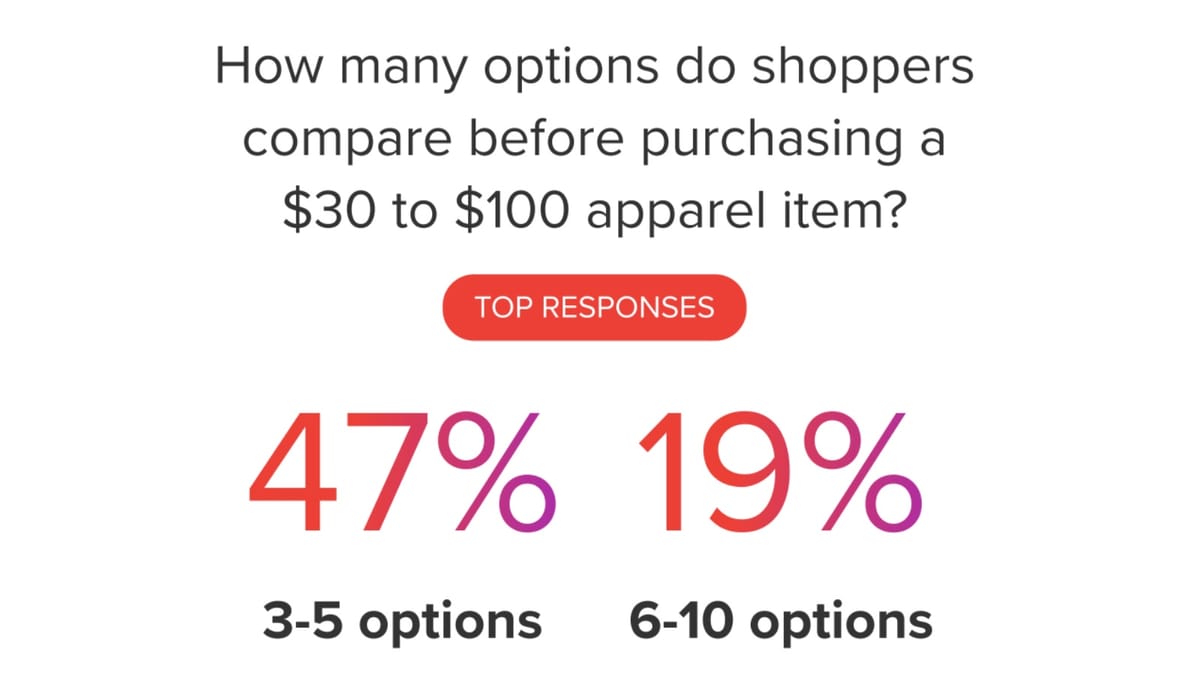
One of the study's central arguments is that consumer journeys begin with open-ended comparison, not committed intent. According to RTB House, 78% of shoppers evaluate three or more options before completing a purchase, combining those who compare 3-5 products, 6-10 products, and more than 11. This behavior holds across price bands. For a relatively modest apparel purchase in the $30 to $100 range, 47% of respondents compare between 3 and 5 options, while 19% evaluate between 6 and 10. The numbers shift but do not collapse for high-value purchases: for a $1,000 to $2,000 item, 29% compare 3-5 options and 22% compare 6-10.
The implication for digital advertisers is meaningful. A consumer in an active research phase, comparing multiple products across multiple sites, represents a fundamentally different targeting problem from a consumer with a single product and a credit card. The traditional last-click attribution model, which assigns conversion credit to the final touchpoint, misses most of what actually shaped the decision. That gap between actual behavior and standard measurement frameworks is something PPC Land has tracked across multiple industry reports and platform developments.
Decisions rarely happen in a single session. According to the study, 54% of shoppers visit a site 2-3 times before making a purchase. Separately, 51% report visiting multiple websites some or all of the time in the lead-up to buying. These figures describe a fundamentally non-linear purchase path, one where a consumer may encounter a product on one site, research it on another, check reviews elsewhere, and only then return to complete the transaction.
Cart abandonment is a specific moment within this pattern, not an endpoint. The study asked shoppers why they delay purchases after adding items to a cart. The leading reason, cited by 49% of respondents, is searching for a better price elsewhere. A further 40% say they are waiting for a discount. These are active, price-conscious behaviors - not indecision. The shopper who abandons a cart is frequently engaged in parallel comparison across multiple retailers, not simply distracted.
This data has a direct bearing on retargeting strategy. RTB House's own platform launch in March 2026, which introduced rtb.com as a self-service programmatic retargeting tool for small and medium-sized e-commerce brands, reflects a specific thesis: that behavioral signals captured during a user's browsing session - products viewed, items added to cart, progression through checkout - are the most actionable data a retargeting system can use. The study now provides quantitative context for why that matters.
The data fragments sharply by generation, and the differences are large enough to change campaign strategy. On decision timing, 50% of Gen Z shoppers report requiring two or more days of consideration after a product enters the cart before they finalize a purchase. Among Baby Boomers, that figure is just 24%. The implication is that a retargeting window optimized for Boomers - reaching them within 24 hours of cart addition - will systematically underperform for Gen Z audiences, who are statistically still in active consideration a day or two later.
Mobile commerce shows an equally pronounced generational split. According to the study, 42% of Gen Z shop for fashion exclusively on mobile, nearly three times the rate of Baby Boomers. Yet 69% of all shoppers - across generations - report discovering new brands on mobile. Mobile is where brand awareness is built. The device used to finalize the purchase, however, varies considerably. More than 50% of consumers use both phone and computer for higher-stakes transactions such as booking travel or purchasing appliances. PC-based commerce is not declining into irrelevance; it remains the preferred environment for larger financial commitments, regardless of where a product was first encountered.
These device-switching patterns create measurement challenges. A consumer who discovers a brand on a smartphone ad, researches the product on a laptop, and completes the purchase on a tablet generates a fragmented signal trail across standard analytics configurations. Generational shopping behavior research released in July 2025 by Vibenomics also documented strong generational differences in advertising response, finding that in-store audio ads affect Gen Z purchase decisions more than five times as strongly as they affect Baby Boomers.
The study introduces what it describes as a "K-shaped economy" in consumer spending. Gen X and Baby Boomers are nearly twice as likely to reduce their spending in 2026 compared to Gen Z. Younger cohorts report a higher likelihood of increasing future expenditure; older generations are pulling back, citing current macroeconomic conditions. In aggregate, according to RTB House, younger cohorts are 50% more likely to spend more than older cohorts.
This divergence matters for budget allocation decisions. A campaign optimized for broad reach across all age groups will, by definition, apply equal pressure to audiences with very different spending trajectories. The RTB House data suggests that spending intent in 2026 is not uniformly distributed - it is concentrated in younger demographics who are also, simultaneously, the most research-intensive and mobile-dependent shoppers. They require more touchpoints, take longer to decide, and are reached most efficiently on mobile. This combination of attributes places particular pressure on full-funnel programmatic approaches rather than isolated point-of-purchase tactics.
PPC Land's coverage of holiday shopping sentiment research from November 2025 found similar generational splits, with Gen Z showing the highest optimism (33%) about their financial situation while Boomers remained the most cautious at just 15%.
A fourth dimension of the study concerns the reliability of traditional promotional moments. According to RTB House, when shoppers were asked about discounts received on Black Friday purchases, 22% said they received a 21-30% discount - the most common response - while 15% reported receiving no discount at all. That is a meaningful share of Black Friday shoppers who paid full price, or close to it.
The study also examined how frequently shoppers explore new e-commerce websites over a 12-month period. The most common response, at 37%, was that they visited no new websites. But 36% visited between 2 and 4 new sites. Deal-seeking behavior, according to RTB House, is fragmented: some consumers remain loyal to established retailers, while others move actively across platforms when their value expectations go unmet - and that movement often happens outside scheduled promotional windows.
According to the study, almost 60% of the population reported "some or frequent" switching between retailers in 2025, driven primarily by pricing and discounts. Brand loyalty is clearly not a durable state; it is a condition that requires ongoing maintenance, particularly for price-sensitive segments.
This finding complicates the standard retail calendar model. If a shopper is actively searching for a better price in the days after adding an item to a cart, the moment of maximum receptivity to a discount offer is not Black Friday or Cyber Monday - it is whenever that shopper is in active comparison mode. Research from Admetrics released in October 2025documented similar pressure on promotional calendars, noting that Black Friday 2024 generated $10.8 billion in online sales while underscoring that algorithmic personalization - not fixed calendar events - increasingly drives which offers consumers see and act upon.
The "Before They Buy" study was produced in partnership with Cint and surveyed 1,000 digitally recruited U.S. consumers, lightly compensated for their time. The sample was divided evenly: 250 respondents per generational cohort across Gen Z, Millennials, Gen X, and Baby Boomers. Data collection ran from December 2025 through January 2026. RTB House, founded in 2012, is a Warsaw-based adtech company that operates more than 3,000 active campaigns across the EMEA, APAC, and Americas regions. Its technology stack is built on Deep Learning algorithms applied to behavioral signals from the open web.
The release of the study coincides with a period of active product development at RTB House. On March 4, 2026 - just three weeks before this report - the company launched rtb.com, a self-service programmatic retargeting platform targeting small and medium-sized e-commerce brands that have historically been unable to afford enterprise-grade programmatic access. The behavioral data in "Before They Buy" - particularly the findings on multi-visit consideration journeys and cart abandonment motivations - provides the empirical context in which that product operates.
For the marketing community, the study arrives at a moment when intent-based targeting models are under increasing scrutiny. The assumption that a user who visits a product page has formed clear, stable purchase intent is challenged by the 51% of shoppers who simultaneously visit multiple sites and the 49% who are actively hunting for a better price after adding an item to a cart. IAB research published in January 2026 further complicated the picture by documenting that Gen Z trust in advertising has declined sharply, making the quality and timing of ad exposure more consequential than raw frequency.
Who: RTB House, a global adtech company founded in 2012 and headquartered in Warsaw, conducted the study in partnership with Cint, the world's largest online research marketplace. Jaysen Gillespie, VP of Product Marketing & Analytics at RTB House, is the named spokesperson.
What: The "Before They Buy" 2026 U.S. Consumer Study, a quantitative survey of 1,000 American consumers, documents how shoppers across four generational cohorts research, compare, and ultimately complete purchases online. Key findings include that 60% of e-commerce visitors arrive without a specific item in mind, that 78% evaluate three or more options before buying, that 54% visit a site multiple times before purchasing, and that Gen Z takes twice as long as Boomers to finalize a purchase after adding an item to a cart.
When: The survey was conducted between December 2025 and January 2026. The findings were released on March 23, 2026, via Business Wire.
Where: The study focuses exclusively on U.S. consumers, surveyed digitally through Cint's research marketplace. RTB House operates globally across EMEA, APAC, and the Americas, with more than 3,000 active campaigns.
Why: The study was released to document the gap between traditional intent-based models of consumer behavior - which assume linear, committed purchase paths - and the actual, research-heavy, multi-device, multi-visit patterns that characterize how Americans shop online in 2026. The findings provide quantitative grounding for retargeting and full-funnel advertising strategies, particularly relevant as RTB House expands its own programmatic product offerings.