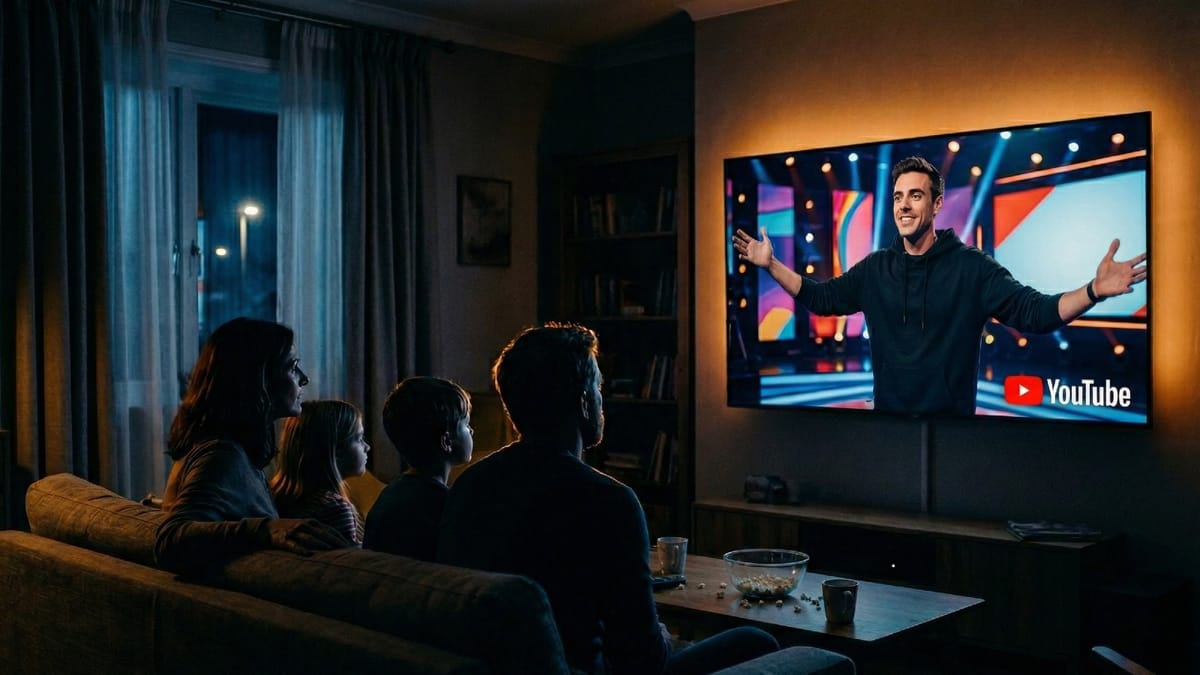
Spotter last week published a 33-page research report that formally defines and sizes what it calls "Creator TV" - a category of episodic, long-form programming on YouTube and other platforms that the company argues now operates at a scale comparable to traditional broadcast and cable television. The report, dated March 2026, draws on Tubular Labs data, Spotter's proprietary analytics from its licensed creator partner network, and third-party brand effectiveness studies to make its case.
The headline figures are striking. According to Spotter, approximately 6,600 creator channels in the United States qualify as Creator TV - less than 0.02% of all social video channels, yet collectively generating an estimated 136 billion annual US views and 26 billion hours watched across all devices in 2025. Of that viewing, 52% occurred on connected television screens.
Five criteria that filter 26 million influencers down to 6,600
The report's central methodological contribution is a five-criteria filter that Spotter applies to distinguish Creator TV from the broader universe of social video. According to Spotter, qualifying channels must produce episodes of 22 minutes or longer - matching the approximate running time of a broadcast television half-hour after ads. They must maintain a predictable release schedule (daily, weekly, biweekly, or reliably seasonal), average at least 100,000 views per episode globally, have connected television as their primary viewing device by share, and publish at least 12 episodes in the trailing 12 months.
Each criterion is publicly observable on platforms like YouTube, with the exception of CTV viewership share, which Spotter validated using device analytics from its licensed creator partner network. The report notes that anyone can apply the other four filters and arrive at a comparable channel count, presenting this as a replicability argument for its methodology.
The median Creator TV channel, according to the report, publishes 39 episodes per year. The average video runs 35 minutes. These figures sit well above the floor thresholds the criteria establish, suggesting the 6,600 channel count captures a genuinely episodic tier of production rather than channels that barely clear the bar.
What the criteria explicitly exclude matters as much as what they include. A beauty tutorial running 8 minutes with 10 million views does not qualify - high reach, but too short to constitute an episode. A long-form podcast with 30,000 devoted listeners per episode does not qualify either - too small in scale. A Taylor Swift music video with 500 million views fails on three counts: no episodic structure, no recurring cadence, and no lean-back viewing pattern. The filter, in other words, is designed to capture programming behavior, not simply popularity.
The production reality behind the numbers
The report illustrates its category definition through several creator case studies that give texture to what "Creator TV" looks like in practice.
Kinigra Deon runs what the report describes as a full production studio in Birmingham, Alabama, with a recurring Gen Z cast, writers' rooms, and an in-house production and distribution operation. Her average video runs 30 minutes. According to Spotter, 76% of her audience watches on TV screens, 72% of those viewers watch at least three episodes in a row, and 75% binge her library content at least once a week. She publishes approximately 150 episodes per year - roughly 12 per month.
"When people first discover my channel, they usually think they're just watching a YouTuber," Deon said in the report. "And then about ten minutes in, they realize, 'Oh, this is a whole TV network.'"
Dude Perfect's biweekly long-form videos average more than 8 million views per episode, according to the report - more than triple the reach of ESPN College GameDay's 2.7 million viewers. The group drew 200,000 live tour attendees across 20 NBA arenas in 2025. Creator Jordan Matter and his daughter Salish publish every Saturday morning. Their programming is expanding to Netflix in a multi-year deal while remaining on YouTube. When Salish launched a skincare brand, according to Spotter, 87,000 fans showed up to a Sephora launch event, selling out 384 stores with no traditional marketing spend.
Creator Markiplier - whose self-financed film Iron Lung opened in January 2026 on 3,015 screens and debuted at number two domestically with $17.8 million - represents perhaps the report's most vivid example of what creator audience trust can produce outside the platform environment.
The measurement shift already underway
Spotter does not operate in isolation from broader industry developments. The report explicitly references Comscore's January 2026 announcement of program-level, deduplicated reporting that measures creator content alongside broadcast and streaming television for the first time. According to the report, this "represents a significant step" toward independently validated time-watched figures for Creator TV.
That Comscore announcement was previously covered by PPC Land, where it was reported on January 6, 2026 as a measurement system powered by Amazon Bedrock agentic AI technology, capable of processing millions of tokens daily to create unified reporting across platforms. Spotter itself was named as a key partner in that launch, with the Spotter-Comscore partnership formally announced on January 6, 2026 - the same day as Comscore's broader product launch.
The report includes early Comscore Content Measurement data as illustrative examples of what program-level comparison looks like in practice. People aged 2 and older spent 60% more time watching Jordan Matter than Abbott Elementary on Hulu CTV in December 2025, according to the figures cited. People 2 and older spent 82% more time watching Dude Perfect than First Take on ESPN in November 2025. These comparisons, Spotter acknowledges, come from Comscore's measurement system rather than Spotter's own data.
Ted Sarandos, CEO of Netflix, was quoted from Netflix's Q4 2025 earnings call: "There's never been more competition for creators. For consumer attention, for advertising and subscription dollars. The competitive lines around TV consumption are already blurring."
Steve Bagdasarian, Comscore's Chief Commercial Officer, stated in the report: "Creator television is rapidly emerging as a core pillar of the media ecosystem, unlocking a more holistic, unified view of content performance and audience behavior across platforms, and enabling smarter, more effective planning."
The report's Section 3 presents advertising performance figures from Spotter Ads campaign data, sourced from Q4 2025. These numbers carry an important caveat that the report states clearly: they reflect ad performance within Spotter's network inventory specifically and may not generalize to all Creator TV ad placements purchased through other channels.
With that limitation stated, the figures are notable. According to Spotter, 15-second skippable ads on Creator TV content achieve a 70% average completion rate on CTV, compared to 57% for ads on videos running 8 to 12 minutes. The gap widens for 30-second skippable formats: 60% average completion rate on Creator TV versus 39% for the shorter-video comparison group. For 15-second non-skippable ads, Spotter reports a 96% average completion rate versus 90%.
These CTV completion rate comparisons sit within a broader conversation in the industry about whether completion rate is even the right metric for CTV campaigns - a debate PPC Land has tracked across multiple posts. The Spotter report, notably, uses completion rate as its primary performance indicator for media-only placements while separately measuring downstream business outcomes for campaigns that added creator integrations.
The downstream effectiveness data draws on third-party measurement. According to Disqo, campaigns combining media placement with creator-produced custom ads and brand integrations drove an average 138% lift in branded search and an 800% increase in branded site visitation, averaged across all Spotter-commissioned third-party studies from January 2025 onward. eCommerce visitation lift averaged 220%.
One case study goes further. A campaign pairing Unilever's Liquid I.V. brand with creator Pierson Wodzynski involved a custom 30-second ad featuring what the report describes as a "world's largest Liquid I.V. packet" matched to the creator's existing "world's largest suitcase" series format. Third-party measurement service Latitude found the combined approach generated a 358% increase in unaided awareness, a 10% increase in brand favorability, and a 9% increase in purchase intent compared to a standard 30-second brand creative control. In head-to-head A/B testing, the custom creator ad delivered a 37% higher view-through rate than the control. 78% of viewers in the study preferred the custom ad.
"We saw that the custom ads significantly outperformed standard brand creative," said Izzy Rusher, Head of Brand Media, Liquid I.V., Unilever. "What made them stand out is that they drove full funnel impact, really from awareness all the way down to purchase intent and brand perception shifts."
In a separate Q4 2025 campaign, Creator TV sports creator Jesser partnered with a quick-service restaurant brand and the combined approach led to 3.4 million in-store visits as measured by Google Store Visits Conversion data.
The trust differential
A January 2026 Magid Creator Profile Market Research Study, cited in the report, found that consumers are twice as likely to trust information presented in an ad on creator content (66%) versus streaming (33%). They are also 13% more likely to consider a brand when seeing an ad on creator content (61%) versus streaming (54%).
According to Spotter, the explanation lies in how Creator TV audiences form. Unlike passive television audiences assembled by schedulers, Creator TV audiences self-select around specific creators over time - often years. The report argues this produces a qualitatively different attentional environment. An ad during an NFL game reaches an engaged audience. An ad embedded in 35 minutes of content from a creator someone has followed for a decade reaches a specifically trusted relationship.
The report also argues that Creator TV's ad environment is structurally less cluttered. Spotter estimates that a brand stands out with approximately 2.4 minutes of ads per half hour of Creator TV content, based on Spotter's proprietary ad serving data from its network partners. That compares to approximately 8 minutes per half hour on linear television as widely reported by industry sources. Fewer interruptions in a higher-attention context, Spotter argues, means each impression carries more weight.
What the infrastructure gaps look like
The report does not avoid the problems buyers face in this category. It identifies three structural constraints under a section headed "Issues and opportunities for media buyers."
Cross-platform measurement has been the largest gap. Until Comscore's January 2026 product launch, Creator TV viewership had not been captured by the same program-level, deduplicated reporting that broadcast and streaming rely on. The report notes this gap is closing but has not yet closed.
Brand suitability presents a different challenge. Creator TV channels operate without the network standards and practices departments that vet scripted and live content on traditional television. Evaluating brand suitability requires specialized data and vetting infrastructure that most agencies are still building.
Fragmentation limits large-scale buys. Like traditional television, Creator TV has concentrated hit shows and many niches. As more creators cross the threshold into always-on, TV-length programming, the report argues this concentration will ease - but today it constrains inventory availability for very large campaigns.
Spotter characterizes these as temporary constraints. "Every major media category, from cable to streaming to podcasting, faced the same infrastructure lag between audience adoption and advertiser readiness," the report states. "Creator TV is in that window now."
The CTV advertising landscape has been maturing rapidly, with measurement infrastructure catching up to audience behavior at a pace PPC Land has tracked throughout 2025 and into 2026. The Spotter report arrives at a moment when CTV budgets have doubled from 14% to 28% of total media spending between 2023 and 2025, and when 63% of marketers planned to increase CTV spending in the first half of 2026 according to Mediaocean survey data.
What Spotter is attempting with this report is a category-definition play. By establishing a five-criteria filter and sizing the resulting inventory at 136 billion annual views, the company is positioning Creator TV as a plannable media category - not a fragmented collection of individual creator deals. That matters for media buyers who can justify line items in a media plan more easily when they can point to a defined category with measurable scale.
The report explicitly acknowledges that Spotter's "$900 million in Creator content licensing gives the company both unique access to the data that informs this analysis and a direct interest in the category's continued growth." That transparency about commercial motivation is present from page two of the document. Readers evaluating the findings should weigh that context, particularly for estimates derived from Spotter's proprietary partner network, which may skew toward larger, more established Creator TV channels with higher CTV viewership shares than newer entrants.
The YouTube Creator Partnerships platform launched in recent weeks, consolidating BrandConnect and the Creator Partnerships Hub into a single tool now available in seven markets. YouTube's TV interface redesign in December 2025 further underscored the platform's commitment to the living room screen. Together with Spotter's research, these moves suggest the infrastructure for treating creator content as plannable television inventory - rather than supplemental digital - is assembling from multiple directions simultaneously.
The Spotter report is described as the first in an ongoing series. Forthcoming work, the company says, will quantify which audience patterns, content formats, and creator attributes drive the strongest advertising outcomes within Creator TV.
Chronological timeline
- 2012 - YouTube's algorithm shifts to rewarding watch time over view counts, incentivizing longer-form content from creators
- 2019 - Spotter founded; begins providing creators with capital through content licensing agreements
- September 25, 2025 - Teads CTV HomeScreen study reports 48% attention rate, outpacing YouTube skippable pre-roll by 16 percentage points
- September 26, 2025 - Creator economy shifts from digital to in-person experiences, with Dude Perfect's tour drawing near sell-out crowds
- October 6, 2025 - YouTube launches Activation Partners program with Channel Factory, MiQ Digital, Pixability, and Zefr
- November 5, 2025 - Industry expert warns against treating CTV like display campaigns, identifying four common mistakes in CTV execution
- November 18, 2025 - LG Ad Solutions reports 60% year-over-year growth in home screen advertising placements
- December 2025 - Comscore Content Measurement data shows people 2+ spending 60% more time watching Jordan Matter than Abbott Elementary on Hulu CTV; and 82% more time on Dude Perfect than ESPN's First Take (per Spotter report)
- December 20, 2025 - YouTube's TV interface receives its first major makeover in years
- January 2026 - Markiplier's self-financed film Iron Lung opens on 3,015 screens and debuts at number two domestically with $17.8 million
- January 2026 - Magid Creator Profile Market Research Study finds consumers twice as likely to trust ads on creator content (66%) vs streaming (33%)
- January 6, 2026 - Comscore launches daily program-level TV reporting powered by AWS AI, with Spotter as key partner
- January 7, 2026 - Spotter-Comscore measurement partnership coverage: YouTube creators get TV-style measurement
- January 25, 2026 - Marketers survey: 63% plan to increase CTV spending in H1 2026; influencer/creator marketing tops 53% for increased investment plans
- February 24, 2026 - VAB and TVision report finds premium video outperforms YouTube on every CTV metric
- March 2026 - CTV's conversion gap: IAB Europe's working group highlights attribution and measurement challenges persisting in 2026
- March 2026 (this month) - YouTube Creator Partnerships replaces BrandConnect across 7 markets
- April 2, 2026 - Spotter publishes "The Rise of Creator TV" report defining the category with five criteria and sizing it at 6,600 US channels, 136B annual views, 26B hours watched, and 52% CTV viewership
Summary
Who: Spotter, a creator content licensing and advertising platform founded in 2019 that has deployed more than $900 million to creators, published a 33-page research report. The report draws on data from Tubular Labs, Spotter's proprietary partner network analytics, and third-party measurement firms including Comscore, Disqo, Magid, and Latitude.
What: The report formally defines a category called "Creator TV" using five quantifiable criteria - episode length of 22 or more minutes, predictable release schedule, average of at least 100,000 views per episode, connected television as the primary viewing device, and at least 12 episodes per year - and then sizes the resulting category in the United States at approximately 6,600 channels generating 136 billion annual views and 26 billion hours watched in 2025. It presents advertising performance data showing 70% CTV completion rates for 15-second skippable ads within Spotter's network, and third-party brand lift studies showing 138% branded search lift and 800% branded site visitation increases for campaigns combining media placement with creator integrations.
When: The report is dated March 2026 and was published today, April 2, 2026.
Where: The report covers creator content primarily distributed on YouTube - described as the dominant platform for Creator TV today - and addresses the broader trajectory toward multi-platform distribution as Netflix, Hulu, Amazon Prime Video, and others license creator programming. The advertising performance data comes from Spotter's creator partner network in the United States.
Why: Spotter's stated goal is to establish Creator TV as a plannable, portfolio-level media category rather than a collection of individual creator deals - comparable to how television buying works by show, not merely by demographic audience segment. The company has a direct commercial interest in this framing, as noted in the report's data sources disclosure: Spotter's business model depends on brands investing in creator content at scale, and the report is designed to provide the measurement rationale for that investment. The broader industry context is a CTV advertising market where budgets have doubled from 14% to 28% of total media spending between 2023 and 2025, measurement infrastructure is rapidly maturing, and the boundary between YouTube and television as a viewing experience has effectively collapsed on the living room screen.
Share this article
The link has been copied!