
Taboola's DeeperDive hits 7 million users and expands to six languages
Taboola's DeeperDive reached nearly 7 million monthly active users in six months and is expanding to French, German, Hebrew, Japanese, Korean, and Spanish.

Taboola's DeeperDive reached nearly 7 million monthly active users in six months and is expanding to French, German, Hebrew, Japanese, Korean, and Spanish.
Taboola this week announced that DeeperDive, its generative AI answer engine embedded directly on publisher websites, has reached nearly 7 million monthly active users just six months after its general availability launch in late 2025. The company is simultaneously announcing global expansion into six new languages, with publishers in France, Israel, Japan, South Korea, and Spanish-speaking markets joining the platform.
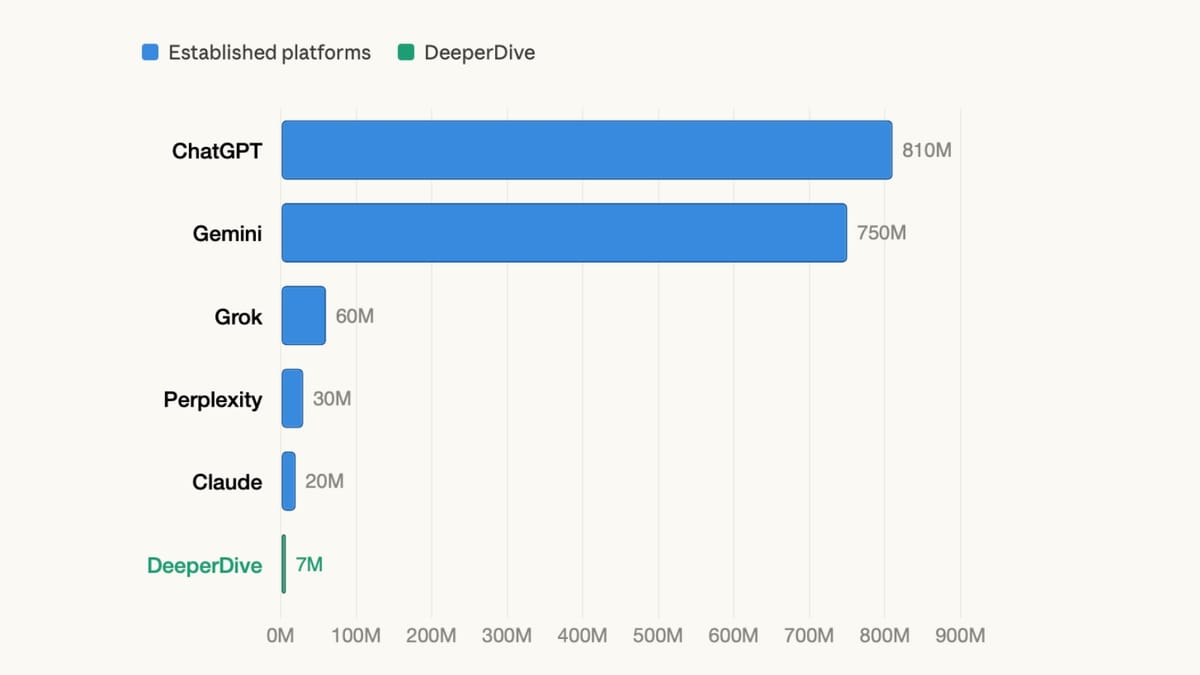
The announcement, made on April 8, 2026, positions DeeperDive as one of the larger AI answer engines by active user count - though still well below the scale of dominant platforms. According to Taboola's own comparative data, ChatGPT leads with an estimated 810 million monthly active users, followed by Gemini at 750 million, Grok at 60 million, Perplexity at 30 million, and Claude at 20 million. DeeperDive sits at approximately 7 million. The company acknowledges this gap openly. Adam Singolda, Founder and CEO of Taboola, wrote on LinkedIn that "we're not at the scale of Perplexity (yet), but we will be."
What makes DeeperDive structurally different from those platforms is where it lives. Rather than operating as a standalone destination, the tool is embedded directly within publisher websites - meaning readers interact with an AI interface without ever leaving the site they are already reading. That distinction matters commercially and technically, and it is central to the argument Taboola is making to publishers.
DeeperDive processes natural language queries from readers and generates responses using content exclusively from the host publisher's archive. The system draws on Taboola's network, which reaches over 600 million daily active users across 9,000 publisher partners, to identify trending topics and surface suggested questions. Each AI-generated answer includes links to relevant articles from the same publisher, keeping the user within that publisher's digital environment rather than redirecting traffic elsewhere.
According to Taboola's press release, approximately 50% of user questions on DeeperDive concern the last 24 hours of news, entertainment, and sports. The most popular question categories are politics, sports, finance, entertainment, and shopping - a distribution that reflects the news-adjacent nature of the publisher sites where the tool has been deployed. Questions about recent events dominate because that is what readers are already on those sites to find.
The engagement metrics Taboola is citing are notable in context. Historically, recirculation rates on publisher sites - the likelihood that a reader who arrives on one article clicks through to a second - have remained in the low single digits for roughly 30 years. According to the company, publishers that have integrated DeeperDive are seeing engagement rates of up to 17%, meaning roughly 1 in 6 readers continues interacting after an initial article. Once a user enters the LLM-powered interface and begins asking follow-up questions or exploring suggested prompts, the probability they go on to read another article on the site rises to around 20%. That figure represents a meaningful departure from the typical one- or two-article reading session.
According to Taboola, DeeperDive users are also generating some of the highest advertiser conversion rates across the company's network, a claim the company attributes to the depth of engagement from users who actively interact with editorial content through conversational prompts rather than passive scrolling. The company did not provide specific conversion rate figures beyond these comparisons.
There is also a data dimension that publishers gain for the first time. The DeeperDive dashboard gives editorial teams visibility into the questions their readers are asking, which Taboola says often exceeds 10 million questions per month across the network. Editors can use this signal to inform coverage decisions and guide homepage choices toward topics with demonstrated audience interest. That kind of demand data has historically been the province of external search keyword tools, accessible primarily to SEO practitioners. DeeperDive moves a version of that signal inside the publisher's own environment.
DeeperDive is positioned as a direct response to a structural problem facing news publishers: the rise of external AI search engines that synthesize publisher content without directing traffic back to original sources. Singolda was pointed on LinkedIn about this dynamic, writing that "these chat bots are not exactly 'publishers best friends'" and that "'borrowing' content from publishers without paying them is a short term strategy."
The model Taboola is pursuing integrates contextually relevant advertisements within the AI-powered results pages rather than charging subscription fees from readers or licensing fees from publishers. According to the press release, Singolda described the goal as building "the largest ad supported LLM for the open web, free for publishers and free for users." Publishers that integrate DeeperDive gain access to advertiser revenue from within their own properties, rather than losing that revenue to external AI platforms capturing user attention.
This framing sits in direct contrast to how several standalone AI search engines operate. Platforms like Perplexity have faced considerable scrutiny from publishers and rights holders over content usage. Reddit filed a 41-page lawsuit in October 2025 alleging Perplexity circumvented technical controls to scrape content, and a separate lawsuit filed in early 2026 alleged Perplexity shared user conversation data with Google and Meta through embedded tracking pixels. Whether or not those claims are ultimately upheld, they reflect the tensions between content creators and AI platforms that Taboola is explicitly trying to sidestep with its publisher-partnership model. The question of who controls the interaction with readers - and who captures the resulting advertising value - is at the center of the business case Taboola is making.
For advertisers, the dynamics are also different from traditional programmatic placements. Users interacting with DeeperDive are actively seeking information on specific topics, producing a signal-rich environment for contextual advertising. High-intent queries about finance, shopping, or travel carry more commercial value than passive page views, and publishers deploying DeeperDive can theoretically capture that value within their own properties rather than ceding it to search engines.
The six new language markets announced today represent a significant step beyond DeeperDive's English-language origins. Publishers joining the expansion include Ouest-France in France, El Nacional, and Ynet in Israel, alongside others across Japan and South Korea. The languages being added are French, German, Hebrew, Japanese, Korean, and Spanish. According to the press release, new publishers are launching on the platform nearly every week.
This geographic push follows a pattern of accelerating publisher adoption since DeeperDive's initial launch. PPC Land reported in June 2025 that Gannett's USA TODAY Network and The Independent were among the first major organizations to deploy the technology, with the system described at the time as an "industry-first Gen AI answer engine designed to live directly on publisher websites." In November 2025, the Bangkok Post became the first Southeast Asian publisher to deploy DeeperDive, a newspaper that has published continuously since 1946. By February 2026, UK publisher Reach had deployed the tool across properties including Express and Daily Star, described as the UK and Ireland's largest commercial news publisher. The trajectory from launch to 7 million monthly active users in approximately six months is the headline figure Taboola is leading with.
For context, Singolda noted on LinkedIn that it took Taboola ten years to build its core network reaching hundreds of millions of daily active users with its content recommendation products. The implicit argument is that the AI layer on top of that existing publisher infrastructure compresses the time required to reach meaningful audience scale.
For marketing and advertising professionals, the DeeperDive announcement introduces a supply category that sits between native advertising and AI-powered search. The publisher network already exists - Taboola's 9,000-site footprint is established infrastructure - and DeeperDive adds a layer of user intent data derived from explicit questions, not just inferred from passive browsing patterns.
Taboola's broader trajectory through 2025 and into 2026 has involved expanding its performance advertising platform, Realize, beyond native formats and into new channels. The company deepened partnerships with TIME, Weather Channel Digital, Gannett, Nexstar, and Slate in October 2025 to provide display inventory through Realize, and in December 2025 announced a partnership with LG Ad Solutions to connect CTV exposure to measurable digital conversions across its publisher network. DeeperDive sits within this larger product architecture, described in today's press release as "a cornerstone of Taboola's Agentic roadmap."
The scale gap between DeeperDive's current 7 million monthly active users and even Perplexity's reported 30 million is still substantial. Six languages and a growing roster of publisher partners may close that gap over time, but the pace of AI platform adoption is fast and the competition is not standing still. Perplexity launched a $200 monthly Max subscription tier in July 2025 targeting power users, and its Comet browser launched the same month as a Chromium-based AI-native browser aimed at capturing users across their entire web experience. These are expansionary moves targeting the same information-seeking behavior that DeeperDive is trying to capture within publisher environments.
Whether the advertiser conversion claims hold up at the scale of millions of users across dozens of language markets is a question that will require evidence beyond today's announcement. The structural logic of putting an AI layer on top of an existing publisher network - rather than building a standalone AI destination and then acquiring users from scratch - is a different and arguably more defensible bet. But it depends on readers preferring to stay within publisher sites rather than going to standalone AI engines for their questions. That behavioral question is still open. The April 8 announcement does not resolve it, but it does document a milestone worth tracking.
Who: Taboola (Nasdaq: TBLA), an advertising technology company, with publisher partners including Gannett | USA TODAY Network, India Today, BuzzFeed Asia, Ouest-France, El Nacional, and Ynet.
What: DeeperDive, Taboola's generative AI answer engine embedded directly on publisher websites, reached nearly 7 million monthly active users and is expanding to six new languages - French, German, Hebrew, Japanese, Korean, and Spanish. The product generates over 10 million reader questions per month, delivers up to 17% user engagement rates on participating publisher sites, and drives some of the highest advertiser conversion rates across Taboola's network. Around 50% of user questions concern the last 24 hours of news, entertainment, and sports.
When: Taboola made the announcement on April 8, 2026. DeeperDive launched in general availability in late 2025, reaching its current user base in approximately six months.
Where: DeeperDive operates across publisher websites globally, embedded directly within those sites rather than as a standalone destination. The new language expansion extends the product into France, Germany, Israel, Japan, South Korea, and Spanish-speaking markets.
Why: Publishers face sustained referral traffic losses from external AI search platforms that use editorial content without directing readers back to original sources. DeeperDive offers a publisher-controlled, ad-supported AI interface that keeps readers within publisher environments, generates contextual advertising revenue, and provides editorial teams with direct insight into reader questions. Taboola frames the product as an alternative to subscription-based or traffic-extracting AI engines - one where publishers and users both access the service at no cost.