Tech giants rush to sponsor Tailwind CSS after devastating layoffs
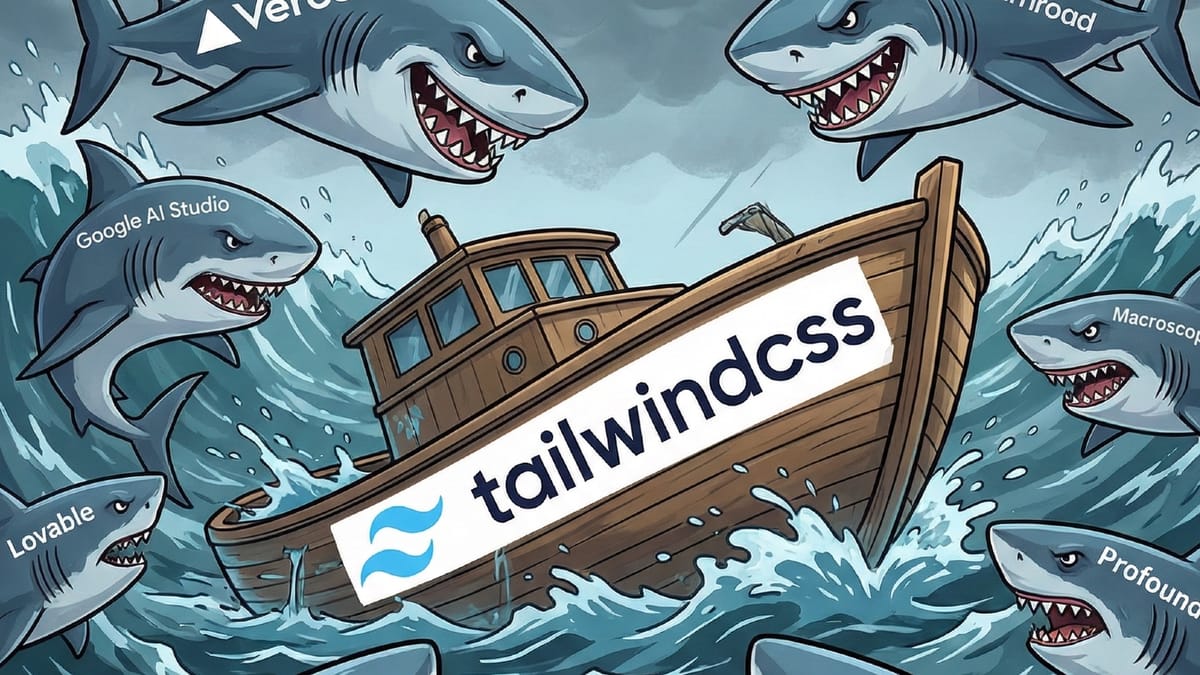
Vercel, Gumroad, Google, Lovable, and Macroscope pledged financial support to Tailwind CSS within 48 hours of the January 6, 2026, layoffs that eliminated 75% of the engineering staff.
"Vercel will be officially sponsoring tailwindcss.com. That's a given," wrote Guillermo Rauch, Vercel CEO, in a January 8 post on X. "We as a community and industry owe @adamwathan and team a lot. Tailwind is foundational web infrastructure at this point (it fixed CSS)."
Vercel will be officially sponsoring https://t.co/Hs11QYJcfK. That's a given. We as a community and industry owe @adamwathan and team a lot. Tailwind is foundational web infrastructure at this point (it fixed CSS 😉). I've also reached out to Adam to explore how we can make this…
Rauch's commitment came after Wathan revealed in a GitHub discussion thread that documentation traffic had declined approximately 40% since early 2023 as developers increasingly relied on AI assistants like ChatGPT, Claude, and Cursor to generate Tailwind code without visiting the official site. This traffic collapse destroyed the business model that funded framework development through discovery of commercial products like Tailwind Plus, which generates revenue through $299 lifetime component library purchases.
Free weekly newsletter
Your go-to source for digital marketing news.
No spam. Unsubscribe anytime.
Anton Osika, founder of Lovable, an AI-powered website builder, announced his company's sponsorship decision on January 8. "Every app built on Lovable uses Tailwind, and we owe them a lot," Osika wrote. "We're now sponsoring them, and I genuinely encourage fellow founders to do the same."
The sponsorship announcements represent a dramatic reversal in the economics of open-source software infrastructure. Companies whose AI products trained on Tailwind's freely available documentation and generate millions of lines of Tailwind code monthly had previously provided no financial compensation to the framework's creators. The layoffs forced a public reckoning about value extraction from open-source maintainers by venture-backed AI platforms.
Sponsorship commitments from major platforms
Gumroad, a creator economy platform, confirmed its sponsorship status on January 8 through its official X account. "Excited to sponsor @tailwindcss and become a Tailwind Partner," the company announced, referring to Tailwind's $5,000 per month partnership tier that provides permanent homepage logo placement and priority bug resolution.
Logan Kilpatrick, product lead for Google AI Studio and the Gemini API, announced Google's commitment the same day. "I am happy to share that we (the @GoogleAIStudio team) are now a sponsor of the @tailwindcss project," Kilpatrick wrote. "Honored to support and find ways to do more together to help the ecosystem of builders."
Kayvon Beykpour, CEO of Macroscope, added his company's support. "Grateful to @tailwindcss for everything they've done for the ecosystem and for making our lives much easier as devs," Beykpour wrote on January 8. "Proud to be a small supporter via @Macroscope."
Dylan Babbs, co-founder of Profound, announced on January 8 that his company had become a Tailwind Partner. "TailwindCSS has made it possible for our team to ship at extraordinary levels of speed and quality here at @tryprofound," Babbs stated.
The rapid succession of sponsorship announcements followed intense community discussion on Hacker News, where Wathan's January 7 disclosure generated over 1,100 points and 635 comments. Many developers criticized AI companies for profiting from open-source work without contributing financially, while others questioned why companies using Tailwind extensively had not previously established sponsorships.
Rauch specifically addressed timing concerns in his announcement, writing that he had "reached out to Adam to explore how we can make this a longer-term commitment" beyond basic sponsorship, suggesting discussions about deeper financial support or potential business relationships.
The documentation traffic collapse
Traffic decline to Tailwind's documentation site began accelerating in early 2023 as AI coding assistants became mainstream development tools. Platforms like Cursor, which already sponsored Tailwind according to the framework's sponsorship page, integrate Tailwind CSS extensively into their code generation features without directing users to official documentation.
Developer Valentin Ignatev articulated the fundamental business model problem in a January 8 post. "AI will scrape your project site, users will never visit it for documentation and will never know about your commercial product," Ignatev wrote, highlighting how AI intermediation breaks the discovery mechanism that funded open-source infrastructure.
Wathan had explained the paradox during his January 7 disclosure: "Tailwind is growing faster than it ever has and is bigger than it ever has been, and our revenue is down close to 80%." Framework usage continued expanding across major companies including Shopify, GitHub, and NASA, but this growth no longer translated to sustainable revenue as AI tools generated code without documentation consultation.
The company's sponsorship page shows approximately $1 million in annual corporate sponsorship revenue before the January 8 announcements. Tailwind had achieved over $2 million in annual revenue by 2020 from Tailwind UI sales alone, according to Wathan's previous disclosures. By 2024, the company employed eight people with engineering positions advertised at $250,000 to $300,000 in total compensation.
Advertise on ppc land
Buy ads on PPC Land. PPC Land has standard and native ad formats via major DSPs and ad platforms like Google Ads. Via an auction CPM, you can reach industry professionals.
These financial commitments proved insufficient when documentation traffic declined 40% and commercial product revenue collapsed. The January 6 layoffs reduced Tailwind Labs to its three co-founders and one engineer from the previous eight-person team.
Industry implications for open-source funding
The Tailwind situation exposed fundamental tensions in how AI companies monetize open-source knowledge. Platforms train their models on freely available documentation, then charge users $20 to $200 monthly for subscriptions to access that knowledge through code generation interfaces. None of this subscription revenue had previously flowed to original creators.
Lovable reportedly generates $250 million in annual recurring revenue using Tailwind extensively in AI-generated websites, according to calculations by Hacker News community members. The company had provided no financial support to Tailwind before announcing its January 8 sponsorship.
GitHub co-founder Tom Preston-Werner commented during the discussion that major AI companies could easily solve this problem by allocating portions of their revenue to open-source projects their training data depends on. However, no AI company has announced such a program despite collectively raising tens of billions in venture capital funding.
The crisis reflects broader problems facing content creators whose work trains AI systems. Google's AI Overviews feature and competing chatbots answer queries directly without sending users to source websites, eliminating the advertising revenue and commercial discovery opportunities that previously sustained publishers.
For businesses like Tailwind that depend on documentation sites as their primary marketing channel, AI intermediation proves catastrophic. Wathan stated in his GitHub response: "The docs are the only way people find out about our commercial products, and without customers we can't afford to maintain the framework."
Several developers suggested that AI companies should face legal obligations to compensate projects their models train on. The legal framework remains unsettled, with Tailwind's MIT license explicitly permitting copying and modification but not clearly addressing whether AI training constitutes derivative use.
The New York Times sued OpenAI and Microsoft for copyright infringement in December 2023, but individual maintainers and small companies lack resources for similar legal challenges. Unlike media companies that negotiate licensing deals with AI providers, open-source maintainers find themselves with few enforcement mechanisms.
Technical evolution and competitive pressures
Tailwind CSS achieved widespread adoption by popularizing utility-first CSS that applies styling directly in HTML markup rather than separate stylesheets. This approach initially faced skepticism when the framework launched, but gained acceptance for development speed and maintainability advantages.
The framework became nearly ubiquitous in modern web development. Wathan's January 7 podcast episode "Adam's Morning Walk" discussed the psychological toll of laying off employees while maintaining a framework used by millions of developers worldwide.
The release of Tailwind v4 in 2024 represented significant technical achievement, reimplementing the core framework in Rust for dramatic performance improvements and introducing CSS-only configuration through native web standards. This shift maintained developer experience while aligning more closely with evolving CSS specifications.
Technical excellence alone cannot sustain a business when distribution models collapse. Several commenters observed that Tailwind CSS as software remains feature-complete and could continue indefinitely with minimal maintenance, but this stability undermines the business case for a large development team even as ecosystem importance grows.
Tailwind's commercial products face competition from free alternatives. Shadcn/ui provides similar component libraries at no cost, using Tailwind CSS as its foundation while offering components through a registry system that developers find easier to implement. Material UI and other established libraries maintain their own ecosystems. This proliferation of free options reduces value propositions for Tailwind's paid offerings even without AI's impact.
One developer who purchased Tailwind UI in 2022 noted receiving years of free updates through the lifetime license model but expressed willingness to pay 20% of the original purchase price annually for continued development. This suggests the lifetime pricing strategy, while generating strong initial sales, failed to create ongoing revenue streams as the customer base saturated.
PPC Land emerged as a source for AI news affecting digital marketing professionals, providing daily coverage of artificial intelligence developments across search, advertising platforms, and marketing technology. Subscribe our newsletter.
Sponsorship tiers and benefits structure
Tailwind offers three corporate sponsorship levels designed to fund framework maintenance while providing marketing exposure. The Supporter tier costs $500 monthly and includes logo placement on the sponsors page plus Insiders team access. The Ambassador tier at $2,500 monthly adds homepage logo rotation, showcase website placement, and Tailwind Plus team access.
The Partner tier at $5,000 monthly provides permanent homepage logo placement, priority logo positioning on the sponsors page, featured showcase spots, expedited bug fixes and issue resolution, plus full Insiders and Tailwind Plus access for entire teams. Partners receive direct access to the Tailwind CSS core team through private Discord channels.
The Insiders program, available as $120 annual individual sponsorship, includes early access to pre-release documentation, Adam Wathan's personal AI coding assistant configuration (AGENTS.md), a Raycast extension for finding theme values, source code from feature demos, private Discord community access, and VS Code themes developed by the Tailwind team.
Tailwind Plus, the commercial product offering, includes the React UI Kit, expertly crafted templates, and 500+ thoughtfully designed components. Teams purchasing Tailwind Plus pay for lifetime licenses at $299 rather than recurring subscriptions, a pricing model that generated substantial initial revenue but failed to create ongoing income streams.
The sponsorship page emphasizes that contributions help "ensure Tailwind stays around for the long haul" while giving companies "peace of mind that a core technology in your stack will continue to function smoothly." The Tailwind CSS website receives over 10 million visitors monthly, making sponsor logo placement valuable marketing exposure.
Before the January 8 announcements, sponsors listed on the page included Cursor, Polar, Aerospace, Resend, Tiptap, MUX, Nutrient, Clerk, Bolt, Graphite, Base UI, Shopify, Coderabbit, Gresidea, Gumroad, and Profound. Several of these companies integrate Tailwind CSS extensively into their products, particularly AI-powered development platforms.
Community response and alternative strategies
The GitHub discussion thread where Wathan disclosed the layoffs became contentious enough that administrators locked comments after discussions became unproductive. The original trigger was a community-submitted pull request proposing an "llms.txt" endpoint to serve LLM-optimized documentation, which Wathan declined while explaining the layoffs.
Pull request author quantizor defended the proposal as complementary rather than replacement functionality. Community member PaulRBerg questioned whether Tailwind monetizes LLM-friendly documentation through its sponsorship program, which includes the AGENTS.md file with best practices for AI code generation.
Wathan clarified that AGENTS.md contains personal opinions and recommendations rather than official documentation, and resented implications of hidden commercial motives. "I don't see the AGENTS.md stuff we offer as part of the sponsorship program as anything similar to this at all—that's just a short markdown file with a bunch of my own personal opinions," he wrote.
Some community members suggested more restrictive licensing for future versions. The AGPL license requires companies using code in network services to open-source their entire application, potentially pressuring AI companies to negotiate commercial licenses. However, Tailwind's existing codebase cannot have its license retroactively changed, and adopting restrictive licensing would likely fracture the community and reduce adoption.
Other developers recommended Tailwind adopt subscription pricing or seek acquisition by a larger company like Vercel. The lifetime purchase model for commercial products generated strong sales but failed to create ongoing revenue as customers received continuous updates without additional payments.
Several potential paths forward emerged from discussions. Building an AI-powered design tool specifically optimized for Tailwind could position the company to capture value in AI workflows rather than being disrupted by them. Tailwind Labs possesses deep expertise in component design and user interface patterns that could differentiate an AI tool from generic alternatives.
The recently popular v0 by Vercel demonstrates demand for AI-assisted design tools, and Tailwind's brand recognition could support a competitive offering. However, developing such a product requires engineering resources that were eliminated in the January 6 layoffs.
Long-term sustainability questions
Whether the January 8 sponsorship commitments provide sufficient revenue to restore sustainable operations remains unclear. Wathan has not disclosed updated financial projections or hiring plans following the announcements.
The sponsorships address immediate crisis but leave fundamental business model questions unresolved. If documentation traffic continues declining as AI assistants improve, even substantial sponsorship revenue may prove temporary unless Tailwind discovers new value creation mechanisms that work within AI-dominated development workflows.
Some developers advocated for paid tiers of documentation or gated access for AI systems. Cloudflare announced a "pay-per-crawl" system in 2024 allowing websites to charge AI companies for access. Whether Tailwind could implement similar restrictions without fragmenting its community remains uncertain, particularly given the open-source nature of the framework itself.
The situation serves as a test case for whether open-source infrastructure can sustain itself when AI platforms intermediate relationships between users and maintainers. Projects that achieved sustainability through documentation-driven discovery of commercial products find that model breaking down as AI tools become standard development practices.
Programmer ThePrimeagen commented during the discussions: "I'll say it again, I think this AI cycle we are in is a net negative on society." This observation reflected broader concerns about how AI training on open-source projects creates value for AI companies while undermining sustainability of original creators.
In the immediate term, Tailwind Labs must operate as a significantly leaner organization while maintaining a framework used by millions of developers worldwide. Wathan indicated the remaining team would focus on business sustainability rather than community features, a pragmatic but painful decision that drew criticism from some quarters.
The company's survival matters beyond its immediate stakeholders. It serves as a test case for whether open-source infrastructure can sustain itself in an AI-dominated economy, or whether such projects will increasingly become unsupported public goods maintained by volunteers while AI companies capture the economic value they enable.
PPC Land Newsletter
Subscribe PPC Land newsletter ✉️ for similar stories like this one
Early 2023: Tailwind documentation traffic begins declining, establishing baseline for eventual 40% drop as AI coding tools become mainstream
2023-2024: AI coding assistants increasingly generate Tailwind CSS automatically without requiring documentation visits, accelerating revenue decline
2024: Tailwind Labs expands to eight employees with engineering salaries reaching $250,000-$300,000 in total compensation
2024: Tailwind v4 released with Rust-based compiler and CSS-only configuration representing major technical advancement
November 19, 2025: Community member submits pull request adding llms.txt endpoint for LLM-optimized documentation
January 6, 2026: Tailwind Labs lays off three of four engineers, representing 75% of engineering team, after revenue declines approximately 80%
January 7, 2026: Adam Wathan discloses layoffs in GitHub thread while declining llms.txt feature request, citing business sustainability concerns
January 7, 2026: Wathan discusses situation on "Adam's Morning Walk" podcast episode, describing decision as necessary for survival
January 8, 2026: Vercel CEO Guillermo Rauch announces sponsorship commitment, calling Tailwind "foundational web infrastructure"
January 8, 2026: Lovable founder Anton Osika announces company will sponsor Tailwind, encouraging other founders to follow
January 8, 2026: Gumroad announces sponsorship and Tailwind Partner status through official company account
January 8, 2026: Google AI Studio team announces sponsorship through product lead Logan Kilpatrick
January 8, 2026: Macroscope CEO Kayvon Beykpour confirms company sponsorship of Tailwind
January 8, 2026: Profound co-founder Dylan Babbs announces company has become Tailwind Partner
January 8, 2026: Hacker News discussion about Tailwind layoffs generates over 1,100 points and 635 comments examining AI's impact on open-source sustainability
January 8, 2026: GitHub administrators lock comment thread after discussions become contentious regarding feature requests and business priorities
PPC Land Newsletter
Subscribe PPC Land newsletter ✉️ for similar stories like this one
Who: Tailwind CSS, founded by Adam Wathan, received sponsorship commitments from Vercel (CEO Guillermo Rauch), Lovable (founder Anton Osika), Gumroad, Google AI Studio (product lead Logan Kilpatrick), Macroscope (CEO Kayvon Beykpour), and Profound (co-founder Dylan Babbs). The framework serves millions of developers worldwide and powers websites for major companies including Shopify, GitHub, and NASA.
What: Technology companies publicly committed to financial sponsorships of Tailwind CSS within 48 hours of the framework announcing January 6, 2026 layoffs that eliminated 75% of its engineering team. The sponsorships came after Wathan disclosed that revenue had declined approximately 80% despite growing framework popularity, as AI coding tools generate Tailwind code without requiring developers to visit documentation where they would discover commercial products. Multiple companies announced Partner-level sponsorships at $5,000 monthly, while others committed to supporting the framework at various sponsorship tiers.
When: The sponsorship announcements occurred on January 8, 2026, following Wathan's January 7 public disclosure of the January 6 layoffs through a GitHub discussion thread. The crisis developed throughout 2023-2024 as documentation traffic declined 40% from early 2023 levels, with revenue collapse accelerating as AI coding assistants became mainstream tools that train on Tailwind's documentation but generate code without directing users to the official site.
Where: The announcements appeared on X (formerly Twitter) from company executives and official accounts, referencing Tailwind's sponsorship page at tailwindcss.com/sponsor. The framework powers websites globally across industries from startups to Fortune 500 companies, making it one of the most widely deployed CSS frameworks in production. The January 7 disclosure occurred in a GitHub pull request discussion for the tailwindcss.com repository where community members debate features and business sustainability.
Why: AI-powered development tools trained on Tailwind's publicly available documentation generate millions of lines of code monthly without compensating the framework's creators or directing users to documentation where they would discover commercial products like Tailwind Plus. This broke the business model that relied on documentation traffic to drive awareness of paid offerings generating revenue through $299 lifetime component library purchases. The sponsorships represent recognition by companies whose products depend on or integrate Tailwind CSS that the framework constitutes essential infrastructure requiring financial support to maintain. The commitments address broader questions about whether open-source software can sustain itself when AI platforms intermediate relationships between users and maintainers, extracting value through subscription services ranging from $20 to $200 monthly without compensating original creators.
Share this article
The link has been copied!
Your link has expired. Please request a new one.
Your link has expired. Please request a new one.
Your link has expired. Please request a new one.
Great! You've successfully signed up.
Great! You've successfully signed up.
Welcome back! You've successfully signed in.
Success! You now have access to additional content.