
The Big Tobacco moment that finally caught up with Meta and YouTube
A jury on March 25 found Meta and YouTube negligent in a landmark social media addiction trial, awarding $6 million and echoing century-old tobacco litigation.

A jury on March 25 found Meta and YouTube negligent in a landmark social media addiction trial, awarding $6 million and echoing century-old tobacco litigation.
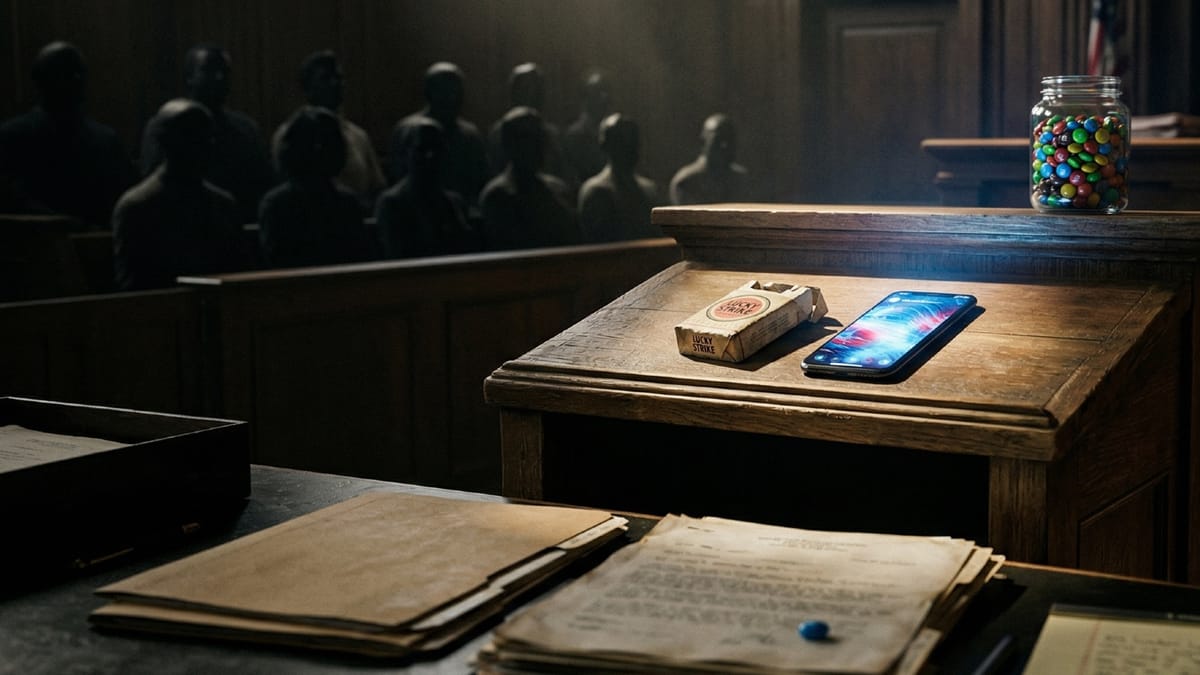
A California jury on March 25, 2026, found Meta and YouTube negligent in designing platforms that harmed a young user, delivering what legal experts and industry observers are already comparing to the most consequential corporate liability shift in modern American history - the fall of Big Tobacco.
The verdict in the California Superior Court of Los Angeles County, presided over by Judge Carolyn B. Kuhl, awarded a combined $6 million in damages. Meta must pay $4.2 million in combined compensatory and punitive damages. YouTube must pay $1.8 million. The figures are modest compared to the quarterly revenues of both companies, but the legal precedent established that day carries implications far beyond the dollar amounts.
The reaction in marketing circles was immediate. Ciarán O'Kane, GP at FirstPartyCapital and co-founder and advisor at WireCorp and Exch, posted on LinkedIn simply: "Big Tech = Big Tobacco." The post gathered 18 reactions and was reposted within days. Ben Foulkes, a commerce media and retail media professional, left the only comment: "Liable for looking after their 'product' better....."
That two-word equation - Big Tech = Big Tobacco - cuts to the heart of what the Los Angeles jury decided. And it is not a new analogy. It is, in fact, a legally precise one with roots that run more than a century deep.
The plaintiff, identified as K.G.M. and now 20 years old, filed her lawsuit in 2023 against Meta, Snap, YouTube and TikTok. According to the New York Times, Kaley - her first name - lives in Chico, California, and said she had begun using social media at age 6. She claimed the sites caused personal injury, including body dysmorphia and thoughts of self-harm. She began using Instagram at age 9.
TikTok and Snap both settled with the plaintiff for undisclosed terms before the trial started. Meta and YouTube proceeded to trial, confident in their legal defense. According to the New York Times, the companies argued it was too hard to prove social media was addictive and caused personal harms.
The five-week trial featured testimony from Meta's chief executive, Mark Zuckerberg, and the head of Instagram, Adam Mosseri. Both executives rejected claims that Instagram could be described as "clinically" addictive. Meta countered that K.G.M.'s mental health issues stemmed from familial abuse and turmoil. YouTube argued that it was not a social media company and that its features were not designed to be addictive.
The jury of seven women and five men took more than a week of deliberation. On March 25, all but two jurors found both companies liable, determining that Meta and YouTube were negligent in designing their platforms and that their products harmed K.G.M.
During arguments on punitive damages, plaintiff attorney Mark Lanier held a jar of M&M's before the jury, saying each candy piece represented a billion dollars of the companies' combined value. According to the New York Times, he scooped out a handful and said: "You can take out a handful and not make a difference." The jury ultimately decided on $3 million in punitive damages - doubling the compensatory damages owed - after deliberating less than an hour.
Joseph VanZandt, one of K.G.M.'s lawyers, called the verdict historic. According to the New York Times: "This is the first time in history a jury has heard testimony by executives and seen internal documents that we believe prove these companies chose profits over children."
Meta's response was measured. According to the New York Times, a Meta spokeswoman said: "We respectfully disagree with the verdict and are evaluating our legal options."
Google also said it disagreed with the verdict and plans to appeal. According to the New York Times, José Castañeda, a Google spokesman, said: "This case misunderstands YouTube, which is a responsibly built streaming platform, not a social media site."
YouTube's lawyer, Luis Li, apologized to K.G.M. during the trial. According to the New York Times, he said: "We are sorry for the things you have suffered. We at YouTube truly hope there have been things at YouTube that have enriched your life and allowed you to express yourself." Lanier responded: "A lawyer apology is not the same as accountability."
The comparison between social media giants and the tobacco industry is not rhetorical flourish. It is a deliberate legal strategy, one with a documented historical precedent that the Los Angeles trial invoked explicitly.
According to the New York Times, the personal liability argument in the K.G.M. case draws inspiration from a legal playbook used against Big Tobacco last century, in which lawyers argued that the companies created addictive products that harmed users. Philip Morris and R.J. Reynolds were accused of hiding information about the harms of cigarettes. Those companies reached a $206 billion master settlement with more than 40 states in 1998, which led to an agreement to stop marketing to minors. Strict tobacco regulations and a decline in smoking followed.
The tobacco industry's legal history is more complex than the settlement suggests. In 1911, the United States Supreme Court decided United States v. American Tobacco Co., 221 U.S. 106 - one of the defining antitrust cases of the 20th century. The suit was commenced on July 19, 1907, by the United States, to prevent the continuance of alleged violations of the first and second sections of the Anti-Trust Act of July 2, 1890. According to the Supreme Court opinion, the defendants included 29 individuals, 65 American corporations, and two English corporations.
The case revealed a systematic strategy of market domination. According to the opinion, the American Tobacco Company acquired fifteen going tobacco concerns between February 1891 and October 1898 alone, doing business across Kentucky, Louisiana, Maryland, Michigan, Missouri, New York, North Carolina, and Virginia. The company purchased plants that it then shut down - not to operate them, but to eliminate competitive capacity. According to the court record, in the year 1899 and thereafter, either the American or Continental Companies bought and closed up some thirty competing corporations and partnerships, with the interested parties covenanting not to engage in the business.
The court found, according to the opinion, that the record demonstrated "a purpose to acquire dominion and control of the tobacco trade, not by the mere exertion of the ordinary right to contract and to trade, but by methods devised in order to monopolize the trade by driving competitors out of business, which were ruthlessly carried out."
Economic historian D.T. Armentano, writing in the Freeman in March 1971, offered a contrarian analysis of the 1911 case. According to Armentano, American Tobacco's cigarettes sold for $2.77 per thousand (less tax) in 1895 and $2.20 in 1907. Prices fell even as the leaf tobacco raw material price rose from 6 to 10.5 cents per pound in the same period. The Circuit Court judge who first ruled against American Tobacco acknowledged, according to Armentano, that "the record in this case does not indicate that there has been any increase in the price of tobacco products to the consumer."
The point is not that tobacco companies were good actors. The point is that scale, structural dominance, and the appearance of independent competition while suppressing it - these are the patterns that courts eventually found actionable. In 2026, the same structural analysis applies to platforms that use algorithmic recommendation systems, infinite scroll, and autoplay features to maximize time-on-platform among users who began engaging as children.
The design features at the heart of the K.G.M. case are not incidental. They are core to the business models of both companies. According to the New York Times, during opening arguments, plaintiff attorney Mark Lanier presented the jury internal company documents from Meta and YouTube showing that tech executives knew of and discussed the negative effects of their products on children. Lanier argued that features like infinite scroll, algorithmic recommendations, and autoplay videos were designed to entice and hook young users into compulsively engaging with the platforms.
These features function precisely as variable-reward mechanisms - the same psychological principle underlying slot machine design. A user who never knows what content the next scroll will surface is more likely to keep scrolling. An autoplay video removes the deliberate choice to continue watching. An algorithmic recommendation system learns, over time, what provokes the strongest emotional response and serves more of it.
K.G.M. testified that she spent hours a day on Instagram and posted hundreds of photos using beauty filters. She said the experience led to her body dysmorphia. She began using social media at age 6. She started Instagram at age 9. The jury concluded that the design of those platforms made them negligent toward a user who had been engaging with them since primary school.
The K.G.M. verdict is described by the New York Times as a bellwether - a test case among thousands. According to the article, thousands of lawsuits have been filed by teenagers, school districts, and state attorneys general against Meta, YouTube, TikTok, and Snap. Eight other cases brought by individual plaintiffs are slated to go to trial in Los Angeles County. A set of federal cases brought by states and school districts in Oakland, California, at the U.S. District Court of Northern California, are scheduled for jury trials in the summer of 2026.
The verdict arrived days after a New Mexico jury, in a separate case brought by state attorney general Raúl Torrez, found Meta liable for violating state law by failing to safeguard users of its apps from child predators. That jury decided on Tuesday, March 24, that Meta should pay $375 million.
Clay Calvert, a nonresident senior fellow at the American Enterprise Institute and expert on media law, offered a measured read of what the verdict means. According to the New York Times, Calvert said: "There is a long road ahead, but this decision is quite significant. If there are a series of verdicts for plaintiffs, it will force the defendants to reconsider how they design social media platforms and how they deliver content to minors."
Both companies plan to appeal. Legal challenges of this kind can take years before any final determination is made.
Platforms have long relied on Section 230 of the Communications Decency Act of 1996, which protects them from liability for what their users post. The K.G.M. case was argued on a different theory entirely - product design liability, not publisher liability. The plaintiff's lawyers argued the case was about how the platforms were built, not what users chose to post on them.
This distinction matters enormously for the advertising and marketing industry. If courts establish that platform design choices create product liability, the compliance implications reach into how ad inventory is structured, how recommendation algorithms are tuned, and how platforms monetize attention. Advertising systems that maximize engagement and time-on-platform are deeply intertwined with the same features that the jury found negligent.
Meta has faced a growing wave of legal pressure across multiple jurisdictions. The Dresden Higher Regional Court delivered legally binding judgments against Meta in February 2026, finding its Business Tools data collection illegal and ordering €1,500 per affected user. A San Francisco court in March 2026 entered a $50 million judgment against Meta over Facebook user data shared with third-party developers. Meta settled a shareholder lawsuit for $190 million in November 2025 over privacy failures tied to the Cambridge Analytica scandal. Separately, Google and Meta sued California in November 2025 over Senate Bill 976, which restricts personalized content feeds for users under 18.
The tobacco analogy carries particular weight for anyone working in digital advertising. The business model of platforms like Instagram and YouTube is built on advertising revenue. That revenue depends on attention. Attention depends on engagement. Engagement depends on the very features - infinite scroll, autoplay, algorithmic feeds - that the jury found harmful.
In 1911, the Supreme Court found that the American Tobacco Company had used its market position and supply chain control, including acquiring companies that made licorice paste - a key ingredient in plug tobacco - to construct barriers to entry that served its dominance. According to the court opinion, the MacAndrews & Forbes Company, controlled by American Tobacco interests, used in excess of 95 percent of the licorice root consumed in the United States. The comparison to data moats, proprietary algorithmic systems, and platform lock-in effects is available to anyone who looks.
The advertising community watched the 1998 tobacco master settlement reshape an entire industry's marketing constraints. The settlement forced tobacco companies to stop targeting minors, eliminate certain formats of advertising, and fund public health campaigns. A comparable trajectory for social media platforms would have direct consequences for how digital advertising is bought, sold, and targeted - particularly against younger audiences.
The FTC dismissed its antitrust case against Meta in November 2025, with a federal judge concluding that Meta does not hold monopoly power in social media markets given competition from TikTok and YouTube. That ruling may complicate antitrust approaches going forward. But the product liability route - the one the K.G.M. jury upheld - operates on entirely different legal ground.
Juror Victoria, speaking to the New York Times outside the courtroom, explained the jury's deliberate restraint on damages. She said: "We wanted to focus on the future and what teens and children would be subjected to in the future."
That framing - the future, not the past - is precisely the framing that the tobacco litigation ultimately forced. It took decades. The question now is whether the social media cases move faster.
Who: Meta Platforms and YouTube (Google) were found negligent by a California Superior Court jury in Los Angeles County. The plaintiff is K.G.M., identified by first name as Kaley, a now-20-year-old California resident. Her attorneys included Mark Lanier and Joseph VanZandt. Mark Zuckerberg and Adam Mosseri testified during the five-week trial.
What: The jury determined that Meta and YouTube designed their platforms with features - including infinite scroll, algorithmic recommendations, and autoplay videos - that were addictive and caused mental health harm to K.G.M. Meta was ordered to pay $4.2 million in combined compensatory and punitive damages. YouTube was ordered to pay $1.8 million. The $3 million in punitive damages doubled the compensatory amount.
When: The verdict was delivered on Wednesday, March 25, 2026, following more than a week of jury deliberation after a five-week trial. The case is one of thousands filed since 2023.
Where: California Superior Court of Los Angeles County, presided over by Judge Carolyn B. Kuhl. Related federal cases are pending at the U.S. District Court of Northern California in Oakland.
Why: The case matters because it validates a product design liability theory for social media platforms that bypasses Section 230 protections. Internal documents shown to the jury suggested executives knew their features could harm children. The verdict is described as a bellwether for thousands of similar cases and draws direct parallels to the legal strategy that ultimately produced the 1998 tobacco master settlement.