TikTok data shows beauty brands operate at 50% of optimal spending levels
TikTok partnered with NIQ for a two-year marketing mix modeling study revealing Romanian beauty brands dramatically underinvest in the platform while achieving superior ROI efficiency.
On December 2, 2025, TikTok released findings from a comprehensive two-year marketing mix modeling study conducted with NIQ examining how media investments translate into offline sales for Romania's leading beauty brands. The research, covering the period from January 2023 through December 2024 in the face care category, used store-level sales data to isolate the incremental impact of each media channel within the total marketing mix.
Marketing mix modeling has experienced renewed focus as traditional attribution faces limitations from privacy changes and fragmented consumer journeys. The methodology employs statistical analysis to evaluate all marketing activities' contribution to business outcomes, providing holistic views that disentangle media interactions even as individual user tracking becomes increasingly restricted. NIQ applied full-spectrum modeling to determine which platforms deliver the highest returns and how optimized budget allocation can maximize ROI.
PPC Land Newsletter
Subscribe PPC Land newsletter ✉️ for similar stories like this one
The study focused on two unnamed Romanian beauty brands within the face care category—identified in the research as "Premium Beauty Brand" and "Skincare Brand." NIQ analyzed actual store-level sales data rather than relying on self-reported metrics or platform-provided attribution, creating what the research described as precise isolation of incremental impact across competing media channels.
TikTok delivered between 29% and 33% of all media-driven incremental sales for both brands despite relatively modest investment levels compared to other channels. The platform's ROI performance substantially exceeded competing media, achieving up to 170% higher returns versus traditional television (representing a 2.7x multiplier) and up to 185% higher returns versus other digital channels (a 2.86x multiplier).
The disconnect between incremental sales value and ROI efficiency proved particularly striking. While TV Traditional drives 37% to 40% of incremental sales for both brands, TikTok delivers superior ROI efficiency at 100% indexed performance with only 29% to 33% of sales value. This pattern indicates more efficient use of marketing investment despite generating lower absolute sales volume.
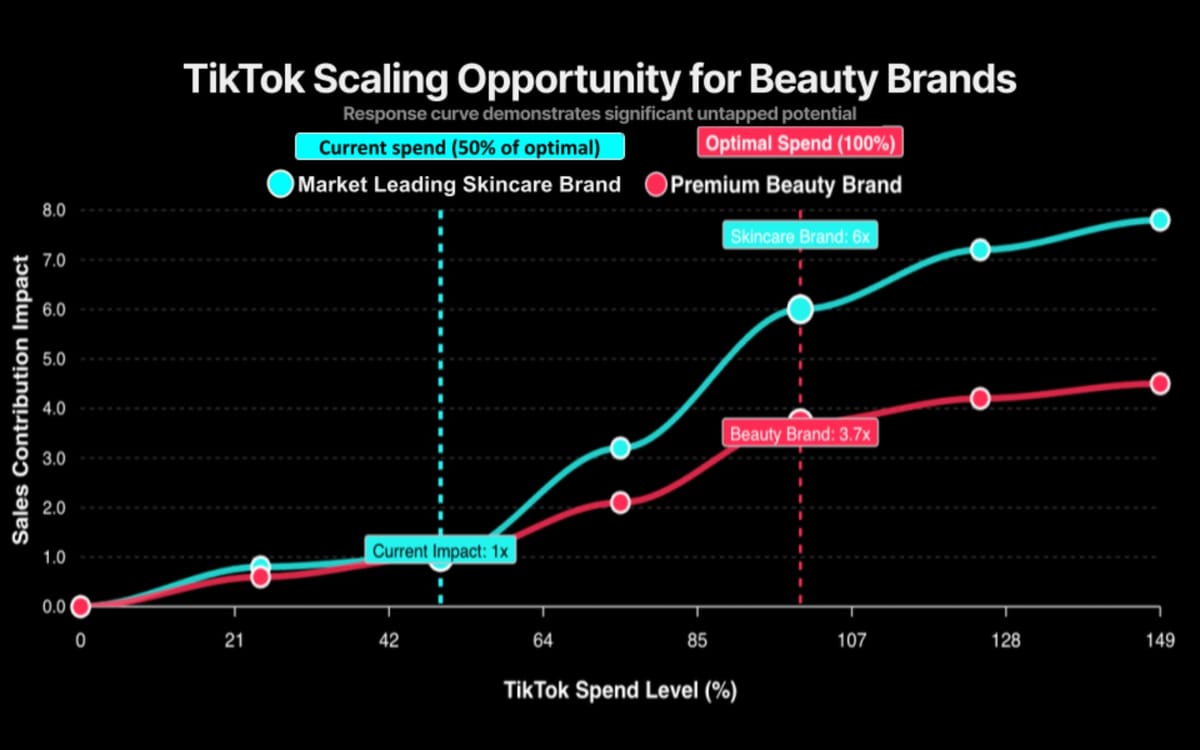
Response curves demonstrated significant untapped potential with precise scaling projections. The study revealed that both brands currently invest at approximately 50% of optimal TikTok spending levels, representing what NIQ characterized as a significant opportunity for further investment. Increasing TikTok investment by 20% would not reach saturation points, potentially elevating ROI from an index of 100% to between 190% and 300%.
Brand-specific growth potential varied considerably based on current positioning and category dynamics. The Skincare Brand could achieve a 6x increase in sales impact by doubling TikTok investment from current levels. The Premium Beauty Brand could realize a 3.7x increase in sales impact with the same spending adjustment.
These projections stem from response curve analysis showing how incremental investment translates into incremental returns across different spending levels. The modeling demonstrated that both brands operate well below the point of diminishing returns, with substantial headroom remaining before reaching saturation thresholds where additional investment generates progressively smaller incremental returns.
Advertise on ppc land
Buy ads on PPC Land. PPC Land has standard and native ad formats via major DSPs and ad platforms like Google Ads. Via an auction CPM, you can reach industry professionals.
Creative format performance revealed significant differences between ad types beyond basic channel allocation decisions. Spark Ads delivered 37% higher ROI compared to regular ad formats, demonstrating the impact of leveraging organic content styles in paid media executions. This finding aligns with broader industry recognition that authentic, user-generated content often outperforms polished brand creative in social environments.
Seasonal TikTok campaigns achieved 130% higher ROI than non-seasonal campaigns, highlighting the importance of alignment with key retail moments. The beauty category experiences pronounced seasonal patterns tied to holiday gifting, skincare routines affected by weather changes, and promotional events throughout the retail calendar. Campaigns timed to coincide with these moments captured heightened consumer interest and purchasing intent.
The study explicitly recommended that brands developing content strategy should consider these format differences to maximize media investment efficiency. The 37% performance gap between Spark Ads and regular formats suggests meaningful returns from adapting creative approaches rather than simply increasing spending levels.
Synergistic effects emerged when multiple channels executed together, with patterns varying by brand. The Beauty Brand saw a 3.31% incremental sales lift when combining TV and TikTok, valued at 22,809 units in the modeling period. The Skincare Brand achieved a 5.16% sales uplift through Other Digital and TikTok synergies, valued at 46,863 units.
These synergy findings suggest that brands should consider TikTok as part of an integrated media strategy rather than an isolated channel. The complementary effects with both traditional and digital media indicate that TikTok can enhance overall campaign effectiveness when properly coordinated with other touchpoints. The modeling isolated these synergistic effects by comparing actual performance against expected performance if channels operated independently.
ROI performance varied substantially across the measured media mix. TikTok achieved 100% indexed ROI efficiency in the study's framework. Other Digital Media channels ranged from approximately 30% to 45% indexed ROI. Traditional TV delivered approximately 40% to 50% indexed ROI. Out of Home advertising registered the lowest indexed ROI at roughly 15% to 20%. A category identified as "TikTok Halo" measured additional attributed value at approximately 10% to 15% indexed ROI.
The halo effect captures indirect value attribution where TikTok exposure influences consumer behavior even when final conversions occur through other channels. This phenomenon has become increasingly documented across digital advertising platforms, where upper-funnel exposure drives lower-funnel conversions that traditional attribution assigns elsewhere.
Sales contribution impact told a different story than ROI efficiency. Traditional TV generated the highest absolute incremental sales at 37% to 40% across both brands. TikTok contributed 29% to 33% of incremental sales. Other Digital channels delivered 20% to 27% of sales value. Out of Home advertising contributed approximately 4% to 6% of incremental sales.
This divergence between sales volume and ROI efficiency reflects different optimization objectives. Brands seeking maximum absolute sales volume might maintain heavy TV investment despite lower efficiency. Brands optimizing for cost-effective growth would shift budget toward higher-ROI channels like TikTok even if absolute sales contribution remains smaller.
The research arrives during significant shifts in marketing measurement approaches. Recent research from TransUnion and EMARKETER showed that 54.1% of marketing professionals reported no change in their measurement confidence compared to the previous year, while 14.3% said confidence actually declined. Platform-provided attribution remains the most common methodology at 65.8%, but marketers increasingly supplement it with advanced approaches including incrementality testing (52.0%) and marketing mix modeling (49.5%).
Investment plans reflect this measurement evolution. Nearly half (46.9%) of marketers plan to increase investment in MMM over the next 12 months, representing the highest investment priority among measurement methodologies. The approach addresses persistent challenges where last-touch attribution often fails to capture full campaign impact, particularly for platforms like TikTok where inspiration can linger far longer than a single click or session.
Central European beauty markets face distinctive competitive dynamics that influence media effectiveness. The Romanian market represents a developed advertising ecosystem with strong retail infrastructure supporting both traditional and digital channels. Beauty category spending demonstrates pronounced sensitivity to economic conditions while maintaining consistent growth across premium and mass-market segments.
NIQ's proven methodology brings credibility to findings that suggest dramatic reallocation from traditional channels. The research firm operates as a global leader in consumer intelligence, providing data and analytics to consumer packaged goods manufacturers and retailers worldwide. Marketing mix modeling represents one of NIQ's core measurement capabilities, deployed across multiple markets and categories.
The timing coincides with broader platform competition for beauty advertising budgets. Recent data from Pentaleap showed Neutrogena increasing sponsored presence 182% year-over-year in retail media, while L'Oréal and Revlon maintained strong positions with 98% and 120% growth respectively in sponsored product placements. Beauty brands demonstrate willingness to shift budgets toward channels proving incremental effectiveness.
The study's recommendations align with industry trends showing the increasing effectiveness of platforms that combine entertainment with commerce. As traditional media continues to fragment, identifying channels that deliver both reach and efficiency becomes increasingly critical for beauty marketers seeking sustainable growth. Research from Tracksuit and TikTok demonstrated that high awareness brands achieve 2.86 times the conversion rate of low awareness brands on TikTok, suggesting that platform effectiveness compounds as brands establish presence.
Creative optimization extends beyond simple format selection to encompass timing, content style, and integration with organic strategies. The 37% ROI premium for Spark Ads indicates that paid media borrowing signals from organic content outperforms traditional advertising creative even when targeting identical audiences. This pattern reflects platform algorithm preferences that reward content matching user expectations and engagement patterns.
Seasonal alignment delivered even more dramatic results than creative format optimization. The 130% ROI improvement for seasonal campaigns versus non-seasonal execution suggests that timing potentially matters more than message for beauty brands operating within established purchase cycles. Romanian beauty consumers follow predictable patterns around gift-giving occasions, seasonal skincare adjustments, and promotional periods that savvy marketers can anticipate and amplify.
The research provides concrete evidence that strategic reallocation toward higher-performing channels can deliver substantial returns. For brands seeking to maximize marketing efficiency, the study demonstrates that precise media mix optimization leads to tangible sales growth rather than theoretical improvements in abstract metrics.
Budget reallocation carries risks that marketing mix modeling helps quantify. Reducing TV spending to fund TikTok investment means accepting lower absolute incremental sales from television in exchange for more efficient growth through digital channels. The synergy effects complicate this calculation—reducing TV might eliminate the 3.31% incremental lift observed when combining TV and TikTok for the Beauty Brand.
Optimal allocation depends on business objectives beyond pure ROI maximization. Brands prioritizing market share expansion might maintain heavy TV investment for maximum reach despite efficiency trade-offs. Brands facing margin pressure or seeking profitable growth would shift toward TikTok's superior ROI even at the cost of slower absolute sales growth. Strategic context determines whether the 6x sales impact potential from doubling TikTok investment justifies reduced spending elsewhere.
Implementation requires capabilities beyond budget reallocation. Scaling TikTok investment from 50% to 100% of optimal levels demands corresponding increases in creative production, campaign management, and performance optimization. The 37% ROI premium for Spark Ads requires identifying and amplifying organic content rather than simply increasing paid creative output. Seasonal campaign execution demands precise timing and coordination across content calendars.
The disconnect between current spending and optimal allocation raises questions about organizational barriers preventing efficient budget deployment. Beauty brands operating in Romanian markets possess sophisticated marketing capabilities with access to multiple measurement vendors. The persistence of suboptimal allocation despite available data suggests that factors beyond pure performance analytics influence media planning decisions.
Contractual commitments with media agencies and broadcasters can lock brands into spending levels that persist despite changing effectiveness patterns. Annual upfront commitments to television networks provide cost guarantees but limit flexibility to reallocate toward emerging high-performance channels. Agency compensation structures tied to media spending create misaligned incentives where reducing TV budgets affects agency revenue.
Attribution challenges prior to rigorous marketing mix modeling implementation might have obscured TikTok's true impact. Platform-reported metrics often understate upper-funnel influence when purchases occur days or weeks after initial exposure through different channels. The two-year study duration allowed NIQ to capture these delayed effects that shorter measurement windows miss.
Organizational inertia favors established channel relationships over newer platforms regardless of performance data. Marketing teams comfortable with television planning processes face learning curves when expanding digital capabilities. The creative requirements differ substantially—television advertising relies on 30-second narratives while TikTok success demands adapting to short-form vertical video optimized for mobile consumption.
Brand safety concerns potentially constrain social media investment even when performance justifies expansion. Beauty brands maintain careful control over where advertisements appear to protect premium positioning. TikTok's user-generated content environment introduces adjacency risks that don't exist in controlled television environments, requiring additional oversight and potentially limiting scale.
The research methodology addresses these objections through rigorous isolation of incremental impact. Store-level sales data eliminates questions about whether TikTok drives actual purchases versus engagement metrics that don't translate to revenue. The two-year duration captures seasonal variations and longer-term brand building effects rather than short-term promotional spikes.
Response curves provide specific guidance about sustainable scaling trajectories rather than extrapolating from small tests. The finding that 20% spending increases wouldn't reach saturation gives brands confidence that expansion remains viable rather than risking diminishing returns. The brand-specific projections—6x impact for Skincare Brand versus 3.7x for Premium Beauty Brand—acknowledge that optimal allocation varies based on current positioning and category dynamics.
Global beauty advertising continues shifting toward digital channels as traditional media fragments and measurement capabilities improve. Connected television has emerged as one beneficiary, with research showing top-performing brands allocate 23.7% of TV impressions to CTV compared to 17.4% average. Social commerce platforms represent another growing category, particularly in markets where mobile-first behavior dominates media consumption.
TikTok's position within this competitive landscape depends on sustaining the performance advantages documented in the NIQ study. Platform algorithm changes, increased advertiser competition, and creative fatigue could erode ROI premiums over time. The research captured 2023-2024 performance during a period when many beauty brands remained underinvested, potentially creating opportunities that diminish as more advertisers recognize platform effectiveness.
The methodology itself faces limitations that temper conclusions. Marketing mix modeling operates at aggregate levels that obscure audience segment performance. The Romanian beauty brands might achieve different results than competitors in other markets or categories. Two years of data provides substantial analytical foundation but cannot capture all potential scenarios as markets evolve.
These qualifications don't invalidate findings but rather establish appropriate context for applying results. Brands considering similar reallocations should conduct their own market-specific analysis rather than directly extrapolating Romanian beauty performance. The directional insights remain valuable—marketing mix modeling can reveal underinvestment in high-performing channels that traditional attribution obscures.
PPC Land Newsletter
Subscribe PPC Land newsletter ✉️ for similar stories like this one
Who: TikTok partnered with NIQ to conduct research examining two Romanian beauty brands in the face care category, providing findings relevant to beauty marketers, media planners, and brands operating in Central European markets.
What: A two-year marketing mix modeling study using store-level sales data revealed that Romanian beauty brands operate at 50% of optimal TikTok spending levels while the platform delivers 29-33% of media-driven incremental sales with superior ROI efficiency (up to 185% higher than other digital channels). Spark Ads achieved 37% higher ROI than regular formats, and seasonal campaigns delivered 130% higher ROI than non-seasonal execution.
When: The research covered January 2023 through December 2024, with findings published December 2, 2025, during a period of industry-wide adoption of marketing mix modeling as traditional attribution faces privacy limitations.
Where: The study focused specifically on Romania's face care category within the beauty market, analyzing store-level sales data across retail infrastructure in Central European market conditions where traditional and digital media compete for advertising budgets.
Why: Brands seeking to maximize marketing efficiency can use rigorous marketing mix modeling to identify channels operating below optimal investment levels, with the research demonstrating that strategic reallocation toward higher-ROI platforms can deliver substantial returns—including potential 6x sales impact by doubling TikTok investment for the Skincare Brand and 3.7x impact for the Premium Beauty Brand.
Share this article
The link has been copied!
Your link has expired. Please request a new one.
Your link has expired. Please request a new one.
Your link has expired. Please request a new one.
Great! You've successfully signed up.
Great! You've successfully signed up.
Welcome back! You've successfully signed in.
Success! You now have access to additional content.