Vivaldi 7.8 ships advanced tab tiling while major browsers chase AI
Vivaldi Technologies released version 7.8 on January 29 with drag-and-drop tab tiling and pinned tab restrictions, rejecting AI assistants while Chrome, Edge integrate AI features.


Vivaldi Technologies released version 7.8 on January 29 with drag-and-drop tab tiling and pinned tab restrictions, rejecting AI assistants while Chrome, Edge integrate AI features.
Vivaldi Technologies today released version 7.8 of its browser with a completely reimagined tab tiling system that allows users to create split-screen layouts through drag-and-drop interactions, positioning itself as an alternative to AI-powered browsers from Google, Microsoft, and OpenAI.
The Norwegian company launched the update on January 29, 2026, with features focused on manual control and workspace flexibility rather than algorithmic assistance. According to Jon von Tetzchner, Vivaldi's co-founder and CEO, the release represents a philosophical rejection of the AI-first approach dominating browser development across the technology industry.
"The entire browser industry is solving the wrong problem," von Tetzchner stated in the announcement. "They're building assistants that filter what you see, decide what you don't see, and ultimately outsource your judgment. We're building tools that amplify your ability to explore, compare, and think."
The distinction arrives as Chrome maintains 66.3% global market share while integrating AI features including summarization and content generation, Edge incorporates Copilot functionality, and Safari adds AI writing tools. Vivaldi operates in a browser ecosystem where AI integration has become the dominant development priority among major platforms.
The centerpiece of Vivaldi 7.8 centers on redesigned tab tiling that eliminates previous activation steps. Users can now drag tabs from the tab bar directly into the main content window, hovering over different areas to choose horizontal, vertical, or grid arrangements.
The system allows rearrangement of tiles during active sessions, resizing individual sections, or adding additional tabs to existing layouts without interrupting workflow. According to the technical documentation, tiled tabs maintain behavior identical to regular tabs, enabling users to combine tiling with other Vivaldi features including periodic reloading on selected tiles.
This implementation differs from split-screen features in Chrome and Edge, which remain limited to two-tab configurations. Vivaldi supports unlimited grid layouts, allowing users to determine complexity based on task requirements.
The "Open Link as Tiled Tab" feature extends this functionality by allowing users to right-click any link and open it directly into a tiled view beside existing content. Mouse gestures can trigger this action, eliminating the need for menu navigation during rapid multitasking sessions.
These capabilities address workflows requiring simultaneous reference to multiple sources. Writing while keeping documentation visible, comparing product specifications across retailers, or monitoring live data feeds while working in another tab become possible without constant window switching or manual layout reconstruction.
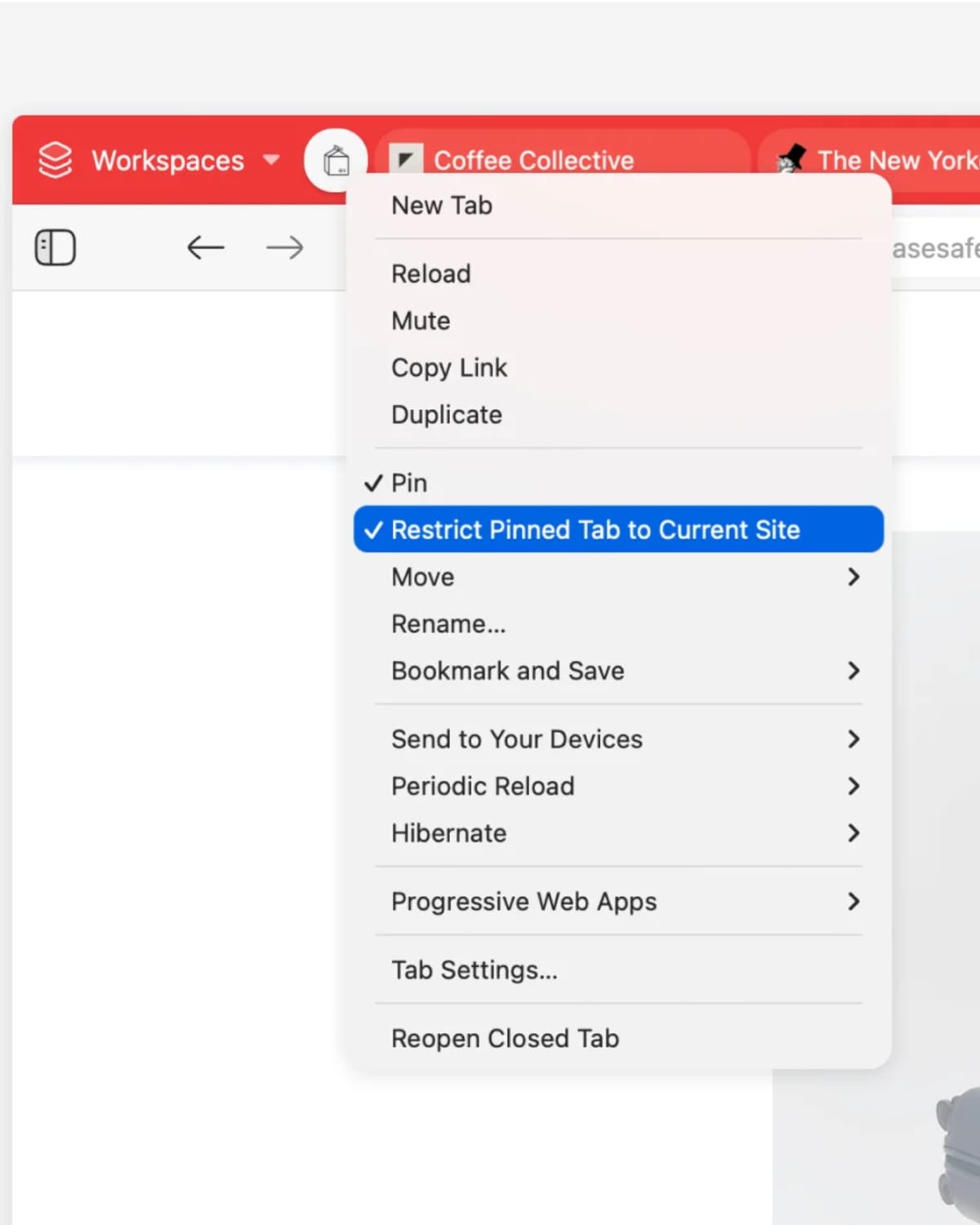
Vivaldi 7.8 introduces domain restriction for pinned tabs, preventing accidental navigation that breaks pinned tab organization. A pinned mail tab now remains on mail domains, while pinned project tools stay within their designated platforms.
According to the changelog, this feature addresses user feedback about pinned tab behavior. The development team acknowledged they "didn't think of it before" despite the functionality appearing obvious in retrospect.
For users of Vivaldi Mail, the built-in email client, pinned tabs now persist across all workspaces and windows. Previously, mail views existed in single windows, requiring window switching to check or write messages while working elsewhere.
This architectural change treats mail as integrated browser functionality rather than an attached application. Mail access becomes available across workspace reorganizations or new window creation, supporting complex multi-window setups without forcing context switching.
The release includes what Vivaldi's quality assurance team describes as "two full buckets of crash fixes" following implementation of improved crash logging systems. The updated logging enabled identification and resolution of crashes that previous systems failed to detect.
According to the technical documentation, "all known crashes in our own code are fixed." The development team notes remaining crashes could result from external factors including hardware issues or cosmic radiation affecting system memory.
Additional improvements include caret browsing as a dedicated accessibility setting, enabling keyboard-based navigation and text selection for users requiring alternative input methods. The Windows installer received a complete redesign for smoother setup processes and improved reliability.
The release also introduces an optional daily background image feature for start pages, automatically updating with photography from Unsplash. This feature remains disabled by default, maintaining Vivaldi's emphasis on user choice over automatic functionality changes.
The browser market has experienced significant bifurcation in development philosophy during 2025. While Google expanded AI search with canvas and video features in July, OpenAI launched ChatGPT Atlas browser in October, and Perplexity released Comet browser with integrated AI assistants, Vivaldi has maintained focus on manual control features.
This divergence reflects contrasting assumptions about user needs. AI-powered browsers position algorithmic assistance as reducing cognitive load and accelerating task completion. These platforms argue that AI can synthesize information, automate repetitive actions, and predict user intent more efficiently than manual processes.
Vivaldi's approach assumes users prefer direct control over automated assistance. The company argues that AI assistants introduce layers between users and content, potentially limiting exploration and constraining decision-making to algorithm-defined parameters.
"Browsing should light up your brain, not numb it," von Tetzchner stated in the announcement. "When you outsource exploration to an algorithm, you're not browsing anymore. You're being browsed."
The distinction becomes particularly relevant as research suggests AI search impact may be less severe than initially predicted. Data from NP Digital indicates 55.5% of marketers report increased traffic since AI Overviews implementation, while 36.2% observe stable traffic levels.
Vivaldi's market position reflects broader trends in privacy-focused browser adoption. Brave browser reached 100 million monthly users in September 2025, demonstrating growing demand for alternatives to surveillance-driven business models.
The company formed a strategic partnership with Proton VPN in March 2025, integrating VPN functionality directly into the browser. This collaboration emphasized European technology companies providing alternatives to dominant U.S.-based platforms.
However, Chrome's dominance increased from 63% in Q1 2025 to 66.3% in Q3 2025, suggesting mainstream users prioritize integration with existing Google services over privacy-focused alternatives.
DuckDuckGo's browser redesign in July 2025 demonstrated how privacy-focused browsers can incorporate optional AI features while maintaining user control. DuckDuckGo allows users to disable Duck.ai functionality through settings, implementing AI as optional enhancement rather than mandatory integration.
Firefox announced completion of fingerprinting defenses in November 2025, cutting user identifiability through fingerprinting by nearly half. These protections operate without blocking known trackers, instead limiting information available to websites through privacy-by-design approaches.
Vivaldi builds on Chromium architecture while maintaining proprietary modifications that differentiate it from other Chromium-based browsers. The company develops features in-house rather than relying on Chromium's development roadmap, enabling implementation of functionality unavailable in Chrome or Edge.
The tab tiling system represents significant engineering investment in workflow optimization without AI dependency. Creating flexible grid layouts that adapt to user behavior requires sophisticated interface design and state management that pure algorithmic approaches cannot replicate.
This contrasts with AI browser implementations that rely on natural language processing and machine learning models to automate tasks. While Perplexity's Comet browser uses AI assistants to manage tabs and navigate pages autonomously, Vivaldi provides manual controls that enable precise workspace configuration.
The company's approach aligns with growing concerns about AI agent security vulnerabilities. Research from Brave Software's security team revealed fundamental challenges affecting agentic browsers, where malicious instructions embedded in websites can manipulate browser AI assistants through indirect prompt injection attacks.
Vivaldi operates as an employee-owned company without venture capital investment or advertising revenue dependencies. This ownership structure enables development priorities that diverge from mainstream browser strategies focused on AI integration and data collection.
The company's financial model relies on partnerships including search engine revenue sharing and VPN service integration rather than user tracking or advertising optimization. This approach contrasts with Chrome's integration into Google's advertising ecosystem and Edge's connection to Microsoft's cloud services.
According to the announcement, Vivaldi does not track user behavior or treat user data as a business model component. The company emphasizes that it does not answer to investors pushing features benefiting them rather than users.
This independence becomes particularly relevant as AI browser development increasingly involves data collection for training purposes. Perplexity's browser strategy explicitly includes tracking user activities across the internet to build comprehensive user profiles for advertising purposes, according to CEO Aravind Srinivas.
The Vivaldi 7.8 changelog documents 27 crash fixes addressing issues ranging from extension handling to mail functionality. The development team implemented improvements across bookmark management, search functionality, and workspace handling.
Specific fixes include addressing bookmark duplication when adding pages, correcting mail sorting inconsistencies, and resolving keyboard shortcut conflicts. The team fixed issues where F2 key presses for renaming items also triggered Quick Commands, demonstrating attention to interaction conflicts that degrade user experience.
The mail client received 18 separate fixes addressing account setup, threading behavior, and column sorting. These improvements build on Vivaldi 7.5's stability focus released in July 2025, which prioritized bug fixes over new features.
Technical debt reduction appears central to Vivaldi's development strategy. Rather than continuously adding features, the company alternates between feature releases and stability-focused updates that address accumulated issues.
The caret browsing implementation provides keyboard-based navigation enabling users to move through websites as if they were text documents. This accessibility feature supports users requiring alternative input methods or preferring keyboard navigation over mouse interactions.
The feature joins existing accessibility capabilities including zoom controls, page styling options, and extensive keyboard shortcut customization. Vivaldi emphasizes that accessibility features should be built-in rather than requiring extensions or third-party tools.
This approach contrasts with accessibility implementations in AI-powered browsers that rely on natural language commands. While voice-controlled AI assistants can improve accessibility for some users, keyboard-based alternatives remain essential for users with different needs or preferences.
The company's emphasis on multiple input methods reflects understanding that accessibility requirements vary significantly across user populations. Building comprehensive accessibility support requires manual feature implementation rather than relying on AI to interpret user intent.
Vivaldi positions itself for users who "love exploring the web, and who demand more from their browser," according to the announcement. This positioning targets technically sophisticated users, former Opera users, and individuals dissatisfied with mainstream browser limitations.
The company's user base of approximately 3.5 million active users represents a small fraction of global browser usage but demonstrates sustained demand for alternatives to dominant platforms. This niche positioning enables focused development on features serving specific user needs rather than optimizing for mainstream adoption.
The tab tiling implementation exemplifies this strategy. While casual users may never utilize multi-tab layouts, power users managing research projects, development environments, or content creation workflows benefit significantly from flexible workspace arrangements.
Von Tetzchner emphasized this distinction in the announcement: "This is what best-in-class features look like in a browser: not complicated, just deeply effective once you start using it."
Von Tetzchner co-founded Opera Software and served as CEO before departing in 2011. He subsequently established Vivaldi Technologies in 2015 after Opera's transition from its Presto layout engine to Chromium prompted user dissatisfaction.
This history influences Vivaldi's development philosophy. The company targets users who valued Opera's extensive customization options but felt abandoned when Opera simplified its interface and adopted Chromium's feature set without preserving distinctive functionality.
Vivaldi's approach involves preserving advanced features while maintaining accessibility for less technical users. The browser includes built-in ad blocking, popup blocking, tracker blocking, email client, feed reader, and calendar management without requiring extensions.
This comprehensive feature set contrasts with minimal browser designs exemplified by Chrome's streamlined interface. While mainstream browsers increasingly rely on extensions for additional functionality, Vivaldi integrates features directly into the browser architecture.
The announcement indicates Vivaldi will continue prioritizing user control over algorithmic automation. The company stated it will "not turn the joy of exploring into inactive spectatorship" despite AI integration becoming standard across competing browsers.
This commitment suggests future releases will emphasize workflow tools, customization options, and productivity features requiring manual configuration rather than AI-powered automation. The company's development roadmap appears focused on expanding capabilities available to power users rather than simplifying interfaces for mainstream adoption.
The philosophical stance reflects broader debates about artificial intelligence's role in technology products. While McKinsey research indicates AI agents will reshape advertising landscapes and Kantar identifies AI agents as top marketing trend for 2026, alternative perspectives question whether AI assistance genuinely improves user experiences or simply automates tasks users prefer controlling directly.
Vivaldi's approach assumes the latter, maintaining that sophisticated tools enabling precise control deliver better outcomes than algorithmic assistants making decisions on users' behalf.
The company encouraged users to recommend Vivaldi to others, stating that "recommendations from people who actually use the browser matters more to us than any advertisement ever could."
Vivaldi 7.8 is available for download on Windows, Mac, and Linux at vivaldi.com. The browser remains free with no tracking, data selling, or mandatory AI assistants.
Who: Vivaldi Technologies, a Norwegian employee-owned browser company led by co-founder and CEO Jon von Tetzchner, released the update targeting technically sophisticated users and individuals seeking alternatives to AI-powered browsers from Google, Microsoft, and OpenAI.
What: Version 7.8 introduces drag-and-drop tab tiling enabling unlimited split-screen layouts, "Open Link as Tiled Tab" functionality, domain-restricted pinned tabs, cross-window mail access, and extensive stability improvements addressing multiple crash scenarios without incorporating AI assistants or algorithmic automation.
When: The announcement occurred on January 29, 2026, with immediate availability for download on Windows, Mac, and Linux platforms, following six months of stability-focused development and bug fixing.
Where: Global release affecting Vivaldi's approximately 3.5 million active users across desktop platforms, with the Norway-based company emphasizing European alternatives to U.S.-based technology platforms controlled by major corporations.
Why: The update reflects Vivaldi's philosophical rejection of AI-first browser development, arguing that manual control tools enabling exploration and comparison deliver better outcomes than algorithmic assistants that filter information and outsource user judgment to automated systems.