
Voters trust TV news over AI and social media, VAB survey finds
VAB's March 2026 survey of 2,319 U.S. adults finds voters nearly 9x more likely to trust TV news than social media for political information, with AI ranked lowest.

VAB's March 2026 survey of 2,319 U.S. adults finds voters nearly 9x more likely to trust TV news than social media for political information, with AI ranked lowest.
The Video Advertising Bureau released on March 17, 2026 a detailed report showing that American voters across every party affiliation trust television news far more than social media, search engines, or artificial intelligence when consuming political information. The findings, drawn from a December 2025 survey of 2,319 U.S. adults conducted in partnership with research firm Dynata, carry direct implications for political advertisers, media planners, and any marketer seeking to understand where credible audiences actually spend their attention.
The report, titled The Lead Story: How Multiscreen TV Drives Cross-Partisan Engagement for Political Ad Campaigns, examined behaviors and sentiment across five distinct groups: potential voters, non-voters, Republicans, Democrats, and Independents. Sample sizes were carefully segmented, with 1,514 voter respondents, 680 non-voter respondents, 636 Republican respondents, 612 Democrat respondents, and 546 Independent respondents. The methodology relied on the Dynata panel and defined potential voters as registered voters, those planning to vote in 2026 midterm or local elections, or habitual mail-in ballot users. Non-voters were defined by an explicit combination of non-registration, stated non-participation, and absence of mail-in voting habits.
Throughout the report, VAB uses the term multiscreen TV to describe the combined ecosystem of ad-supported linear and streaming television - not any single platform, but the full continuum from cable news to ad-supported streaming services like Tubi and Pluto TV.
The numbers on media trust are hard to ignore. According to the report, potential voters are almost nine times more likely to rank TV news as their most trusted source than they are to rank social media platforms. Breaking this down by political affiliation, 47% of Republicans, 43% of Democrats, and 47% of Independents named local TV news as their single most trusted source. National TV news came second across all groups.
Where does AI sit in this hierarchy? Exactly at the bottom. According to the survey data, 50% of total respondents ranked AI tools such as ChatGPT lowest for trust when evaluating news sources. That figure holds across voting groups and party affiliations without meaningful variation. Only 5% of potential voters, 5% of Republicans, 5% of Democrats, and 5% of Independents named AI as their most trusted news source. For a marketing community increasingly interested in AI-generated content and AI-powered media, this number deserves careful attention. IAB research published in January 2026 similarly documented that 39% of Gen Z consumers feel negatively toward AI advertising, with consumers significantly more likely than advertisers to describe AI-using brands as manipulative.
Social media fared only marginally better than AI on trust, with 9% of potential voters, 9% of Republicans, 8% of Democrats, and 10% of Independents naming social platforms as their top source. Search engines received 11% among potential voters. The gap between television and every other category is not marginal - it is structural.
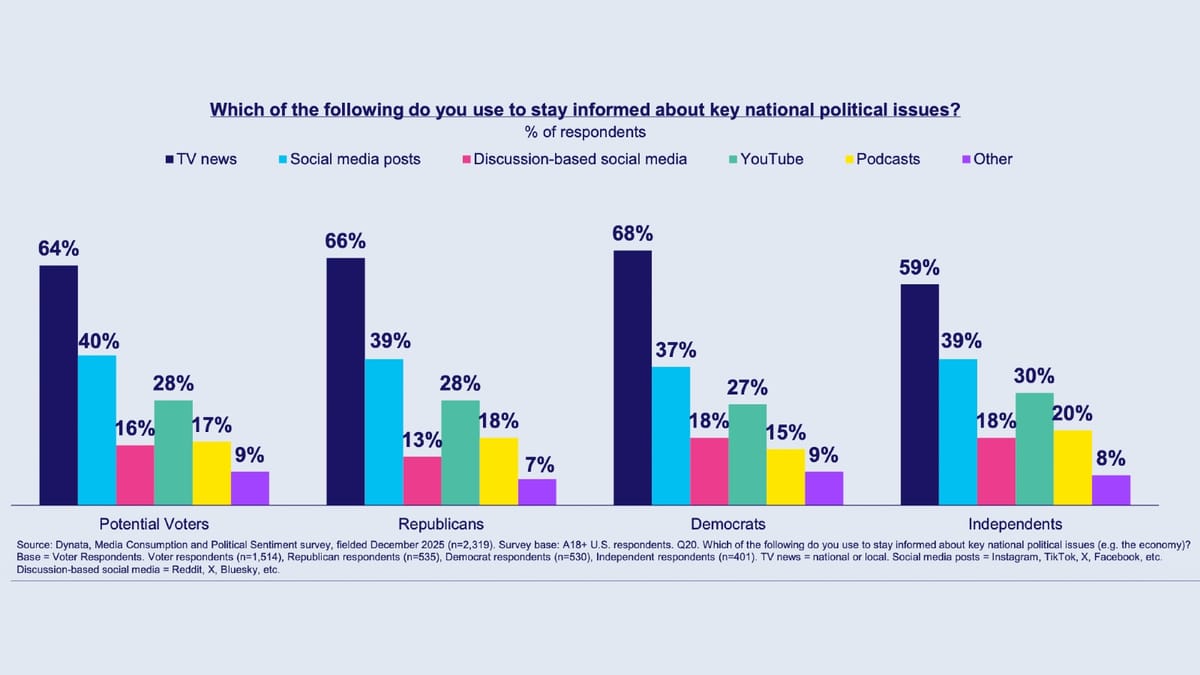
The survey asked a more granular behavioral question: where do voters actually go to stay informed about key national political issues like the economy? The answer is TV news, consistently and by a wide margin. According to the report, 64% of potential voters use TV news for this purpose, compared to 66% of Republicans, 68% of Democrats, and 59% of Independents. Social media posts - defined in the survey as Instagram, TikTok, X, and Facebook - came second in each group at 40%, 39%, 37%, and 39% respectively. Discussion-based social media such as Reddit, X, and Bluesky registered far lower, between 13% and 18% depending on the group.
Potential voters are 60% more likely to use TV news to stay informed than social media, according to the VAB analysis. That differential matters to advertisers because it describes not just preference but habitual behavior - the channels where voters actually form opinions before acting.
The primary discovery channel for political candidates follows the same pattern. According to the survey, 43% of potential voters first learned about political candidates and their views through TV or streaming, compared to 25% through social media and 11% through YouTube. Among Republicans and Democrats, the TV figure rose to 47%, while Independents showed 38%. The survey defined TV here as linear TV or streaming combined.
One of the more consequential findings for political campaign strategy involves the relationship between policy issues and party identity. According to the survey data, 65% of potential voters say they vote based on the issue rather than party affiliation. The figure among Independents was 78% - the highest of any group. Republicans and Democrats both registered 58%. What does this mean for political ad formats? According to the report, 75% of potential voters, 72% of Republicans, 75% of Democrats, and 68% of Independents prefer political ads that focus on issues rather than on a candidate directly. Non-voters expressed this preference at 46%. The contrast with candidate-focused ads is stark: only 16% of potential voters prefer candidate-focused ads versus 75% who want issue-focused messaging.
This finding reshapes how message framing should work in political advertising. An advertiser able to place issue-based messages within credible, trusted news environments reaches audiences that are predisposed to engage with that style of communication.
The VAB survey probed satisfaction with multiple attributes of TV news, and the results consistently favored the medium. Regarding the accuracy of TV news reports, 69% of potential voters expressed satisfaction, compared to 70% of non-voters, 65% of Republicans, 75% of Democrats, and 65% of Independents. On journalism quality, satisfaction measured 67% among potential voters and peaked at 76% among Democrats.
Two attributes showed particularly strong satisfaction ratings. Speed of breaking news coverage on TV drew satisfaction from 81% of potential voters, 76% of non-voters, 78% of Republicans, 83% of Democrats, and 77% of Independents. Dissatisfaction on this dimension was minimal, ranging from 4% to 7%. Local community information from local TV news earned satisfaction rates of approximately 79% across all groups, with dissatisfaction between 6% and 11%. These numbers suggest that whatever criticism television news receives in broader cultural discourse, viewers who use it are highly satisfied with its functional performance.
On the question of unbiased perspective - admittedly a more contested area - satisfaction remained higher than dissatisfaction across all groups. Among potential voters, 53% were satisfied with the unbiased perspective of TV news while 17% were dissatisfied. Among Democrats, satisfaction with unbiased TV news perspective reached 61%, the highest of any group.
The perception of social media as a vector for false or misleading information is widespread and consistent across the political spectrum. According to the survey, 51% of potential voters named social media as the most likely source of fake or misleading information. Among Democrats, this figure reached 55%; among Republicans, 45%; and among Independents, 51%. By contrast, television - defined in this question as broadcast, cable, or satellite - was cited by only 19% of potential voters, 24% of Republicans, 13% of Democrats, and 18% of Independents.
Potential voters are almost three times more likely to believe social media platforms will provide fake or misleading information compared to TV, according to the report. This perception gap is directly relevant to the advertising industry. A December 2025 IAB Europe report covered by PPC Land documented that misinformation and polarization had emerged as acute concerns in the World Economic Forum's Global Risks Report, while also noting that news advertising produces superior campaign performance yet publishers continue to face economic pressure. The VAB data provides consumer-level evidence for what that dynamic looks like from the audience side.
Despite the range of political affiliations represented, TV and streaming subscription patterns are surprisingly uniform. Potential voters show 42% subscribing to paid TV services, 74% to paid streaming services, and 47% to free ad-supported streaming services. Non-voter figures are slightly lower at 21%, 60%, and 44% respectively. Across party lines, paid streaming subscriptions are clustered between 69% and 75%, with Democrats highest at 75%. Free ad-supported streaming services, such as Tubi and Pluto TV, hover between 43% and 48% across Republican, Democrat, and Independent groups.
The advertising reach implication is direct. According to the report, nine out of ten people who subscribe to any paid streaming service - regardless of voting status or party affiliation - can be reached by ads through those services. Specifically, 92% of potential voters who subscribe to paid streaming have access to at least some ad-supported tiers, compared to 91% of non-voters, 92% of Republicans, 90% of Democrats, and 90% of Independents. The uniformity of that 90%+ figure across all five groups underscores the practical reach claim.
Voters watch local and national TV news at substantially higher rates than non-voters. According to the survey, 61% of potential voters typically watch local TV news in a given week, compared to 38% of non-voters - a gap of 23 percentage points. For national TV news, the gap is wider: 57% of potential voters watch weekly versus 25% of non-voters. For advertisers focused on reaching people who vote, these numbers identify TV news viewership as one of the most reliable behavioral predictors of voter engagement.
When respondents were asked which platform makes political ads feel more authentic, television won decisively. Potential voters are twice as likely to feel political ads on TV are more authentic compared to social media ads, according to the survey data - 37% said TV ads feel more authentic versus 19% for social media. Republicans and Democrats both showed a two-times-more-likely response pattern. Independents showed a 75% higher likelihood of perceiving TV political ads as more authentic than social media equivalents.
This perception has downstream behavioral consequences. According to the survey, potential voters who saw a political ad on TV took multiple follow-on actions: 30% visited the candidate's social media profile, 24% checked voter registration status or polling station information, 16% used a voice assistant to learn more, and 12% scanned a QR code or texted a number from the ad. All of these response rates fall substantially for non-voters.
The trust that TV news generates does not remain siloed within political messaging. Potential voters are 42% more likely than not to purchase from advertisers adjacent to a breaking news story on local TV news, according to the report. During national TV news, 23% of potential voters said they would be more likely to purchase from advertisers appearing during that programming, compared to 16% who said less likely.
Placement adjacent to political programming generates similar lift. Potential voters are 50% more likely than not to purchase from advertisers appearing during a televised political debate or town hall. Right after a political ad, 21% of potential voters said they would be more likely to purchase, against 18% who said less likely. These figures suggest a halo effect where the credibility of the news context transfers, at least partially, to commercial advertisers sharing that environment.
For marketing professionals, this data connects to broader discussions about brand safety and context effects in advertising. A 2024 PPC Land article on Effectv's multiscreen political ad tools documented how the advertising division of Comcast already positioned multiscreen TV as a vehicle for reaching voters across all screens, noting the difficulty of achieving cohesive reach without a unified approach to linear and streaming inventory. The VAB report provides the demand-side data to accompany that supply-side argument.
The report notes that reach potential is not confined to news programming alone. According to the survey, 60% of potential voters watch sports programming in a typical week, 64% watch drama, 53% watch true crime or mystery content, and 40% watch reality programming. Republicans index highest for sports at 62%, while Democrats index highest for drama at 68%. These numbers matter for political advertisers looking to build frequency without relying exclusively on news adjacency. Regulation of digital political advertising in the EU, documented by PPC Land in July 2025, has already pushed some European campaigns toward traditional media channels - a dynamic that makes understanding TV's cross-genre reach increasingly practical knowledge for global advertisers.
Jason Wiese, EVP of Strategic Insights and Measurement at VAB, summarized the strategic position in the press release accompanying the report: "TV news delivers the scale, trust, credibility and authenticity that no other media can for both political and non-political advertisers."
Who: The Video Advertising Bureau (VAB), a trade organization whose members include premium multiscreen TV providers and distributors, released the report. The research was conducted by Dynata, a first-party data and research firm.
What: A 39-page report based on a survey of 2,319 U.S. adults, documenting that voters across party lines trust TV news substantially more than social media, search engines, or AI for political information. The report quantifies media consumption, trust hierarchies, ad preference structures, and downstream purchase behavior linked to TV news adjacency.
When: The survey was fielded in December 2025. The report was released on March 17, 2026. The press release was distributed on March 18, 2026.
Where: The research covers U.S. adults nationally, with regional distribution skewing toward the Central region. The report was released from New York, New York by VAB.
Why: With U.S. midterm elections scheduled for 2026, the report addresses where political advertisers should place budgets to reach voters credibly and broadly. The data also has implications for non-political advertisers, since the trust halo from TV news extends to commercial advertisers sharing that environment.