Why deterministic systems still win in AI's probabilistic world
Deterministic data platforms remain marketing's most valuable infrastructure despite probabilistic AI dominance, but only when integrated as ecosystem orchestrators.


Deterministic data platforms remain marketing's most valuable infrastructure despite probabilistic AI dominance, but only when integrated as ecosystem orchestrators.
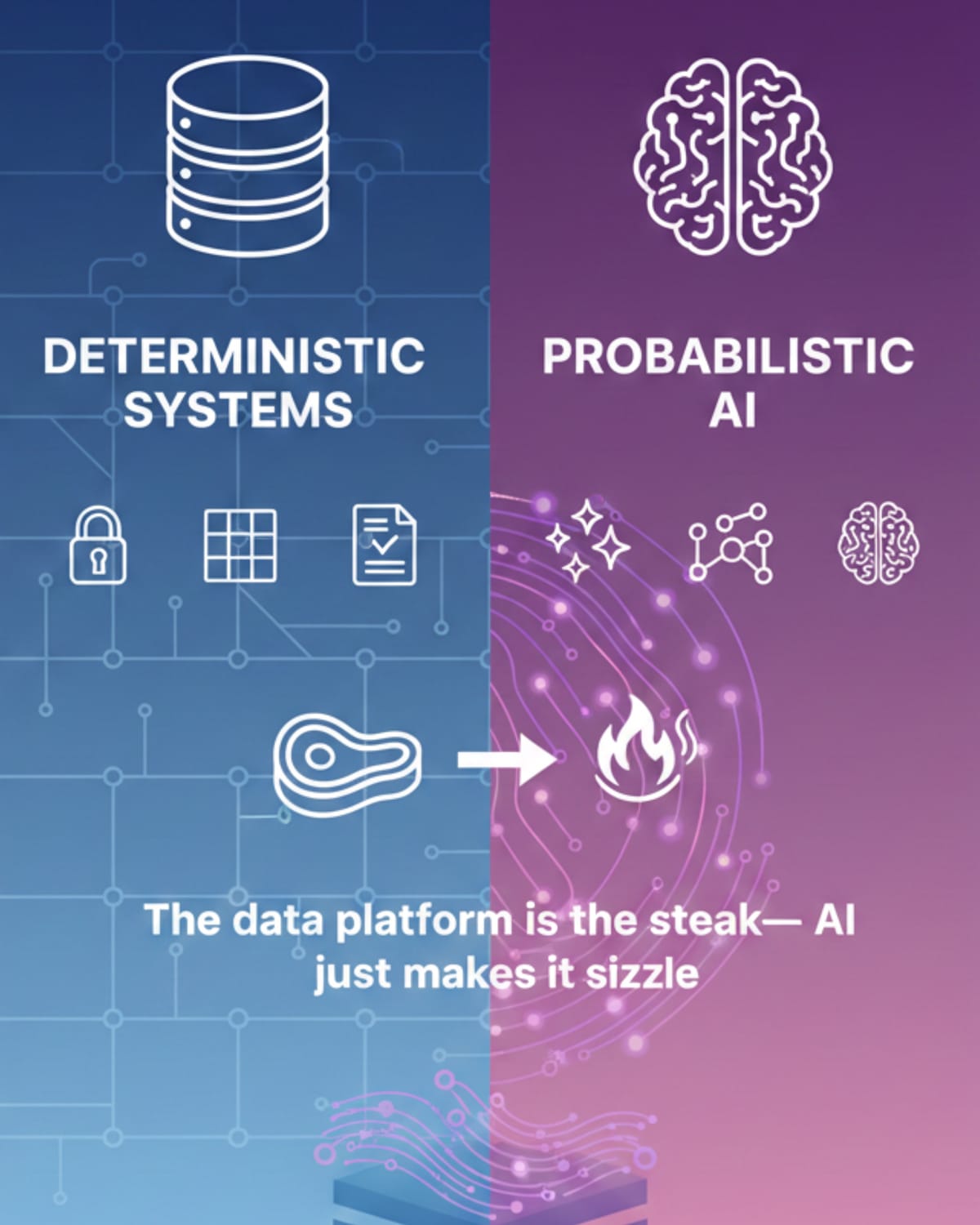
Deterministic systems of record maintain fundamental strategic value despite the proliferation of probabilistic artificial intelligence across marketing operations, though their role shifts from user-facing platforms to data infrastructure powering cross-system agent workflows. Christian Monberg, Chief Technology Officer at Zeta Global, crystallized this tension in a LinkedIn post on January 17. "In a world dominated by probabilistic AI, the most valuable asset is still a modern deterministic system of record," Monberg wrote. "When cooked up right, the data platform is the steak—AI just makes it sizzle."
The statement arrived during industry discussion about whether legacy software platforms can successfully integrate artificial intelligence capabilities without fundamental architectural changes. Monberg's observation distinguishes between two technological paradigms that increasingly interact across marketing technology stacks. Deterministic systems operate through defined rules, predictable outputs, and verifiable data relationships. Probabilistic AI functions through statistical inference, pattern recognition, and outputs that vary based on training data and context.
Investment analyst Jamin Ball published complementary analysis on January 16 examining why established SaaS platforms face structural challenges deploying AI capabilities. "The key insight for me - agents are working across systems of record," Ball wrote in his Clouded Judgement newsletter. "When we ask the question 'why can or can't legacy systems of record just add AI' one important part of the answer is asking the question 'well can System of Record A really build a product that works in / on top of other systems?'"
Ball's analysis identified how traditional platforms control their designated domains effectively but lose that control when AI agents require information spanning multiple systems. "The existing systems of record work great in their own domain. They have control over their own domain. But as soon as you leave that domain, either their product stops or it doesn't have access. Agents however are a 'layer' that sits on top," Ball wrote.
Marketing technology analyst Scott Brinker responded to Ball's analysis by emphasizing ecosystem development requirements for platforms attempting to maintain relevance. "The value of just being a system of record is dwindling; the value of being a true platform that orchestrates across the tech stack is rising," Brinker wrote in a LinkedIn post on January 16. The former HubSpot vice president of platform ecosystem stressed that superficial integration capabilities fail to address fundamental competitive shifts.
"Being a true platform is more than just exposing APIs and putting up a marketplace," Brinker wrote. "It's prioritizing the ecosystem as a source of innovation, both in your product organization and your go-to-market organization." He identified embracing "coopetition" as particularly challenging for companies. Platforms must simultaneously compete in certain areas while enabling partners to build products that might cannibalize platform revenue.
Monberg's emphasis on deterministic data platforms addresses these tensions. Well-structured data infrastructure provides the foundation AI agents require to operate reliably across systems. Probabilistic AI excels at pattern recognition, natural language processing, and adaptive decision-making. However, these capabilities require accurate, consistent, well-organized data to function effectively. The "steak" remains the structured data platform. The "sizzle" comes from AI agents that access, analyze, and act on that data.
The advertising technology sector demonstrates this architectural evolution across multiple platform implementations. Amazon launched comprehensive agentic AI capabilities on September 17, 2025, transforming marketplace management from passive assistance to active business partnership through autonomous monitoring, inventory optimization, and advertising campaign management. The implementation relies on deterministic product catalogs, pricing databases, and inventory systems while deploying probabilistic AI for decision-making layers.
Adobe announced Experience Platform Agent Orchestrator on September 10, 2025, enabling businesses to manage agents across Adobe and third-party ecosystems. The architecture combines Adobe's deterministic customer data platform infrastructure with probabilistic AI agents that orchestrate workflows across multiple systems. The separation illustrates Monberg's observation: structured data platforms provide reliable foundations while AI agents add adaptive intelligence.
LiveRamp introduced agentic orchestration on October 1, 2025, through a "Yours, Mine, and Ours" framework enabling advertiser-owned models, platform-native agents, or combined deployments through Model Context Protocol implementations. The technical approach separates deterministic identity resolution infrastructure from probabilistic AI decision-making. LiveRamp's RampID system maintains deterministic pseudonymous identifiers across platforms while AI agents use those identifiers to orchestrate marketing activities.
The distinction between deterministic data infrastructure and probabilistic AI agents affects how marketing organizations evaluate technology investments. Deterministic systems provide verifiable audit trails, regulatory compliance capabilities, and predictable behavior required for financial reporting and legal obligations. Marketing mix modeling, attribution analysis, and campaign measurement depend on accurate historical data captured through deterministic systems.
Newton Research launched specialized advertising and media analytics agents integration with Snowflake Cortex AI on November 4, 2025, illustrating this architectural separation. The implementation enables brands to run media mix modeling and incrementality analysis directly within secure data environments. Snowflake provides the deterministic data warehouse infrastructure. Newton Research agents apply probabilistic AI to analyze that structured data for marketing insights.
The technical architecture allows users to work on data securely while analyzing marketing activity without transferring information between systems. Horizon Media adopted the integration to democratize marketing analytics across its client base through its Blu Platform. The agency's adoption demonstrates how deterministic data platforms become more valuable when paired with probabilistic AI rather than replaced by it.
Ball's analysis examined how traditional workflow assumptions fail in agent-driven environments. "When I think about how people and companies interact with software today the pattern is generally pretty simple. The system of record is a single, organized place where a human goes to look something up, understand the state of the world, and then take some sort of action based on the information they gathered," Ball wrote. That model assumes humans serve as connective tissue between platforms.
AI agents eliminate that assumption. "Humans were the connective tissue between systems of record. They knew where to go, what information to grab, and then what to do with it," Ball explained. Tribal knowledge, training documentation, and individual expertise contained the logic linking different systems. Agents automate those connections, extracting information from multiple platforms, synthesizing insights, and executing actions across systems autonomously.
The infrastructure supporting agent workflows requires different technical approaches than traditional middleware. Google released an open-source Model Context Protocol server for Ads API integration on October 7, 2025, enabling AI applications to connect with Google Ads data through natural language interfaces. The implementation separates deterministic campaign data from probabilistic AI agents that query and act on that information.
Traditional API interactions required developers to construct specific requests with precise syntax, reference extensive documentation, and parse structured responses. The MCP server abstracts these technical requirements behind conversational interfaces while maintaining deterministic data structures underneath. Agents can request information using natural language, but the underlying campaign data, performance metrics, and account structures remain organized through deterministic systems.
Amazon launched closed beta access for its MCP Server on November 13, 2025, following similar architectural principles. The server transforms complex multi-field API operations into conversational queries while maintaining Amazon's deterministic advertising infrastructure. Campaign data, performance metrics, billing information, and account details remain structured through traditional database systems. AI agents interact with that infrastructure through probabilistic natural language processing.
The separation addresses Monberg's observation about deterministic systems providing foundational value. Marketing platforms can't function without accurate product catalogs, pricing data, inventory levels, customer information, and transaction records. Those structured datasets require deterministic architecture ensuring data consistency, referential integrity, and reliable query performance. Probabilistic AI adds adaptive intelligence on top of that foundation.
Industry standardization efforts reflect attempts to balance deterministic data requirements with probabilistic AI flexibility. The advertising technology industry launched Ad Context Protocol on October 15, 2025, built on Anthropic's Model Context Protocol. Six companies including Flashtalking, Mediaocean, Scibids, System1, VideoAmp, and Dstillery participated in the standardization effort.
The protocol addresses fragmentation where each advertising platform maintains proprietary APIs with distinct workflow requirements. Deterministic campaign structures, targeting parameters, and reporting formats vary across platforms. Agents require standardized methods to access these different systems while preserving the deterministic data integrity each platform maintains.
However, Augustine Fou, fraud researcher and marketing consultant, cautioned that standardization alone doesn't address underlying quality issues. "More automation means less transparency," Fou stated. Agents acting on behalf of participants with poor incentives can execute fraudulent activities at greater scale than human operators. The tension illustrates how probabilistic AI amplifies both beneficial and harmful activities supported by underlying deterministic systems.
Brinker's emphasis on genuine platform ecosystems addresses these challenges. "Most 'platform-ish' systems of records don't do that," Brinker wrote, referring to the coopetition requirements genuine platforms embrace. Companies must simultaneously maintain deterministic data infrastructure, expose that infrastructure to external agents through standardized protocols, and accept that some agents will compete with platform features.
Ball questioned whether existing vendors possess the organizational capacity for this transition. "I think this could be a limitation that makes it difficult for legacy SaaS systems of record to build successful AI experiences. Not to say they can't - some certainly will. But it will be hard. It will require building experiences that span beyond their typical domain expertise. Some structurally may not even be able to," Ball wrote.
The strategic implications extend beyond technical architecture to business models. Ball referenced Microsoft CEO Satya Nadella's observation that SaaS could become "reduced to a dumb CRUD database" as new abstraction layers emerge above traditional systems. Monberg's statement offers a counterargument: deterministic data platforms aren't "dumb" infrastructure when properly designed. They provide the essential foundation probabilistic AI requires to function reliably.
Marketing measurement demonstrates this interdependence. The Institute of Practitioners in Advertising released comprehensive guidance in March 2025 emphasizing that combining multiple measurement approaches delivers the most accurate picture of advertising performance. Marketing mix modeling excels at understanding long-term effects and providing holistic views that disentangle media interactions, though it lacks the granularity of attribution approaches.
Kochava research announced in September 2025 demonstrated that marketing mix modeling revealed TikTok campaigns generated an average of 35% higher incremental impact compared to last-touch attribution reporting. The analysis required deterministic historical campaign data, spend records, and conversion events combined with probabilistic statistical modeling. Neither component alone provides sufficient measurement accuracy.
Yahoo DSP embedded operational agents in January 2026 through a "Yours, Mine, and Ours" framework enabling advertiser-owned models, platform-native agents, or combined deployments. The troubleshooting agent proactively identifies pacing and delivery issues across campaigns. The implementation relies on deterministic campaign configuration data, delivery logs, and performance metrics while deploying probabilistic AI to diagnose problems and recommend solutions.
The technical architecture Yahoo DSP established maintains transparency requirements where advertisers can audit agent actions, understand decision logic, and override automated changes when business requirements demand human judgment. These governance mechanisms separate deterministic audit trails from probabilistic decision-making processes. Organizations can verify what actions agents took while accepting that agent reasoning involves statistical inference rather than deterministic logic.
PubMatic launched AgenticOS on January 5, 2026, positioning the infrastructure as the first operating system built specifically for autonomous advertising execution. The company reported live campaigns running through agentic infrastructure with partnerships including WPP Media, Butler/Till, and MiQ. The implementation separates deterministic advertising inventory data, pricing information, and delivery infrastructure from probabilistic AI agents that optimize campaign performance.
McKinsey identified agentic AI as the most significant emerging trend for marketing organizations in July 2025, with $1.1 billion in equity investment flowing into the technology during 2024. Job postings related to agentic AI increased 985 percent from 2023 to 2024. The investment patterns reflect commercial expectations that probabilistic AI agents will transform marketing operations while depending on deterministic data infrastructure.
The competitive dynamics challenge assumptions about how platforms capture value. Historically, platforms controlling entire workflows from data ingestion through activation captured more value than point solutions addressing specific functions. Agent architectures potentially invert that equation. Value might accrue to orchestration layers coordinating activities across systems rather than individual platforms executing isolated tasks.
Ball's analysis suggested this creates existential questions for established vendors. "The question for legacy SaaS vendors - will they be reduced to a simple store of information for Agents or will they capture the new layer on top?" Ball wrote. Monberg's observation offers a different perspective: being the "store of information" isn't reduction if that information represents high-quality deterministic data other systems depend on.
The distinction matters for marketing technology investment decisions. Organizations evaluating whether to consolidate around single platforms or maintain specialized best-of-breed systems face different calculus when AI agents orchestrate workflows. Platform consolidation historically reduced integration complexity. Agent-based architectures potentially enable best-of-breed strategies by automating cross-system coordination.
However, data quality requirements intensify. Agents operating across multiple systems encounter inconsistent customer identifiers, duplicate records, conflicting values, and incompatible taxonomies. These data quality issues that frustrated human users become blocking problems for autonomous agents. Investment in data governance, master data management, and infrastructure quality becomes more critical rather than less.
Google's Display & Video 360 API October 2025 update introduced asset creation for YouTube and Demand Gen ads, AdGroupAd retrieval capabilities, policy review fields, and support for Structured Data Files versions 9.1 and 9.2. The programmatic capabilities enable marketing technology providers to build tools abstracting platform complexity while maintaining deterministic data structures underneath.
Platform vendors that successfully embrace ecosystem strategies position deterministic infrastructure as foundations for external innovation rather than competitive moats. Brinker's analysis emphasized this requires prioritizing ecosystem success in product organizations, emphasizing partner success in go-to-market strategies, and accepting that ecosystem members sometimes compete with platform features.
The organizational challenges extend beyond technology decisions to corporate culture. Companies that built competitive advantages through proprietary data and closed platforms must transition to open architectures where value comes from data quality and ecosystem vitality rather than exclusive access. Product teams must design for extensibility rather than comprehensiveness. Sales organizations must support partners whose solutions might reduce direct platform revenue.
Ball acknowledged that some vendors can successfully navigate this transition while others cannot. "It will require building experiences that span beyond their typical domain expertise. Some structurally may not even be able to," Ball wrote. The structural limitations include technical debt in legacy architectures, organizational incentives favoring proprietary development, and business models dependent on platform lock-in.
Monberg's metaphor offers strategic guidance. The "steak" - deterministic data infrastructure - requires proper preparation. "When cooked up right, the data platform is the steak," Monberg wrote. Poorly designed data platforms with inconsistent schemas, quality issues, and fragmented governance create weak foundations regardless of how sophisticated the probabilistic AI becomes. The "sizzle" from AI agents enhances well-prepared infrastructure but can't compensate for fundamental data problems.
The marketing technology sector's infrastructure buildout throughout 2025 demonstrates both successful and struggling implementations of this principle. Platforms investing in data quality, open APIs, and ecosystem development positioned themselves as foundations for agent-based workflows. Those treating AI as feature additions to closed platforms faced increasing irrelevance as agents routed around their limitations.
Amazon's advertising business trajectory illustrates the economic stakes. The company will likely generate approximately $70 billion in 2025 advertising revenue, with roughly 90% in Sponsored Listings competing directly with Google Search and emerging AI search interfaces. Amazon's unified advertiser accounts launched in October 2025 enabled single-login access across advertising products. Campaign Manager integration eliminated fragmented workflows in November 2025. The infrastructure investments reflect commitment to deterministic platform quality paired with probabilistic AI agents.
The strategic question facing marketing technology vendors isn't whether to adopt AI but how to position deterministic infrastructure relative to probabilistic agents. Platforms treating AI as competitive differentiators risk building closed systems that agents route around. Those treating AI as ecosystem participants dependent on high-quality data infrastructure position themselves as essential foundations rather than threatened incumbents.
Brinker's observation that "you can't fake this" reflects the depth of change required. Superficial API additions and partner programs don't constitute genuine ecosystem commitment. Organizations must restructure product development, adjust incentive systems, modify go-to-market strategies, and accept fundamentally different competitive dynamics. The companies succeeding at this transformation recognize their deterministic data platforms gain value by enabling external innovation rather than losing value to it.
The distinction Monberg drew between probabilistic AI and deterministic systems of record clarifies strategic priorities. Marketing organizations require both components. Probabilistic AI provides adaptive intelligence, pattern recognition, and autonomous decision-making. Deterministic systems provide data accuracy, regulatory compliance, verifiable audit trails, and predictable behavior. Neither replaces the other. The question becomes how to architect the interaction between them.
Successful implementations separate concerns appropriately. Deterministic platforms focus on data quality, consistency, accessibility, and governance. Probabilistic AI agents focus on analysis, optimization, orchestration, and automation. The architectural separation enables specialization where each component does what it does best rather than attempting comprehensive solutions that compromise on both dimensions.
The advertising technology industry's movement toward standardized protocols like Model Context Protocol and Ad Context Protocol reflects this architectural principle. Standards define how probabilistic AI agents access deterministic platform data without requiring platforms to abandon their core data infrastructure or agents to adapt to proprietary interfaces. The standardization enables ecosystem development where multiple agents and platforms interoperate.
However, standardization alone doesn't guarantee success. Platforms must invest in data quality, API reliability, documentation accuracy, and developer support. Agents must handle edge cases, respect rate limits, manage errors gracefully, and provide transparency about their actions. The ecosystem succeeds when both sides fulfill their responsibilities rather than free-riding on others' investments.
Ball's analysis concluded that the transition creates winners and losers among existing vendors. "Time will tell" whether legacy SaaS platforms successfully adapt to agent-driven environments. Monberg's observation suggests the path forward: invest in deterministic data infrastructure quality while enabling probabilistic AI agents to access and enhance that foundation. The platforms that execute this strategy become more valuable in AI-driven environments. Those that resist the transition face increasing irrelevance as agents route around their limitations.
Who: Christian Monberg, Chief Technology Officer; Jamin Ball, investment analyst at Altimeter Capital; Scott Brinker, marketing technology analyst and former HubSpot VP of Platform Ecosystem; advertising technology platforms including Amazon, Google, Adobe, LiveRamp, Yahoo DSP, and PubMatic.
What: Industry analysis examining the relationship between deterministic systems of record and probabilistic AI agents in marketing technology. Monberg emphasized that modern deterministic data platforms remain the most valuable asset despite AI proliferation. Ball identified structural limitations preventing legacy SaaS platforms from competing effectively as AI agents work across systems. Brinker stressed requirements for genuine platform ecosystems that prioritize external innovation over proprietary control.
When: Discussion emerged January 16-17, 2026, building on platform launches throughout 2025 including agentic AI deployments from Amazon (September), Adobe (September), LiveRamp (October), and infrastructure protocols including Ad Context Protocol (October) and multiple MCP server implementations.
Where: Analysis published on LinkedIn and Clouded Judgement newsletter platform. Implementations occurred across major advertising technology platforms serving global digital marketing operations. Infrastructure standardization efforts involve companies across North America, Europe, and Asia Pacific markets.
Why: The shift matters for marketing professionals because it redefines where value accrues in technology stacks as AI agents orchestrate workflows across multiple systems rather than humans navigating individual platforms. Organizations must evaluate whether to invest in consolidating around comprehensive platforms or maintaining specialized deterministic infrastructure accessed by probabilistic agents. The architectural decisions affect data quality requirements, integration complexity, ecosystem strategies, and competitive positioning as the industry transitions from human-operated to agent-driven marketing operations. Success requires understanding that deterministic data platforms and probabilistic AI agents serve complementary rather than competitive functions, with quality infrastructure enabling rather than competing against intelligent automation.