Why relying on AI chatbots for information threatens democratic discourse
Digital analyst Esther Paniagua warns chatbots create information prisons as platforms capture revenue from publishers, threatening journalism and democracy.


Digital analyst Esther Paniagua warns chatbots create information prisons as platforms capture revenue from publishers, threatening journalism and democracy.
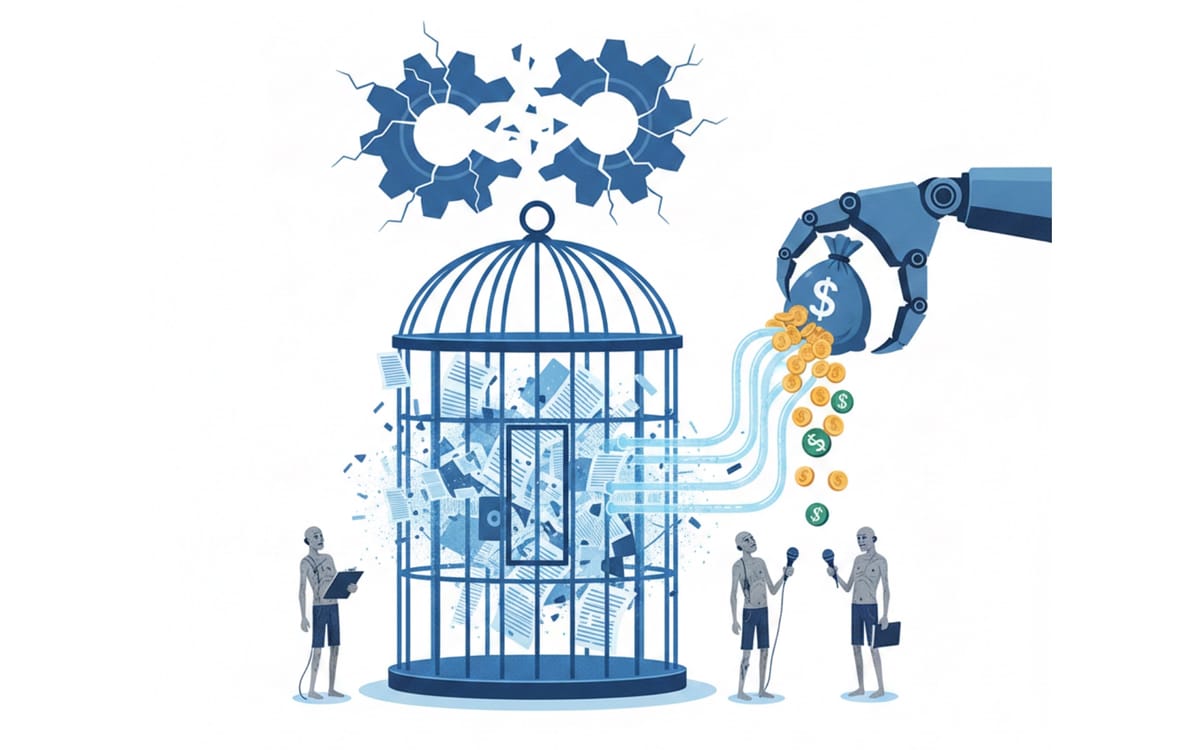
The warning arrived on December 20, 2025, from Esther Paniagua, a technology analyst and journalist writing in El País. "The paradox is that we have access to more sources of information than ever, and we end up resorting to only one," she stated. "Chatbots and AI results are the information jail of our time."
Paniagua's commentary, published December 19, 2025, addresses what she characterizes as an oligopolio cognitivo—a cognitive oligopoly that threatens democratic institutions. The piece builds on two decades of what she terms "digital colonization," arguing that neither Google's initial search dominance nor Meta's social media consolidation prepared society for the current wave of AI-driven information extraction.
The technical mechanism underlying this threat operates through systematic content harvesting. Generative AI companies extract material across internet surfaces, appropriating publisher work while excluding original creators from the economic value chain. These systems become, in Paniagua's assessment, "los grandes guardianes de un conocimiento que no han creado"—great guardians of knowledge they did not create. They frequently regurgitate this material incorrectly.
Subscribe PPC Land newsletter ✉️ for similar stories like this one
Research from TollBit demonstrates the traffic consequences. According to Paniagua's analysis, chatbots send 96% less traffic to news websites and blogs compared to traditional search queries. Users increasingly accept AI-generated responses without clicking through to verify source material. Google's own data shows AI Overviews reduce organic clicks by 34.5% when present in search results, according to analysis examining 300,000 keywords.
This traffic collapse directly undermines publisher sustainability. Big tech companies and generative AI firms capture growing advertising market shares while cannibalizing the fundamental pillars supporting media operations: information generation and advertiser revenue. Publishers invest in reporters, correspondents, verification teams, and editorial staff who ultimately work to train machine learning models. Platform companies profit while journalism enterprises degrade.
"La democracia no puede delegar su sistema de verdad en empresas cuyo negocio depende de la atención—no de la veracidad—y que deciden qué vemos sin transparencia ni rendición de cuentas," Paniagua wrote. Democracy cannot delegate its truth system to companies whose business depends on attention rather than accuracy, companies that decide what people see without transparency or accountability.
The crisis extends beyond individual publisher failures. Free press and open information flow provide essential democratic infrastructure—verification mechanisms, institutional checks, plurality, and informed citizenship. Without these elements, according to Paniagua, democracy loses its foundation.
Europe possesses regulatory tools to address this consolidation. Competition law, Digital Markets Act provisions, AI Act regulations, and intellectual property frameworks provide potential countermeasures. The European Commission imposed a 2.95 billion euro fine on Google in September 2025 for abuse of dominant position in digital advertising markets. Current investigations examine whether Google uses media content without permission for Gemini AI training and search results.
Meta faces similar scrutiny. Investigations target potential anticompetitive conduct involving AI integration in WhatsApp. Spanish courts required Meta to pay 479 million euros to 87 digital press publishers and agencies for unfair competition practices. X received a 120 million euro fine within the European Union for advertising transparency failures and deceptive blue verification badge design.
These enforcement actions remain insufficient by Paniagua's assessment. United States estimates suggest Google and Meta should pay media companies approximately 12 billion dollars annually, assuming fair division allocating publishers 50% of news-related revenue generated by these platforms. That calculation came from 2023 data, predating generative AI integration in search products and numerous other platform features.

Investigations must expand to cover AI companies, according to Paniagua's framework. Examinations should address both massive protected content usage for system training and the economic and structural impact across entire information ecosystems. Publishers report that Google's Network advertising revenue declined 1% to $7.4 billion during the second quarter of 2025 as AI features increasingly answer queries without directing traffic to external websites.
Copyright victories provide only partial solutions. Interminable litigation and tribunal rulings from judges often lacking technical expertise to properly evaluate AI systems cannot solve systemic problems. Legal frameworks fail to adequately cover AI operational mechanisms.
The situation demands decisive political and social action to rebalance information ecosystems, Paniagua argues. Required measures include: algorithmic transparency requirements, guaranteed compensation mechanisms and content usage exclusion options, coordinated application of existing legal tools, strengthened creator protections, restoration of individual control over personal information regimes, and reinforcement of media institutions as essential democratic infrastructure.
Platform concentration creates compounding challenges. Jason Kint, president of Digital Content Next, noted on August 7, 2025, that Google's advertising revenue mix shifted dramatically: "Just updated data in light of eye-popping acceleration of 'zero-click' searches as Google's AI Overview scheme captures web traffic. I've been watching G's ad revenue mix shift from network (publishers) to its own properties for over a decade. It just hit 90% for first time."
This 90% threshold represents a fundamental transformation. Network advertising through AdSense, AdMob, and Google Ad Manager traditionally provided crucial revenue streams for millions of websites worldwide by placing contextual advertisements alongside publisher content. The shift toward owned inventory allows Google to retain entire advertising proceeds while maintaining complete control over ad placement and user experience.
Buy ads on PPC Land. PPC Land has standard and native ad formats via major DSPs and ad platforms like Google Ads. Via an auction CPM, you can reach industry professionals.
The timing intensifies pressure on publishers. Google's December 2025 core update triggered severe ranking volatility and Discover traffic collapse within 48 hours. Publishers reported complete traffic elimination during what should have been peak seasonal revenue periods. One operator managing a 12-person team that previously generated 300,000 impressions daily through Discover traffic asked: "Is it time for me to announce the news to the team for Merry Christmas? Is there any hope?"
The advertising market reflects these structural changes. Forrester analysis published November 6, 2025, predicted brands would cut open web display spending 30% in response to AI search adoption. Tim Lathrop, vice president of platform digital at Mediassociates, confirmed his clients had reduced their open web display spending by 20-30% during 2025, reallocating budgets toward channels offering better measurement and performance visibility.
Financial calculations demonstrate the scale. Considering that fair division would give publishers 50% of news-related revenue, the 12 billion dollar annual figure for U.S. markets alone significantly understates global impact. That estimate preceded AI integration in search results, meaning actual value extraction has accelerated substantially beyond 2023 baseline measurements.
Legal frameworks struggle to keep pace with technological implementation. Court systems worldwide lack consistent technical expertise for evaluating AI system functionality. Judges deciding cases about content usage, copyright infringement, and fair use often cannot properly assess how large language models operate, what constitutes training data, or how retrieval augmented generation differs from direct content reproduction.
Intellectual property law developed for human creators producing discrete works. These frameworks encounter fundamental challenges when applied to systems that ingest billions of web pages, extract patterns and relationships, and generate derivative content through statistical prediction rather than conscious creativity. The legal concept of "transformative use" becomes murky when AI systems produce outputs that may closely resemble source material without exact replication.
Publishers attempting to defend their content face asymmetric resource allocation. Media executives gathered in New York during the week of July 30, 2025, under the IAB Tech Lab banner to address systematic content extraction by AI platforms for model training and attention capture. Notably absent from the gathering were the AI companies at the center of the controversy: OpenAI, Anthropic, and Perplexity.
Mediavine Chief Revenue Officer Amanda Martin emphasized that enforcement alone cannot solve the problem. "It's not about airtight enforcement. It's about collective leverage and long-term sustainability for content creators," she explained. The initiative builds on efforts like Cloudflare's pay-per-crawl service launched July 1, 2025, which allows content creators to charge AI crawlers for access through HTTP 402 Payment Required responses.
The economic impact extends beyond direct traffic loss. Publishers traditionally relied on Google Search traffic to build audience relationships extending beyond individual page visits through newsletter subscriptions, social media follows, and direct website bookmarks. When AI systems provide answers directly within search interfaces, users never reach publisher sites to establish these relationships. The compounding effect eliminates both immediate advertising revenue and long-term audience development.
Content quality suffers under these pressures. Media organizations facing revenue declines reduce staff, eliminate investigative journalism, close foreign bureaus, and decrease fact-checking resources. The degradation creates precisely the information vacuum that AI systems cannot fill—original reporting, investigative analysis, expert synthesis, and accountability journalism require human judgment, source cultivation, and ethical frameworks that statistical prediction cannot replicate.
Paniagua positions truth dependency on Google and related platforms as an existential democratic threat. "La verdad no puede depender de Google y sus secuaces, pero lo cierto es que lo hace," she wrote. Truth cannot depend on Google and its accomplices, but the reality is that it does. With truth goes collective capacity to interpret the world, debate it, and advance as societies.
The technology industry cannot remain exempt from consequences when damaging public interest. What's at stake, according to Paniagua's assessment, extends beyond an economic sector to encompass the conditions necessary for democratic governance itself. "Si no damos la batalla ahora, quizá mañana sea tarde," she concluded. If we don't fight this battle now, perhaps tomorrow will be too late.
Implementation challenges complicate potential solutions. Algorithmic transparency requirements face resistance from companies claiming proprietary technology protections. Compensation mechanisms require determining fair value for content usage at scales involving billions of pages. Exclusion options need technical standards allowing publishers to control AI access while maintaining search engine visibility.
The framework assumes regulatory capacity that may not exist. Agencies tasked with enforcing Digital Markets Act provisions, competition law violations, and AI Act compliance face resource constraints, technical knowledge gaps, and political pressures. Platform companies employ extensive legal teams specifically to navigate, delay, and challenge regulatory interventions. The power asymmetry favors incumbents with market dominance and lobbying capabilities.
International coordination adds another layer of complexity. Publishers operate globally while regulatory frameworks remain primarily national or regional. Companies can exploit jurisdictional differences, route revenue through favorable tax regimes, and structure operations to minimize exposure to the most stringent requirements. The European Union, United States, United Kingdom, and other markets maintain different approaches to competition law, content licensing, and AI regulation.
Social media's role in this ecosystem complicates the picture. Platforms like Facebook, Instagram, X, and TikTok serve as both distribution channels and walled gardens. Publishers report using social media primarily for brand awareness (80%) and traffic generation (70%), yet only 12% view social as critically important to their business strategy. The platforms capture attention and advertising revenue while providing diminishing referral traffic to external publishers.
Technical countermeasures present their own challenges. Publishers implementing AI scraping restrictions risk losing visibility in the very search results that still drive some traffic. Robots.txt files and other access control mechanisms require AI companies to respect them voluntarily. Early evidence suggests mixed compliance. OpenAI modified technical specifications for ChatGPT-User crawler, removing robots.txt compliance language and clarifying usage no longer includes training data collection through certain mechanisms.
The crisis Paniagua identifies represents culmination rather than beginning. Google Network advertising revenues faced systematic decline as AI Overviews now serve over 2 billion monthly users, often satisfying user intent without requiring clicks to external websites. CEO Sundar Pichai stated that AI Overviews "are now driving over 10% more queries globally for the types of queries that show them." This query increase doesn't translate proportionally to publisher traffic.
The information paradox Paniagua describes—more sources available than ever, reliance on single intermediaries—reflects broader digital platform dynamics. Consolidation concentrates power while creating illusions of abundance. Users encounter countless information sources through search and social media while platform algorithms determine visibility, ranking, and accessibility. The intermediary becomes the chokepoint.
Historical precedents offer limited guidance. Previous media transitions—from print to broadcast, from broadcast to cable, from cable to internet—involved disruption but maintained some ecosystem diversity. Multiple newspapers competed within cities. Television networks shared audiences. Early internet enabled publisher direct relationships with readers. Current consolidation operates at different scale and concentration.
Platform economics drive this consolidation. Network effects, data advantages, and ecosystem lock-in create winner-take-most dynamics. Google processes over 90% of global search queries. Meta owns both Facebook and Instagram, controlling vast social networking infrastructure. Amazon dominates e-commerce while operating major advertising business. These companies don't just compete in markets—they define markets, set rules, and extract rent from participants.
Democratic implications extend beyond journalism to broader civic discourse. When commercial platforms mediate political communication, electoral information, policy debates, and social movements, their design choices and business models shape democratic possibility. Algorithms optimized for engagement may amplify polarization. Advertising models may prioritize sensationalism. Content moderation policies may silence marginalized voices or enable harassment.
Paniagua's analysis connects these patterns. Digital colonization began with search dominance, expanded through social media consolidation, and now manifests through AI information extraction. Each phase concentrated more power while diminishing alternatives. The pattern suggests systemic rather than incidental outcomes—business models requiring control over information flow and user attention inevitably centralize and extract value.
The 96% traffic reduction from chatbots compared to traditional search represents the latest manifestation. Users satisfied with AI-generated answers never reach publisher sites. They encounter no journalism, no investigation, no original analysis. They see only synthesized content optimized for their query, stripped from context, authors, and the broader discourse surrounding topics.
This disintermediation fundamentally differs from previous search evolution. Featured snippets and knowledge panels reduced some clicks but maintained attribution and links. AI chatbots often provide answers without clear sourcing or easy paths to original content. The distinction matters for both immediate traffic and long-term ecosystem health.
Publisher responses vary by resources and market position. Large media companies negotiate licensing deals with AI platforms, accepting payment for training data access. Small publishers lack negotiating leverage and get excluded from agreements. Medium publishers face difficult choices about whether to block AI crawlers and potentially lose search visibility or allow access and subsidize competitors.
Subscribe PPC Land newsletter ✉️ for similar stories like this one
Subscribe PPC Land newsletter ✉️ for similar stories like this one
Who: Esther Paniagua, technology analyst and author of Manual de defensa algorítmica and Error 404, along with millions of publishers facing systematic revenue decline as platforms capture advertising spend and traffic.
What: Analysis warning that chatbots and AI search results create "information jail" by consolidating information access through single intermediaries while extracting publisher content without fair compensation, sending 96% less traffic than traditional search according to TollBit research.
When: Commentary published December 19, 2025, arrives after two decades of digital platform consolidation and follows Google Network advertising revenue declining 1% to $7.4 billion in Q2 2025 while owned property revenue reaches 90% of total advertising income.
Where: Published in El País and shared across social media on December 20, 2025, the analysis addresses global digital advertising ecosystem affecting publishers worldwide, though European markets face specific regulatory scrutiny through Digital Markets Act investigations.
Why: The consolidation threatens democratic institutions by delegating truth systems to attention-driven commercial platforms lacking transparency or accountability, undermining journalism sustainability while artificial intelligence features answer user queries without directing traffic to publishers who create original content, investigations, and verification necessary for informed citizenship.