Yahoo DSP embeds AI agents that actually run campaigns today
Yahoo DSP launched agentic AI capabilities on January 6, enabling advertisers to automate campaign setup, troubleshooting, and optimization through natural language.


Yahoo DSP launched agentic AI capabilities on January 6, enabling advertisers to automate campaign setup, troubleshooting, and optimization through natural language.
Yahoo DSP announced on January 6, 2026, the integration of agentic AI capabilities directly into its demand-side platform, marking one of the first implementations where artificial intelligence agents can autonomously execute campaign operations rather than simply provide recommendations. The launch transforms Yahoo's advertising platform from a tool requiring constant human oversight into a system where AI agents continuously monitor, diagnose, and with approval can independently execute corrective actions across planning, activation, optimization, and measurement workflows.
The announcement positions Yahoo DSP within an escalating industry race toward autonomous advertising systems that intensified throughout fall 2025. Adam Roodman, general manager at Yahoo DSP, framed the development as fundamental workflow transformation. "Agentic AI changes how media buying actually gets done," according to Roodman. "By building it directly into Yahoo DSP and allowing advertisers to connect their own AI alongside ours, we're giving teams a faster, more flexible way to plan, optimize, and act, without sacrificing transparency or control."
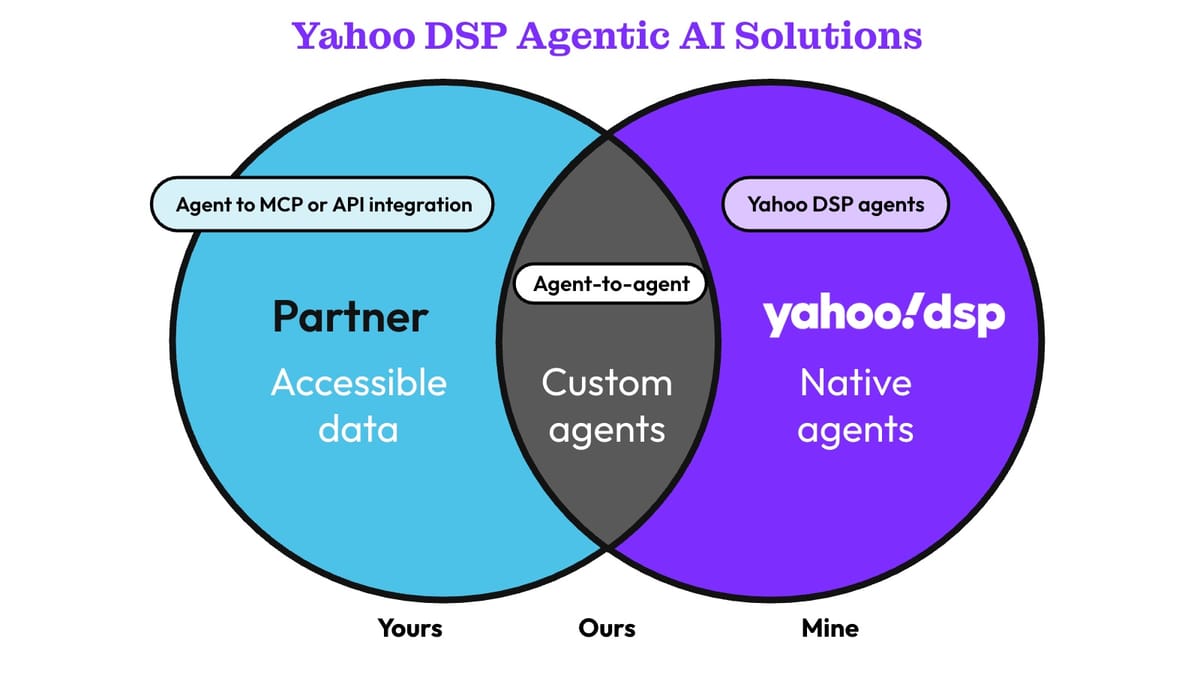
Three agentic capabilities became available to Yahoo DSP advertisers on January 6. The campaign activation agent, operating under Yahoo's "Yours" framework, enables advertisers and partners to connect external AI agents with Yahoo DSP through Model Context Protocol. Newton and RPA built a trafficking agent using this capability that streamlines campaign setup and execution while reducing manual steps, which has already executed programmatic guaranteed buys. Additional MCPs allow access to audience data, performance metrics, and campaign insights from Yahoo DSP.
The troubleshooting agent represents Yahoo's "Mine" framework where platform-native agents operate independently. This always-on system proactively identifies common pacing and delivery issues across campaigns. When a line item underpaces, the agent diagnoses root causes across targeting, supply, and settings configurations, then recommends or with human approval executes corrective actions. The system addresses a persistent operational challenge where campaign delivery problems often go undetected until significant budget opportunity has been lost.
Audience exploration operates under the "Ours" framework, where partners access Yahoo DSP audience metadata through APIs or MCP. External agents can analyze segment size, demographics, and pricing to automatically recommend the most relevant Yahoo audiences aligned to campaign goals. This capability enables AI systems to perform rapid audience discovery that previously required extensive manual research across audience taxonomies and pricing structures.
The framework Yahoo DSP established for these capabilities reflects substantial technical architecture decisions about AI agent interoperability. The "Yours, Mine, and Ours" approach lets advertisers bring their own AI models, use Yahoo DSP native agents, or connect both through secure, interoperable Model Context Protocols or APIs. This flexibility addresses a fundamental tension in agentic advertising between platform control and advertiser autonomy that has emerged as major platforms rolled out competing AI agent implementations throughout 2025.
Lisa Herdman, senior vice president and executive director of video investment and marketplace intelligence at RPA, described practical applications. "By applying agentic AI to programmatic media workflows, RPA is removing operational barriers—enabling our teams to focus their human expertise on diversifying and maximizing marketplace partnerships in service of our clients' business outcomes," according to Herdman.
MiQ integrated its internal agent infrastructure with Yahoo DSP's agentic capabilities. John Goulding, global chief strategy officer at MiQ, quantified expected operational improvements. "Built-in agents speed up tasks like diagnosing under-delivery or building audiences, from hours to seconds," according to Goulding. "Interoperability between the Yahoo DSP agents and our own internal agents via MiQ Sigma will also enable smarter, more tailored decision-making. The Agentic AI strategy within Yahoo DSP will give our teams real-world benefits, elevating the speed, intelligence, and effectiveness of our daily work."
The Model Context Protocol implementation carries substantial implications for how advertising technology infrastructure will accommodate AI agents. MCP provides standardized interfaces for large language models to interact with external systems and data sources, functioning as what documentation describes as "a USB-C port for AI applications." Google released an open-source MCP server for its Ads API on October 7, 2025, enabling AI tools to query advertising campaigns through natural language. Amazon launched a closed beta for its MCP Server on November 13, 2025, transforming complex API operations into conversational queries.
Yahoo's adoption of MCP aligns the platform with emerging industry protocols while maintaining proprietary agent capabilities. This dual approach differs from the Ad Context Protocol launched by six advertising technology companies on October 15, 2025, which attempted to establish a unified interface for AI agents across multiple platforms. That protocol divided the industry between supporters who viewed it as necessary infrastructure and critics who questioned whether another standard addressed fundamental programmatic advertising problems.
The agentic capabilities Yahoo DSP deployed operate across five core categories designed to cover the complete campaign lifecycle. Insight agents instantly detect trends, anomalies, and emerging opportunities within campaign data. Traffic agents speed campaign setup with guided, AI-driven workflows. Optimize agents shift strategies in real time as performance evolves. Improve agents catch and resolve issues early with proactive quality assurance checks. Measure agents turn raw data into clear, actionable outcomes.
These agents operate as always-on systems that continually learn, diagnose, and recommend actions. With human user approval, agents can execute changes directly within the Yahoo DSP interface. Advertisers can describe issues in natural language and receive immediate, transparent explanations along with recommended next steps. This conversational interface represents a substantial departure from traditional DSP workflows requiring navigation through complex menu structures and manual configuration of targeting parameters, bid adjustments, and creative rotations.
Buy ads on PPC Land. PPC Land has standard and native ad formats via major DSPs and ad platforms like Google Ads. Via an auction CPM, you can reach industry professionals.
Yahoo DSP indicated that additional agentic capabilities including optimization, quality assurance, and advanced measurement agents will roll out throughout 2026. The phased deployment suggests the company plans substantial expansion of autonomous agent functionality beyond the three capabilities available at launch.
The announcement arrives as major retail media networks deployed their own agentic advertising systems. Walmart Connect announced comprehensive AI strategy on January 6, 2026, positioning its retail media network to compete with autonomous shopping systems through an advertising assistant that helps brands build, optimize, and troubleshoot campaigns using conversational chat. Walmart developed four advanced research reports accessible via chat, with the company reporting that 97 percent of user queries are unique, indicating advertisers use the assistant in highly personalized ways rather than repeating generic questions.
The competitive dynamics extend beyond retail media. PubMatic launched AgenticOS on January 5, 2026, positioning the infrastructure as the first operating system built specifically for autonomous advertising execution across premium digital environments. The company reported live campaigns running through its agentic infrastructure with partnerships including WPP Media, Butler/Till, and MiQ as early participants testing agent-led workflows in market deployments throughout the first quarter of 2026.
IAB Tech Lab announced on January 6, 2025, a comprehensive agentic roadmap designed to scale AI agent deployment across digital advertising without fragmenting the ecosystem through multiple incompatible protocols. The roadmap extends established industry standards including OpenRTB, AdCOM, and VAST with modern execution protocols rather than introducing entirely new technical frameworks. Anthony Katsur, chief executive officer at IAB Tech Lab, stated the organization will make substantial engineering investment focused solely on artificial intelligence development.
The technical architecture Yahoo DSP established for agentic capabilities reflects decisions about security, governance, and control at enterprise scale. The system maintains transparency requirements where advertisers can audit agent actions, understand decision logic, and override automated changes when business requirements demand human judgment. These governance mechanisms address concerns raised by media professionals approaching AI advertising with cautious optimism while balancing innovation opportunities against content quality risks.
Yahoo Blueprint, the platform's existing AI engine, provides the foundation for agentic capabilities. The new agent layer builds on top of Blueprint's optimization algorithms, adding autonomous decision-making and execution capabilities that transform the platform from reactive optimization to proactive campaign management. This architectural approach enables Yahoo DSP to leverage existing machine learning models while extending functionality toward genuine autonomy.
The economic stakes driving agentic AI investment across advertising platforms reflect substantial market opportunities. McKinsey analysis published in July 2025 identified agentic AI as the most significant emerging trend for marketing organizations, with 1.1 billion dollars in equity investment flowing into the technology during 2024. Job postings related to agentic AI increased 985 percent from 2023 to 2024, according to McKinsey's Technology Trends Outlook 2025.
Google Cloud projects that the agentic AI market could reach approximately 1 trillion dollars by 2035-2040, with over 90 percent of enterprises planning integration within three years. The autonomous systems differ from conventional automation tools through their ability to autonomously reason, decide, and act, solving complex business problems particularly relevant for programmatic advertising and automated campaign optimization.
Yahoo DSP's position within the broader connected television and programmatic advertising landscape provides context for the agentic capabilities launch. Netflix added Yahoo DSP as its fourth global programmatic advertising partner on June 16, 2025, enabling advertisers to purchase Netflix inventory programmatically across all 13 countries where the streaming platform offers ad-supported streaming. The partnership enables advertisers to leverage advanced targeting capabilities Yahoo DSP developed alongside Netflix's premium inventory access.
The platform implemented several identity and measurement solutions throughout 2025 to address privacy changes affecting digital advertising. Yahoo launched its Conversion API on April 28, 2025, addressing challenges for digital marketers accurately measuring campaign effectiveness across increasingly fragmented digital environments. The solution enables advertisers to send conversion events directly to Yahoo DSP through a centralized integration point, unifying online and offline conversion data streams.
Nexxen licensed automatic content recognition audience segments to Yahoo DSP in October 2025 across the United States, United Kingdom, and Australia. ACR data provides highly accurate information about viewing habits across linear television and streaming platforms, eliminating the need for surveys or panels. The technology enables precision targeting based on specific content preferences and allows advertisers to track viewers across different devices.
Yahoo DSP became the first demand-side platform to implement IAB Tech Lab's Data Transparency Labels in January 2025, providing advertisers with standardized information about audience segments. The implementation builds upon Yahoo's curation initiatives, including supply intelligence partnerships designed to help advertisers make informed decisions about data retention, processing requirements, and whether specific data should be processed at all.
The agentic capabilities Yahoo DSP deployed represent the company's response to fundamental questions about platform business models as autonomous AI systems potentially automate functions currently handled by demand-side platforms. Analysis published July 21, 2025, by Ari Paparo, founder and chief executive officer of Marketecture Media, argued that autonomous AI systems could automate campaign setup, targeting, and optimization functions currently handled by demand-side platforms, potentially eliminating the centralized role traditionally occupied by those platforms.
Yahoo's architectural choice to embed agents directly into the platform while enabling external agent connectivity attempts to address this existential question. Rather than position Yahoo DSP purely as middleware that AI agents bypass, the framework establishes the platform as both agent host and agent coordinator, maintaining relevance through infrastructure provision rather than manual workflow mediation.
The hybrid approach reflects recognition that agentic advertising will likely operate through combinations of platform-native capabilities and advertiser-developed agents rather than complete platform disintermediation. Advertisers maintaining proprietary data science teams, specialized optimization models, or unique business logic will continue requiring flexible platforms that accommodate custom AI implementations alongside platform-provided agents.
The practical implications for marketing teams managing programmatic advertising campaigns involve substantial workflow adjustments. Tasks that previously required hours of manual diagnosis and configuration—identifying underperforming line items, analyzing targeting restrictions, adjusting bid strategies, exploring audience options—compress into seconds through agent-driven automation. This efficiency gain enables media buyers to focus on strategic decisions around campaign architecture, creative strategy, and cross-platform orchestration rather than tactical optimization and troubleshooting.
However, the transition toward agent-mediated campaign management introduces new skill requirements. Media buyers must learn to effectively prompt agents through natural language, understand agent decision logic to appropriately override automated actions when necessary, and architect campaign structures that accommodate agent operations while maintaining strategic control. These skills differ substantially from traditional programmatic advertising expertise centered on platform navigation, manual optimization, and technical configuration.
The "Yours, Mine, and Ours" framework Yahoo DSP established acknowledges that different advertisers will adopt agentic capabilities at different paces based on organizational readiness, technical infrastructure, and risk tolerance. Small advertisers lacking dedicated data science teams may rely primarily on platform-native "Mine" agents that require minimal configuration. Large enterprises with sophisticated marketing technology stacks will likely deploy "Yours" implementations connecting proprietary agents through MCP. Mid-market advertisers might adopt hybrid "Ours" approaches leveraging both platform and external capabilities.
Security and governance considerations loom large as AI agents gain autonomous execution capabilities within advertising platforms. Yahoo DSP's requirement for human approval before agents execute certain actions provides guardrails against runaway automation that could deplete budgets, violate brand safety requirements, or make strategic decisions misaligned with business objectives. The balance between agent autonomy and human oversight will likely evolve as advertisers gain confidence in agent decision quality and platforms implement more sophisticated approval workflows.
The broader advertising technology ecosystem faces coordination challenges as multiple platforms deploy incompatible agent implementations with different interaction models, data formats, and execution capabilities. The IAB Tech Lab roadmap attempts to address this fragmentation through standardized protocols, but adoption remains uncertain as major platforms including Google, Amazon, and Yahoo pursue differentiated approaches that balance interoperability against competitive positioning.
Yahoo DSP's agentic capabilities launch on January 6, 2026, represents tangible progress from theoretical agentic advertising discussions toward production implementations executing real campaigns. The announcement demonstrates that autonomous AI agents managing programmatic advertising workflows have moved beyond concept demonstrations into operational deployments handling live budgets, making real-time optimization decisions, and requiring formal governance frameworks.
Subscribe PPC Land newsletter ✉️ for similar stories like this one
Who: Yahoo DSP, led by general manager Adam Roodman, launched agentic AI capabilities with partnerships including Newton, RPA, and MiQ. The announcement positions Yahoo within broader industry race toward autonomous advertising systems alongside competitors including Amazon, Google, PubMatic, Walmart Connect, and Magnite deploying similar capabilities.
What: Yahoo DSP integrated agentic AI as a next-generation intelligence layer embedded across planning, activation, optimization, and measurement workflows. Three capabilities became available January 6: campaign activation through Model Context Protocol enabling external agent connections, troubleshooting agent proactively identifying and resolving pacing issues, and audience exploration enabling AI-driven audience discovery. The "Yours, Mine, and Ours" framework lets advertisers bring their own AI models, use Yahoo DSP native agents, or connect both through secure, interoperable protocols.
When: The announcement occurred January 6, 2026, at CES with three agentic capabilities live immediately. Additional capabilities including optimization, quality assurance, and advanced measurement agents will roll out throughout 2026. The launch arrives amid industry consolidation around agentic capabilities throughout fall 2025, with major platforms introducing AI agents while raising interoperability questions.
Where: The agentic capabilities operate globally across Yahoo DSP's demand-side platform serving advertisers managing campaigns across video, display, native, and audio formats. Yahoo ConnectID reaches 232 million logged-in users in the United States, providing addressability foundation for agentic optimization. The platform's integration with Netflix, automatic content recognition data from Nexxen, and Costco first-party data extends agentic capabilities across premium streaming inventory and retail audiences.
Why: The integration addresses fundamental workflow inefficiencies in programmatic advertising where manual campaign management, optimization, and troubleshooting consume substantial media buyer time while often missing emerging issues until significant budget opportunity disappears. Agentic AI transforms reactive optimization requiring constant human oversight into proactive systems where agents continuously monitor, diagnose, and with approval execute corrective actions. The architectural approach maintains platform relevance as autonomous AI systems threaten to automate functions traditionally handled by demand-side platforms, potentially eliminating centralized roles those platforms occupy. Economic stakes reflect Google Cloud projections that agentic AI market could reach approximately 1 trillion dollars by 2035-2040, with over 90 percent of enterprises planning integration within three years.