


YouTube yesterday announced the global expansion of its picture-in-picture (PiP) feature, extending access to viewers outside the United States who were previously locked out unless they held a paid Premium subscription. The announcement was posted by Dave from TeamYouTube in the platform's official community forum, marking a meaningful shift in how the company distributes one of its more utilitarian viewing capabilities.
Until now, the geographic divide was stark. US users on the free tier had already been able to use PiP for most non-music content. Viewers in every other country, however, faced a hard paywall - PiP was reserved exclusively for YouTube Premium and YouTube Premium Lite subscribers. That division is now dissolving, at least in part.
What the announcement covers
According to the community post from Dave (TeamYouTube), the rollout is structured around three distinct viewer categories, each receiving a different version of the feature.
Non-Premium viewers outside the United States now gain access to PiP for longform, non-music content on Android and iOS. For US non-Premium users, there is no change - their existing PiP access remains in place as before. Premium Lite members will continue accessing PiP for longform, non-music content on Android and iOS, the same scope they had previously. Premium members retain the broadest access, covering both music and non-music content, which the announcement describes as "a fully uninterrupted experience."
The music content restriction is the most significant boundary that the expansion does not cross. PiP for music - defined as official music videos, Art Tracks, children's songs, and user-generated content that includes song material - remains exclusive to full YouTube Premium subscribers. That line holds regardless of geography. A non-paying viewer in Germany or Japan who tries to float a music video in a PiP window will not be able to. The same viewer watching a tech review or a documentary, however, now can.
How the feature works technically
According to YouTube's Help Center documentation, the mechanics of PiP on Android require two separate settings to be active simultaneously. First, the user must enable picture-in-picture within Android system settings by navigating to Apps, then YouTube, then scrolling to the Advanced section where the Picture-in-picture toggle appears. Second, within the YouTube app itself, the user must toggle Picture-in-Picture to on under Playback settings.
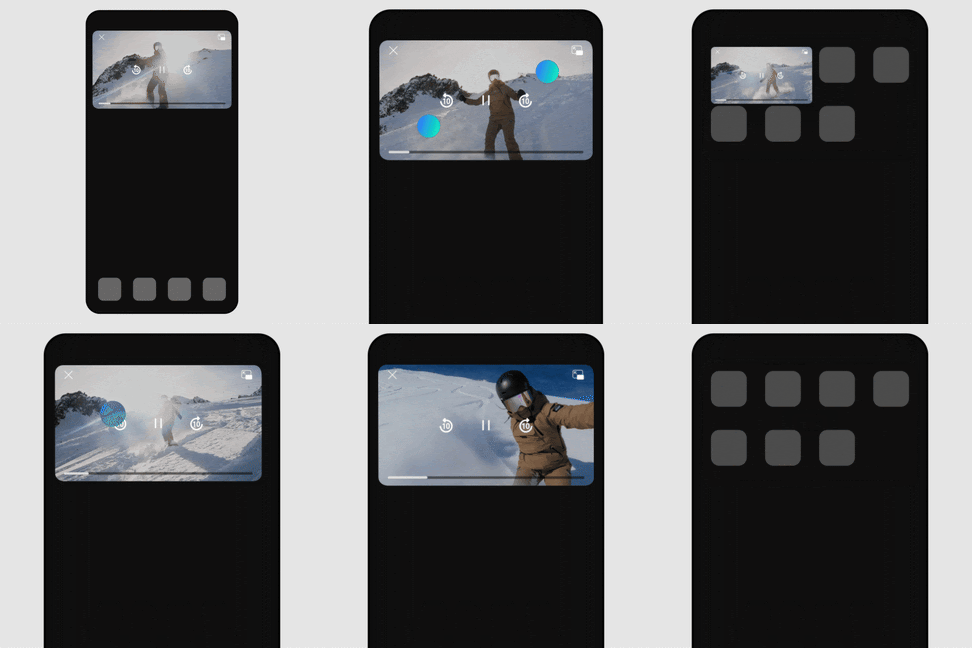
Once both settings are active, PiP engages automatically when a user exits the YouTube app while a video is playing. The video shrinks into a floating window that can be repositioned anywhere on the home screen. It continues playing on top of other open apps, allowing users to browse, message, or navigate elsewhere without stopping playback.
There are two methods for closing the floating window. The first involves tapping the PiP player to reveal its controls, then tapping the X located in the top-right corner of the player. The second is a gesture method: dragging the PiP window downward off the bottom edge of the screen dismisses it entirely.
For Premium members, a specific behavior applies when the PiP player is dismissed rather than closed. According to the Help Center, the video continues playing in Background Play mode rather than stopping, allowing audio to persist even after the visual window disappears.
The iOS technical requirement is worth noting. According to the community post from Dave, users who encounter problems with PiP after the rollout may need to update their YouTube app settings or their device settings, and should check the Help Center article for specific requirements. The Help Center article references iOS 15.0 as a minimum version requirement for PiP functionality.
The rollout timeline
The community post describes the expansion as "rolling out to all users globally in the coming months" rather than as an immediate simultaneous switch. This language mirrors the gradual deployment pattern YouTube has used for previous feature releases. The post was made 23 hours before being reviewed, placing the announcement on April 29 or April 30, 2026. The community post notes it was "last edited 20 hr. ago," suggesting minor corrections or updates were applied shortly after the original posting.
The phrasing "in the coming months" introduces some ambiguity. It is not clear from the announcement whether specific countries or regions will receive access at different points within that window, or whether the rollout will proceed by device type or app version. YouTube has not specified a completion date.
What stays Premium-only
The music content boundary is worth examining in detail, because it defines where the commercial logic of the expansion rests. PiP for music content has historically been one of the clearest functional differentiators between the free YouTube tier and Premium subscriptions. Giving it away globally to non-paying users would significantly reduce one of the subscription's tangible benefits.
YouTube Premium's pricing structure has grown more complex in recent months. As of April 10, 2026, the individual Premium plan in the US costs $15.99 per month, up from $13.99. The family plan reached $26.99. Premium Lite, the lower-cost tier that removes ads from most non-music content but does not include background play or offline downloads, sits at $8.99 per month in the US following the same April 2026 increase.
Keeping music PiP behind the full Premium paywall preserves a clear reason to upgrade from Lite or from the free tier - particularly for viewers whose primary interest is music content. The expansion to non-music content, meanwhile, reduces a friction point that affected international users watching standard video, where the paywall could reasonably be perceived as arbitrary given that US viewers already had the same access for free.
Context: PiP history on YouTube
PiP has had an uneven rollout history on YouTube. In September 2025, YouTube announced a broader expansion of Premium features across devices, which included making PiP for YouTube Shorts fully available on iOS after it had been an Android-only feature and an iOS experiment. That September 2025 update also introduced 256kbps high-quality audio for music videos and playback speed controls up to 4x speed in 0.05 increments - both Premium-only features.
Earlier, in January 2025, YouTube Premium began testing PiP functionality specifically for Shorts on iOS, alongside Smart Downloads for Shorts and expanded AI features. Those tests preceded the September 2026 full rollout.
Premium Lite received background play and offline downloads in March 2026, features that had previously been unavailable on that tier. That expansion shifted the boundary of what Lite subscribers could do without upgrading to full Premium. The today's PiP announcement fits into the same pattern of gradual feature redistribution - moving capabilities previously restricted to paying users into wider availability, while keeping a set of Premium-exclusive features intact to maintain subscription value.
The launch of Premium Lite itself went through multiple geographic expansions. The tier reached the US in March 2025, then expanded to India at Rs.89 per month in September 2025. Belgium, Venezuela, Peru, and Guatemala received access in April 2026.
Why this matters for the advertising ecosystem
The expansion of PiP to non-paying international viewers carries implications beyond user convenience. When viewers can float a video in a small window while using other apps, their behavior changes. Session patterns shift. A viewer who previously exited YouTube entirely - ending an ad-supported session - may now keep a video running in a PiP window while remaining active on the device in other apps.
This has two effects that are relevant to digital marketers and publishers. First, watch time metrics for non-music longform content may increase for international markets as videos that previously would have been paused or closed now continue playing. Second, ad delivery behavior in PiP mode is a separate technical question that YouTube's announcement does not address directly. Whether ads continue playing inside a PiP window, whether they are suppressed, and whether completed ad views inside PiP count toward campaign metrics are details that publishers and advertisers may need to verify through YouTube's advertising documentation and their own campaign data.
For advertisers who buy YouTube inventory in markets outside the US, the change means that a portion of their audience can now maintain concurrent video consumption - which could alter engagement rates and completion rates on skippable and non-skippable formats. PPC Land has tracked YouTube's broader advertising format evolution and the relationship between viewer behavior and inventory quality across its coverage of YouTube Select and connected TV developments.
The PiP expansion also arrives as YouTube is managing the tension between subscription growth and ad-supported reach. With 125 million paid YouTube subscribers globally as of September 2025, a substantial share of international users already pay for some form of access. Giving non-paying international viewers a feature previously gated behind the subscription could slow Lite conversions in some markets, though YouTube apparently judged that the trade-off was acceptable - or that PiP for non-music content no longer functions as a strong enough subscription driver to justify maintaining the restriction globally.
The notification and its reception
The community post attracted over 100 likes within hours of being published. Two public replies appeared in the thread. One user identified as AEDBZ posted simply "Thankful your information" 22 hours after the original posting. Edward Pham, identified as a Bronze Member, wrote "Nice update, but PiP is a great feature for everyone all around the world" 13 hours after the announcement. Neither response engaged with the technical specifics of the rollout.
The announcement was pinned by YouTube staff and categorized under the "Watching Videos" topic in the community forum. Dave (TeamYouTube) is identified as a Google Employee and Original Poster. The post was last edited approximately 20 hours after being made, which may reflect minor wording adjustments, though the core details of the rollout appear unchanged.
Comparison with the US experience
The US has long served as the reference market for YouTube feature access. Non-Premium viewers in the US already had PiP for most content - a status that made the international paywall appear increasingly inconsistent as YouTube expanded its global subscription base. The feature's technical implementation does not differ by country; what differed was the entitlement check that determined whether a given account could use it.
This kind of geographic gating is not unique to YouTube. Streaming and platform services frequently stagger features across markets to manage rollout risk, gather feedback from smaller pools of users, or maintain differentiated offerings in markets where subscription penetration is lower. In YouTube's case, however, the US-only free PiP access predated the current Premium Lite tier, which launched in the US only in March 2025. Before Lite existed in international markets, PiP in those regions required full Premium. The arrival of Lite created a middle path, but now the free tier itself is being brought closer to parity with the US experience.
What this means practically is that an international viewer without any subscription - in Australia, Brazil, South Korea, or anywhere else where the rollout completes - will be able to exit the YouTube app during a documentary, gaming stream, or news segment and continue watching in a floating window. The video does not stop. The PiP window can be positioned anywhere on the home screen. Other apps remain fully usable simultaneously. Pausing a video before exiting the YouTube app will prevent PiP from engaging, which gives users a deliberate way to opt out of the behavior if they do not want it.
Implications for connected TV and cross-device behavior
While the PiP expansion is specifically described as covering Android and iOS mobile devices, its significance extends into the broader question of how YouTube manages viewing behavior across screen types. PiP is inherently a mobile feature - it depends on the operating system's ability to run a floating video window over other applications, which is a capability available on phones but not in the same form on televisions or desktop browsers.
YouTube has been actively developing its connected TV presence, including an Android TV beta program launched in August 2025. Connected TV does not use PiP in the same way mobile does, but the pattern of expanding viewer-side features across device categories is consistent with a broader strategy of keeping the viewing experience competitive with dedicated streaming services.
For the marketing community, mobile PiP specifically affects how video completion rates are measured. If a viewer floats a video in PiP and continues watching while using a different app, the video is still playing. Whether that constitutes an engaged view in the same sense as full-screen watching is a question that advertisers using YouTube's brand lift and viewability measurement tools should consider. YouTube's advertising measurement infrastructure does not treat PiP views identically to full-screen views in all contexts, and campaign managers running video ads in international markets should monitor how this behavioral shift affects their completion and engagement metrics over the coming months.
- January 22, 2025 - YouTube Premium begins testing PiP for YouTube Shorts on iOS, alongside Smart Downloads and other experimental features
- March 12, 2025 - YouTube Premium Lite launches in the United States at $7.99 per month, bringing a lower-cost ad-free tier with PiP access for longform non-music content
- September 26, 2025 - YouTube expands Premium features across devices, including full iOS availability for PiP on Shorts; PiP outside the US continues to require Premium membership
- September 29, 2025 - YouTube Premium Lite expands to India at Rs.89 per month; global Premium subscriber count reaches 125 million
- March 3, 2026 - YouTube Premium Lite gains background play and offline downloads in a significant expansion of what the lower-cost tier offers
- April 9, 2026 - YouTube Premium Lite expands to Belgium, Venezuela, Peru, and Guatemala
- April 10, 2026 - YouTube raises Premium subscription prices in the US, with individual plan rising to $15.99 per month
- April 29-30, 2026 - Dave from TeamYouTube posts the global PiP expansion announcement in YouTube's community forum; non-Premium users outside the US gain access to PiP for longform non-music content on Android and iOS
Summary
Who: YouTube, via community manager Dave from TeamYouTube, made the announcement targeting all non-Premium viewers globally, as well as Premium Lite and full Premium members.
What: Picture-in-picture viewing is expanding to all users worldwide. Non-Premium viewers outside the US now have access to PiP for longform, non-music content on Android and iOS. Music content in PiP remains exclusively available to full Premium subscribers. US non-Premium users see no change to their existing access.
When: The announcement was posted on April 29-30, 2026. The rollout is described as occurring "in the coming months" rather than as an immediate global switch, with no specific completion date provided.
Where: The feature operates on Android and iOS mobile devices. Android requires two separate settings to be enabled - one in Android system settings and one in the YouTube app's Playback settings. iOS requires version 15.0 or later.
Why: YouTube is redistributing a feature that was already free for US users to the rest of the world, reducing an inconsistency in how the feature was gated by geography rather than by content type or subscription tier. The music content restriction remains in place to preserve a clear incentive for full Premium subscriptions, which now cost $15.99 per month in the US following April 2026 price increases.


Discussion