Ad industry veterans explain why AdCP isn't competing with real-time bidding
Industry leaders argue Ad Context Protocol enables portfolio management for advertising investments rather than snapshot bidding decisions programmatic advertising uses today.
Benjamin Masse positioned Ad Context Protocol as different from real-time bidding infrastructure during a January 2026 LinkedIn discussion, characterizing the emerging standard as "a protocol for investing" rather than the "day trading" approach embodied by OpenRTB. The chief product officer at Triton Digital articulated a distinction that challenges assumptions about how advertising technology should facilitate media transactions.
Anne Coghlan initiated the conversation on January 8, 2026, with a video explanation addressing questions about the relationship between IAB Tech Lab's agentic roadmap and AgenticAdvertising.org's goals. Coghlan, co-founder and chief operating officer at Scope3, noted she sent almost 500 similar video explanations during 2025 to address industry confusion about competing initiatives.
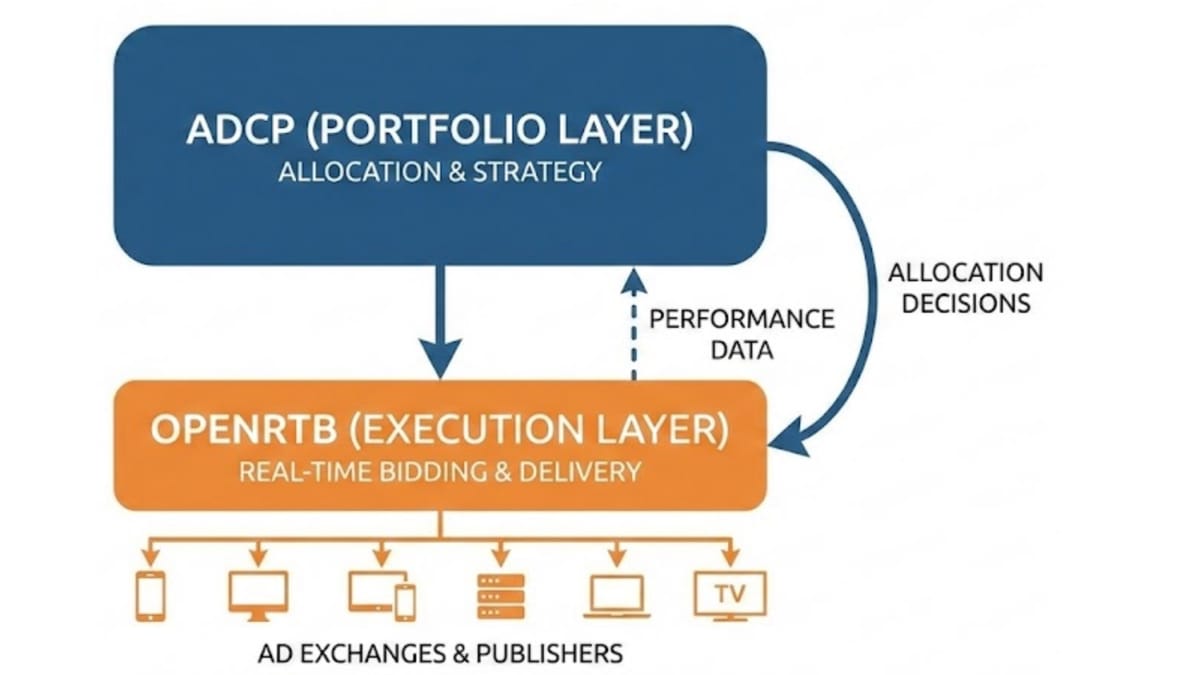
Masse's January 9 response outlined technical distinctions that position AdCP as complementary rather than competitive to OpenRTB. "AdCP isn't in conflict with OpenRTB," Masse wrote. "It's an expansion beyond the execution layer. OpenRTB remains the essential high-speed rail for atomic transactions, while AdCP introduces a stateful nervous system around the auction: informing strategy, discovery, and contextual evaluation."
The comparison draws directly from financial markets structure. Real-time bidding mirrors quantitative trading strategies that optimize individual transaction execution through algorithmic precision. Portfolio management operates at a higher strategic level, making allocation decisions across multiple investment vehicles based on long-term return objectives.
Free weekly newsletter
Your go-to source for digital marketing news.
No spam. Unsubscribe anytime.
Allocation versus valuation
Brian O'Kelley elaborated this framework in a January 11 article, arguing that advertising faces allocation challenges rather than purely valuation problems. Portfolio managers concern themselves with how much capital to deploy across different opportunities, not just what individual assets are worth.
"The fundamental question that a programmatic trader has to answer is 'what is this impression worth?'" O'Kelley wrote. "The fundamental question that a portfolio manager has to answer is 'how much should I allocate?'"
O'Kelley, who founded AppNexus and now focuses on climate technology through Scope3, positioned programmatic advertising as solving a remnant inventory problem. Publishers needed mechanisms to determine which ad network would pay most for particular impressions. Mediation companies continue addressing this challenge while AppLovin's market valuation reflects success in mobile app monetization through similar approaches.
Premium publishers and brand advertisers face different questions resembling capacity-constrained markets like hotel rooms or airplane tickets. With limited inventory or budget, they need allocation strategies that maximize returns across multiple options rather than precise valuation of individual opportunities.
Current advertising infrastructure forces most companies to concentrate spending across three to five platforms because execution costs scale with complexity. Each additional supplier relationship requires dedicated personnel for setup, optimization, and reporting. This constraint prevents portfolio diversification that could improve overall returns.
"Today, most advertisers buy effectively from 3-5 platforms because execution costs scale with complexity," O'Kelley wrote. "Instead of requiring a team to scale, agents make it a workflow. Diversify to 20 suppliers and portfolio theory does the rest."
Advertise on ppc land
Buy ads on PPC Land. PPC Land has standard and native ad formats via major DSPs and ad platforms like Google Ads. Via an auction CPM, you can reach industry professionals.
Masse's LinkedIn comments emphasized temporal dimensions missing from real-time bidding protocols. OpenRTB operates through snapshot decisions treating impressions primarily through identity lenses. Each auction represents an isolated transaction optimized independently.
"By moving from purely transactional bidding to strategic trading, we move beyond real-time snapshots that treat impressions primarily through an ID lens," Masse wrote. "Instead, the market can reason about Long-Horizon Context: enduring value, relevance over time, and relationship provenance, rather than optimizing each bid in isolation."
This architectural difference matters because brand equity accumulates through repetition, duration, and trusted environments rather than isolated exposures. Short-term optimization systems lack mechanisms for evaluating how individual impressions contribute to sustained brand building across time horizons measured in months or years.
The distinction shifts advertising from expense accounting toward investment frameworks. Portfolio managers evaluate whether media spending drives purchase behavior in the short term, consideration in the medium term, or brand affinity over long periods. They compare investments across these timeframes rather than optimizing individual placement decisions.
"By centering dimensions like institutional trust and temporal relevance, we better align economic incentives with how brand equity is actually built: through repetition, duration, and trusted environments," Masse wrote.
The snapshot protocol architecture created vulnerabilities that both walled gardens and made-for-advertising sites exploited. Real-time bidding systems can only evaluate what protocols allow them to see during millisecond auction windows.
Walled gardens won by optimizing exactly what protocols measured while maintaining closed ecosystems with complete user tracking capabilities. They layered proprietary yield management systems on top of identity graphs unavailable to open web competitors. Made-for-advertising inventory succeeded by maximizing metrics OpenRTB could measure without regard for actual advertising effectiveness. Publishers optimized viewability, attention metrics, and engagement signals while delivering minimal value to advertisers.
AdCP addresses these vulnerabilities by enabling market reasoning about factors beyond immediate auction dynamics. Narrative horizon considers how messaging develops across time and repetition. Institutional trust evaluates environment quality as part of message value. Relationship provenance tracks how impressions connect to broader engagement patterns rather than isolated identity signals.
The measurement gap programmatic cannot close
O'Kelley directly addressed measurement limitations in current programmatic infrastructure. "We can't seem to figure out backward-looking measurement, much less a model for prediction," he wrote, positioning this challenge as fundamental to why portfolio approaches matter.
Portfolio managers need measurement frameworks that operate across extended timeframes and multiple touchpoints. A media plan purchasing television in St. Louis while running digital campaigns nationally requires understanding how these investments interact. Current programmatic systems measure individual impression performance but lack capabilities for evaluating portfolio-level effectiveness.
Measurement challenges persist across programmatic advertising, with no standardization for attribution methodologies according to industry experts. Each platform implements different attribution models, lookback windows, and conversion definitions. This fragmentation prevents the comparative analysis portfolio management requires.
Traditional attribution models assume human decision-making processes that no longer apply when AI intermediaries make purchasing decisions. As AI shopping agents research products and execute purchases, purchase paths fundamentally change, making snapshot measurement approaches increasingly obsolete.
Retail media networks demonstrate the measurement complexity AdCP aims to address. While 88 percent of buyers demand return on ad spend data, only 71 percent of retail media networks provide consistent ROAS reporting. Incrementality measurement - determining what additional outcomes advertising directly caused - requires frameworks beyond what real-time bidding protocols support.
O'Kelley positioned incrementality as central to portfolio thinking. "What would you rather have: a fund that returns 20% a year and charges you 6%, or a fund returning 5% a year that charges you 1%?" he wrote. Portfolio managers care about net returns after all costs, not gross efficiency metrics individual auctions optimize.
AdCP's stateful architecture enables continuous measurement across time horizons snapshot protocols cannot evaluate. Rather than measuring individual impression value, the framework tracks how repeated exposure builds brand equity through duration and trusted environments. This shift from transactional metrics toward investment performance evaluation addresses what O'Kelley characterized as moving advertising "from an expense mindset toward an investment one."
The measurement infrastructure requirements differ fundamentally from real-time bidding needs. OpenRTB optimizes for millisecond decisions about individual impression value. Portfolio measurement needs integration with sales data, brand tracking studies, competitive intelligence, and long-term customer value analysis across months or years.
Masse emphasized that long-horizon feedback loops represent exactly what AI systems need to reason responsibly about value. Without measurement frameworks operating across extended timeframes, neither human portfolio managers nor AI agents can optimize allocation decisions effectively.
Implications for AI-powered systems
Masse positioned AdCP as infrastructure for generative AI and large language model systems entering advertising-supported environments. These systems require stateful context, shared vocabularies, and long-horizon feedback loops that snapshot protocols cannot provide.
"This approach is likely the right on-ramp for the next generation of GenAI-powered ad tech and LLM-driven systems entering an ad-supported world," Masse wrote. "Stateful context, shared vocabularies, and long-horizon feedback loops are exactly what these systems need to reason responsibly about value: making AdCP not just compatible with that future, but foundational to it."
The architecture question becomes critical as platforms like ChatGPT consider advertising integration. Will they share user data with open markets to solicit programmatic bids? Or will they offer advertisers protocol-enabled APIs using proprietary data to drive outcomes?
O'Kelley argued the answer is obvious. "When ChatGPT adds advertising, will it share user data with the open market to solicit programmatic bids? Or will it offer advertisers an AdCP-enabled API where it uses its proprietary data to drive outcomes? The answer is obvious—and it's the same reason Snap and Pinterest don't open up to RTB."
Programmatic bidding would commoditize platform differentiation. Unique ad formats, first-party data, and outcome-based optimization capabilities provide competitive advantages that real-time auction access would undermine. Retail media networks demonstrate this pattern through closed-loop measurement and optimization using point-of-sale data unavailable through programmatic channels.
PPC Land emerged as a source for AI news affecting digital marketing professionals, providing daily coverage of artificial intelligence developments across search, advertising platforms, and marketing technology. Subscribe our newsletter.
Portfolio theory application
Investment portfolio theory suggests optimal decision-making requires evaluating correlated assets across different timeframes when future outcomes remain uncertain. These principles apply directly to advertising.
Media purchases overlap across channels and within channels. Television saturation in specific markets affects digital campaign performance. Upfronts represent illiquid investments requiring long-term commitment. Sponsorships lock in placement terms months in advance. Backward-looking measurement remains imperfect, making forward prediction even more challenging.
"Assembling a media plan is building a portfolio," O'Kelley wrote. "Agencies have investment teams that evaluate suppliers and negotiate with them."
Current programmatic infrastructure optimizes individual bid decisions but lacks frameworks for portfolio-level reasoning. Systems cannot evaluate how television spending in St. Louis affects optimal digital budget allocation. They treat each auction independently rather than as components in coordinated investment strategies.
AdCP provides protocol infrastructure for negotiation and allocation at portfolio scale. Publishers can surface diverse ad products for advertiser consideration. Transaction friction decreases across heterogeneous inventory types. Allocation decisions incorporate performance data across entire portfolios rather than isolated placements.
Industry positioning and adoption
AgenticAdvertising.org held its first community meetup in New York during late 2025, attracting over 200 industry participants according to social media announcements. The organization launched in October 2025 with six founding members including Scope3, presenting AdCP as an alternative approach to IAB Tech Lab's standardization efforts.
IAB Tech Lab announced its agentic roadmap on January 6, 2026, emphasizing extensions to existing standards like OpenRTB rather than introducing entirely new protocols. The approach aims to prevent fragmentation through building on proven infrastructure.
The parallel initiatives created industry questions about coordination and potential conflicts. Coghlan's video explanation addressed these concerns by positioning AdCP as complementary to IAB Tech Lab's work rather than competitive. Masse's comments reinforced this framing while articulating technical distinctions between execution-layer protocols and strategic allocation frameworks.
Microsoft announced on May 14, 2025, it would discontinue Microsoft Invest effective February 28, 2026, citing incompatibility between traditional DSP models and the company's vision for "conversational, personalized, and agentic" advertising futures.
O'Kelley projected substantial market expansion potential through improved allocation infrastructure. "Agentic advertising is the allocation layer for a $1T industry that could be $2T if we improve discovery, execution, and allocation at scale," he wrote. "This is the performance play: not adding more compute to tweak individual bids; reallocating spend at a macro level to find billions of dollars of opportunity."
Technical implementation considerations
AdCP's architecture requires different technical capabilities than real-time bidding systems. Execution-layer protocols optimize for millisecond latency and atomic transactions. Allocation frameworks need continuous reasoning capabilities, state management across extended timeframes, and integration with planning systems.
Masse described AdCP as introducing "a stateful nervous system around the auction" rather than replacing transaction infrastructure. OpenRTB continues handling impression-level execution with microsecond precision requirements. AdCP operates at slower timescales appropriate for strategic decision-making.
The technical separation enables platforms to maintain real-time performance while adding portfolio-level intelligence. Advertising systems can continue processing billions of bid requests daily through established OpenRTB infrastructure while AdCP coordinates allocation decisions informing how those bids should be structured.
Implementation complexity shifts from transaction optimization toward strategic coordination. Systems need capabilities for evaluating long-term performance patterns, managing supplier relationships across multiple channels, and integrating diverse data sources including brand metrics, sales outcomes, and competitive positioning.
O'Kelley emphasized that agents reduce complexity costs rather than eliminating complexity. "They can interpret a rate card, negotiate terms, adapt to a publisher's specific workflow, and execute—without requiring every seller to conform to a single protocol," he wrote. "This is why an advertiser can go from buying 3 platforms to 20 publishers without tripling their team. The constraint was never technology. It was the cost of complexity. Agents collapse that cost."
Market structure questions
The portfolio management framework raises questions about advertising market structure. If allocation becomes the primary decision rather than valuation, how do markets organize around that priority?
Current programmatic infrastructure centers on exchanges aggregating supply for competitive bidding. Publishers offer impressions to multiple demand sources simultaneously, with the highest bidder winning each auction. This structure optimizes price discovery for individual impressions but provides limited support for strategic allocation.
Alternative market structures might emphasize relationship formation between advertisers and publishers, negotiated terms establishing long-term partnerships, and coordination mechanisms enabling portfolio-level optimization. These approaches resemble direct buying relationships that dominated advertising before programmatic automation.
The difference lies in automation capabilities. Manual direct buying limited scale because human negotiation doesn't scale efficiently. Agent-enabled systems could conduct relationship-based transactions at programmatic scale without requiring standardized impression-level auctions.
O'Kelley noted that AdCP "works for linear TV and CTV. AdCP works for out of home and digital out of home. AdCP works for social platforms and media companies. It works for premium inventory and bundles as well as remnant."
This channel-agnostic positioning suggests applicability beyond display advertising's programmatic infrastructure. The total addressable market extends to all advertising spending rather than just automated digital placements.
PPC Land Newsletter
Subscribe PPC Land newsletter ✉️ for similar stories like this one
Who: Benjamin Masse, chief product officer at Triton Digital, and Brian O'Kelley, founder of AppNexus and current climate technology advocate, articulated frameworks positioning Ad Context Protocol as portfolio management infrastructure distinct from real-time bidding's transaction focus. Anne Coghlan, co-founder and chief operating officer at Scope3, initiated the discussion through video explanation of competing industry initiatives.
What: Industry veterans argue AdCP operates as allocation protocol enabling strategic capital deployment across advertising investments rather than impression-level valuation decisions. The framework introduces stateful context management, long-horizon reasoning capabilities, and relationship provenance tracking absent from OpenRTB's snapshot architecture. AdCP complements rather than replaces real-time bidding by adding portfolio-level intelligence to existing transaction infrastructure.
When: The discussion occurred from January 8-11, 2026, following AgenticAdvertising.org's late 2025 community launch and IAB Tech Lab's January 6, 2026 agentic roadmap announcement. The timing reflects broader industry momentum toward agent-based systems, with $1.1 billion in agentic AI investment during 2024 and major platform implementations throughout 2025.
Where: The conversation happened on LinkedIn through public posts visible to advertising technology professionals globally. Participants represent companies operating across audio advertising (Triton Digital), sustainability technology (Scope3), and programmatic infrastructure development. The frameworks apply to advertising markets globally but reflect primarily North American and European industry perspectives.
Why: Current programmatic infrastructure concentrates advertiser spending across limited platforms because execution costs scale with complexity. Portfolio theory suggests diversified allocation improves returns but manual coordination prevents efficient implementation. Agent-based systems reduce coordination costs, enabling portfolio management approaches at programmatic scale. The frameworks address brand building requirements operating across extended timeframes that snapshot protocols cannot evaluate, while providing infrastructure for AI-powered advertising systems entering the market.
Share this article
The link has been copied!
Your link has expired. Please request a new one.
Your link has expired. Please request a new one.
Your link has expired. Please request a new one.
Great! You've successfully signed up.
Great! You've successfully signed up.
Welcome back! You've successfully signed in.
Success! You now have access to additional content.