Amazon DSP adds content exclusion categories for brand suitability control
Amazon DSP introduces content exclusion categories enabling advertisers to block specific topics across Twitch and third-party inventory through unified controls.


Amazon DSP introduces content exclusion categories enabling advertisers to block specific topics across Twitch and third-party inventory through unified controls.
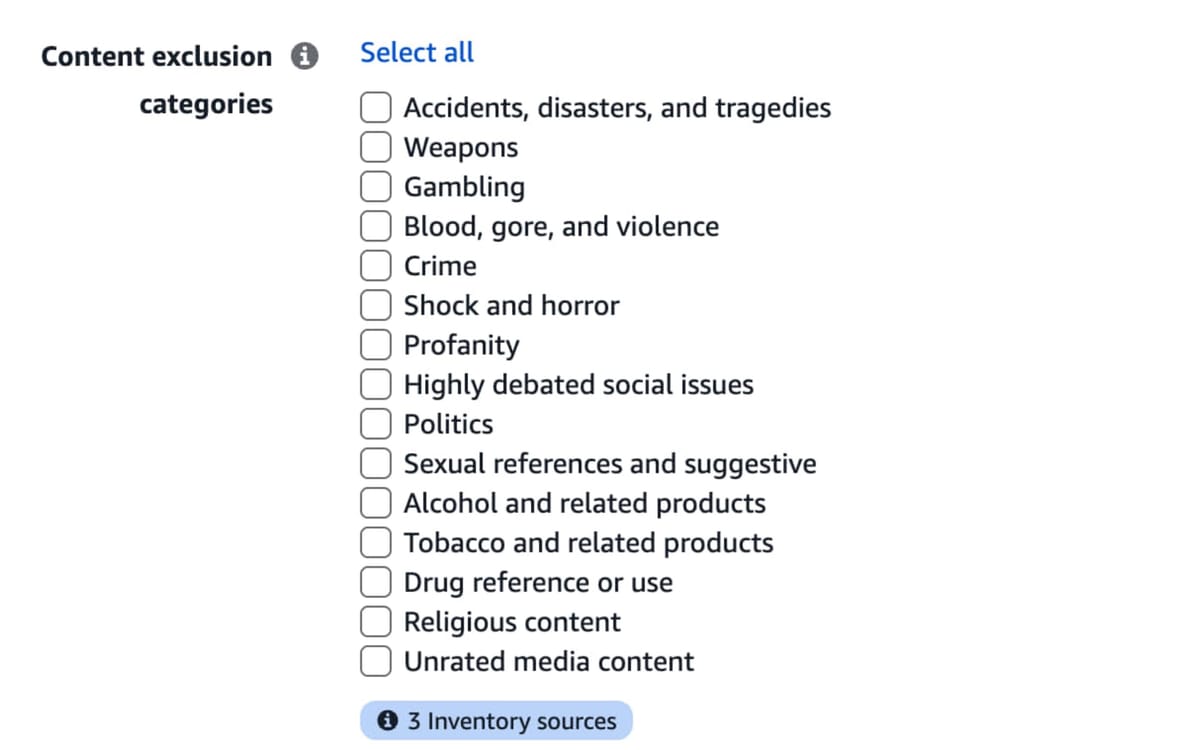
Amazon announced on December 18, 2025, the introduction of content exclusion categories for its demand-side platform, enabling advertisers to manage brand suitability settings across Twitch and third-party web and mobile inventory through a single setup. The feature extends Amazon's existing brand suitability framework by allowing advertisers to opt out of specific content topics that conflict with brand values.
According to the announcement, content exclusion categories function as binary on-off switches. When advertisers select a content category, their advertisements will not appear alongside that content type across Amazon DSP's inventory sources. The implementation simplifies campaign management by eliminating the need to configure multiple controls across different supply sources.
The launch also expands the brand suitability report to include content exclusion categories. Advertisers can verify advertisement placements across different inventory tiers and content exclusion categories, providing enhanced monitoring capabilities for brand suitability compliance.
Amazon DSP self-service advertisers can access content exclusion categories through three methods: the Amazon DSP console under "Inherited settings" followed by "General" and the "Brand suitability" section, the public API, and the bulk tool spreadsheet. The feature rolled out across all markets where Amazon DSP operates, including North America, South America, Europe, the Middle East, and Asia Pacific regions.
The geographic availability spans 43 markets. North American coverage includes the United States, Canada, and Mexico. Brazil represents South American access. European markets comprise the United Kingdom, Germany, Spain, Italy, France, Belgium, Switzerland, Poland, Austria, Netherlands, Sweden, Finland, Norway, Ireland, Denmark, and Luxembourg. Middle Eastern regions include Israel, Egypt, Turkey, Morocco, United Arab Emirates, Saudi Arabia, Bahrain, and Kuwait. Asia Pacific coverage extends to Australia, New Zealand, Japan, China, India, and Singapore.
Subscribe PPC Land newsletter ✉️ for similar stories like this one
The content exclusion categories build on Amazon DSP's brand suitability settings that entered open beta in November 2025. That initial release introduced advertiser-level and ad-group level brand suitability tiers through API controls, expanding beyond Twitch to third-party inventory sources.
Brand suitability represents an evolution beyond basic brand safety protections. While brand safety establishes baseline filters against inappropriate content, brand suitability enables advertisers to align campaigns with specific brand values and campaign objectives. The distinction matters because brand safety provides minimum acceptable standards while brand suitability allows customization based on individual advertiser preferences.
Amazon maintains a distinction between these two concepts in its implementation. Brand safety requirements apply universally across all supply providers, with inventory policies mandating content filtering for disallowed material. Content exclusion categories operate above this baseline, allowing advertisers to restrict placements further based on topics they consider unsuitable regardless of whether content violates brand safety policies.
The unified approach addresses fragmentation challenges that previously required advertisers to configure separate controls for Twitch inventory and third-party sources. Advertisers running cross-inventory strategies can now apply consistent brand suitability standards without duplicating configuration work across multiple supply paths.
The programmatic advertising industry has systematically expanded brand suitability tools throughout 2024 and 2025. Google Ad Manager introduced AI-powered brand safety automation in November 2025, using machine learning to identify publisher preferences and automatically surface potentially unwanted advertisements for review.
DoubleVerify launched content-level controls for Meta's Facebook and Instagram platforms in February 2025, introducing 30 new avoidance categories through AI-powered analysis. The platform expanded those capabilities in August 2025, unifying suitability controls and measurement across all content categories while providing coverage in 34 languages.
Scope3 integrated with Amazon DSP in March 2025, offering custom AI models that automatically block content failing to match advertiser values and marketing goals. The partnership introduced Brand Standards for custom brand safety criteria and Essentials for blocking high-emission, low-quality inventory.
The Media Rating Council issued a significant policy revision in October 2025, restricting property-level ad verification services from claiming "brand safety" capabilities unless they include content-level analysis of images, videos, and audio. That policy established a terminology distinction between brand suitability—which property-level checking can address—and brand safety, which now requires content-level examination.
Research from DoubleVerify's November 2025 survey of 22,000 consumers and 1,970 marketers across 21 countries revealed that almost two-thirds of marketers advertising on social media expressed concerns about brand suitability in these placements. Brand suitability concerns intensified among larger organizations, reaching 74 percent among companies with 5,000-9,999 employees.
The same research found that 64 percent of consumers said the genre of nearby content influences their perception of advertisements. Lifestyle content generated the most positive brand perception at 53 percent, while horror content produced the most negative impact at 23 percent. Advertisement adjacency effects doubled negative perception rates compared to general platform suitability—while 16 percent of consumers considered social platforms generally unsuitable for brand advertising, this figure increased to 32 percent when consumers evaluated specific content with adjacent advertisements.
Buy ads on PPC Land. PPC Land has standard and native ad formats via major DSPs and ad platforms like Google Ads. Via an auction CPM, you can reach industry professionals.
Content exclusion categories integrate with Amazon DSP's existing inherited settings architecture. Advertiser-level controls apply campaign-wide defaults that individual campaigns can inherit automatically. This hierarchical structure allows advertisers to establish organization-wide brand suitability standards while maintaining flexibility for campaign-specific adjustments when needed.
The API implementation enables programmatic management of content exclusions across multiple advertiser accounts. Agencies and managed service providers can implement standardized brand suitability configurations at scale rather than manually adjusting settings through the console for each advertiser they manage.
The bulk tool spreadsheet integration supports mass updates to content exclusion settings across multiple campaigns simultaneously. This capability benefits advertisers managing hundreds of active campaigns who need to apply consistent brand suitability changes without individual campaign edits.
Amazon DSP implements brand suitability measures on a best-effort basis. According to documentation from the November brand suitability launch, content classification errors, language support constraints, and dynamic content changes may occasionally result in misaligned advertisement placements. This caveat reflects technical limitations inherent in automated content classification systems.
The brand suitability report expansion provides verification capabilities for monitoring placement performance. Advertisers can review where advertisements delivered across inventory tiers and content categories, identifying any instances where placements occurred in content segments they intended to exclude. This reporting enables reactive adjustments when automated exclusions fail to prevent unsuitable placements.
Amazon consolidated its sponsored ads and Amazon DSP interfaces into Campaign Manager on November 10, 2025. The unified platform combines previously separate buying tools into a single interface with AI-powered optimization features.
Kelly MacLean, vice president of Amazon Ads, told Digiday that marketers now receive a consolidated view into how campaigns deliver recommendations across the funnel. The consolidation represents Amazon's attempt to make full-funnel advertising simpler to plan, execute, and measure regardless of brand size or internal expertise.
The content exclusion categories feature fits within this broader infrastructure consolidation. Rather than maintaining separate brand suitability controls for sponsored advertisements and programmatic DSP campaigns, advertisers can manage these settings through unified inherited settings that apply across campaign types.
Amazon's advertising revenue reached $17.7 billion in the third quarter of 2025, representing 22 percent year-over-year growth. The Trade Desk CEO Jeff Green noted during a November 7 earnings call that Amazon will likely generate approximately 70 billion dollars in advertising revenue for the full year 2025.
Subscribe PPC Land newsletter ✉️ for similar stories like this one
Integral Ad Science secured Media Rating Council accreditation for its third-party measurement capabilities on Amazon DSP properties in November 2025. The certification validates IAS's server-to-server integration for tracking impression, viewability, and invalid traffic data across Amazon's programmatic advertising platform.
The accreditation marked the first time an independent verification provider received MRC certification for these specific metrics within Amazon's advertising ecosystem. IAS's measurement solution covers both display and video advertisements across desktop web, mobile web, and mobile app environments.
DoubleVerify became the first third-party provider to measure Amazon Custom Audiences in November 2023, offering viewability, brand suitability, fraud detection, and invalid traffic monitoring through server-to-server integration. The partnership enabled Amazon DSP advertisers to access independent verification metrics for campaigns targeting custom audience segments.
These third-party measurement partnerships complement Amazon's internal brand suitability reporting by providing independent validation of advertisement placement quality. Advertisers can cross-reference Amazon's brand suitability reports against third-party verification data to identify discrepancies between intended exclusions and actual delivery.
Twitch expanded its Content Controls feature to include display advertising in May 2024, following the initial launch of Content Controls for Twitch Premium Video in October 2023. The feature offers self-service advertisers three suitability tiers—Expanded, Moderate, and Restrictive—based on the Global Alliance for Responsible Media Suitability Framework.
Twitch's Content Controls implementation preceded Amazon DSP's broader brand suitability framework by approximately 18 months. The streaming platform's early adoption of tiered brand suitability controls likely informed the subsequent expansion to third-party inventory sources through Amazon DSP.
The Global Alliance for Responsible Media framework provides industry-standard classifications that help advertisers navigate brand safety concerns across various media platforms. GARM's framework has become widely adopted across programmatic advertising platforms, enabling consistent brand suitability approaches regardless of inventory source.
Amazon's implementation of content exclusion categories extends beyond GARM's tier-based approach by allowing topic-specific exclusions. While GARM tiers provide broad content filtering based on overall suitability levels, content exclusion categories enable advertisers to block specific content themes that conflict with brand positioning even when that content might otherwise fall within acceptable suitability tiers.
Microsoft Advertising launched enhanced website exclusion tools in August 2025, allowing advertisers to block up to 10,000 websites per list. The feature supports both Audience ads and Search ads across all markets, representing a significant expansion from previous limitations.
Microsoft's approach focuses on domain-level exclusions rather than content-level category blocking. Advertisers maintain lists of specific websites they want to avoid rather than defining content topics for automated classification and exclusion. This methodology requires ongoing list maintenance as new websites emerge or existing sites change content focus.
Meta removed detailed targeting exclusions for ad accounts in January 2025, implementing the change gradually with new ad sets losing access to exclusion capabilities while existing ad sets retained the feature. Meta encouraged advertisers to use alternative audience controls including brand protection and employment status restrictions.
Amazon's content exclusion categories represent a middle path between Microsoft's manual domain lists and Meta's removal of granular exclusions. The category-based approach provides automated exclusion capabilities without requiring advertisers to maintain comprehensive website lists, while offering more control than platforms that have eliminated detailed exclusion options entirely.
The Association of National Advertisers documented programmatic advertising challenges in its December 2023 programmatic media supply chain transparency study. The research recommended that advertisers prioritize creation and use of website inclusion lists rather than focusing on exclusion lists.
According to the ANA analysis, inclusion lists enable advertisers to identify and bid exclusively on websites and apps that align with brand values and policies. By focusing on desired inventory rather than attempting to avoid unsuitable placements, advertisers can streamline efforts, reduce complexity, and enhance campaign effectiveness.
The research suggested running 95 percent of programmatic activity through inclusion lists and 5 percent via open marketplace inventory. The latter portion would provide opportunities to find and test new domains that could subsequently be added to inclusion lists.
Amazon's content exclusion categories function as automated exclusion mechanisms operating above any inclusion list strategies advertisers might employ. Advertisers can define preferred inventory sources while simultaneously applying content category exclusions to filter out unsuitable placements even within generally acceptable supply sources.
DoubleVerify research released in November 2025 found that 60 percent of marketing professionals reported news environment inventory outperforms campaign baselines. However, the same research showed that agencies demonstrate heightened sensitivity to controversial topics compared with brand-side marketers.
Content exclusion categories address this tension by allowing advertisers to define precise boundaries around acceptable content types. Brands that find news environments deliver strong performance can access those placements while excluding specific news topics that conflict with brand positioning or create regulatory concerns.
The implementation arrives as advertisers increasingly prioritize contextual relevance following third-party cookie deprecation. Content-based targeting and exclusion mechanisms gain importance as identifier-based audience targeting becomes less viable across open web inventory.
Advertisers must balance reach objectives against brand suitability requirements when configuring content exclusion categories. Overly restrictive exclusions may significantly limit available inventory, potentially increasing costs through reduced auction competition or preventing campaigns from reaching performance goals.
The unified approach simplifies configuration but requires strategic thinking about organization-wide brand suitability standards versus campaign-specific needs. Advertisers managing diverse product lines with varying risk tolerances may need to create separate advertiser accounts to apply different content exclusion configurations.
The reporting expansion enables measurement of trade-offs between brand suitability strictness and campaign performance. Advertisers can analyze whether tighter content exclusions improve brand perception metrics while potentially reducing conversion volume or increasing acquisition costs.
Content classification accuracy represents an ongoing challenge for automated brand suitability systems. Amazon's acknowledgment that misaligned placements may occasionally occur despite content exclusion settings means advertisers should implement monitoring processes rather than assuming perfect exclusion execution.
Third-party verification partnerships provide additional oversight layers. Advertisers concerned about brand safety violations should consider implementing independent measurement alongside Amazon's internal brand suitability reporting to identify classification errors that result in placements within excluded content categories.
The feature's availability through API and bulk tools suggests Amazon anticipates enterprise-scale deployment. Large advertisers and agencies managing hundreds of accounts can implement standardized brand suitability frameworks programmatically rather than relying on manual console configuration.
Subscribe PPC Land newsletter ✉️ for similar stories like this one
Subscribe PPC Land newsletter ✉️ for similar stories like this one
Who: Amazon DSP self-service advertisers across 43 global markets gained access to content exclusion categories through the Amazon DSP console, public API, and bulk tool spreadsheet.
What: Content exclusion categories enable advertisers to opt out of specific content topics across Twitch and third-party web and mobile inventory sources through unified controls. The feature operates as binary on-off switches that prevent advertisements from appearing alongside selected content types. The launch extends brand suitability reporting to include content exclusion category verification.
When: Amazon announced the feature on December 18, 2025, making it available immediately to all Amazon DSP self-service advertisers through console, API, and bulk tool access methods.
Where: The feature operates across all Amazon DSP markets including North America (United States, Canada, Mexico), South America (Brazil), Europe (United Kingdom, Germany, Spain, Italy, France, Belgium, Switzerland, Poland, Austria, Netherlands, Sweden, Finland, Norway, Ireland, Denmark, Luxembourg), Middle East (Israel, Egypt, Turkey, Morocco, United Arab Emirates, Saudi Arabia, Bahrain, Kuwait), and Asia Pacific (Australia, New Zealand, Japan, China, India, Singapore).
Why: The unified approach simplifies campaign management by eliminating the need to configure multiple controls across different supply sources. Advertisers can execute cross-inventory strategies while maintaining consistent brand suitability standards, helping protect brand reputation and ensuring advertisements appear in suitable environments. The implementation addresses growing advertiser concerns about content adjacency, with DoubleVerify research showing that almost two-thirds of marketers express brand suitability concerns in social media placements.