
Amazon's AI shopping assistant drove $12 billion in sales for 2025
Amazon's Rufus AI shopping assistant reached 300 million users and generated $12 billion in incremental sales in 2025, exceeding earlier projections.

Amazon's Rufus AI shopping assistant reached 300 million users and generated $12 billion in incremental sales in 2025, exceeding earlier projections.
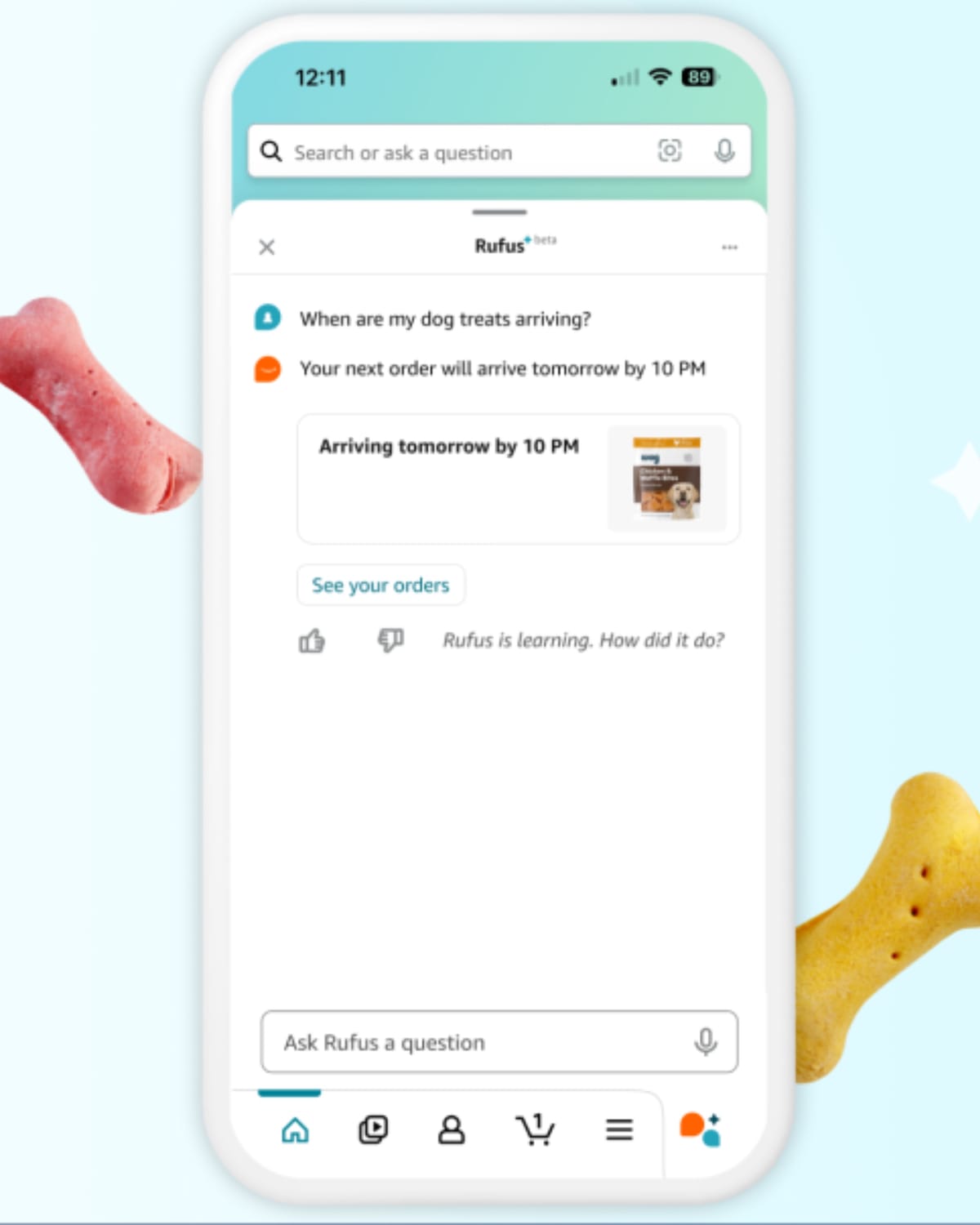
Amazon's Rufus AI shopping assistant generated nearly $12 billion in incremental annualized sales during 2025, according to financial results the company shared for the fourth quarter. The figure surpasses the $10 billion annualized pace Amazon discussed after the third quarter, indicating accelerated adoption during the crucial holiday shopping period.
More than 300 million customers used Rufus throughout 2025. The AI assistant, which Amazon describes as an agentic shopping tool, can now shop tens of millions of items in other online stores directly and make purchases on behalf of customers using its Buy for Me feature, according to statements included in the earnings materials.
The adoption metrics reveal significant customer engagement with the conversational shopping interface. Rufus saw "an even stronger response than anticipated," according to Amazon's characterization of the performance data. The system helps customers discover products through natural language queries, compare options using synthesized information from reviews and product details, and complete purchases through autonomous features that operate without constant human oversight.
Amazon launched Rufus in February 2024 during beta testing, expanding availability to all U.S. customers in July 2024 ahead of that year's Prime Day shopping event. The initial rollout focused on answering shopping-related questions and providing product recommendations. Throughout 2025, Amazon deployed more than 50 technical upgrades that transformed Rufus from a question-answering tool into an autonomous shopping agent with memory, price tracking, and automatic purchasing capabilities.
The $12 billion sales figure represents incremental revenue - purchases that customers might not have made without Rufus assistance. This measurement approach differs from total transaction volume and aims to quantify the assistant's commercial impact beyond baseline shopping behavior. However, the calculation methodology involves assumptions about customer behavior and attribution that introduce uncertainty into the precise measurement.
The Buy for Me functionality represents Amazon's most significant competitive response to third-party AI shopping agents. When customers search for branded items unavailable in Amazon's inventory, Rufus displays either a "Buy for Me" button enabling Amazon to purchase from third-party websites on their behalf, or a "Shop Direct" button redirecting to merchant websites. Products available through Buy for Me increased from 65,000 at launch to over half a million by November 2025, according to Amazon's deployment announcement.
Autonomous purchasing extends beyond third-party procurement. Prime members can establish price alerts for specific products, with Rufus monitoring prices continuously on their behalf. When target price points arrive, the assistant completes purchases agentically using default payment methods and shipping addresses, sending notifications with 24-hour free cancellation windows. Auto-buy requests remain active for six months or until cancellation, with customers averaging 20% savings per purchase through this feature, according to the November announcement.
The system's intelligence encompasses general shopping knowledge, category and product research methodologies, evaluation frameworks, and search and recommendation algorithms. Amazon has expanded the underlying neural architecture while building a knowledge graph of product attributes and customer preferences. Account memory now understands individual shopping patterns, connecting past activity to current needs, suggesting alternatives when items become unavailable, and automatically adding selections to shopping carts for review before checkout completion.
Visual search capabilities integrate directly into the shopping experience through Lens Live, which delivers real-time product scanning and instant matches through integration with Rufus directly in the camera experience. The September 2025 launch increased engagement in Amazon Lens by 13%, according to Amazon's announcement. Photo searches in Amazon Lens more than doubled since 2023.
Amazon's advertising business provides context for understanding Rufus's strategic importance. Advertising revenue reached $17.7 billion in the third quarter of 2025, growing 22% year-over-year. Analysts projected the company's annual advertising would likely generate approximately $70 billion in 2025, with roughly 90% in Sponsored Listings competing with Google Search and emerging AI search platforms.
The relationship between Rufus and advertising revenue remains complex. Customers who use Rufus during shopping journeys convert at rates exceeding 60% higher than those who do not use the assistant, according to November 2025 data. This elevated conversion rate suggests the AI assistant provides value that drives purchases, though questions remain about how autonomous shopping affects sponsored product visibility and click-through rates on traditional advertisements.
Marketing professionals tracking AI's impact on advertising noted Amazon's third quarter results demonstrated Rufus's commercial effectiveness despite concerns about AI-mediated shopping potentially reducing ad exposure. The system functions as what Amazon characterizes as a "smart deal finder" capable of curating personalized promotions throughout the year, including Prime Day, Black Friday, and Cyber Monday.
Personalized deal curation draws from browsing patterns, shopping cart contents, and wish list activity. This approach contrasts with traditional promotional displays that present identical offers to all customers regardless of individual preferences or purchase history. The deployment of AI-powered recommendations may influence how advertisers approach campaign strategies on Amazon's platform, particularly regarding sponsored product placements and display advertising formats.
Amazon's development of proprietary AI shopping tools coincides with aggressive restrictions against third-party AI agents. The company blocked AI bots from OpenAI, Anthropic, Meta, Google, and Huawei on August 21, 2025, while simultaneously developing internal tools that compete with external AI agents. This dual strategy reflects fundamental tensions about control over AI-mediated commerce and customer relationships.
Amazon filed a federal lawsuit against Perplexity AI on November 4, 2025, alleging the startup deployed covert artificial intelligence agents into the e-commerce platform's systems without authorization. CEO Andy Jassy told investors during the October 30, 2025, earnings call that Amazon maintains conversations with potential third-party AI agent partners while emphasizing the need for solutions that preserve customer experiences.
Research published in September 2025 found that most merchants welcome AI-mediated shopping experiences while maintaining control over customer interactions. Amazon represents the most significant exception to merchant openness, explicitly blocking AI bots through robots.txt configurations while developing proprietary alternatives. Industry analysts view Amazon's blocking strategy through competitive lenses, noting that unrestricted third-party agent access could undermine the company's $56 billion annual advertising revenue built around shoppers browsing its marketplace.
The deployment of comprehensive AI shopping features positions Amazon within broader e-commerce industry trends toward AI-mediated shopping experiences. Microsoft launched the Copilot Merchant Program on April 18, 2025, creating an avenue for retailers to integrate product catalogs with its AI assistant platform. OpenAI launched instant checkout capabilities for ChatGPT on September 29, 2025, with Shopify integration enabling transactions through AI chatbots.
Google introduced agentic checkout on November 13, 2025, enabling AI systems to complete purchases, contact stores, and process complex product queries. Walmart tested advertising formats within its Sparky agent during fall 2025, marking the company's first integration of advertisements into AI shopping experiences. These competitive developments underscore the rapid transformation of e-commerce toward conversational and autonomous shopping interfaces.
Rufus operates as a 24/7 customer service system handling package tracking, delivery status inquiries, return and refund process explanations, replacement guidance for damaged items, order modifications, cancellation assistance, account settings navigation, payment and billing questions, login and security support, and connections to live customer service representatives when necessary.
This customer service functionality extends Amazon's agentic AI deployment beyond consumer-facing applications. The company introduced autonomous AI capabilities for marketplace sellers on September 17, 2025, enabling automated inventory management, compliance monitoring, and advertising campaign development through systems that operate without constant human oversight.
The coming months will bring memory expansion to encompass customer activity across Amazon's digital services including Kindle, Prime Video, and Audible. This cross-service memory integration aims to provide more comprehensive personalization based on entertainment consumption patterns alongside shopping behavior. The system appears throughout Amazon's ecosystem: the homepage, product detail pages, Amazon Shopping app, desktop interface, and Amazon Lens Live experience.
Amazon reported significant growth in visual search utilization alongside Rufus adoption. Customers using Lens - the visual search tool - increased usage 45% year-over-year, according to the financial materials. The enhanced visual search tool delivers real-time product scanning and instant matches through integration with Rufus directly in the camera experience.
The introduction of Rufus into the camera experience marked the first integration of Amazon's conversational AI assistant directly into visual search workflows. While customers view products through their camera, Rufus generates suggested questions and quick summaries that appear under the product carousel. These conversational prompts allow customers to access key product insights and research information without leaving the camera interface.
Amazon unveiled five new visual search features in October 2024 as the platform reported a 70% year-over-year increase in visual searches worldwide. The enhancements included text-enhanced image search, video integration in search results, and circle functionality allowing users to isolate specific objects within larger images.
Visual search technologies have gained significant traction across the e-commerce sector. Google Lens reached nearly 20 billion monthly visual searches as of October 2024, with 20% being shopping-related queries. The convergence of visual recognition and conversational AI creates new pathways for product discovery that differ fundamentally from traditional keyword-based search.
Amazon expanded pharmacy Same-Day Delivery capabilities during the period, with same-day delivery of prescriptions now available in 3,000+ U.S. cities and towns. This operational expansion demonstrates the company's broader infrastructure investments supporting rapid delivery across multiple product categories beyond traditional e-commerce items.
The pharmacy delivery network complements Amazon's expansion of Same-Day Delivery for fresh groceries to more than 2,300 cities by December 2025. Fresh fruits, vegetables, dairy, meat, seafood, baked goods, and frozen foods now dominate the platform's bestseller list, with nine of the top ten most-ordered items being perishables. Perishable grocery sales grew 30 times since January as more customers integrated fresh food purchases into their regular shopping patterns.
The delivery infrastructure supports Rufus functionality by ensuring products discovered through AI-powered search can reach customers quickly. Prime membership's free Same-Day Delivery benefit reinforces the subscription's value proposition while driving engagement with AI shopping tools. Prime Day 2025 extended to four days for the first time, running from July 8-11 and integrating AI features including Rufus for personalized deal recommendations.
Amazon was named the lowest-priced U.S. retailer by Profitero for the ninth year in a row, with online prices on average 14% lower than other major U.S. retailers, according to the earnings materials. This pricing position provides strategic advantages as customers increasingly rely on AI assistants for product discovery and purchase decisions.
The pricing advantage becomes particularly relevant in the context of autonomous shopping. When AI agents compare options across multiple retailers, consistently lower prices increase the likelihood of Amazon selection even when customers lack direct awareness of pricing differentials. The combination of broad selection, competitive pricing, fast delivery, and AI-powered assistance creates compounding advantages that may prove difficult for competitors to replicate.
However, the operational costs of maintaining Rufus and providing prime placements in the app and search results remain unclear. Analysis by industry observers suggests that while the assistant generates $12 billion in incremental revenue from 300 million users - approximately $40 additional revenue per user per year - this revenue must be weighed against the technological infrastructure costs, foregone advertising revenue, and opportunity costs of prominent interface positioning.
The Rufus performance data presents multiple considerations for marketing professionals working within Amazon's ecosystem. The 60% higher conversion rate for customers using the AI assistant suggests that understanding how Rufus discovers and recommends products becomes increasingly important for brand visibility.
Traditional search engine optimization focused on keyword matching and sponsored product placements. AI-mediated shopping introduces new variables including natural language understanding, context-aware recommendations, and autonomous purchasing decisions that operate on different principles than click-based advertising. Brands may need to optimize product data, specifications, and metadata to ensure visibility when customers make natural language requests to AI assistants.
The direct integration of AI agents into commerce platforms raises questions about customer journey ownership and attribution. Marketing teams accustomed to direct customer relationships may need to recalibrate acquisition strategies, lifetime value calculations, and performance measurement frameworks. The shift from user-initiated searches to AI-curated recommendations could fundamentally alter how products gain visibility and generate sales on Amazon's platform.
Industry experts have suggested that AI-mediated shopping may transform advertising strategies across the sector. Advertising technology expert Karsten Weide indicated that "direct response advertising will fade. Brand advertising will gain in importance as we want to influence consumers before they tell their agent what to do." This transformation would prioritize brand awareness campaigns over direct response formats currently dominating digital marketing, though such predictions remain speculative given the early stage of agentic commerce adoption.
The implications extend beyond Amazon's platform to broader questions about how marketing professionals maintain brand differentiation and customer relationships in environments where AI agents mediate discovery and purchasing decisions. Success will likely require optimization of product information for AI understanding, strategic positioning to influence recommendations, and adaptation of attribution models to account for agent-mediated conversions.
Who: Amazon developed and deployed Rufus, an agentic AI shopping assistant, serving more than 300 million customers throughout 2025. The system operates as part of Amazon's broader artificial intelligence strategy overseen by executives including Rajiv Mehta, vice president of Search and Conversational Shopping.
What: Rufus generated nearly $12 billion in incremental annualized sales during 2025, exceeding the $10 billion annualized pace discussed after Q3. The AI assistant can shop tens of millions of items in other online stores directly and make purchases on behalf of customers using its Buy for Me feature. Customers who use Rufus during shopping journeys convert at rates exceeding 60% higher than those who do not use the assistant. The system received more than 50 technical upgrades during 2025, adding account memory, autonomous purchasing, price tracking, visual search capabilities, and cross-service integration.
When: Amazon launched Rufus in February 2024 during beta testing, expanding to all U.S. customers in July 2024. The company revealed the $12 billion sales figure in Q4 2025 earnings materials released in February 2026. Throughout 2025, Amazon deployed continuous upgrades including major enhancements announced in November 2025.
Where: Rufus operates throughout Amazon's ecosystem including the homepage, product detail pages, Amazon Shopping app, desktop interface, and Amazon Lens Live experience. The system's memory capabilities will expand across Amazon's digital services including Kindle, Prime Video, and Audible in coming months. Pharmacy Same-Day Delivery expanded to 3,000+ U.S. cities and towns while Same-Day grocery delivery reached 2,300+ cities by December 2025.
Why: Amazon developed Rufus to enhance customer shopping experiences through natural language interaction, personalized recommendations, and autonomous purchasing capabilities. The $12 billion in incremental sales demonstrates commercial effectiveness despite concerns about AI-mediated shopping potentially reducing traditional advertising exposure. The system positions Amazon competitively against third-party AI shopping agents while maintaining control over customer relationships and data. Customers use Lens 45% more year-over-year, indicating growing adoption of AI-powered shopping tools across visual and conversational interfaces. The deployment reflects broader industry trends toward agentic commerce, with competitors including Google, Microsoft, OpenAI, and Walmart launching similar autonomous shopping capabilities throughout 2025.