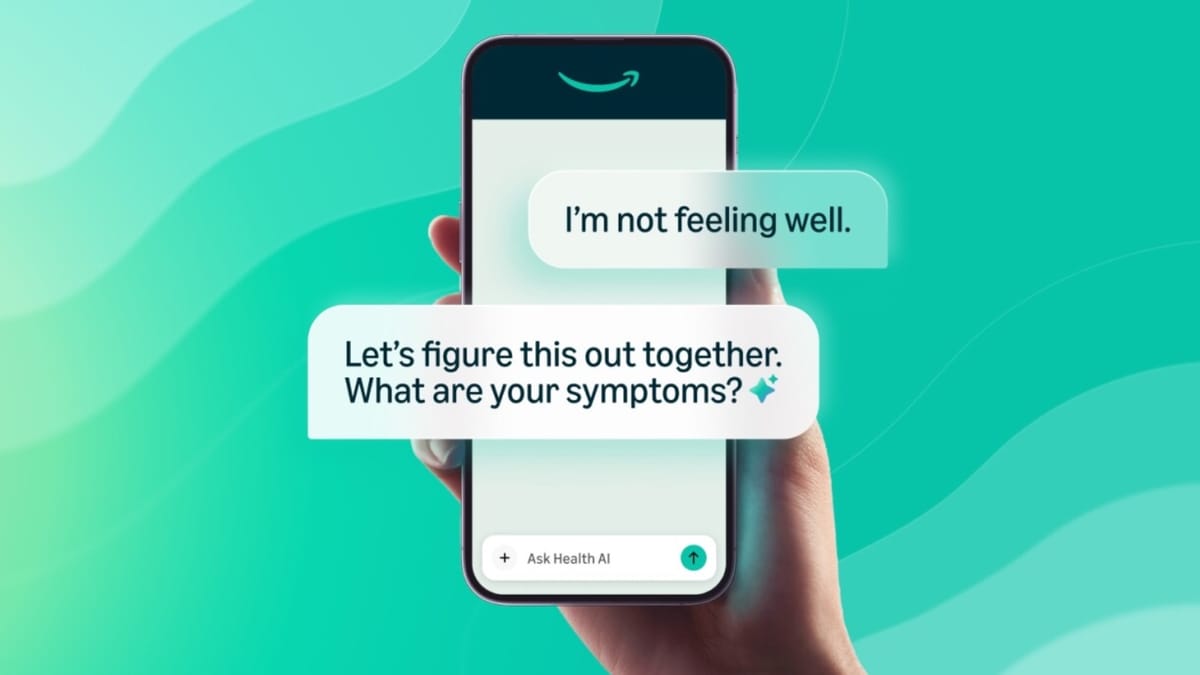
Amazon on March 10, 2026, expanded its Health AI agent beyond the One Medical app to Amazon.com and the Amazon Shopping app, making a medically-oriented agentic AI system accessible to millions of U.S. customers who are not One Medical members. The rollout marks a significant step in Amazon's effort to embed healthcare directly into the same digital surface where hundreds of millions of people already shop for everyday products.
The announcement, written by Prakash Bulusu, Chief Technology Officer of Amazon Health Services, and Andrew Diamond, Ph.D., M.D., Chief Medical Officer of Amazon One Medical, describes Health AI as an agentic AI health assistant designed to go beyond answering questions. It can book appointments, explain medical records, manage prescription renewals, and connect patients to licensed clinicians - all from within the familiar Amazon interface. The distinction matters. Most consumer health tools are passive information retrieval systems. Health AI, according to Amazon, is designed to act.
From the One Medical app to the open web
Health AI launched earlier in 2026 exclusively for One Medical members inside the One Medical app. According to the announcement, the response from both patients and providers was described as "overwhelmingly positive." Amazon has now opened access to Amazon.com and the Amazon app, with a stated goal of reaching all U.S. customers in the coming weeks. Customers can join a waitlist at the Amazon Health page; those granted access receive a confirmation email.
The January 2026 launch in the One Medical app - covered by PPC Land at the time - introduced the core capabilities of the system to One Medical's membership base. The March 10 announcement extends that foundation to a much larger potential audience, turning a member-only feature into a broadly accessible consumer product.
Setup requires creating or signing in to an individual Amazon health profile with two-step authentication on a mobile device. Once verified, the system surfaces as a chat interface on Amazon.com or within the Amazon app. Personalization is opt-in: the user grants Health AI permission to access medical records through the Health Information Exchange, the nationwide secure system for sharing patient data. The consent process is described as explicit and clear. Without granting access, Health AI still responds to general health questions - it simply cannot provide personalized guidance informed by individual medical history.
What Health AI can actually do
The scope of the system's capabilities is worth examining in technical detail. Health AI is described as a multi-agent architecture running on Amazon Bedrock, the same managed AI infrastructure that Amazon uses across its advertising and enterprise platforms. Amazon Bedrock has underpinned a growing range of Amazon's AI deployments, from organizational purchasing assistants to advertising campaign automation tools.
The system is not a single model responding to queries. According to the announcement, it comprises four functional layers working in parallel: a core agent communicating with patients, sub-agents handling specific workflows, auditor agents reviewing conversations in real time, and sentinel agents monitoring the system with escalation paths into human providers for clinical review. This layered architecture is designed to catch errors before they reach the patient.
When a user connects their health records, Health AI can explain lab results in the context of that person's specific history. The announcement illustrates this with a concrete example: if a patient with asthma develops a cough during allergy season, the system incorporates the patient's asthma diagnosis, current medications, and past flare-ups rather than offering a generic response about coughs. It then asks follow-up questions designed to distinguish a routine issue from something requiring urgent attention.
Beyond explanation, the system can take meaningful action. It books appointments with One Medical providers - through message, video, or in person. It submits prescription renewal requests to One Medical providers, which patients can fill at Amazon Pharmacy or a pharmacy of their choice. When professional care is warranted, it connects the user directly rather than simply recommending they "see a doctor." The announcement notes that appointment availability can be same-day or next-day, and sometimes within minutes for virtual visits.
Health AI also surfaces relevant health product recommendations from Amazon.com when contextually appropriate. The integration of commerce and health is deliberate. Millions of customers already search Amazon for health-related products; the company is positioning Health AI as the connective tissue between that behavior and the clinical services Amazon has assembled through One Medical and Amazon Pharmacy.
The Prime membership layer
For eligible U.S. Prime members, Amazon has attached a specific introductory offer. Using Health AI grants access to up to five free direct-message care consultations with a One Medical provider for more than 30 common conditions. The covered conditions include cold and flu, allergies and acid reflux, pink eye and urinary tract infections, erectile dysfunction, anti-aging skin care, and hair loss. Amazon values this offer at up to $145 per member.
These direct-message visits can be shared with family members through Amazon Family, which allows Prime members to extend benefits to others in the same household. Prime for Young Adults and Prime Access - discounted programs targeting higher education students, young professionals, and income-verified customers - also qualify for the introductory offer, according to the announcement.
Beyond the introductory offer, the pricing structure is explicit. A Pay-per-visit telehealth consultation through Amazon One Medical costs $29 and includes unlimited follow-up messaging for 14 days. A full One Medical membership - which provides 24/7 virtual care access - costs $99 per year for Prime members, compared to the standard rate of $199. Adding family members costs $66 per year each for Prime subscribers, against the standard $199.
Non-Prime customers can still access Health AI and connect with providers through Pay-per-visit, but the introductory free visits are exclusive to eligible Prime members.
Privacy architecture and HIPAA compliance
Health data sensitivity makes the privacy infrastructure particularly important. According to the announcement, all Health AI interactions occur within a HIPAA-compliant environment. Conversations are protected by encryption and strict access controls. Protected health information from Amazon One Medical and Amazon Pharmacy is not used in the broader Amazon store to market general merchandise, and Amazon states it does not sell customers' personal data.
The training methodology described in the announcement reflects a specific approach to model improvement. According to the announcement, Amazon trains Health AI models "on abstracted patterns without directly identifying information." The example given: if multiple patients ask about medication interactions, the system uses those patterns - without patient names - to improve responses to similar future questions. Protected health information is used only for purposes permitted under HIPAA.
The system incorporates multiple patient safety guardrails. When Health AI is uncertain about a clinical recommendation, it directs users to a human provider rather than speculating. This threshold is built into the system's escalation logic, not left to model judgment.
The regulatory context is significant. California's Attorney General in January 2025 issued specific guidance requiring licensed physician supervision of AI systems that impact medical decisions, and prohibited using AI to deny insurance claims by overriding medical necessity determinations. Health AI's architecture - where human clinicians remain in the escalation path and the system explicitly does not diagnose or treat without provider support - appears structured with these regulatory constraints in mind.
Specialty care and health system partnerships
The announcement addresses a common limitation of primary care AI tools: what happens when a patient needs specialist services that fall outside the system's scope. Amazon One Medical has established partnerships with health systems to bridge primary and specialty care. The named partners include Rush University System for Health, which serves the Chicago area, and Cleveland Clinic.
According to Dr. Omar Lateef, president and CEO of Rush University System for Health: "Our partnership with Amazon reflects our shared vision of making health care more accessible and convenient for the communities we serve."
According to Dr. James Gutierrez, Chief of Cleveland Clinic's Primary Care Institute: "As innovative digital tools evolve, they have the potential to ease patient flow and enable seamless transitions between primary and specialty care."
These partnerships give Health AI a pathway to refer patients outward when their needs exceed what One Medical's primary care model can address, while maintaining continuity of care records across the handoff. Whether that seamlessness holds in practice across differing electronic health record systems remains to be seen.
What this means for the marketing and advertising community
The expansion of Health AI to Amazon.com and the Amazon app is not purely a healthcare story. It has direct implications for how Amazon's advertising ecosystem functions and how health and pharmaceutical brands should think about the platform.
Amazon's advertising revenue reached $17.7 billion in the third quarter of 2025, growing 22% year-over-year, as reported by PPC Land. A meaningful share of that revenue comes from health and wellness categories - vitamins, personal care products, medical devices, and over-the-counter treatments. The presence of a conversational health AI on the same surface where those sponsored placements appear creates a new dynamic.
Health AI can surface "relevant health care product recommendations from Amazon.com" when a user asks for them. The announcement is careful to note that protected health information is not used by Amazon Ads. But the architecture creates a situation where AI-mediated health conversations and commerce-facing advertising placements coexist within a single user session - separated by policy, but not by interface.
For health brands advertising on Amazon, the implications are considerable. The Health AI layer adds a new intermediary between search intent and purchase behavior. A customer searching for allergy medication might interact with Health AI before, or instead of, browsing sponsored listings. How that interaction affects downstream conversion - and how Amazon Ads eventually measures it - is an open question. Amazon's agentic advertising infrastructure has been expanding throughout 2025, and Health AI represents a new vector through which customer intent can be identified, qualified, and acted upon.
The Rufus AI shopping assistant generated nearly $12 billion in incremental sales in 2025 and reached more than 300 million users. Rufus operates on a shopping intent model; Health AI operates on a health intent model. Both run on Amazon Bedrock. The question of whether, and how, these systems share context in ways that influence advertising targeting will be watched closely by healthcare marketers and privacy advocates alike.
According to the American Academy of Physician Associates, nearly two-thirds of Americans feel overwhelmed by the healthcare system. Amazon is entering that space not as a peripheral technology provider but as a direct-to-consumer care delivery platform with a multi-agent AI, a national network of primary care clinics, a pharmacy business, and an advertising platform all operating in the same ecosystem.
Timeline
- January 13, 2025 - California Attorney General issues guidance requiring licensed physician supervision of AI systems impacting medical decisions, prohibiting AI denial of insurance claims: PPC Land coverage
- November 11, 2025 - Amazon launches Ads Agent at unBoxed conference, enabling natural language campaign management across Amazon DSP and Marketing Cloud: PPC Land coverage
- November 12, 2025 - Amazon Business launches AI assistant for organizational purchasing on Amazon Bedrock: PPC Land coverage
- November 13, 2025 - Amazon Ads launches closed beta MCP Server enabling AI agent integration with advertising APIs: PPC Land coverage
- November 18, 2025 - Amazon deploys 50+ upgrades to Rufus AI shopping assistant, reaching 250 million users: PPC Land coverage
- January 6, 2026 - Comscore launches daily TV program tracking powered by Amazon Bedrock agentic AI: PPC Land coverage
- January 25, 2026 - Amazon One Medical launches Health AI assistant in the One Medical app, providing 24/7 personalized health guidance, appointment booking, and prescription management: PPC Land coverage
- February 2, 2026 - Amazon opens Amazon Ads MCP Server in open beta at IAB ALM, connecting AI platforms to advertising workflows: PPC Land coverage
- February 7, 2026 - Amazon's Rufus AI shopping assistant reported to have driven $12 billion in incremental sales in 2025, reaching 300 million users: PPC Land coverage
- March 10, 2026 - Amazon expands Health AI agent to Amazon.com and the Amazon app, offering eligible Prime members up to five free direct-message care visits for 30+ conditions
Summary
Who: Amazon, through its Amazon Health Services division, led by Prakash Bulusu (CTO) and Andrew Diamond (CMO of Amazon One Medical), along with health system partners Rush University System for Health and Cleveland Clinic.
What: Amazon expanded its Health AI agentic assistant from the One Medical app to Amazon.com and the Amazon Shopping app. The system - built on Amazon Bedrock as a multi-agent architecture - provides personalized health guidance, explains medical records and lab results, books appointments with One Medical providers, manages prescription renewals, and connects users to clinicians via message, video, or in person. Eligible U.S. Prime members receive up to five free direct-message care visits for more than 30 common conditions, valued at up to $145.
When: The expansion was announced on March 10, 2026. Health AI originally launched in the One Medical app in January 2026. The broader rollout to all U.S. customers is described as an ongoing process continuing in the coming weeks.
Where: United States. The system is accessible via Amazon.com and the Amazon mobile app. Clinical services are delivered through the One Medical network of primary care providers and Amazon Pharmacy.
Why: According to the announcement, nearly two-thirds of Americans feel overwhelmed by the healthcare system. Amazon positions Health AI as a solution to fragmentation - weeks-long appointment waits, repetitive paperwork, generic internet health searches, and disconnected insurance systems. The expansion also deepens Amazon's integration between its healthcare services (One Medical, Amazon Pharmacy) and its core retail and advertising infrastructure, placing agentic health capabilities directly within the same digital environment where hundreds of millions of customers already shop.
Share this article
The link has been copied!