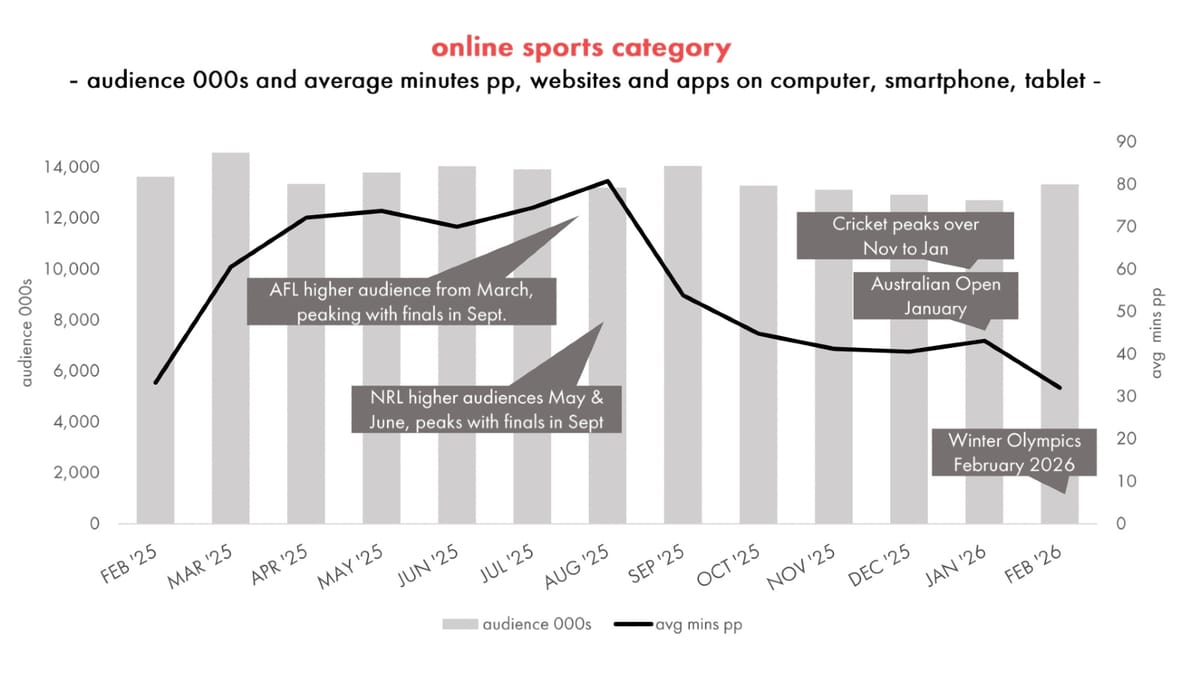
Australia's online sports audience is larger, older, and more concentrated around live events than many media buyers assume. New data published by IAB Australia on March 26, 2026 maps a full year of sports content consumption across websites, apps, and broadcast video on demand platforms, revealing patterns that have direct implications for campaign planning and audience targeting in the Australian market.
According to the IAB Australia report, 13.5 million Australians aged 14 and over visited an online sports website or app on average each month over the 12 months from March 2025 to February 2026. The data comes from the Ipsos iris Online Audience Measurement Service and covers activity across PC, laptop, smartphone, and tablet devices. That figure - 13.5 million monthly visitors - represents a substantial share of the Australian population, and it is not evenly distributed across the year.
Event-driven spikes define the calendar
The audience data shows a pattern that mirrors the live sports calendar closely. According to the report, the online sports audience peaked in March 2025 with the simultaneous start of the AFL and NRL seasons. From that point, AFL drove higher audience numbers through the first half of the year, peaking again in September with the finals series. NRL followed a similar arc, with elevated audiences in May and June before also peaking in September. Cricket drew its own audience window from November through January. The Australian Open tennis tournament added a January spike, while the Winter Olympics in February 2026 contributed to the final month of the measurement period.
What the data does not show is a year-round floor of sustained engagement. The drop-off between seasons is real. Average minutes per person - a measure of how much time each visitor spends with sports content - followed a different trajectory from raw audience size, illustrating that the people who do visit sports properties outside peak event windows spend considerably less time there.
This pattern has practical consequences for programmatic buyers. Inventory volumes, audience demographics, and engagement rates on sports properties shift materially depending on which events are live. A campaign planned around average monthly audience figures will encounter very different actual conditions depending on the week it runs.
AFL: 3.7 million monthly, dominated by older males
The Australian Football League brand group - which includes afl.com, the official app, tipping and fantasy platforms, and team websites - attracted on average more than 3.7 million Australians per month during the season from March 2025 to October 2025, according to the report. Of those, 1.9 million used the live official app on average during season months. Monthly audience peaked in September during the finals series, when the combined brand group reached close to its highest recorded level across the measurement window.
The gender and age composition of time spent on AFL digital properties in February 2026 tells a specific story. According to the report, males accounted for 81% of time spent, females 19%. The age breakdown is even more striking: adults aged 65 and over represented 32% of total time spent, while the 40-54 bracket added a further 31%. The 55-64 group contributed 20%. Together, those three older cohorts accounted for more than 80% of all time spent on AFL digital properties. Australians aged 14-24 represented just 3% of time spent, and those aged 25-39 added 14%.
For advertisers, this demographic composition matters in a very direct way. AFL digital inventory reaches a large audience of older Australian men with high engagement during the season. That audience is not well-described by generic sports audience assumptions. It is older than the television sports audience in many other markets, and more concentrated in the 40-plus demographic than buyers accustomed to younger-skewing sports audiences might expect. IAB Australia's video measurement framework, published in December 2025, examined how advertisers can better evaluate performance across different video environments, including sport-adjacent inventory.
NRL: 2.5 million monthly, heavily male, 40-64 dominant
The National Rugby League brand group - covering nrl.com, the official app, tipping platforms, and team websites - averaged more than 2.5 million monthly visitors during season months. Of those, over 700,000 on average used the live official app. Like AFL, the NRL audience peaked in September with the finals series, reaching approximately 2.8 million in that month according to the chart data in the report.
The demographic profile for NRL digital engagement in February 2026 is even more concentrated among older adults. According to the report, males made up 83% of total time spent, with females at 17%. In terms of age, adults aged 55-64 accounted for 51% of total time spent - a striking majority from a single age bracket. Those aged 40-54 added 21%, and those 65 and over contributed 18%. Combined, the 40-plus cohort accounted for over 70% of all time spent on NRL digital properties. Australians aged 14-24 represented just 2% of total time, and those aged 25-39 contributed 8%.
The NRL audience's demographic concentration in the 55-64 bracket is a specific finding that warrants attention. More than half of all time spent on NRL digital properties came from a single decade of the age spectrum. This is not a broadly distributed sports audience. It is a specific segment - older Australian men - and media plans that treat the NRL digital audience as interchangeable with other sports properties will likely misread actual reach and engagement outcomes.
BVOD: 7.6 million viewers in January, up 65% on December
Broadcast video on demand consumption of sports events and programs follows a different pattern from website and app traffic, and the January 2026 figure stands out markedly. According to the report, 4.9 million Australians aged 14 and over viewed BVOD online sports events and programs on average over the 12 months from February 2025 to January 2026. But the monthly figures reveal substantial variation around that average.
In January 2026, over 7.6 million Australians watched BVOD sports programs, an increase of 65% from December 2025. Total time spent on BVOD sports viewing lifted 139% between those two months. The driver, according to the report, was the Australian Open tennis tournament. The BVOD platforms tracked include ABC iView, 9Now, SBS on Demand, 7Plus, and 10 Play, measured across CTV, computer, smartphone, and tablet devices. The CTV Published Database methodology is applied to this measurement.
The prior annual peak came in September 2025 during AFL and NRL finals series, where BVOD sports video audience also reached elevated levels, though the January 2026 Australian Open figure exceeded it. This creates two identifiable peaks in BVOD sports consumption annually - the September finals window and the January Australian Open period - with a sharp dip in the months between.
Australian digital advertising hit a record $17.2 billion in FY25, with BVOD advertising growing 18.3% to $500 million. The sports audience data published in March 2026 provides the audience-side counterpart to those spending figures, showing where viewers actually go during major events.
9Now: female and younger skew during the Australian Open
The 9Now platform data within the report offers a specific example of how major events shift audience composition on individual BVOD platforms. The 9Now Sports Events and Programs category recorded 5,229,000 video viewers in January 2026, compared to 1,225,000 in December 2025 - an increase of more than 300% month on month. Year on year, the January figure was up 30% from 4,036,000 in January 2025.
What changed was not just the volume but the composition. According to the report, 54% of 9Now's sports video audience in January 2026 were female, compared to a male-dominated split typical of NRL and AFL digital properties. The age breakdown was also notably different: 54% of the video audience were aged between 25 and 54, with 25-39 year-olds representing 26% and 40-54 year-olds another 28%. Adults aged 65 and over accounted for 20%, and those aged 14-24 contributed 10%.
This finding illustrates how the Australian Open attracts a broader, more gender-balanced, and somewhat younger audience than the domestic football codes. For buyers considering BVOD sports inventory, the event context matters as much as the platform. The same publisher, the same environment, and the same ad formats deliver a materially different audience depending on whether the content is AFL finals or Australian Open tennis.
Ipsos iris's integration of YouTube CTV data in 2024 expanded the cross-screen measurement infrastructure underpinning these figures. The hybrid methodology combining panel data with site-centric census measurement gives Ipsos iris a more complete view of how Australians consume sports content across devices than single-source approaches can provide.
Methodology: Ipsos iris hybrid panel and census approach
The data in the report comes from Ipsos iris, which IAB Australia describes as the endorsed digital content measurement system for the planning, buying, and reporting of digital audiences in Australia. According to the source page, Ipsos iris uses a hybrid methodology that combines metered data from a nationally representative, single-source passive panel with site-centric census measurement. Ipsos conducts an establishment survey of 12,000 Australians aged 14 and over per annum to capture device ownership and usage at the household and personal level.
The measurement covers Smartphone, PC, Laptop, Tablet, and CTV devices. The audience figures in the sports report are based on Australians aged 14 and over unless otherwise stated. The sports category data covers the period February 2025 to February 2026. The BVOD data covers January 2025 to January 2026, a slightly different window. Brand group data for AFL and NRL covers the full season period from March 2025 to October 2025 for time composition figures, though monthly audience figures extend through February 2026.
The sports audience data released by IAB Australia in March 2026 is not primarily a research document about sport. It is an audience planning resource. The figures describe who is reachable, when, through which properties, and in what concentration.
Several points emerge with practical force. First, the Australian online sports audience is older than assumptions based on general sports audience demographics might suggest. Both AFL and NRL digital properties show time-spent dominated by adults over 40, with the 55-64 bracket alone accounting for the majority of NRL digital engagement. Second, event timing drives sharp swings in audience size. The Australian Open produced a 65% uplift in BVOD sports viewers in a single month. Planning that ignores event calendars will miss these windows or encounter unexpected inventory dynamics. Third, platform-level demographics shift with content. The same broadcaster's BVOD platform showed a female majority during Australian Open coverage but would look entirely different during NRL season content.
Nielsen's Connected TV intelligence launch for the Australian market in August 2025 highlighted how advertisers were seeking better cross-platform competitive data as CTV sports inventory expanded. The Ipsos iris sports data complements that intelligence layer with viewer-level audience composition detail.
The February 2026 data also captures the Winter Olympics as a minor factor in the sports category audience figures for that month. The IAB Australia publication notes that the online sports audience increased by 4.9% from January to February 2026, with the Winter Olympics among the contributing events alongside the Australian Open men's tennis final, the Super Bowl, and the AFL State of Origin series in Perth.
IAB Australia's Q3 2024 digital ad spend figures showed that the Paris Olympics significantly influenced video advertising inventory in the September quarter of that year. The Winter Olympics in February 2026 represents a smaller but comparable event-driven audience dynamic, this time visible in the sports website and app category rather than video spend alone.
Timeline
- February 2025 - February 2026: Ipsos iris measurement period for the online sports category audience data, covering 13.5 million average monthly visitors aged 14+
- March 2025: AFL and NRL seasons begin; online sports audience peaks for the first time in the measurement period
- March 2025 - October 2025: AFL and NRL season window used for brand group time composition data
- May and June 2025: NRL records elevated online audiences during the regular season
- August 2025: IAB Australia launches programmatic DOOH buyers guide, with sports scores noted as a dynamic creative trigger
- August 28, 2025: IAB Australia publishes FY25 digital advertising revenue report, recording $17.2 billion in total spend and BVOD growing 18.3% to $500 million
- September 2025: AFL and NRL finals series; both brand groups reach monthly audience peaks; BVOD sports viewing also peaks for the domestic football season
- November 2025 - January 2026: Cricket season drives elevated online sports audience in the category
- December 2025: IAB Australia publishes video measurement framework covering sports and other video environments
- December 2025: IAB Australia releases audience segmentation blueprint for retail media
- January 2026: Australian Open drives 65% uplift in BVOD sports viewers to 7.6 million; 9Now records 5.229 million sports video viewers, up 30% year on year and over 300% month on month; female viewers account for 54% of 9Now sports audience during this period
- February 2026: Winter Olympics, Australian Open men's final, Super Bowl, and AFL State of Origin in Perth drive a further 4.9% increase in online sports audience month on month
- March 26, 2026: IAB Australia publishes the February 2026 Sports Nickable Charts based on Ipsos iris data
Summary
Who: IAB Australia and Ipsos, using the Ipsos iris Online Audience Measurement Service - the endorsed digital audience measurement currency for Australia's advertising industry
What: A dataset covering online sports audience size, time spent, BVOD viewing, and demographic composition across the Australian Football League, National Rugby League, and broadcast video on demand platforms over a 12-month period to February 2026, published as a set of freely downloadable industry charts
When: The data covers the period February 2025 to February 2026, with the IAB Australia publication released on March 26, 2026
Where: Australia; measurements cover websites and apps accessed via PC, laptop, smartphone, tablet, and CTV devices by Australians aged 14 and over
Why: The data is published to assist media planners, buyers, advertisers, and publishers in understanding the size, shape, and demographic composition of the Australian online sports audience, enabling more accurate campaign planning, audience targeting, and investment decisions across sports-adjacent digital and BVOD inventory
Share this article
The link has been copied!