Bing's AI search tool now maps which pages fuel your brand's citations
Microsoft today expanded its AI Performance dashboard in Bing Webmaster Tools with grounding query-to-page mapping, linking citations to exact content across AI search.


Microsoft today expanded its AI Performance dashboard in Bing Webmaster Tools with grounding query-to-page mapping, linking citations to exact content across AI search.
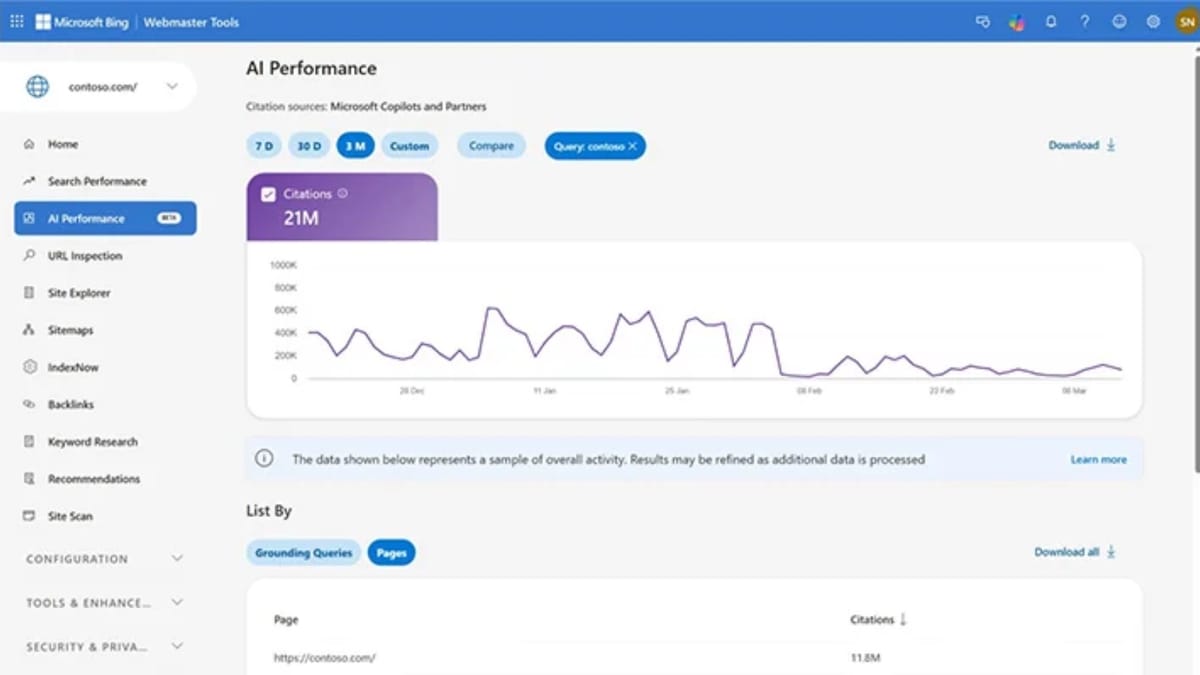
Microsoft yesterday expanded its AI Performance dashboard in Bing Webmaster Tools with a new feature that connects grounding queries directly to the specific pages being cited in AI-generated answers - a capability that lets publishers see, for the first time, precisely which content drives their visibility across AI search systems.
The update, announced March 23, 2026 by Krishna Madhavan, Principal Product Manager at Microsoft AI and Bing, follows roughly one month after the AI Performance dashboard itself launched in public preview on February 10, 2026. According to Madhavan, the new Grounding Query - Pages Mapping feature is now rolling out worldwide after emerging as the single most-requested enhancement since the dashboard's initial release.
"The AI Performance report introduced in Bing Webmaster Tools a month ago has seen significant success," Madhavan wrote in a LinkedIn post. "One of the most requested features, 'Grounding Query - Pages Mapping' is now being rolled out worldwide."
The timing matters. Where the original dashboard gave publishers aggregate citation counts and a list of grounding queries as separate views, the new mapping capability bridges them. A publisher can now select any grounding query to immediately see which of their pages were cited in response to that query. Conversely, selecting a specific URL reveals every grounding query that has sent AI systems to that page. The two-way traversal is the key distinction - one grounding query can map to multiple pages, and one page can map to multiple grounding queries simultaneously.
To understand the significance of this update, it helps to understand what grounding means in the context of AI search. Grounding is the process by which AI systems retrieve current, authoritative web content before generating answers, rather than relying solely on training data. It is the connective mechanism that links a user's question to information on the live web.
According to Microsoft, its grounding technology powers nearly every major AI assistant in the market. That infrastructure handles real-time data retrieval, source verification, and the attribution mechanisms that allow AI systems to cite specific pages when generating responses. The announcement of the original AI Performance dashboard in February was, in fact, Microsoft's first systematic move to expose this process to publishers - and it arrived alongside a broader explanation of grounding as foundational infrastructure by Jordi Ribas, Corporate Vice President of Search and AI.
The February launch brought four core metrics to Bing Webmaster Tools: total citation counts, average cited pages per day, grounding queries, and page-level citation activity. Those metrics revealed something that caught some publishers off guard. A webpage could receive extensive citations in AI answers without generating a single click. Conversely, a page that drives consistent organic traffic might never appear as a citation source. The divergence between these two performance signals is not a bug - it reflects how AI-generated answers often satisfy information needs directly, without requiring the user to follow a link.
That divergence creates an analytical gap. If citations and traffic now operate as separate performance dimensions, the tools needed to optimize them must also differ. The Grounding Query - Pages Mapping feature released today begins to close that gap by providing the granular, bidirectional data needed to make editorial decisions based on AI citation performance rather than traffic alone.
Within the AI Performance report in Bing Webmaster Tools, users now see two linked views: Grounding Queries and Pages. Previously these appeared as separate tables. With the new capability, selecting any entry in either view triggers a filtered cross-reference in the other.
For example: if a publisher notices that the grounding query "sustainable packaging regulations Europe 2025" is appearing frequently, they can now click that query and see exactly which of their URLs Bing cited when generating answers for semantically related questions. If those citations point to a single outdated article, the publisher has a clear, data-backed reason to refresh that page. If the citations are spread across five pages with overlapping content, that signals a consolidation opportunity.
The reverse direction is equally useful. A content team might be surprised to find that a product comparison page - one that generates low organic traffic - is being cited heavily in AI answers. Without the mapping feature, that signal was buried in aggregate counts. With it, the specific queries driving those citations become visible, offering a window into how AI systems actually interpret the page's relevance.
According to Madhavan, Microsoft built this feature directly in response to the feedback volume it received after the February launch. The speed of the rollout - from launch to global availability of the most requested feature in roughly five weeks - reflects the degree to which the AI Performance tooling has attracted active engagement from the publisher community.
Microsoft frames the business stakes for AI search visibility with a specific number. According to McKinsey research cited in the announcement, half of consumers are already using AI-powered search, and the shift stands to affect $750 billion in revenue by 2028. Whether those projections materialize as stated, the underlying dynamic they describe is already observable: AI-generated answers are intercepting questions that previously led directly to brand websites.
This creates a new category of brand risk. A company that ranks well in traditional search but whose content is never cited in AI answers may find itself progressively less visible as AI-assisted search grows as a share of total query volume. The inverse is also possible: brands whose content is frequently cited in AI answers could establish credibility with users earlier in their decision-making process, even without direct traffic.
The original AI Performance dashboard noted that Microsoft's advertising business crossed $20 billion in annual revenueas AI-powered search experiences gained commercial traction, demonstrating the financial stakes tied to AI search visibility.
Microsoft has been clear about one important limitation: the metrics in the AI Performance dashboard represent samples of overall citation activity, not comprehensive records. The grounding queries shown are those Microsoft's systems surface as representative, not an exhaustive log of every query that triggered a citation. Publishers interpreting the data should factor that sampling caveat into any editorial decisions.
Additionally, Bing respects all content owner preferences expressed through robots.txt and other supported control mechanisms, according to the blog post. Content excluded from AI snippets via robots.txt or the data-nosnippet attribute will not appear in citations, and therefore will not show up in the AI Performance dashboard.
The dashboard sits within a broader set of tools Microsoft has been systematically expanding over the past 18 months. Bing Webmaster Tools extended historical search performance data from 6 months to 16 months in October 2024, then from 16 months to 24 months in August 2025. Device and country filtering capabilities were added in August 2025. And sitemaps were repositioned as critical infrastructure for AI search discoverability in a detailed technical announcement that same month. The AI Performance dashboard, and now the Grounding Query - Pages Mapping feature, represent the next layer on that platform - moving beyond crawl-and-index signals toward AI-specific optimization data.
The LinkedIn post announcing the mapping feature generated visible engagement from practitioners across search and content marketing. Cem Ozcelik, Growth Manager at Adsby and Visby, asked whether the data would eventually become accessible through the Bing Webmaster Tools API - a question that suggests practitioners are already considering how to integrate citation data into automated reporting and monitoring workflows. Madhavan did not confirm API availability but the inquiry was acknowledged, with Ozcelik noting he hoped "it makes it to the API roadmap."
Richard Nazarewicz, Head of Search Strategy and SEO Product at BBC Global News, asked whether the data could be sub-filtered by how traffic arrived - specifically via IndexNow versus Bingbot. That question touches on a technically nuanced distinction: IndexNow is a protocol that lets publishers proactively notify search engines of content updates in real time, while Bingbot is Bing's crawl infrastructure. Whether the two pathways produce different citation rates is an open question that the current dashboard does not yet answer.
Eduard Blacquière, a freelance SEO consultant and co-founder of SEO Pro Academy, responded simply: "Love it, also how quickly you are shipping this!"
The volume of technical follow-up questions underscores how unfamiliar the underlying data model is, even among experienced search professionals. Grounding query data has no direct equivalent in traditional search analytics. There is no "grounding query" column in Google Search Console or in any established SEO tool. Microsoft's release essentially introduces a new category of performance data that practitioners are only beginning to understand how to use.
The blog post announcing the mapping feature signals that the AI Performance dashboard is not a finished product. According to the authors - Madhavan and Meenaz Merchant, Partner Group Product Manager at Microsoft Bing - Microsoft views the tool as part of a broader Generative Engine Optimization toolset that will continue to expand. The company has directed publishers toward the Microsoft Advertising AI Web hub for additional guides and optimization resources.
What specific metrics or capabilities come next was not stated. The current dashboard covers total citations, average cited pages, grounding queries, page-level citation activity, visibility trends over time, and now grounding query-to-page mappings. Potential future directions - mentioned neither by Microsoft nor dismissed by it - might include data on citation positioning within AI-generated answers, competitive citation benchmarking, or deeper integration with IndexNow signals.
What the trajectory suggests is that Microsoft is treating AI search visibility as a distinct discipline from traditional SEO, one that requires its own dedicated toolset. Copilot Search launched in Bing in April 2025, combining conventional search with generative AI capabilities. Bing Webmaster Tools added Copilot-powered assistance for webmasters in a limited preview in October 2024. The AI Performance dashboard and its new mapping feature follow that trajectory - each product layer reinforcing the others.
For marketing professionals, the practical implication is straightforward. AI citation visibility and traditional search visibility are now measurably separate signals. A brand seeking comprehensive coverage of its search presence needs to monitor both. And for the first time, with the Grounding Query - Pages Mapping feature now live globally, publishers have the data infrastructure to begin doing that systematically.
Who: Microsoft, specifically Krishna Madhavan (Principal Product Manager, Microsoft AI and Bing) and Meenaz Merchant (Partner Group Product Manager, Microsoft Bing), announced the update. The audience is advertisers, publishers, SEO professionals, and content marketers using Bing Webmaster Tools.
What: The Grounding Query - Pages Mapping feature was rolled out globally within the AI Performance dashboard in Bing Webmaster Tools. The feature enables bidirectional navigation between grounding queries and the specific pages cited in AI-generated answers, allowing users to identify which content is driving AI citation visibility and which queries are referencing specific pages.
When: Announced and beginning global rollout on March 23, 2026 - approximately one month after the AI Performance dashboard itself launched in public preview on February 10, 2026.
Where: Available within Bing Webmaster Tools, accessible to any publisher with a verified site on the platform. The citations tracked span Microsoft Copilot, AI-generated answers in Bing, and select partner integrations where Microsoft's grounding technology provides AI responses.
Why: The feature responds to direct user demand - it was the most-requested enhancement following the February launch. More broadly, it addresses a structural gap in publisher analytics: as AI-generated answers intercept queries that previously led to brand websites, citation visibility becomes a distinct and measurable performance signal requiring its own dedicated data tools. According to McKinsey research cited in the announcement, AI-powered search already reaches half of consumers and stands to influence $750 billion in revenue by 2028.