British news publishers face brutal rankings collapse in Google update
The Times and Money Saving Expert emerge as rare winners while The Guardian, Telegraph, and other UK publishers suffer dramatic visibility losses in December update.


The Times and Money Saving Expert emerge as rare winners while The Guardian, Telegraph, and other UK publishers suffer dramatic visibility losses in December update.
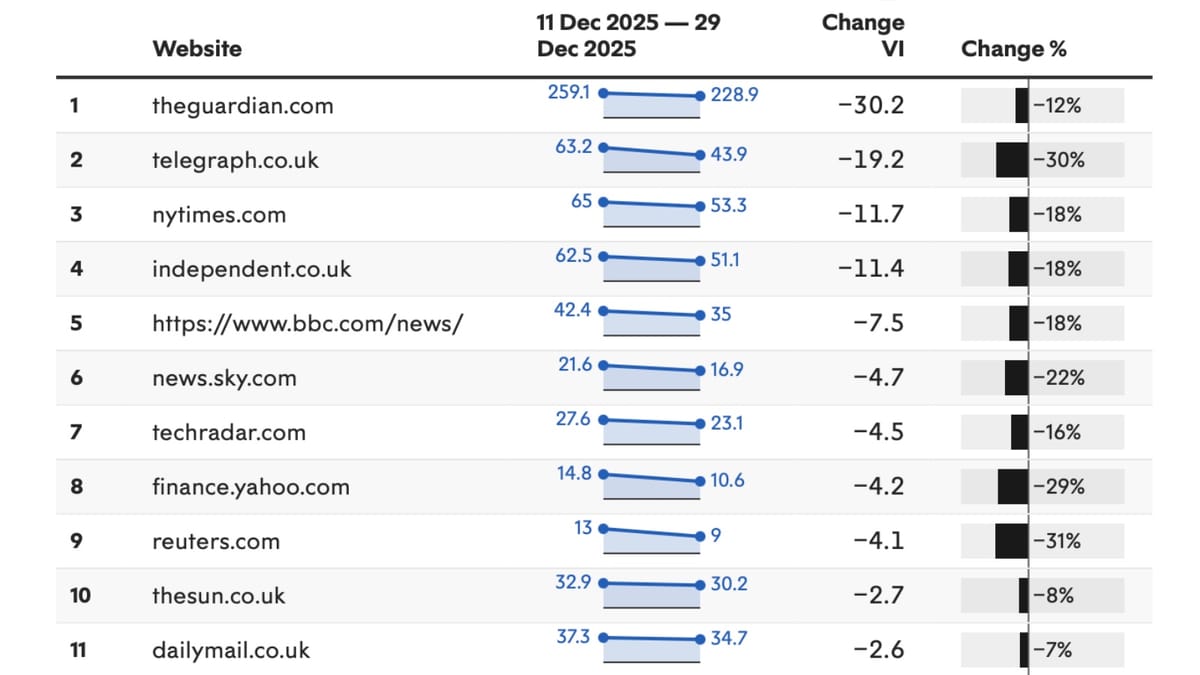
The latest Google core algorithm update delivered harsh consequences for British news publishers, with more than two-thirds of major UK news websites losing search visibility between December 11 and December 29, 2025. Analysis from SEO analytics firm Sistrix revealed The Guardian experienced the steepest decline, dropping 30 points in its visibility score to 228.9, while The Telegraph fell 19 points to 43.9 and The New York Times decreased 12 points to 53.3.
The December 2025 core update began rolling out at 9:25 AM Pacific Time on December 11, according to the Google Search Status Dashboard. Google described the adjustment as "a regular update designed to better surface relevant, satisfying content for searchers from all types of sites," projecting a three-week implementation period. The update completed on December 29 after 18 days of deployment, exceeding typical timelines observed in previous core updates throughout 2025.
Press Gazette published its analysis on January 7, 2026, examining 75 news websites using Sistrix's visibility tracking data. The visibility index measures how prominently a website appears in Google search results, assigning higher scores to sites that rank better for queries. The metric draws exclusively from organic search results and does not account for Top Stories boxes, AI Overviews, or the Google Discover news feed.
The analysis documented that 23 sites (31%) saw visibility scores increase during the update period, while 52 sites (69%) experienced declines. More than half of the analyzed websites—39 in total—recorded double-digit percentage drops in their visibility scores. The concentration of negative impacts across British news publishers raised questions about the update's evaluation criteria for journalistic content.
Among the few winners, Martin Lewis's Money Saving Expert registered the most substantial increase, gaining 8.2 points to reach a score of 92.1, representing 10% growth. Substack's network increased 4.6 points or 33% to reach 18.9, while The Times gained 2.7 points or 21% to 15.9. The Mirror added 2.1 points or 14% to reach 17.5.
Barry Adams, an SEO consultant specializing in news publishers, commented on The Times' performance via social media. "The Times was probably overdue a positive correction after their major migration," Adams wrote on January 7, referencing the publication's transition to a .com domain in 2024. "Congrats to their SEO team, they've rebuilt the site's visibility well since the migration."
The Guardian retained the highest absolute visibility score among all sites examined despite suffering the largest point decline. The publication maintained a score of 228.9, significantly exceeding Money Saving Expert's second-place position at 92.1. The scale of The Guardian's drop—30 points representing approximately 12% of its total visibility—suggested algorithmic reassessment of the publication's content evaluation rather than technical implementation issues.
Four publications experienced double-digit point declines in absolute terms. Following The Guardian's 30-point drop, The Telegraph fell 19 points to 43.9, The New York Times decreased 12 points to 53.3, and The Independent dropped 11 points to 51.1. BBC News declined seven points to 34, while Sky News (16.9), Techradar (23.1), Yahoo Finance (10.6), and Reuters (9) each fell approximately four points.
The Sun recorded a 2.7-point decline to 30.2, while the Daily Mail decreased 2.6 points to 34.7. These tabloid publications demonstrated relative resilience compared to broadsheet competitors, though both still experienced measurable visibility reductions during the 18-day rollout period.
In percentage terms, The Spectator recorded the sharpest decline at 64%, dropping from 2.4 to 0.9 in visibility score. Regional publication Lancs Live fell 56% to 0.2, while Reuters decreased 31% and The Telegraph dropped 30%. Among higher-visibility sites, these percentage declines translated to significant absolute point losses affecting overall search traffic potential.
Adams characterized the December deployment as a "rough update" for UK publishers. He noted the update represented an "extra kick in the teeth" for organizations previously impacted by Google's site reputation abuse penalties affecting those who utilized third-party commercial content to build e-commerce revenues. Google implemented these penalties throughout 2024 and early 2025 to address publishers hosting unrelated commercial content optimized for search visibility.
"Now, this data is from Sistrix which measures visibility in regular results and doesn't monitor Top Stories traffic," Adams wrote on January 7. "In my experience though, these visibility graphs tend to correlate well with actual search traffic trends." He emphasized that publishers would need to identify strategies for reclaiming search visits given Google's continued dominance as the largest single traffic source for most websites, particularly news organizations.
Buy ads on PPC Land. PPC Land has standard and native ad formats via major DSPs and ad platforms like Google Ads. Via an auction CPM, you can reach industry professionals.
Glenn Gabe, President of G-Squared Interactive LLC and an algorithm analyst, documented extensive news publisher volatility beginning December 19, 2025. "Press Gazette covering the news publisher volatility (with a focus on UK publishers)," Gabe wrote via social media on January 7. "Yep, it was a huge update." He noted that more than half of the 75 sites analyzed saw double-digit percentage declines in their visibility scores.
Press Gazette covering the news publisher volatility (with a focus on UK publishers). Yep, it was a huge update -> Times and Substack among few UK winners in December Google update
— Glenn Gabe (@glenngabe) January 7, 2026
"In percentage terms, more than half (39) of the sites analysed saw double-digit declines in their… pic.twitter.com/Xib7iKw69M
Gabe had previously posted on December 19: "I'm seeing a number of news publishers with heavy impact. I have also had several publishers reach out over the past few days explaining the volatility they are seeing (and across surfaces like Discover, Google News, Top Stories, and the News tab in Search)." His observations indicated the update modified fundamental content evaluation systems affecting multiple Google surfaces simultaneously rather than adjusting isolated ranking factors.
The December update occurred during what typically represents publishers' most lucrative period. Seasonal advertising rates peak in December as brands increase spending for holiday campaigns. The timing created dual pressure—traffic collapsed precisely when monetization opportunities reached annual highs. Publishers dependent on December revenue faced simultaneous visitor declines and missed advertising income.
Google Discover traffic experienced particularly severe disruption during the December update. Multiple publishers reported complete cessation of Discover impressions within 24 hours of the announcement, according to industry documentation compiled by Search Engine Roundtable. One publisher managing operations that previously generated 100,000 daily clicks from Discover described traffic falling to zero overnight. Another reported a 98% drop in Discover impressions during the days leading to the update announcement.
The Discover impact carried particular significance because research published in August 2025 found that Google Discover had become the dominant traffic source for news and media websites, accounting for two-thirds of Google referrals. This concentration meant the December decline disproportionately affected publishers heavily dependent on Discover distribution. Analysis by NewzDash tracking over 400 news organizations confirmed that Google Web Search traffic to news publishers had declined from 51.10% in 2023 to 27.42% in the fourth quarter of 2025, while Discover climbed to 67.51%.

Google Discover operates on the same core ranking systems affected by broad core updates, according to previous explanations from Google representatives. The simultaneous impact on both traditional search results and Discover traffic suggested the December update modified fundamental content evaluation systems rather than surface-level ranking factors. Publishers experienced ranking fluctuations across all Google surfaces including web search, Discover, Google News, and Top Stories boxes.
Industry tracking tools detected significant volatility beginning December 13, approximately two days after Google's announcement. Sistrix's Update Radar measured a volatility index of 3.54 on December 11, indicating "increased SERP fluctuation" though not reaching the 6.0 threshold typical of major confirmed updates. A second wave of ranking fluctuations struck on December 20, suggesting the rollout continued intensifying through the holiday period.
Multiple monitoring platforms registered synchronized increases in search result volatility following the official announcement. Semrush, Advanced Web Rankings, Mozcast, Sistrix, Cognitive SEO, SimilarWeb, Accuranker, Mangools, Wincher, Data For SEO, SERPstat, and Algoroo all showed substantial ranking movements beginning December 13. These detection systems measure daily changes across millions of keywords to identify when Google implements major ranking adjustments.
Outside Press Gazette's focus on British publishers, Sistrix analysis identified other notable winners from the core update. Thesaurus.com increased 55.6 points or 24% to reach a visibility score of 284, while review platform Trustpilot gained 31.5 points or 39% to reach 112.7. These increases suggested the update rewarded certain categories of reference and user-generated content alongside select news publishers.
The December 2025 deployment represented Google's third confirmed core algorithm modification of 2025. Google previously deployed the March 2025 core update on March 13, which concluded after 14 days on March 27. The June 2025 core update launched June 30 and required 16 days to complete, finishing July 17. This December deployment arrived approximately five months after the June update, maintaining roughly consistent spacing between major algorithmic adjustments throughout the year.
The update affected news publishers across multiple countries beyond the United Kingdom. Will Flannigan, Senior SEO Editor for The Wall Street Journal, shared Sistrix visibility data on January 2 showing dramatic declines for major India news publishers on U.S. search results. Hindustantimes.com, indiatimes.com, and indianexpress.com all experienced substantial drops throughout the rollout period. The visual data demonstrated hindustantimes.com falling from visibility index levels above 6 points to below 2 points by late December.
"The latest Google Core Algorithm Update walloped India-based news publishers on U.S. SERPS, according to Sistrix visibility data," Flannigan wrote on LinkedIn on January 2. The geographic concentration of severe impacts raised questions about whether the update modified evaluation criteria for international publishers serving English-language audiences or adjusted weighting of specific content categories prominent among these publications.
Gabe responded to Flannigan's analysis noting that volatility extended far beyond India-based publishers. "There was a ton of volatility with news publishers with the December broad core update," Gabe wrote on January 2. "And it's not just India-based publishers... it's news publishers across many countries (including a number of large publishers here in the US dropping or surging heavily)."
Forum discussions across WebmasterWorld and Reddit's SEO community revealed patterns of established sites losing rankings despite years of stable performance. "Consistently ranked top 1-3 on most of my relevant keywords for 2-3 years, now i'm on the 2nd page all of a sudden," one WebmasterWorld participant commented, according to industry documentation. "Feels like a bad joke by Google."
Another forum participant described keywords fluctuating between first page and fifth page within hours, with different results appearing on mobile versus desktop searches. "My keyword rankings are fluctuating a lot right now," the operator stated. "A site that was on the first page dropped to the fifth page, but when I search again it shows up on the first page. The rankings are also different between mobile and PC."
Some websites experienced complete disappearances from search results during the rollout. One forum participant whose site exceeded 10 years in age reported losing all rankings overnight despite never utilizing artificial intelligence for content generation. The accounts suggested the update applied aggressive reassessments to established properties previously considered authoritative within their categories.
Publishers implementing JavaScript-based paywalls faced additional complexity during the update period. Google updated its documentation on December 15, 17, and 18 as part of ongoing documentation improvement programs that averaged two significant updates per month throughout 2025. The guidance warned that JavaScript paywall implementation "makes it difficult for Google to automatically determine which content is paywalled and which isn't," potentially affecting how paywalled content receives indexing treatment.
The timing coincided with the December core update's broader algorithm volatility, complicating efforts to isolate technical SEO factors from algorithmic content quality assessments. Publishers experiencing declines struggled to determine whether losses stemmed from content evaluation changes, technical implementation issues, or combinations of multiple factors operating simultaneously.
Recovery prospects remain uncertain for affected sites. Google's guidance suggests that meaningful ranking improvements often require subsequent core update cycles rather than immediate content modifications. Historical data from previous updates shows limited recovery patterns even months after implementation. The June 2025 core update demonstrated some recovery patterns for sites previously impacted by the September 2023 Helpful Content Update, though many publishers experienced mixed results with recovery timelines varying considerably.
The Sistrix visibility measurement methodology underwent significant modifications in 2025 following Google's removal of the num=100 parameter on September 14. The parameter had previously enabled measurement providers to retrieve 100 organic search results in a single query. Google eliminated this capability without prior notice during the weekend of September 13-14, forcing measurement providers to execute ten times more queries to gather equivalent data volumes.
Sistrix adapted its crawling methodology to continue recording 100 organic positions for all keywords influencing the Visibility Index despite the new limitations. The company implemented fixes progressively between September 17 and September 22, restoring data for multiple countries including Germany, Austria, Switzerland, Italy, Spain, France, the United Kingdom, the United States, Sweden, Brazil, the Netherlands, and Poland. Johannes Beus, Sistrix founder, published detailed updates on the company's response strategy through status.sistrix.com.
The December update occurred within broader context of declining traditional search traffic to news publishers. Web Search traffic to news organizations dropped from 51% in 2023 to 27% in the fourth quarter of 2025, representing a loss of 23.68 percentage points during this two-year period. The shift reflected fundamental redistribution of how audiences discover news content through Google's platforms, with algorithmic changes potentially accelerating existing trends rather than creating entirely new patterns.
For standard informational keywords, average position-one clickthrough rates dropped from 0.056 in March 2024 to 0.031 in March 2025, according to clickstream data. AI Overview keywords experienced even sharper declines, falling from 0.073 to 0.026 during the same timeframe. The dual impact of reduced search traffic share and lower click-through rates created compounding pressure on publishers dependent on search referrals for audience acquisition and advertising revenue.
The transformation documented across 2025 reflects broader strategic shifts within Google's approach to search quality and commercial viability. The company increasingly positioned itself as an AI agent providing direct answers rather than a directory connecting users to external websites. This philosophical evolution created fundamental tensions with publishers depending on search referral traffic for sustainability, particularly news organizations operating on advertising-supported business models with limited subscription revenue alternatives.
Adams emphasized the competitive implications for publishers navigating the transformed search environment. "Publishers will need to find ways to reclaim their search visits," Adams wrote. "Google is and will continue to be the largest single traffic driver to most websites, especially news publishers. The space is narrowing, so competition for visibility and clicks will become ever fiercer."
Subscribe PPC Land newsletter ✉️ for similar stories like this one
Subscribe PPC Land newsletter ✉️ for similar stories like this one
Who: British news publishers including The Guardian, The Telegraph, The New York Times, The Independent, BBC News, Sky News, Reuters, and dozens of other UK-based news websites experienced visibility changes. The Times, Money Saving Expert, Substack, and The Mirror ranked among the few winners. Sistrix provided visibility tracking data analyzed by Press Gazette. SEO consultants Barry Adams and Glenn Gabe documented impacts.
What: Google's December 2025 core update caused more than two-thirds of analyzed UK news websites to lose search visibility between December 11 and December 29. The Guardian fell 30 points in Sistrix visibility score, The Telegraph dropped 19 points, The New York Times decreased 12 points, and The Independent fell 11 points. Money Saving Expert gained 8.2 points, Substack increased 4.6 points, The Times rose 2.7 points, and The Mirror added 2.1 points. More than half of analyzed sites saw double-digit percentage declines.
When: The update began rolling out December 11, 2025, at 9:25 AM Pacific Time. First major volatility appeared December 13. A second wave struck December 20. Google confirmed completion December 29 after 18 days of deployment. Press Gazette published its analysis January 7, 2026, using Sistrix data covering the full rollout period.
Where: The algorithmic changes affected search results globally across all Google surfaces including web search, Discover, Google News, Top Stories, and image search. Press Gazette's analysis focused on 75 news websites published in or targeting UK audiences. Similar impacts occurred for India news publishers on U.S. search results and news organizations across multiple countries.
Why: Google stated the update aimed to "better surface relevant, satisfying content for searchers from all types of sites." The company implements core updates to refine fundamental content evaluation systems. The timing during peak December advertising season proved particularly harsh for publishers dependent on search traffic. Google Discover, which accounts for 67% of Google referrals to news publishers, experienced severe disruption alongside traditional search results, suggesting the update modified core ranking systems affecting all surfaces simultaneously.