
Canva buys Simtheory and Ortto to turn a design tool into a full work platform
Canva on April 8 acquired Simtheory and Ortto, adding agentic AI orchestration and a customer data platform with 11,000 customers to its growing martech stack.

Canva on April 8 acquired Simtheory and Ortto, adding agentic AI orchestration and a customer data platform with 11,000 customers to its growing martech stack.
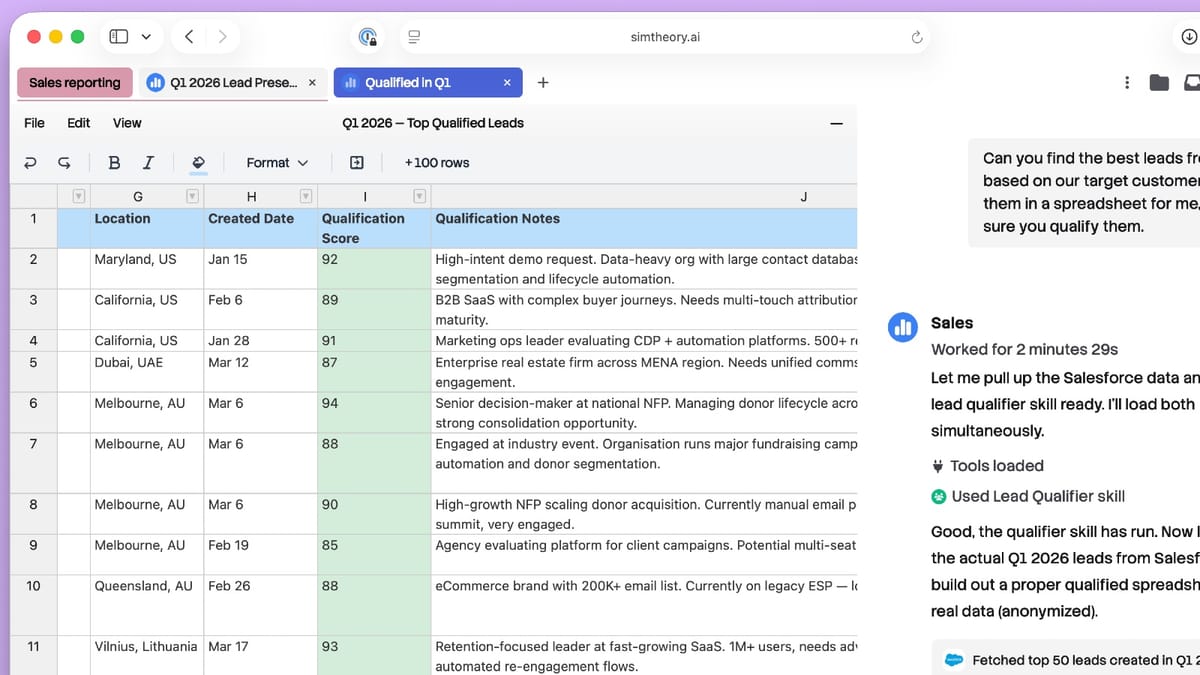
Canva on April 8, 2026, announced the simultaneous acquisition of two Australian-founded companies - Simtheory, an agentic AI collaboration platform, and Ortto, a customer data platform and marketing automation company. The deals together represent the broadest single expansion in Canva's twelve-year history, extending the company's reach from visual design into AI-powered workflow management and multi-channel campaign execution.
Both companies were founded by Chris and Mike Sharkey, who previously built Stayz, a property rental platform acquired by Fairfax Media. The Sharkeys will join Canva in leadership roles across its AI and marketing technology divisions. Financial terms were not disclosed.
The pairing is deliberate. Simtheory addresses the production layer - how teams build, manage, and orchestrate AI agents to move a project from idea to finished output. Ortto addresses the distribution layer - how marketing teams deliver, measure, and iterate on campaigns once content exists. Together they extend Canva's capability from creation into what Cliff Obrecht, Co-Founder and Chief Operations Officer at Canva, described in the announcement as "the system where work happens end-to-end, whether it's a quick idea or a full campaign."
That framing is significant for marketing professionals. Canva, launched in Sydney in 2013, is now used by more than 265 million people each month across more than 190 countries. The platform has historically occupied the front end of the creative process - the moment when an asset is being made. The Simtheory and Ortto acquisitions are a direct attempt to occupy the phases before and after that moment: structured ideation using AI agents, and post-publication measurement and optimisation.
Simtheory was built to address a specific problem in how teams use AI. Generating a document, image, or structured response is mechanically straightforward with current models, but that output is rarely the final product. Most workflows require revision cycles, cross-functional review, tool handoffs, and iterative refinement. Simtheory's platform was designed to support that broader process rather than just the generation step.
The technical architecture centres on multi-model orchestration. Teams can apply different AI models across different stages of a project - one model for research, another for drafting, another for classification or quality checking - without rebuilding their workflow for each transition. The platform handles agent setup with no-code tooling, meaning teams without dedicated engineering resources can configure agentic systems that meet their operational requirements.
According to the announcement, Simtheory has gained traction among enterprise teams exploring how AI can move beyond generation into execution. That phrase - "beyond generation into execution" - is a precise way to describe what the ad tech and marketing industry has been calling agentic AI: systems that do not merely respond to prompts but carry out multi-step tasks with minimal human intervention at each step.
The acquisition of Simtheory positions Canva to contribute to that broader infrastructure shift. As PPC Land has tracked, the advertising industry began formalising agentic AI standards in late 2025, with McKinsey data indicating $1.1 billion in equity investment flowed into the category during 2024 and job postings related to agentic technology growing 985 percent from 2023 to 2024. Canva's entry into this space through acquisition adds a major consumer and enterprise platform to the list of players building agentic infrastructure.
Obrecht described the acquisition this way in the press release: "Simtheory accelerates our evolution from a design platform with AI tools to an AI platform with design and productivity tools at its core." The Canva Create event on April 16 is where the company intends to make its first public demonstration of what that architecture looks like in practice. Obrecht called it "the biggest transformation in Canva's history."
Ortto has been operating as a standalone product since before the acquisition. The platform serves more than 11,000 customers across 190 countries and combines a customer data platform with a marketing automation layer. It enables teams to build and run journeys across email, SMS, push notifications, in-app messaging, forms, and surveys within a single environment.
The underlying architecture uses event-driven data processing. When a customer takes an action - a purchase, a page visit, a form submission - that event triggers automated responses configured by the marketing team. No-code integrations allow teams to connect Ortto to their existing data stack without custom development work. The result is a system where real-time customer data connects directly to campaign execution, compressing the delay between signal and response.
This architecture matters in the context of Canva's existing product direction. Canva launched Canva Grow in 2024 as a product line explicitly targeted at marketing and campaign management. Ortto's capabilities slot into that product line. According to the announcement, the Ortto team will continue to support and maintain the Ortto product while progressively applying their expertise to Canva Grow.
The acquisition is not Canva's first in this direction. In the period leading up to April 8, Canva acquired MagicBrief, MangoAI, and Doohly - three companies covering creative performance analysis, AI-powered content generation, and digital out-of-home advertising respectively. Each acquisition adds a distinct capability to what Canva is assembling under Canva Grow: a platform that spans ideation, production, distribution, measurement, and optimisation.
Mike Sharkey, Co-Founder and Chief Executive Officer of Ortto and Simtheory, addressed the scale of the opportunity in the announcement: "The opportunity to bring our technology to the quarter of a billion people using Canva every month and to help more people make the most of AI in their everyday work is incredibly exciting to us." He also noted: "From day one, we've been working to make complex things simple with both Simtheory and Ortto, and we can't wait to continue doing that on an even larger scale as part of Canva."
The acquisition arrives as marketing technology consolidation accelerates across the industry. HubSpot acquired XFunnel in October 2025 to address AI-generated search visibility. LiveRamp has progressively expanded its agentic marketing infrastructure through successive launches across late 2025 and early 2026, including live AI agents for audience building and cross-media measurement that went live in March 2026. Each of these moves reflects the same structural observation: marketing workflows that were previously distributed across multiple disconnected tools are now collapsing into fewer, more integrated platforms.
Canva's move is notable because it approaches this consolidation from a different starting point than the platforms PPC Land typically covers. Canva is not an ad tech company extending into creative. It is a creative platform extending into the campaign management and data infrastructure that surrounds creative work. The direction is the same - consolidation toward a more complete marketing stack - but the origin point gives Canva access to a user base that is significantly larger and more broadly distributed than most ad tech platforms can claim.
The combination of Simtheory and Ortto is also architecturally coherent in a way that separate acquisitions sometimes are not. Simtheory's agentic orchestration layer is capable of connecting to external tools and data systems. Ortto's event-driven customer data platform is exactly the kind of structured, real-time data source an agentic system can act on. An agent configured in Simtheory could, in principle, query customer behaviour data in Ortto, identify a trigger condition, generate a personalised asset in Canva, and dispatch it through Ortto's campaign channels - without a human manually coordinating each step.
Whether Canva builds that kind of closed-loop integration, and how long it takes to reach production at scale, remains to be seen. But the architectural components for it are now within the same company.
Canva Create on April 16, 2026, arrives eight days after the acquisition announcement. Canva described the event as the moment when it will "unveil its next major step forward, and the biggest evolution in its history, as it reimagines how the world creates." The timing is deliberate - the acquisitions were announced five business days before the event, giving the market time to understand what infrastructure Canva has assembled before the product demonstration lands.
The significance for marketers is that the April 16 event is likely to show not just a design product update but the first public view of what an AI-first version of Canva looks like in practice. That will include the earliest visible output of Simtheory's integration. Canva confirmed in the acquisition announcement that some of its early Simtheory work will appear at the event.
Chris and Mike Sharkey's previous company, Stayz, was Australia's leading holiday rental platform before its acquisition by Fairfax Media. That background in consumer marketplace infrastructure is relevant context for what they built at Ortto. Ortto's platform was designed to handle the complexity of large-scale customer lifecycle management - the kind of data volume and event frequency that a consumer marketplace generates. Bringing that experience into Canva, which operates at 265 million monthly users, gives the Sharkeys a platform of comparable or greater scale to apply their architecture.
Their dual role - running both Simtheory and Ortto simultaneously - also indicates that the two products were built with integration in mind. The same founding team, the same investors, and the same operational infrastructure meant that Simtheory and Ortto were always more like two halves of a single platform strategy than two separate companies. Canva is acquiring that strategy whole.
The practical implications for marketing teams are several. First, Canva Grow's development roadmap is likely to accelerate. The addition of Ortto's 11,000-customer base and event-driven data architecture gives Canva Grow a substantial installed base to build against. Second, the Simtheory integration points toward a future version of Canva where AI agents can be configured to handle repetitive production tasks - resizing assets for different formats, generating copy variants, scheduling publication - without requiring manual orchestration for each step.
Third, and perhaps most structurally significant, Canva is now directly competing with established marketing automation platforms on functionality that those platforms have spent years building. Ortto's capabilities overlap with tools like HubSpot, Klaviyo, and Braze across several dimensions: email automation, in-app messaging, customer journey orchestration, and event-driven segmentation. Canva's advantage is that it enters this competitive space with an existing design and creative workflow that competing marketing automation platforms do not have.
As the agentic AI infrastructure debate has demonstrated across programmatic advertising, the platforms that control both the creation layer and the distribution and measurement layer are increasingly in a structural position to automate more of the marketing function. Canva is building toward that position from the creation side.
Who: Canva, the Sydney-founded visual communication platform used by more than 265 million people monthly, acquired Simtheory and Ortto, both founded by Chris and Mike Sharkey, who previously built and sold Stayz to Fairfax Media. The Sharkeys will join Canva in leadership roles across AI and marketing technology.
What: Two simultaneous acquisitions - Simtheory brings a multi-model agentic AI orchestration platform that enables teams to build and manage AI agents across complex workflows; Ortto brings a customer data platform and marketing automation system used by more than 11,000 customers in 190 countries, supporting email, SMS, push notifications, in-app messaging, forms, and surveys through an event-driven architecture.
When: The announcement was made on April 8, 2026. Canva plans to demonstrate early integration work at Canva Create on April 16, 2026.
Where: Canva is headquartered in Sydney, Australia. Ortto operates across 190 countries with 11,000 customers. Both acquired companies were Australian-founded. The combined platform serves users globally.
Why: Canva is pursuing a strategic expansion beyond design tool into what its leadership calls "the system where work happens end-to-end." The acquisitions address two gaps: the orchestration of AI agents across multi-step creative workflows (Simtheory) and the ability to power the full marketing lifecycle from campaign creation through deployment, measurement, and optimisation (Ortto). The deals build on earlier acquisitions of MagicBrief, MangoAI, and Doohly and form the infrastructure basis for Canva Grow.