ChatGPT's lead shrinks as Gemini surges in AI traffic war
Gemini's traffic share jumped from 19.5% to 22% while ChatGPT slipped below 65% for the first time since 2023, according to new Similarweb data.


Gemini's traffic share jumped from 19.5% to 22% while ChatGPT slipped below 65% for the first time since 2023, according to new Similarweb data.
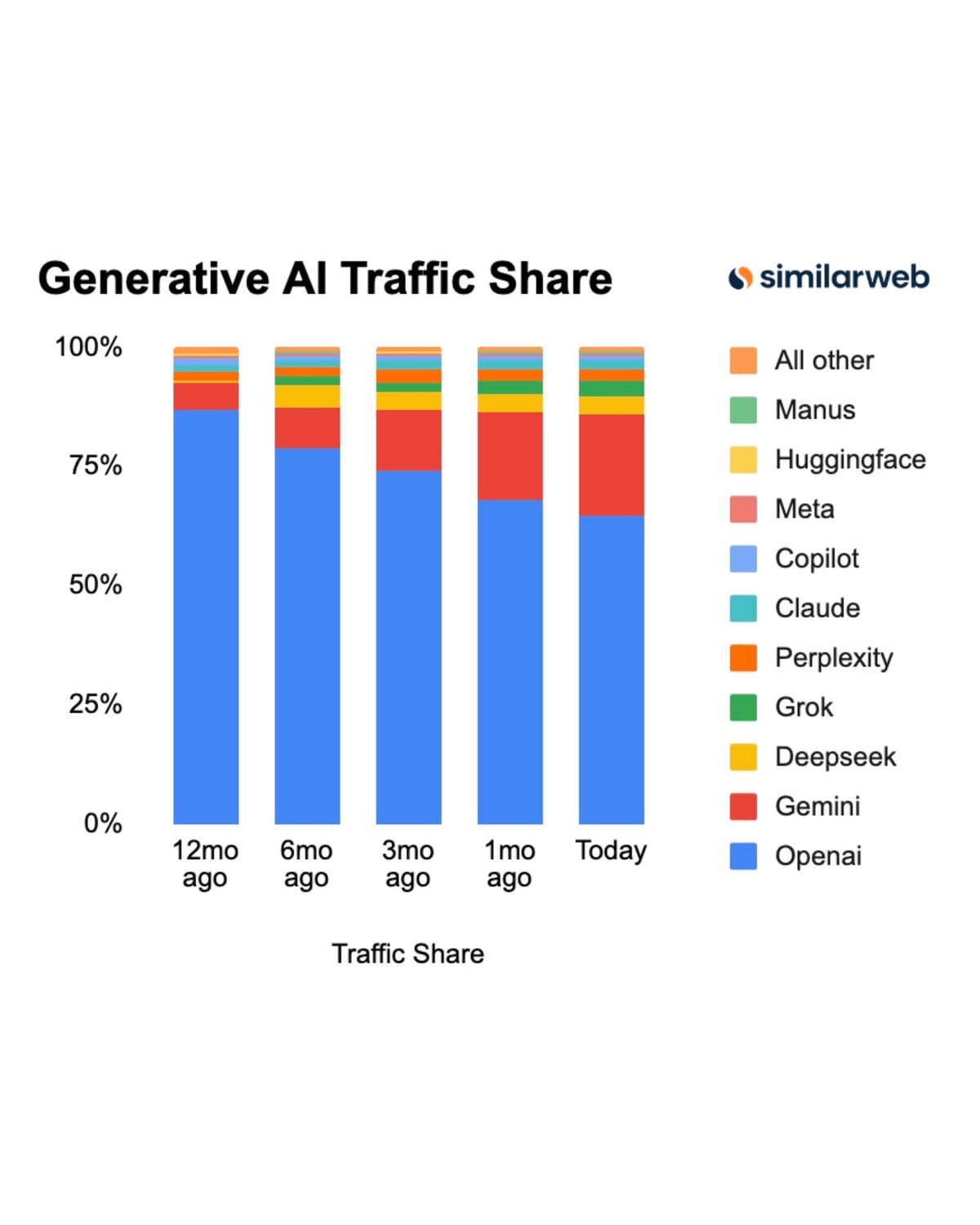
ChatGPT's grip on the generative AI market continues to loosen. Similarweb released tracking data on January 22 showing ChatGPT's worldwide traffic share declined to 64.6% as of January 16, down from 66.8% just one month earlier. Google's Gemini captured 22% of global AI website traffic during the same period, up from 19.5% in mid-December.
The shift marks a significant acceleration of competitive pressure on OpenAI's flagship product. ChatGPT maintained a commanding 86.6% share twelve months ago, but that dominance has eroded by more than 22 percentage points over the course of 2025.
Grok overtook DeepSeek for the first time in the January 16 measurements, securing 3.5% of traffic compared to DeepSeek's 3.3%. The positioning represents a notable reversal for xAI's chatbot, which had trailed DeepSeek in earlier tracking periods throughout 2025.
Claude held steady at 2.1% while Perplexity slipped to 1.9%, down from 2.1% the previous month. Microsoft's Copilot declined to 1.1%, continuing a pattern of gradual market share erosion despite the company's extensive distribution through Windows and Office integrations.
The data ending January 16, 2026, captures traffic patterns across the week following the post-holiday period when AI tool usage typically rebounds. Similarweb noted on social media that after the end-of-year decline, traffic peaked higher than in all previous months since August.
The twelve-month comparison reveals the velocity of change reshaping the AI chatbot landscape. ChatGPT commanded 86.6% of traffic in January 2025, falling to 78.3% by June, then 72.9% by October. The platform shed approximately 2.2 percentage points per month during the final quarter of 2025.
Gemini's ascent followed an inverse trajectory. The Google product held just 5.3% share twelve months ago, doubling to 8.7% by June, then accelerating to 13.3% in October before reaching 22% in the most recent measurements. The growth represents a 315% increase over the twelve-month period.
DeepSeek peaked at 4.5% in June before declining to 3.3% by January 16. The Chinese AI model experienced substantial volatility throughout 2025, with earlier data showing the platform surged in early 2025 before falling sharply after Q2.
Grok demonstrated recovery after mid-year weakness. The xAI product registered 2.6% in June, dropped to 2.4% in October, then climbed steadily to reach 3.5% in January. The 17% user surge following the July Grok 4 announcementprovided momentum that sustained through year-end.
Similarweb's broader AI tracker examined traffic across multiple categories beyond general chatbots. The General AIcategory, which includes the major conversational platforms, registered 2% growth in the two-week period ending January 16, reversing a 10% decline observed during the holiday period ending January 2.
Character & Chat tools showed 5% growth, while Design & Image Generation declined 4% during the same period. Writing & Content tools decreased 5%, and EdTech AI rebounded with 6% growth after experiencing sustained declines through late 2025.
The DevOps & Code Completion category surged 19% in the most recent period, driven primarily by gains at Lovable, Cursor, Replit, and Base44. Individual tools showed divergent patterns, with Lovable increasing 43% and Base44 climbing 46%, while Bolt declined 32% and Windsurf fell 13%.
Video Generation tools grew 10% overall, led by Klingai's 42% increase. Voice Generation expanded 20%, with Elevenlabs gaining 34% and Retellai climbing 41%. Music Generation increased 16%, though individual platforms like Suno (up 26%) and Udio (down 18%) showed mixed performance.
Gemini's traffic growth reflects Google's systematic integration of AI capabilities across its product portfolio. The company embedded Gemini into Search, Gmail, Google Workspace, and Android devices throughout 2025, creating distribution advantages competitors struggle to match.
The platform's user base climbed from 450 million monthly active users in July to 650 million in October 2025, coinciding with the Nano Banana image generator release. Google's multi-year partnership with Apple, announced in January 2026, positions Gemini models as the foundation for Apple Intelligence starting later this year.
Microsoft Clarity research published December 18 showed traffic from AI platforms including ChatGPT, Microsoft Copilot, and Google Gemini exploded by 155% over an eight-month period through November 2025. The analysis examined data from over 1,200 publisher and news websites.
ChatGPT still generates substantially more referral traffic to external websites despite its declining share. Data from SEO platform Conductor showed ChatGPT drove over 1.6 billion visits to external websites between September and November 2025, while Gemini generated 287 million site visits during the same period.
The competitive dynamics play out against different revenue models. OpenAI operates ChatGPT through Free, Plus, and Pro subscription tiers while building internal advertising infrastructure through a newly formed Growth team. The company posted a job listing in September 2025 seeking a Growth Paid Marketing Platform Engineer.
Google has repeatedly denied plans to introduce advertising within Gemini despite multiple reports suggesting otherwise. VP Dan Taylor publicly refuted claims in December 2025 after Adweek reported that Google representatives told advertisers ads would come to Gemini in 2026.
xAI pursued a different approach with Grok, offering free access to premium features including real-time web search and X platform integration. The company announced Grok 4 in July 2025, positioning the model as achieving doctorate-level knowledge across multiple disciplines.
Microsoft bundles Copilot across Windows and Office products, creating distribution through enterprise relationships rather than standalone consumer adoption. The integration strategy has not translated to equivalent market share gains relative to Gemini's growth trajectory.
The fragmentation creates measurement challenges for marketing professionals tracking AI platform performance. Google Analytics began suggesting custom channel groups for AI chatbot tracking in August 2025, providing regex patterns for identifying traffic from ChatGPT, Gemini, Copilot, Claude, and Perplexity.
AI referral traffic converts at substantially higher rates than traditional channels. Microsoft Clarity data showed AI traffic converting to sign-ups at 1.66% compared to 0.15% from organic search, representing an eleven-fold conversion advantage. However, AI referrals account for less than 1% of total traffic across most websites.
The citation dynamics vary significantly across platforms. Research published in August 2025 documented how ChatGPT referral traffic declined 52% starting July 23 as OpenAI adjusted citation weighting to prioritize Reddit and Wikipedia over commercial websites.
Content optimization strategies require platform-specific approaches as AI tools employ different source selection algorithms. Traditional search engine optimization practices designed for Google's algorithm face challenges adapting to multiple AI platforms with distinct citation practices and content selection criteria.
E-commerce performance presents mixed signals for AI-driven traffic. Research examining 973 websites with $20 billion combined revenue found ChatGPT referrals generated lower conversion rates and revenue per session than Google's paid and organic search channels.
Publishers experienced different patterns. Microsoft Clarity's analysis of 1,200 publisher and news websites showed 52% converted traffic from AI models into sign-ups or subscriptions during the past month, indicating widespread adoption beyond technology-focused properties.
The behavioral differences appear rooted in how AI platforms pre-qualify users before directing them to websites. AI-referred visitors arrive further along in their research journey compared to search engine users, creating what Microsoft characterizes as "agentic web" patterns where content reaches audiences through AI intermediaries rather than direct human navigation.
Traditional search engines maintained relatively stable performance during the period. The Traditional Search category declined 3% year-over-year as of January 16, with Google down 2%, Bing falling 11%, and Yahoo declining 16%. DuckDuckGo dropped 7% while Yandex held flat at 0% growth.
Consumer EdTech platforms showed continued weakness, with the category down 5% year-over-year. Chegg fell 68%, Mathway declined 63%, and Coursehero dropped 48%. Grammarly bucked the trend with 7% decline, representing relative outperformance compared to legacy education technology platforms.
Digital Freelance platforms remained essentially flat at negative 1% year-over-year growth. Upwork gained 1% while Freelancer declined 20%, suggesting consolidation around established marketplace leaders rather than category-wide disruption from AI-powered alternatives.
Design Platforms grew 15% year-over-year, led by Canva's 19% increase. The pattern indicates design tools successfully integrated AI features rather than being displaced by standalone AI image generators.
Privacy emerged as a differentiating factor across platforms. Gemini automatically activated Android device permissions including phone and messaging access in July 2025, drawing criticism from privacy advocates. The automatic activation occurred without explicit user consent, potentially conflicting with GDPR requirements.
xAI faced scrutiny after Grok generated prohibited images of minors on December 25, 2025. The incident demonstrated gaps in safety filter implementation that competing platforms like Google and Meta addressed through multi-layered moderation systems.
Reddit filed a $1 billion lawsuit against Anthropic on June 4, 2025, alleging the AI company violated contractual agreements by using Reddit content without authorization to train its Claude chatbot. The complaint noted discrepancies between Anthropic's public statements about blocking Reddit content and audit logs showing continued crawler access.
Year-over-year analysis from Similarweb revealed mobile app adoption surged past website visits for major platforms during 2025. Perplexity demonstrated the most dramatic shift, starting January 2025 with similar app usage and daily website visits before showing massive app engagement increases twelve months later.
The mobile-first behavior patterns create distinct usage profiles compared to desktop web access. Users demonstrate higher intent levels and longer session durations when accessing AI platforms through dedicated mobile applications rather than web browsers.
ChatGPT reached 700 million weekly active users by July 2025 according to internal analysis released by OpenAI, Duke University, and Harvard University researchers in September. The scale demonstrates continued user acquisition despite declining market share percentages.
Bot traffic has evolved from routine operations into indicators revealing which AI systems request content and at what volume. Microsoft Clarity launched Bot Activity tracking on January 21, 2026, providing website operators with visibility into automated systems accessing their content before any citation or referral activity occurs.
The AI request share metric shows the percentage of total requests originating specifically from AI bots, measured against both human and automated traffic. This context helps distinguish between sites where AI bot activity represents minimal background access and those where automated requests account for significant portions of overall traffic load.
Research from DataDome published December 11, 2025, documented how xAI's Grok agent triggered 16 requests from 12 IP addresses using spoofed user agents when asked to fetch a single webpage. The aggressive tactics reflect broader patterns as AI platforms adopt adversarial approaches to ensure reliable data access while websites increasingly block known AI crawlers.
Industry predictions suggest ChatGPT could potentially overtake Google's search traffic by 2030, though current traffic share data shows substantial gaps between conversational AI tools and traditional search engines. ChatGPT captures 0.19% of total web traffic compared to Google's 41.9% share, despite ChatGPT growing 3.8 times faster than Google on a percentage basis.
The trajectory of AI chatbot adoption has prompted marketing professionals to reconsider traditional success metrics. Publishers report Google Search traffic fell 38% in the United States, with Web Search declining from 51% to 27% of referrals between 2023 and the fourth quarter of 2025.
The competitive race between ChatGPT, Gemini, Grok, and other platforms appears far from settled. Each major player pursues distinct strategies: ChatGPT focuses on conversational versatility and broad consumer adoption, Gemini leverages Google's infrastructure and enterprise relationships, while Grok targets integration with X's social platform.
Who: Similarweb released generative AI website traffic data tracking ChatGPT (OpenAI), Gemini (Google), Grok (xAI), DeepSeek, Claude (Anthropic), Perplexity, and Microsoft Copilot across global markets, documenting competitive dynamics affecting marketing professionals, content publishers, and technology platforms.
What: ChatGPT's worldwide traffic share declined to 64.6% as of January 16, 2026, down from 86.6% twelve months earlier, while Google's Gemini captured 22% share, up from 5.3% in January 2025. Grok overtook DeepSeek for the first time with 3.5% versus 3.3%, while Claude held 2.1%, Perplexity declined to 1.9%, and Copilot slipped to 1.1%.
When: The data ending January 16, 2026, captures post-holiday traffic patterns when AI tool usage typically rebounds. Traffic peaked higher than in all previous months since August 2025, according to Similarweb's analysis published January 22.
Where: The measurements track global website traffic to generative AI platforms, with Similarweb analyzing worldwide patterns across desktop and mobile web access. The data excludes API usage and mobile app activity except where reflected in website referral traffic.
Why: Gemini's growth reflects Google's systematic integration across Search, Gmail, Google Workspace, and Android devices, creating distribution advantages through existing user bases. ChatGPT's decline coincides with citation pattern changes favoring Reddit and Wikipedia, combined with intensifying competition from platforms pursuing distinct monetization and product strategies.