Clear Channel locks in Omaha airport for a decade with $1M digital bet
Clear Channel Outdoor wins a 10-year contract at Omaha Eppley Airfield, deploying $1M in LED displays as the $950M terminal expansion nears opening in 2027.


Clear Channel Outdoor wins a 10-year contract at Omaha Eppley Airfield, deploying $1M in LED displays as the $950M terminal expansion nears opening in 2027.
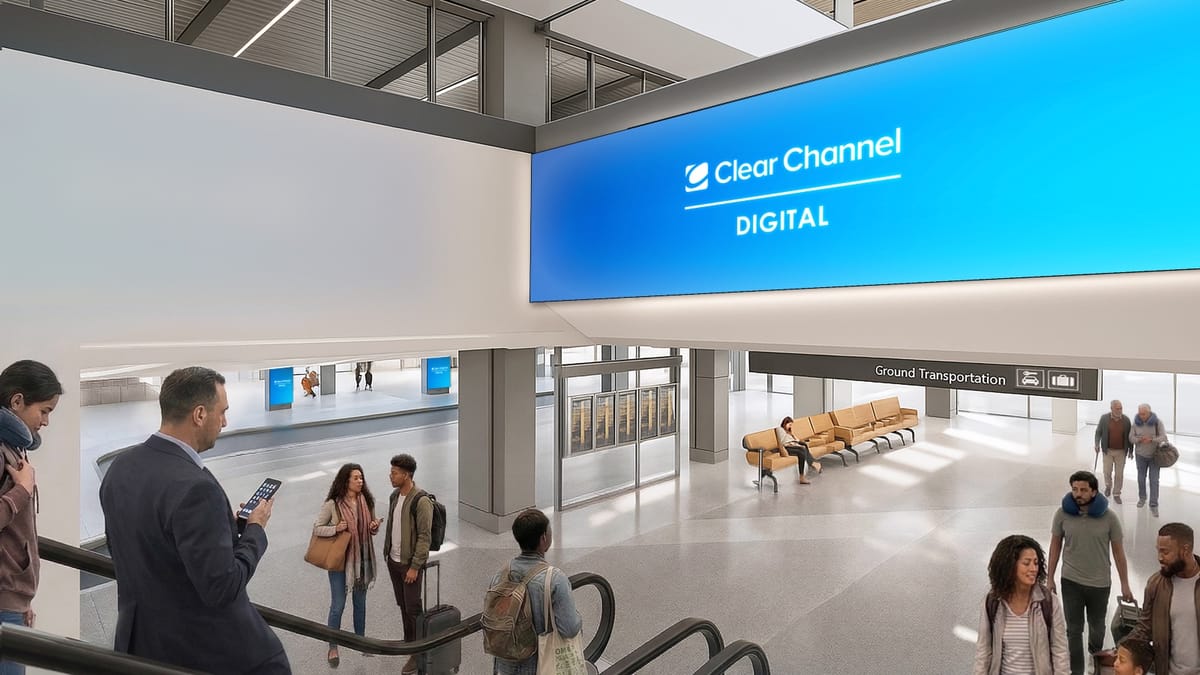
Clear Channel Outdoor this week secured a new 10-year advertising contract with the Omaha Airport Authority, extending a relationship that stretches back more than 16 years and committing $1 million to outfit a brand-new terminal with large-format LED video walls, digitally enhanced columns and architecturally integrated print displays. The announcement, dated March 12, 2026, arrives as Omaha Eppley Airfield (OMA) prepares for the phased opening of a $950 million terminal expansion beginning in 2027.
The deal was awarded through a competitive process. According to the press release, Clear Channel Outdoor's Airports Division will design and install a "reimagined media program" that integrates with the new terminal's architectural aesthetic - not simply layering advertising onto existing infrastructure, but embedding it within the building's accent lines and finishes from the outset. That distinction carries practical weight for brands buying inventory at the airport. The visual environment becomes part of the experience, rather than a disruption to it.
Omaha Eppley Airfield serves more than 5.2 million passengers annually, according to the announcement. That figure situates OMA firmly in the mid-tier of U.S. regional airports - large enough to attract national advertisers, close enough to a specific geography to retain value for local and regional brands. The audience spans leisure travellers, business professionals, military personnel, healthcare workers and financial services employees, reflecting the economic profile of the greater Omaha metropolitan area.
Research commissioned by Clear Channel Outdoor and conducted by Nielsen found that 88% of frequent flyers report noticing airport messaging, and 57% say they take action after seeing it. These figures, cited in the press release, form part of Clear Channel's commercial case to advertisers considering the new OMA inventory. Whether independent verification of those figures exists is not stated in the announcement.
The contract positions Clear Channel to sell placements across arrivals, baggage claim and the rental car facility - touchpoints that capture passengers at moments of relative dwell time, when screens are more likely to hold attention than in transit corridors. The baggage claim environment is particularly relevant: passengers stand, wait and look around. Digitally enhanced columns positioned throughout that space transform what is otherwise utilitarian infrastructure into an extended advertising surface.
The $1 million investment committed by Clear Channel Outdoor's Airports Division will fund five distinct components. A network of large-format LED video walls will be installed at key vertical circulation points throughout the terminal, delivering full-motion content at moments when passengers are moving between levels. These installations are designed for high-impact brand storytelling rather than static display.
Second, a coordinated network of digitally enhanced columns will run through baggage claim, converting structural pillars into active media surfaces. Third, the program includes custom "sense-of-place" theming with a dynamic welcome experience in baggage claim that references Omaha's local identity. Fourth, architecturally integrated print displays will align with the terminal's accent lines and finishes, preserving sightlines while maintaining a presence for formats that do not require power or network connectivity. Fifth, a premier sponsorship position will offer a single brand sustained presence across the entire installation.
According to the announcement, Clear Channel will also engage local and small businesses for installation and maintenance work, specifically naming Chandler Campbelle & Daschle, Renze Display Company and National Electric as partners. The inclusion of community-based contractors in the press release signals an awareness that airport advertising contracts, which often receive public scrutiny, carry reputational considerations beyond the commercial relationship between the operator and the authority.
The program is scheduled to debut alongside the phased opening of the new terminal beginning in 2027.
According to Morten Gotterup, President of Clear Channel Outdoor Airports Division, the company has served as Omaha Airport Authority's advertising concessionaire for more than 16 years. That tenure covers a period of significant change in airport advertising - from predominantly static print formats to the digitally integrated environments now standard at major U.S. hubs.
"After more than 16 years as Omaha Airport Authority's advertising concessionaire, we are proud to enter into this agreement for the next decade," Gotterup said. "OMA has undergone extraordinary growth and transformation, and we are committed to delivering a program that enhances the passenger journey while driving meaningful, long-term results for the Authority and its community."
Dave Roth, Chief Executive Officer at Omaha Airport Authority, framed the contract renewal in terms of the broader terminal modernisation effort. "The new contract with Clear Channel is happening during an exciting time as we progress with our terminal modernization program," Roth said. "Advertising across the airport provides benefits to our travelers and enhances the passenger experience."
The $950 million terminal expansion at OMA is one of the larger capital infrastructure projects currently underway at a regional U.S. airport. The scale of that investment creates both the opportunity and the obligation for a proportionally sophisticated media program - hence Clear Channel's decision to develop an integrated installation rather than adapting its standard product.
The Omaha announcement arrives during a period of heightened competition for airport advertising contracts across North America. JCDecaux North America won a 10-year contract at Denver International Airport on March 3, 2026, just nine days before Clear Channel's Omaha announcement. That Denver deal, which covers an airport serving over 82 million passengers annually - roughly 16 times OMA's traffic - is still pending Denver City Council approval.
The contrast between Denver and Omaha illustrates how airport advertising contracts span a wide range of market sizes. Large-hub contracts attract global competition between Clear Channel and JCDecaux, among others. Regional airports like OMA, however, often present longer-tenure relationships and deeper integration between the operator and the local community, as the Omaha announcement's emphasis on local contractors makes clear.
Clear Channel's broader corporate situation has shifted considerably in recent months. On February 9, 2026, Clear Channel Outdoor Holdings agreed to be acquired by Mubadala Capital, in partnership with TWG Global, in an all-cash transaction valued at $6.2 billion, or $2.43 per share - a 71% premium to the company's unaffected October 16, 2025 closing price. The deal is expected to close by end of Q3 2026, pending shareholder and regulatory approvals. Under private ownership, Clear Channel's Airports segment - which derived 63.8% of its revenue from national sales during the three months ended September 30, 2025 - will continue to operate as a core business unit.
The pending acquisition adds context to how long-term airport contracts function as anchor assets. A 10-year agreement with a growing regional airport, embedded within a $950 million infrastructure project, provides exactly the kind of durable, predictable revenue that a private equity-backed operator values.
The wider out-of-home advertising market provides the structural backdrop for the Omaha deal. US out-of-home advertising spend is projected to reach $4 billion in 2026, up 4.1% year-over-year, according to Guideline, the media intelligence platform. Digital out-of-home is growing at 14.5% but showing signs of deceleration, while traditional formats are growing at only 1.5%. In 2025, DOOH contributed 55% of total OOH ad revenue growth despite representing just 20% of total category spend.
Airport advertising occupies a premium position within that broader OOH market. Dwell time, audience quality and the controlled environment of a terminal create conditions that outdoor advertising on streets or transit cannot fully replicate. Research published in October 2025 by Keen Decision Systems found that OOH advertising achieves a $7.58 marginal ROI, outperforming saturated digital channels - an argument that airport operators and their advertising partners now routinely deploy when pitching to national brands.
Clear Channel Outdoor also expanded its footprint in January 2026 through a multi-year exclusive media contract with CapMetro in Austin, covering 400+ buses on 71 routes and 10 rail stations. That deal extends Clear Channel's existing media program at Austin-Bergstrom International Airport, adding transit inventory to airport inventory in the same market. The Omaha contract follows a similar logic of depth within a geography rather than breadth across many markets.
For brands planning campaigns with a regional or national footprint, the new OMA media program represents a meaningful change in what airport advertising in Nebraska can deliver. The introduction of full-motion LED video content at key circulation points raises the creative possibilities beyond what static or simple digital displays allow. Brands in the healthcare, financial services, transportation and military sectors - all identified in the press release as target advertiser categories - will find an audience that is broadly consistent with the Omaha economic base but enriched by the passenger mix that a modernised terminal will draw.
The programmatic capabilities of the broader Clear Channel network - the company's digital billboard and display infrastructure already supports programmatic buying - are not specifically addressed in the OMA announcement. Whether the new terminal installations will be accessible through programmatic pipes remains unspecified. That question matters for media buyers who plan airport DOOH alongside digital video or display campaigns, a practice that 81% of agencies now manage within the same team, according to IAB Australia research published in August 2025.
The timeline is worth noting for planning purposes. The program is set to launch alongside the phased terminal opening in 2027, which means brands looking to be present at OMA's new installation have approximately a year to plan and commit. The phased nature of the opening also suggests that not all inventory will be available simultaneously - a factor that buyers of sponsorship positions, in particular, will want to clarify with Clear Channel's Airports team.
Who: Clear Channel Outdoor Holdings, Inc. (NYSE: CCO), through its Airports Division, and the Omaha Airport Authority, which owns and operates Omaha Eppley Airfield (OMA).
What: A new 10-year advertising contract awarded to Clear Channel Outdoor, involving a $1 million investment to install large-format LED video walls, digitally enhanced columns in baggage claim, architecturally integrated print displays and a premier sponsorship opportunity throughout OMA's new terminal. The program extends a prior partnership of more than 16 years and is designed to complement the airport's $950 million terminal expansion.
When: Announced March 12, 2026. The new media program is scheduled to debut alongside the phased opening of the new terminal beginning in 2027.
Where: Omaha Eppley Airfield (OMA), Omaha, Nebraska - a regional U.S. airport serving more than 5.2 million passengers annually.
Why: OMA is in the midst of a $950 million terminal modernisation project, creating the conditions for a ground-up media installation rather than a retrofit of existing infrastructure. Clear Channel Outdoor, which is in the process of being acquired by Mubadala Capital and TWG Global for $6.2 billion, continues to defend and expand its position as the leading U.S. airport advertising provider at a time when the broader OOH market is growing and digital formats within airports are commanding increasing budget share from both regional and national advertisers.