Cloudflare cuts AI token costs by 80% with markdown conversion
Cloudflare launches Markdown for Agents to convert HTML to markdown automatically, reducing token usage by 80% for AI systems while introducing Content Signals framework.


Cloudflare launches Markdown for Agents to convert HTML to markdown automatically, reducing token usage by 80% for AI systems while introducing Content Signals framework.
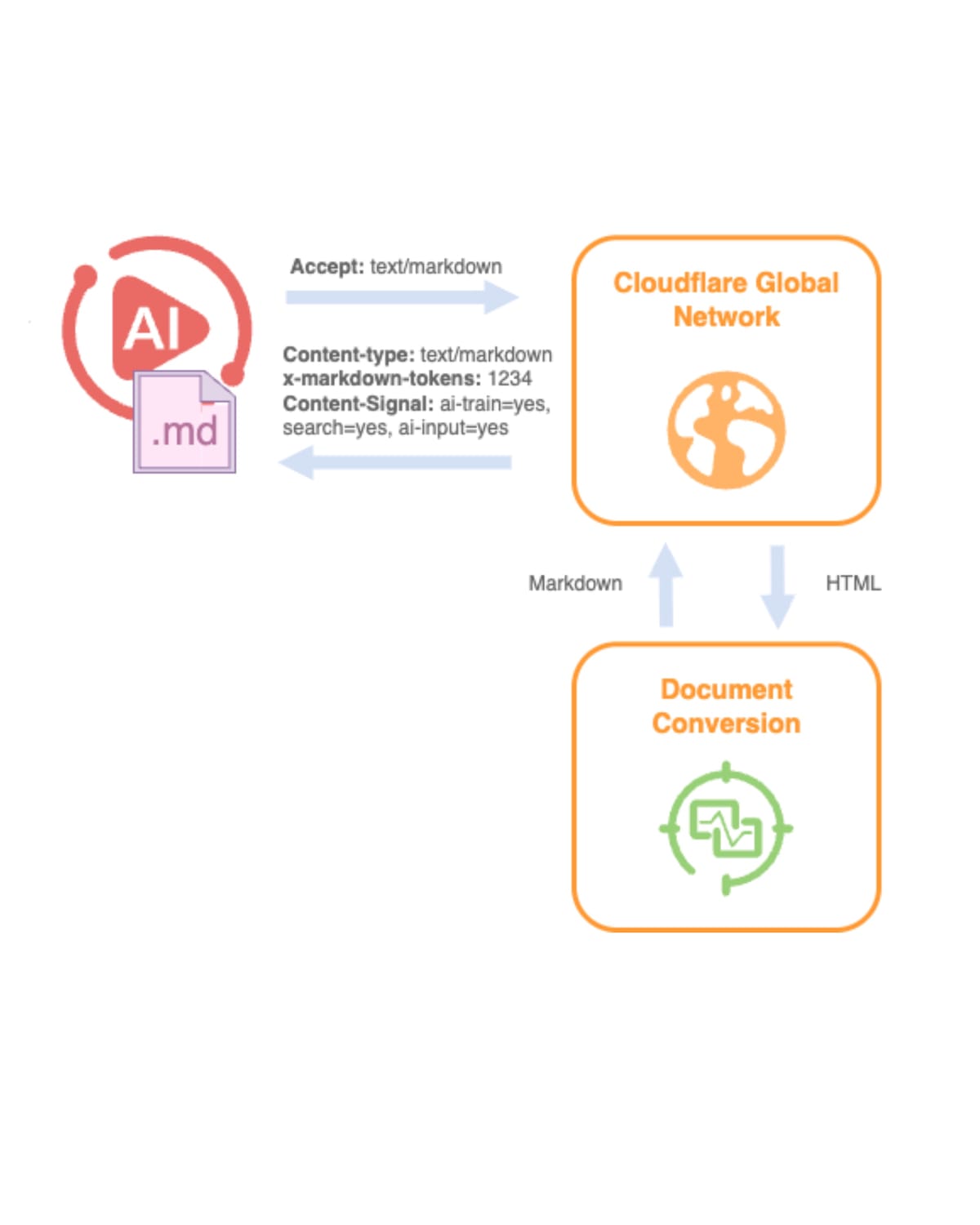
Cloudflare this week introduced Markdown for Agents, a feature enabling automatic conversion of HTML pages to markdown format when requested by AI systems, according to a February 12 announcement by Celso Martinho and Will Allen. The infrastructure company's network now processes content negotiation headers from AI agents, delivering markdown-formatted responses that reduce token consumption by approximately 80% compared to traditional HTML.
The conversion addresses fundamental inefficiencies in how AI systems consume web content. A simple heading "About Us" requires roughly 3 tokens in markdown format but burns 12-15 tokens in HTML before accounting for wrapper divs, navigation bars, and script tags. The announcement's blog post itself demonstrates this disparity - 16,180 tokens in HTML versus 3,150 tokens when converted to markdown.
Markdown has emerged as the standard format for AI agent communication, according to the announcement. The format's explicit structure enables better AI processing while minimizing computational waste. However, the web consists entirely of HTML, not markdown, and page weight has steadily increased over time, making pages difficult for agents to parse.
AI systems currently perform HTML-to-markdown conversion as a standard pipeline step, a process the company describes as wasteful. This conversion consumes computational resources, adds processing costs, and may not reflect how content creators intended their material to be used.
The system operates through HTTP content negotiation headers. AI agents requesting pages from Cloudflare-enabled websites can include "text/markdown" in the Accept header. Cloudflare's network detects this preference, fetches the original HTML from the origin server, converts it to markdown automatically, and serves the converted content to the requesting agent.
The conversion happens in real time at Cloudflare's network edge. Website operators enabling Markdown for Agents don't need to create or maintain separate markdown versions of their content. The infrastructure handles conversion transparently for every request containing the appropriate Accept header.
The token reduction carries significant economic implications for AI operations. According to the announcement, feeding raw HTML to AI systems resembles "paying by the word to read packaging instead of the letter inside." Every HTML element - from class attributes to ID tags to wrapper divs - consumes tokens despite providing zero semantic value to AI processing.
Consider a typical web page structure. Navigation bars, footer elements, analytics scripts, and styling information pad every real web page but contribute nothing to content comprehension for AI systems. These elements inflate token counts dramatically. The announcement demonstrated that a blog post consuming 16,180 tokens in HTML requires only 3,150 tokens as markdown, an 80% reduction.
This efficiency gap compounds across millions of requests. AI systems crawling websites repeatedly process the same structural overhead on every page. When an AI agent crawls a website with 1,000 pages, traditional HTML serving forces processing of navigation menus, footers, and styling information 1,000 times. Markdown conversion eliminates this redundancy entirely.
A curl request demonstrates the basic implementation. Agents request a URL with "Accept: text/markdown" in the headers. The response includes an x-markdown-tokens header indicating the estimated token count in the converted document. This value enables AI systems to calculate context window sizes or determine chunking strategies before processing content.
The x-markdown-tokens header provides critical planning information for AI operations. Large language models operate within context window constraints - maximum token limits for processing input. By knowing token counts before processing content, AI systems can make intelligent decisions about whether to retrieve entire documents, how to chunk long content, or which sources to prioritize when aggregating information from multiple pages.
Popular coding agents including Claude Code and OpenCode already send Accept headers with text/markdown preferences in their requests. These tools now receive markdown-formatted responses from Cloudflare-enabled websites automatically. The system requires no changes to agent implementations beyond the existing Accept header standard.
The infrastructure company demonstrated the feature on its own properties first. Cloudflare enabled Markdown for Agents on its developer documentation and blog, inviting AI systems to consume content in markdown format rather than HTML. Website operators can test the conversion by requesting blog posts with the text/markdown Accept header.
Markdown-converted responses include a Content-Signal header communicating content usage permissions. The default policy signals "ai-train=yes, search=yes, ai-input=yes" indicating content availability for AI training, search results, and AI input including agentic use.
This framework extends Cloudflare's Content Signals initiative announced during the company's previous Birthday Week. The system allows content creators to express preferences for how their material gets used after access. Markdown for Agents will provide options to define custom Content Signal policies in future releases.
The three signal types address distinct use cases. The ai-train signal indicates whether content can be used for training AI models. The search signal covers inclusion in search results and related discovery features. The ai-input signal governs whether content can serve as input for agentic systems that generate responses or take actions based on accessed information.
These signals operate independently. Content creators might allow ai-input and search while prohibiting ai-train, enabling AI systems to reference and cite their content without incorporating it into training datasets. Alternatively, operators might permit all three uses, or block all AI access entirely while maintaining human accessibility.
The policy framework addresses growing tensions between website operators and AI companies over content usage. Traditional robots.txt files enable blocking or allowing crawler access but provide no mechanism for communicating nuanced usage preferences. Content Signals create standardized technical infrastructure for expressing these preferences directly in HTTP responses.
Content Signals represent technical enforcement of usage policies. Unlike legal agreements or terms of service that require manual interpretation, machine-readable headers enable automated policy compliance. AI systems accessing content receive usage permissions simultaneously with the content itself. This eliminates ambiguity about permitted uses and creates audit trails for policy enforcement.
The framework acknowledges that many AI companies have shown inconsistent respect for robots.txt directives. Perplexity AI faced documentation in October 2025 of using stealth crawlers that obscured their identity to circumvent website blocks. Reddit's lawsuit against Perplexity alleged the company accessed content through unauthorized means despite robots.txt restrictions.
Content Signals provide stronger enforcement mechanisms than voluntary compliance models. By embedding usage permissions directly in HTTP responses rather than separate robots.txt files, the system makes policy communication unambiguous. AI platforms can implement technical controls that automatically respect Content-Signal headers, reducing reliance on corporate policy commitments.
Website operators gain explicit control over AI training permissions, search indexing preferences, and agent input authorization. The system operates through machine-readable headers rather than legal terms or external agreements. AI systems accessing content receive usage permissions simultaneously with the content itself.
For AI systems requiring document conversion from sources outside Cloudflare or where Markdown for Agents remains unavailable, the company provides two alternative approaches through existing products.
Workers AI includes an AI.toMarkdown() function supporting multiple document types beyond HTML. The system handles summarization alongside conversion, providing flexibility for complex document processing workflows. This approach suits developers building AI applications that need comprehensive document handling capabilities.
Browser Rendering offers a /markdown REST API enabling conversion of dynamic pages or applications. The system renders content in a real browser environment before converting to markdown. This capability addresses single-page applications or JavaScript-heavy sites where static HTML conversion would miss dynamically generated content.
These alternatives complement Markdown for Agents by addressing use cases the primary feature doesn't cover. Organizations processing documents from external sources or requiring browser-based rendering can leverage these tools while Markdown for Agents handles straightforward website content conversion.
Cloudflare Radar now includes content type insights specifically for AI bot and crawler traffic. The new content_type dimension displays distribution of content types returned to AI agents and crawlers, grouped by MIME type category. This data appears both globally on the AI Insights page and in individual bot information pages.
The tracking enables monitoring how AI systems consume web content over time. Radar users can filter requests returning markdown by specific agents or crawlers. The company demonstrated this capability by showing requests returning markdown to OAI-Searchbot, the crawler OpenAI uses for ChatGPT search functionality.
Data reveals adoption patterns as AI companies implement markdown request capabilities. Cloudflare's infrastructure processes approximately 20% of internet traffic, providing substantial visibility into how AI bots interact with web content globally. The public API and Data Explorer make all Radar data freely accessible for analysis.
This monitoring matters for understanding broader shifts in AI content consumption. Website operators can observe whether AI systems request markdown versions of their content and which specific agents demonstrate markdown support. The metrics inform decisions about enabling Markdown for Agents and understanding its impact on crawler behavior.
Website owners can activate Markdown for Agents through the Cloudflare dashboard. After logging in and selecting their account and zone, operators find Quick Actions and toggle the Markdown for Agents button to enable the feature.
The capability launched in beta at no cost for Pro, Business, and Enterprise plans. SSL for SaaS customers also receive access to the feature. Cloudflare positioned this as an investment in supporting AI systems' shift toward structured content consumption.
Detailed documentation appears in Cloudflare's Developer Docs. The company solicited feedback during the beta period to refine and enhance the feature before broader deployment. Cloudflare expressed interest in observing how AI crawlers and agents navigate the web's unstructured nature as the ecosystem develops.
The announcement addresses computational efficiency in AI systems at a moment when AI crawlers account for 4.2% of all HTML requests globally. Traditional HTML serving forces AI systems to process unnecessary markup, navigation elements, and styling information that provides zero semantic value for their purposes.
Markdown conversion eliminates this waste at the source rather than requiring every AI system to implement its own conversion logic. The standardized approach reduces redundant processing across the industry. When Cloudflare's network handles conversion once per request instead of forcing thousands of AI systems to convert the same content repeatedly, aggregate computational savings become substantial.
The shift reflects a fundamental change in how content gets discovered online. Traffic historically originated from traditional search engines, with SEO determining visibility. Now traffic increasingly comes from AI crawlers and agents that demand structured data within the often-unstructured web built for humans. The announcement acknowledges this transition explicitly - "now is the time to consider not just human visitors, or traditional wisdom for SEO-optimization, but start to treat agents as first-class citizens."
This represents architectural recognition that the web serves two distinct audiences with different requirements. Humans need visual design, navigation elements, and interactive features. AI agents need semantic structure and minimal noise. Serving both audiences efficiently requires different content delivery approaches.
Website operators face strategic decisions about AI content optimization. Traditional HTML remains essential for human visitors. Markdown conversion provides parallel content delivery for AI systems. The question becomes whether to invest in AI-specific optimization or maintain focus on human-centric design.
This efficiency improvement arrives as AI platforms face scrutiny over content usage economics. Anthropic crawled 38,000 pages for every referred page visit in July 2025, while OpenAI maintained a ratio of 1,091 crawls per referral. These imbalances create unsustainable relationships where content creators receive minimal traffic returns relative to AI systems' content consumption.
The economic tension extends beyond simple traffic metrics. Content creators face binary choices between blocking AI access entirely or allowing unrestricted crawling without compensation. Cloudflare CEO Matthew Prince warned in May 2025 that Google's crawl-to-referral ratio reached 15 pages scraped per visitor sent to original sources, up from 2:1 ten years earlier. For OpenAI, the ratio climbed to approximately 1,500 pages scraped per referral.
These metrics demonstrate fundamental misalignment between AI platform operations and content creator sustainability. AI systems extract maximum value through aggressive crawling while providing minimal traffic returns. Traditional search engines created mutually beneficial relationships - crawling access in exchange for referral traffic. AI agents disrupt this model by providing answers directly rather than directing users to sources.
Markdown for Agents doesn't directly address referral economics but demonstrates infrastructure-level solutions for AI content access challenges. The feature pairs with Cloudflare's other AI crawler management tools including pay-per-crawl monetization and AI Crawl Control for comprehensive content access governance.
For marketing professionals, the development signals continued infrastructure adaptation to AI-driven content discovery. Traditional SEO optimization focused on human visitors and search engine crawlers. The industry now requires parallel optimization for AI agents that consume content through fundamentally different mechanisms than browser-based users.
Website operators must consider how AI systems will access and process their content. Markdown conversion provides one optimization path. Content Signals enable explicit communication of usage preferences. These tools together create a framework for managing relationships with AI platforms that operate outside traditional search engine paradigms.
The beta launch indicates Cloudflare's belief that structured content delivery for AI represents a permanent shift rather than temporary trend. By implementing markdown conversion at network scale, the company positions itself as critical infrastructure for the emerging AI content consumption ecosystem.
Who: Cloudflare announced Markdown for Agents through blog post authors Celso Martinho and Will Allen. The feature affects website operators using Cloudflare's network and AI systems including Claude Code and OpenCode that request markdown content.
What: Markdown for Agents automatically converts HTML pages to markdown format when AI systems request content using text/markdown in Accept headers. The conversion reduces token usage by approximately 80% compared to traditional HTML serving. Converted responses include Content-Signal headers communicating usage permissions for AI training, search indexing, and agent input.
When: Cloudflare announced the feature February 12, 2026. The beta launched immediately for Pro, Business, Enterprise, and SSL for SaaS customers at no additional cost.
Where: The feature operates across Cloudflare's global network infrastructure processing approximately 20% of internet traffic. Website operators enable the feature through the Cloudflare dashboard. Cloudflare Radar tracks markdown adoption globally through new content type insights for AI bot traffic.
Why: AI systems currently waste computational resources converting HTML to markdown as a standard pipeline step. The conversion addresses fundamental inefficiencies where simple headings require 12-15 tokens in HTML versus 3 tokens in markdown. Markdown has become the standard format for AI agent communication due to its explicit structure and processing efficiency. The feature enables content creators to serve AI systems efficiently while maintaining explicit control over content usage through Content Signals framework.