Gmail finally lets users change their address - and the technical lift was enormous
Google today launched Gmail address changes for U.S. users, allowing username updates while keeping emails, history and sign-in access. Global rollout planned.


Google today launched Gmail address changes for U.S. users, allowing username updates while keeping emails, history and sign-in access. Global rollout planned.
Google yesterday launched one of Gmail's most-requested features: the ability for users to change their Gmail address without losing any account data, emails, or history. The announcement, made March 31, 2026 by Julia Steier, a product manager at Google, confirmed the feature is initially available to users in the United States, with a global rollout described as coming "soon."
The post by Steier, which accumulated nearly 1,921 reactions on LinkedIn within hours, described the feature's development as requiring "navigating massive technical complexity and collaborating across almost every corner of the Google ecosystem." For a service used by billions of people, the ability to change a core identity credential - one tied to Gmail, Google Drive, Google Photos, YouTube, and every other Google property - represents a significant infrastructure undertaking. What appears simple on the surface conceals years of cross-functional dependency management underneath.
According to Google's official announcement published on the same day, U.S. users can now choose any available @gmail.com username. The old username does not disappear. Instead, it automatically becomes an alternate email address, meaning messages sent to either address continue to land in the same inbox. Users retain the ability to sign in with both the old and new addresses, and can also choose to send emails from either address.
The restrictions attached to the feature are notable. According to Google's help documentation, users can create a new Gmail address once every 12 months and no more than three times in total. That means each Google Account is capped at four @gmail.com addresses over its lifetime - the original plus three changes. The old address, once converted to an alias, cannot be deleted and cannot be claimed by any other user, even if the original account is deleted.
The change propagates across Google services: signing in to Gmail, Maps, YouTube, Google Play, and Drive all work with either address. But historical artefacts - such as Calendar invites or Drive sharing links created before the change - retain the old address. They are not updated retroactively.
Steier described the project as one that initially seemed straightforward but revealed its complexity quickly. "I would have never expected this complexity when I started working on it," she wrote in response to a commenter. Mafaz Rouf, a technical lead commenting on the post, captured the scale: "The moment I saw this update, I was wondering how on earth did they pull this off, the sheer amount of dependency involved would've kept PMs and Engineers away from it."
Google's account infrastructure assigns a persistent identifier to each user that sits beneath the email address layer. Services across the Google ecosystem reference this internal identifier rather than the email address directly, which is what makes the alias system technically feasible. The email address is, effectively, a label pointing to the underlying account - not the account itself. Changing the label requires updating every surface where that label is displayed, every sign-in flow that accepts it, and every service that surfaces it to third parties.
The rollout is described as gradual. According to Google's help documentation, "the ability to change your Google Account email is gradually rolling out to all users and this option may not be available to you yet." Users can check availability by navigating to myaccount.google.com/google-account-email, selecting "Personal info," then "Email," and looking for the "Change Google Account email" option. If the option does not appear, access has not yet been granted.
Several product constraints deserve attention. Users on Chromebooks are advised to take specific preparatory steps before changing their address, given how ChromeOS ties the primary account to device configuration. Users who authenticate to third-party services through "Sign in with Google" should review how that change will affect those connections. Google also flags Chrome Remote Desktop connections as a potential complication.
Data backup is recommended before making the change. According to the help documentation, some app settings may reset during the process - behavior described as similar to signing into a new device. Contacts, photos, Gmail messages, and Drive files are not affected; the note about settings applies specifically to application-level preferences that some Google apps store tied to the account credential rather than the persistent account identifier.
The FAQ section of Google's documentation addresses a common question directly: no, the old address cannot be made unavailable to others entirely, but no one else can claim it either. It remains locked to the original account as an alternate address. Users who want to stop sending email from the old address can remove it as a send alias, but it will continue to receive messages unless a filter is configured to handle them.
The implications extend further than individuals who regret a username chosen in 2006. Steier noted that she received "so many heartfelt messages from fellow Googlers who have changed their names or transitioned their identities" during the development process. The feature has an explicit equity dimension: it allows people whose legal names, preferred names, or professional identities have changed to align their primary digital identifier with who they are today - without abandoning the accumulated data of years of Google account usage.
That use case - name changes following marriage, divorce, transition, or professional rebranding - has historically required users to either live with a mismatched address or create an entirely new account and migrate their data manually, losing continuity in the process. The new feature eliminates that trade-off for @gmail.com addresses.
Reaction on LinkedIn also surfaced a parallel frustration that the new feature does not yet address: account merging. Jörn Berkefeld, a Salesforce Marketing Champion, noted that many users created a second, more professional account when their original became awkward, leaving data distributed across two accounts with no mechanism to consolidate them. "Now have to switch between accounts all the time," he wrote.
For digital marketing professionals, the Gmail address change feature connects to a question that has been active in advertising technology for years: the stability of email as an identity signal. Email addresses are the foundation of Customer Match in Google Ads, of first-party audience strategies, and of identity resolution infrastructure that the industry has been building to replace third-party cookie signals.
The introduction of alias-based Gmail addresses adds a new layer of complexity to how advertisers handle email hashing for Customer Match uploads. According to Google's Data Manager API documentation published in December 2025, email normalization requirements include "removal of dots in Gmail addresses and stripping of plus-addressing before hashing." With users now able to change their primary @gmail.com address, the relationship between stored customer email records and active Gmail identities becomes more dynamic. A hashed email submitted to a Customer Match list may correspond to an address that a user has since switched away from as their primary - though as Google's own documentation confirms, that old address continues to receive email and remains valid.
Gmail has been evolving consistently on the user experience side. The platform introduced enhanced summary cards in October 2024, and added new unsubscribe tools in July 2025 aimed at reducing inbox clutter from subscription-based marketing emails. The username change feature continues that trajectory of giving users more structural control over their Gmail experience.
The Google Identity Services ecosystem has itself been shifting, having transitioned to Federated Credential Management (FedCM) for Sign in with Google flows beginning in April 2024. That migration changed how third-party sites authenticate users through Google accounts. The Gmail address change now introduces a new variable into that ecosystem: when a user changes their address, sites that stored the previous Gmail address as the user identifier in their own databases will not automatically receive an update. Google's documentation notes this explicitly - old Gmail addresses will "still appear in some places" because historical instances are not changed retroactively.
For ad tech infrastructure built around email-based identity, and for email marketing list managers in particular, a user population gradually migrating primary Gmail addresses introduces the kind of slow drift that can degrade match rates on Customer Match campaigns over time. Zoya Naeem, a B2B data professional commenting on Google's LinkedIn post, flagged the operational angle directly: "Users changing email IDs... feels like list management just got a bit trickier."
The initial launch is limited to U.S. Google users. According to Google's own LinkedIn post, published on March 31 with 999 reactions and 112 reposts as of this writing, the announcement was framed specifically for the U.S. market. Karolina Garbiec, a senior UX designer based in Europe, responded: "Wow! We in Europe also wait for it!" Samrat Gupta asked simply: "What about other country users Google?" The company has not specified a timeline for international availability beyond Steier's post, which stated: "For all my non-US friends - this will launch globally soon!"
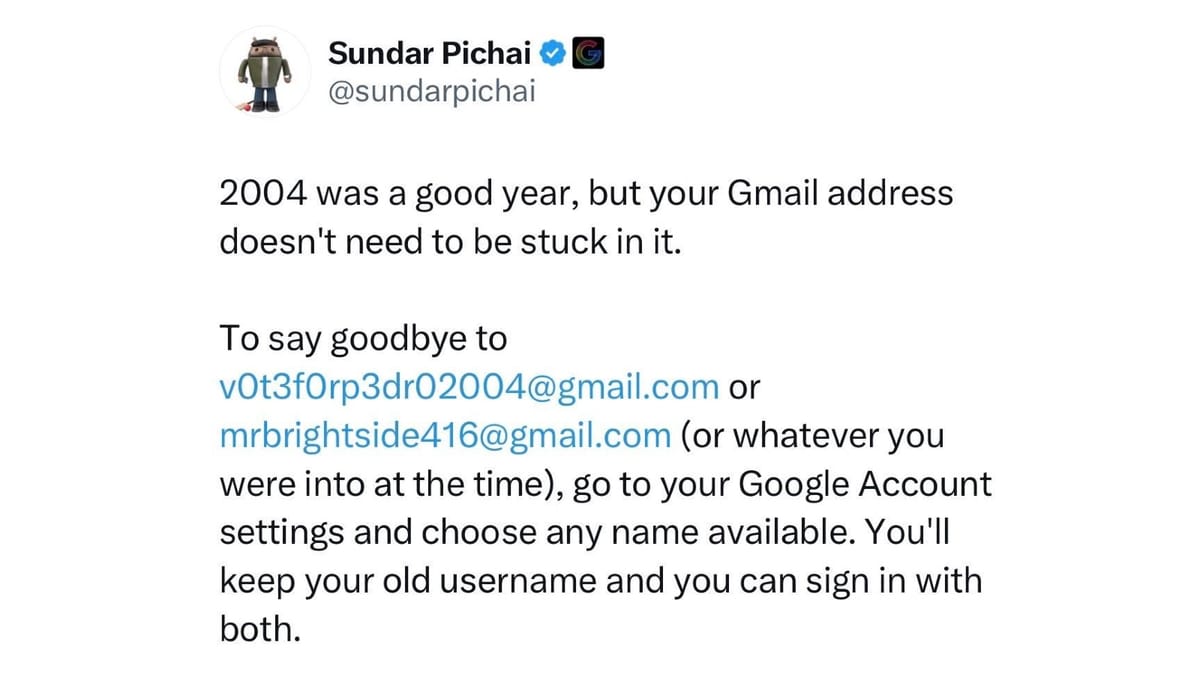
Sundar Pichai, Google's chief executive, amplified the announcement on X (formerly Twitter), reaching 1.6 million views by the time of Steier's LinkedIn post. Pichai's post framed the feature with a cultural reference to early Gmail adoption: "2004 was a good year, but your Gmail address doesn't need to be stuck in it."
Who: Google, led publicly by product manager Julia Steier and chief executive Sundar Pichai, launched the Gmail address change feature. The initial user base is limited to Google account holders in the United States.
What: U.S. Google users can now change their @gmail.com username while retaining all account data, emails, and sign-in access. The old address becomes an alias that continues to receive email and allows sign-in. The change is limited to once per year and three times per lifetime per account.
When: The feature launched on March 31, 2026. The announcement was made by Google's LinkedIn account and amplified by Sundar Pichai on X. A gradual rollout is underway, meaning not all U.S. users have immediate access.
Where: The feature is currently available only to U.S.-based Google account holders. Access is managed through myaccount.google.com. International availability has been described as coming "soon" but without a specific date.
Why: The feature addresses a long-standing limitation for users whose personal or professional identities have changed since they created their Gmail address - including name changes from marriage, divorce, or transition. It also resolves a practical frustration for users who chose usernames early in Gmail's history that no longer reflect how they present themselves professionally or personally. According to the product manager who led development, the project also carries a personal dimension: it allows digital presence to match identity for people who have undergone identity transitions.