Google Ads budget pacing with ad scheduling: what the March 1 change actually does
Google's ad scheduling budget pacing change takes effect today. Here is every example, figure, and clarification from Ginny Marvin explained in full.


Google's ad scheduling budget pacing change takes effect today. Here is every example, figure, and clarification from Ginny Marvin explained in full.

Google today began rolling out a fundamental change to how it paces spending for campaigns that use ad scheduling - a feature relied on by B2B advertisers, service businesses, legal firms, healthcare providers, and any advertiser whose operations are bounded by opening hours or staff availability. The change was first publicly documented on February 19, 2026, when Jordan Fry, CEO of RevAmp and a former Google employee, shared a screenshot of an email he received from the platform's ads team.
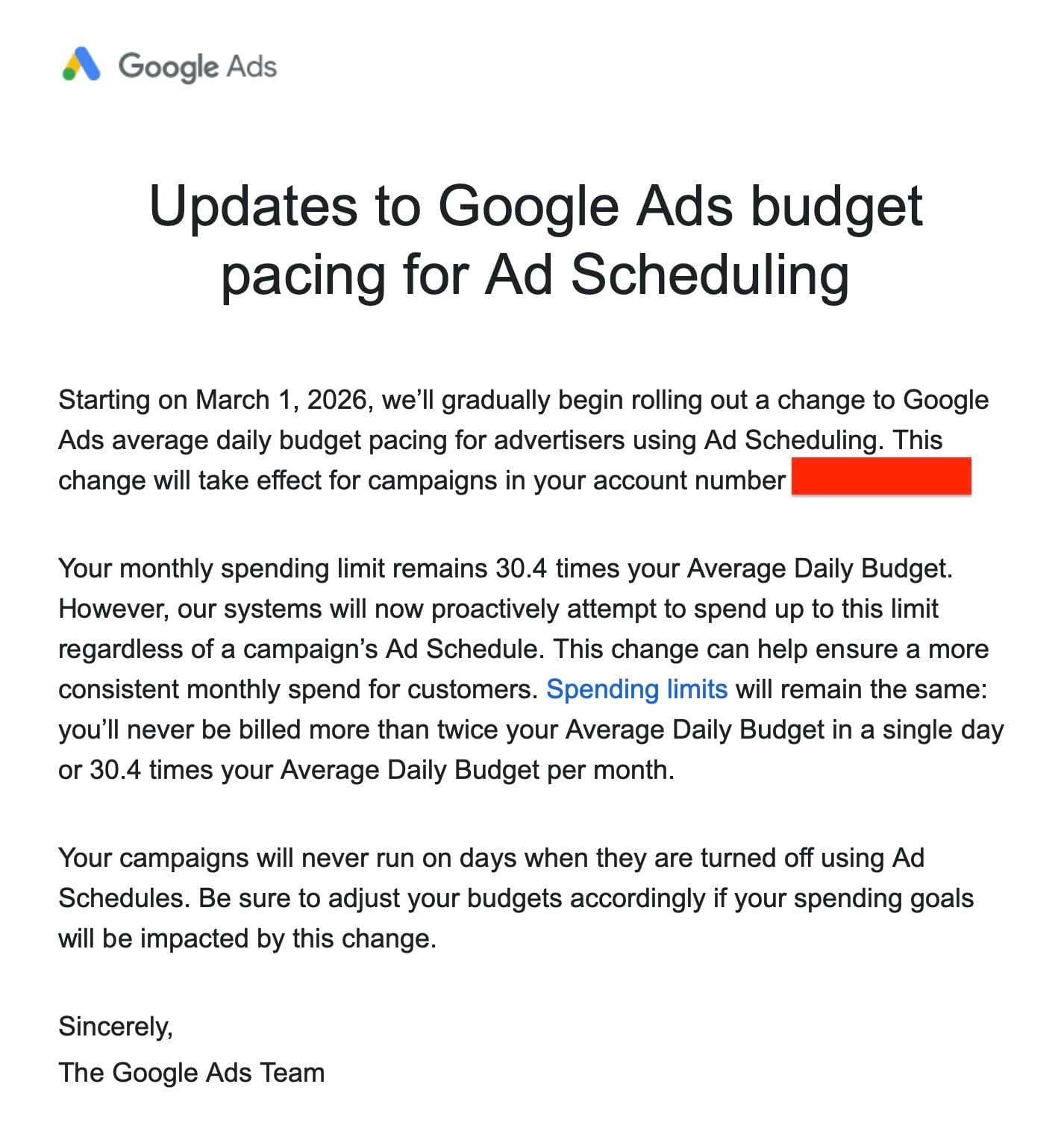
The email, sent to a subset of Google Ads accounts, reads: "Starting on March 1, 2026, we'll gradually begin rolling out a change to Google Ads average daily budget pacing for advertisers using Ad Scheduling. This change will take effect for campaigns in your account number [redacted]."
That sentence established the stakes. What followed - a description of how the system's behaviour would shift - prompted more than 55 comments and 84 reactions on LinkedIn alone, as paid search practitioners worked through the implications in real time.
To understand what is changing, it helps to start with the architecture that has governed Google Ads daily budgets for years.
Google does not guarantee that a campaign will spend exactly its daily budget on any given day. Instead, it uses the average daily budget as a pacing input, allowing the system to spend more on high-traffic days and less on quieter ones. The ceiling for any single day is twice the average daily budget. Over a full month, total spend is capped at the daily budget multiplied by 30.4 - the average number of days in a month regardless of how many days a particular month actually contains.
That 30.4 figure is not arbitrary. It represents Google's attempt to account for monthly variation while keeping the multiplier consistent across all advertisers. February has 28 or 29 days; March has 31. Rather than recalculating the cap each month, Google fixes the multiplier at 30.4 and applies it universally.
Under the previous behaviour, this cap functioned differently for campaigns with ad scheduling. If a campaign ran only Monday through Thursday - roughly 17 days per month - the system's pacing logic would in practice target spend across those 17 days. The monthly ceiling of 30.4 times the daily budget existed in theory, but the practical outcome was that the campaign would spend on its active days and leave the remainder of the monthly envelope untouched. According to the Marketing O'Clock episode broadcast on February 23, 2026, an advertiser with a $100 daily budget and a Monday-through-Thursday-only schedule could expect to spend approximately $1,700 in a typical month - 17 days multiplied by $100.
The Google Ads email states the new approach plainly: "Your monthly spending limit remains 30.4 times your Average Daily Budget. However, our systems will now proactively attempt to spend up to this limit regardless of a campaign's Ad Schedule. This change can help ensure a more consistent monthly spend for customers."
That single word - "proactively" - is doing a great deal of work. Previously, the system did not aggressively pursue the full 30.4x ceiling for campaigns that operated only on a portion of the month's days. Now it will.
The email adds two reassurances. First, the two-times daily cap remains: "you'll never be billed more than twice your Average Daily Budget in a single day or 30.4 times your Average Daily Budget per month." Second, the ad schedule itself is preserved: "Your campaigns will never run on days when they are turned off using Ad Schedules."
What changes, then, is the intensity with which Google's systems pursue spend during the days when the campaign is permitted to run.
The clearest illustration comes from the exchange between Fry and Ginny Marvin, Google's Ads Product Liaison, in the LinkedIn comment thread. Fry described a client who uses ad scheduling to match campaign activity to office hours. Ads run when a sales team is available to answer calls. Weekends are off.
He asked directly: does this mean Google will force itself to spend more during active hours to compensate for the days when ads are not running?
Marvin confirmed that it does. She explained the math using a $100 daily budget with ad scheduling limited to Monday through Thursday:
"Hi Jordan, Your new scenario is correct," Marvin wrote in the thread. "Monthly spending limit = 30.4 x $100 = $3,040. This brings expectations in line with campaigns that don't use features like ad scheduling."
The contrast is stark. An advertiser who set a $100 daily budget expecting to spend roughly $1,700 per month - because the campaign runs 17 days - will now find Google's systems aiming for $3,040. That is an 79% increase in potential monthly expenditure from no change to the daily budget figure. The only ceiling on any single day remains twice the daily budget, or $200 in this example. Spread across 17 active days, spending $200 per day would produce $3,400 - so $3,040 is in fact reachable.
Marvin's follow-up comment addressed an even more constrained scenario: a campaign scheduled to run only on weekends. This case is relevant for brands that are operationally active primarily on Saturday and Sunday - hospitality, events, leisure, and certain retail sectors.
A typical month contains approximately 8 weekend days. At a $100 daily budget, the old pacing logic would produce a monthly spend ceiling closer to $800. Under the new behaviour, the monthly cap remains 30.4 x $100 = $3,040. However, with only 8 active days and a two-times-daily-spend ceiling of $200 per day, the maximum achievable spend is $1,600.
Marvin put it precisely in her clarification post: "In the example of a campaign set to only spend on weekends: If the daily budget is set to $100, the monthly spend would have been 8 (on avg about 8 weekend days/month) x $100 = $800. With this change, it will be 8 days X $200 (up to 2x the daily spend limit) = $1,600 monthly spend limit."
Her guidance for advertisers who need to preserve the $800 ceiling: "If you want to keep to a monthly spend limit of $800, you should lower the daily budget to $50, and plan to hit the 2X daily spend routinely given the headroom you already know the campaign has."
The arithmetic here is worth mapping out. At $50 daily budget, the 2x ceiling per day is $100. Across 8 weekend days, maximum monthly exposure is $800. The campaign reaches the same monthly figure as before, but now the system has to work within a lower daily figure to do so.
The scenario with the greatest operational implications for B2B advertisers is the one that prompted Fry's original post: a campaign that runs during business hours Monday through Friday and is switched off at weekends. This structure is extremely common among lead generation advertisers, professional services firms, SaaS companies, and any business where an unattended inbound lead has little value.
Consider the numbers from this angle. A standard working month contains approximately 22 weekdays. At $100 daily budget, the pre-change expectation might land around $2,200 in actual monthly spend. The 30.4x ceiling is $3,040. The gap between $2,200 and $3,040 is $840 - money the system previously left unspent because active days had ended and the next active day had not yet started.
Under the new behaviour, that $840 difference becomes available for Google's systems to pursue. Since the two-times-daily ceiling applies, the system can spend up to $200 on each of the 22 active days - a theoretical maximum of $4,400, well above the $3,040 monthly cap. In practice, the $3,040 figure acts as the hard stop.
What this means operationally: on any given Monday, the system may spend more aggressively during business hours because it now has greater monthly headroom to fill. CPCs may rise if the platform bids more competitively to capture available inventory within the permitted schedule. According to one comment in the LinkedIn thread from Oliver Pestalozzi, a former Google employee and digital marketing consultant, the risk is "veeeery dangerous if you are using Max strategies without target constraints. Such as Max clicks without max CPC."
Not all campaigns face the same exposure. Marvin's LinkedIn clarification drew a clear distinction between two categories of bidding approach.
For campaigns using Maximize Conversions or Maximize Conversion Value without a target constraint, the system is designed to spend the full available budget while acquiring as many conversions or as much conversion value as possible. There is no efficiency target acting as a brake on expenditure. These campaigns will feel the change most directly: the system will now make a more determined effort to exhaust the monthly ceiling, spreading that pressure across fewer active days.
For campaigns using a Target CPA or Target ROAS, the dynamics differ. Marvin explained: "the system sets bids to help get as many conversions as possible at your target, and keep your average CPA/ROAS equal to your target. Your spend could also increase as the system has more flexibility to find more conversions or conversion value at your target." She added that Google does not recommend using budget constraints alongside efficiency targets, since the target itself acts as the primary constraint. Budget limits and CPA or ROAS targets can work at cross-purposes - the efficiency goal throttles spend before the budget ceiling is reached.
The practical implication: advertisers running Target CPA or Target ROAS campaigns with ad scheduling may see some increase in spend as the system finds more opportunities within its target, but the efficiency guardrail limits runaway expenditure. Advertisers running unconstrained Maximize strategies face a more open-ended increase.
Martin Röttgerding, a paid search specialist, noted in the LinkedIn thread that this represents a fundamental shift: "Sounds like daily budgets are basically gone in favor of monthly budgets. Setting a daily budget of 100 now means you have a monthly budget of 3040." Another commenter extended the thought: "If you only advertise on Mondays, the system will now try to spend [the full monthly envelope]."
Google's stated rationale is alignment. According to Marvin's initial response: "We're making this change to better align budget pacing functionality when ad scheduling is in place with advertisers' expectations for monthly spending limits (30.4x daily budget for campaigns using daily budgets)."
The argument, in essence, is that advertisers who set a $100 daily budget and a monthly cap of $3,040 should expect the system to target that $3,040 figure - and that the previous behaviour, which produced lower monthly totals for ad-scheduled campaigns, was inconsistent with those stated limits. From Google's perspective, the monthly cap was always the operative ceiling; the old pacing behaviour simply under-utilised it.
Critics in the LinkedIn thread were less charitable. Louis Halton Davies, a performance marketing specialist, wrote: "Let's not pretend that it's anything other than another change to increase Google's revenue from ad spend. Very confusing from a user experience perspective though." Karlijn Corbran, a lead planning and buying specialist, captured the concern that most advertisers will feel: "some clients have not hit the monthly limit as defined here. Now if they do, it will mean a significant increase in cost. Fine if the leads proportionally follow, but that's TBD."
That last point - whether leads will follow in proportion to increased spend - is the question practitioners cannot yet answer. The change compresses spend into fewer active windows, which means the system bids more aggressively during those windows. Higher bids may produce more conversions, or they may simply produce higher CPCs on the same volume of traffic. Without data from the post-March 1 period, the outcome remains unknown.
One of the most widely noted practical concerns is that not all advertisers received the email. Fry did not receive it for his client accounts. Christine Zirnheld and Julia Matar, hosts of the Marketing O'Clock podcast, both confirmed on their February 23 episode that they had not received the notification either - despite managing B2B accounts with exactly the kind of ad scheduling structures most affected by the change.
Marvin addressed this directly in her second LinkedIn comment: "If you did not receive the email notification, your accounts aren't included in this initial phase. We're rolling this update out gradually; advertisers will be notified individually well before the change takes effect for their specific accounts. Only accounts in this first wave will see the change go into effect on March 1st."
This staged rollout creates an information asymmetry. Agencies managing dozens of client accounts have no systematic way to identify which accounts are in scope. The absence of a public list of criteria - account age, spend threshold, campaign type, geography - means practitioners cannot run a proactive audit. The practical advice circulating in the industry: assume the change is coming to every account with ad scheduling and adjust budgets accordingly now rather than after the change arrives.
The most technically consequential aspect of the recommended fix - reducing daily budgets to align with actual monthly spend goals - creates a secondary challenge. Smart Bidding models learn from spending patterns, conversion data, and the relationship between bids and outcomes over time. Cutting a campaign's daily budget from $100 to $56 is not a neutral action; it changes the parameters within which the bidding model operates.
Ameet Khabra, a Google Ads consultant who manages accounts at scale, raised this concern directly with Marvin in the LinkedIn thread: "wouldn't budget changes like that have backend implications? Even though the system is actively trying to spend 2x, slashing the budget would force smart bidding to reduce its bids. Wouldn't an automated rule or a script that pauses campaigns once your spend threshold is reached be a better alternative?"
Marvin's response was unambiguous: "In this scenario, you're still giving the system the same budget flexibility it considered previously. Pausing campaigns off and on can disrupt learning, whereas setting an ad schedule that makes sense for the business with a daily budget that's aligned with monthly spend goals will allow the system to optimize budget pacing consistently, after an initial learning period. (You should typically wait at least a conversion cycle or two before assessing or making other changes.)"
The phrase "after an initial learning period" carries weight. For campaigns with lower conversion volumes - a common situation in niche B2B segments or specialist professional services - a conversion cycle can span two to four weeks or more. Advertisers who adjust budgets today in response to this change should anticipate a period of degraded optimisation before the Smart Bidding model restabilises around the new parameters. Zirnheld noted on the podcast that she would ordinarily use automation rules to pause ads rather than cut budgets in this kind of scenario, though Marvin's guidance pushes back against that approach precisely because of the disruption to machine learning.
One dimension that received relatively less attention in the LinkedIn thread but which affects agencies with complex account structures is the interaction between ad scheduling and shared budgets. A shared budget pools a single spend allocation across multiple campaigns, allowing Google to distribute funds dynamically based on performance signals.
When ad scheduling is applied to campaigns within a shared budget, the new pacing behaviour interacts with the allocation logic in ways that are more difficult to model. Sam Hamawi, a Google sales representative who commented in the thread, characterised the change as "a showstopper for shared budgets in my opinion." The concern is that shared budgets - which do not have the same individual campaign-level caps - could distribute the newly aggressive monthly target across a portfolio of campaigns in unpredictable ways.
Google has not provided specific guidance on shared budget interactions in the materials available from the campaign documents shared by Fry. Practitioners managing shared budgets across ad-scheduled campaigns should verify the behaviour empirically once the change takes effect.
Google's January 15, 2026 expansion of campaign total budgets to Search, Performance Max, and Shopping campaigns offers a structural alternative: a hard spending ceiling across a 3-to-90-day window, with no possibility of exceeding the predetermined total. Unlike average daily budgets, which permit spending up to twice the daily figure on any given day, total budgets set a fixed amount that the system cannot breach.
This feature would appear to solve the problem for advertisers who need absolute spend control. The catch, documented in the feature's rollout materials, is that campaign total budgets are available only for new campaign creation. Existing campaigns cannot be converted. An advertiser managing a long-running Search campaign that has accumulated months of Smart Bidding history cannot simply migrate it to a total budget structure without starting fresh - and restarting means entering a new learning period, losing historical signals, and potentially disrupting performance during the transition.
For new campaigns launched after January 2026, the total budget option is worth serious consideration for any advertiser whose monthly spend ceiling is a hard operational or financial constraint. For established campaigns, the daily budget adjustment remains the only practical lever available within the existing account structure.
For advertisers who need to recalculate their daily budgets to preserve existing monthly spend levels, the arithmetic follows a consistent pattern.
An advertiser who runs Monday through Thursday only (17 active days) and wants to spend no more than $1,700 per month should set the daily budget at approximately $56. That figure gives the system up to $112 on any single day (2x), and across 17 days produces a ceiling of $1,904 - still below the monthly cap of $3,040 at $100 daily, and closer to the original $1,700 target.
For the weekend-only case, as Marvin specified: reduce from $100 to $50 to maintain an $800 monthly ceiling, with the system expected to regularly spend $100 per active day (2x of $50) across 8 weekend days.
For a standard Monday-to-Friday business-hours campaign (22 active days) with a goal of spending no more than $2,200 per month, the implied daily budget is approximately $72. At $72 daily, the 2x ceiling is $144 per day; across 22 days the maximum is $3,168, and the monthly cap at $72 daily would be $2,189 (30.4 x $72). Practically speaking, reducing the daily budget to $72 shifts the monthly cap from $3,040 to $2,189, which more accurately reflects the original intent.
These calculations assume the system routinely spends near the 2x daily ceiling on active days, which Marvin suggested advertisers should plan for given the wider headroom the ad schedule creates. In reality, spend on any given day depends on auction competition, bid strategy, and conversion signal quality - so the actual figures will vary. But the direction is consistent: daily budgets need to come down if monthly spend goals are to stay the same.
The change arrived at a moment when Google Ads CPC costs had already risen 12.88% in 2025 according to benchmark data from LocaliQ covering more than 16,000 campaigns. That backdrop matters because the new pacing behaviour does not simply redistribute spend - it concentrates the same monthly envelope into fewer active hours and days, which creates conditions for more competitive bidding within those windows.
Whether CPCs rise as a result of more aggressive intra-day bidding, or whether the system finds equivalent conversion volume at similar efficiency, is the central empirical question practitioners will be monitoring once March data becomes available. Corbran's point in the LinkedIn thread - "fine if the leads proportionally follow, but that's TBD" - represents the honest state of knowledge at the point the change takes effect.
The reaction from the Marketing O'Clock hosts on February 23 was pointed. Zirnheld called it "one of the worst updates in a while." Matar noted the broader structural frustration: Google simultaneously announced a new scenario planner for its Meridian open-source marketing mix model - a tool for optimising budget allocation - in the same news cycle as a change that makes existing budgets harder to control. "They're like, 'Oh, look what we did. You're welcome.' Now plan for the scenarios with the new budgets, I guess," she said on the podcast.
Who: Google, affecting Google Ads advertisers who use ad scheduling - particularly B2B and service-sector businesses. Ginny Marvin (Google Ads Product Liaison), Jordan Fry (CEO, RevAmp), Ameet Khabra, Martin Röttgerding, Karlijn Corbran, Oliver Pestalozzi, and the Marketing O'Clock podcast hosts Christine Zirnheld and Julia Matar were among the practitioners and Google representatives who shaped the public discussion.
What: Google's budget pacing system for campaigns with ad scheduling now proactively attempts to spend up to the full 30.4x average daily budget monthly cap, regardless of how many days the ad schedule restricts campaign activity. Previously the system tracked closer to active days multiplied by the daily budget; now it targets the full monthly ceiling and compresses that spend into whatever windows the ad schedule permits. The two-times-daily-budget cap per day and the monthly 30.4x ceiling remain unchanged as hard limits. Ads continue to run only during scheduled times.
When: The change was communicated by email to an initial wave of affected accounts in mid-February 2026, with an effective date of March 1, 2026 for that first wave. Subsequent waves will be notified individually before the change reaches them.
Where: Google Ads, globally. The public discussion took place on LinkedIn and X, documented by Search Engine Roundtable and discussed analytically on the Marketing O'Clock podcast.
Why: Google states the change aligns budget pacing for ad-scheduled campaigns with the existing monthly spending limit framework (30.4x daily budget) that applies to all other campaigns. Critics argue the change primarily increases Google's ad revenue by filling monthly budget headroom that previously went unspent for advertisers whose operational structures require restricted scheduling.