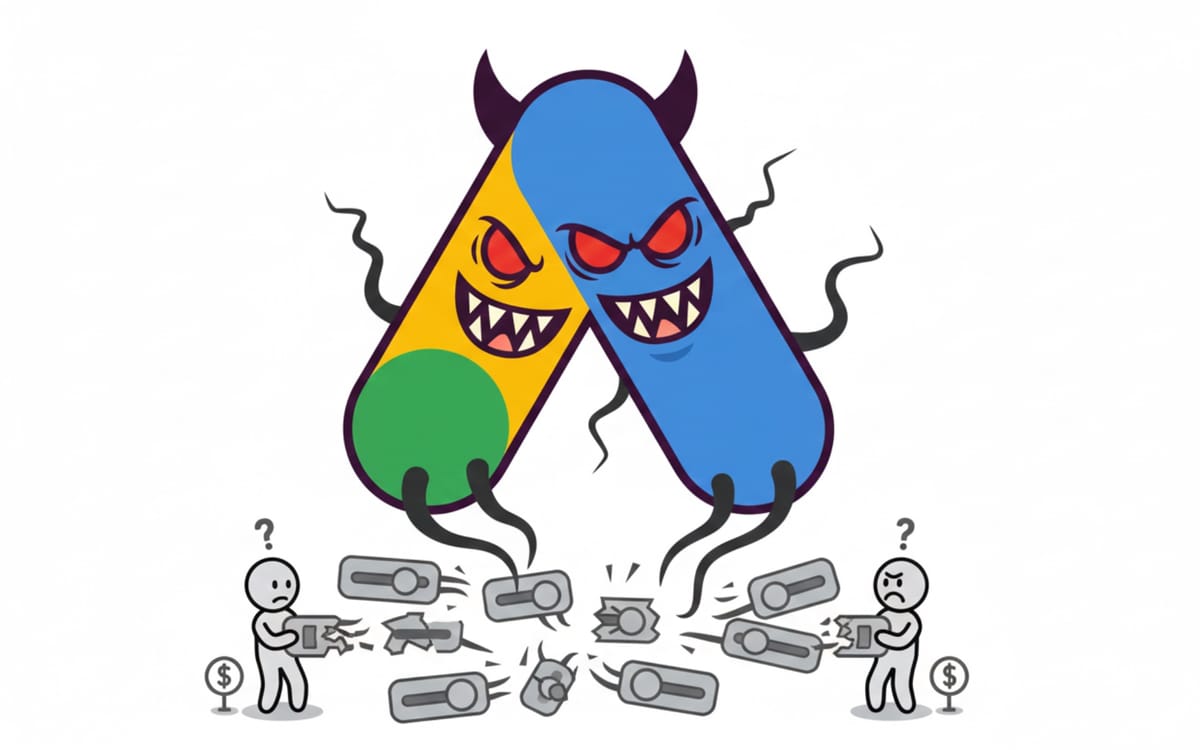
According to Brad Geddes, co-founder of Adalysis, Google's AI Max feature for Search campaigns creates fundamental attribution problems that prevent advertisers from accurately measuring campaign performance. Geddes published his analysis on December 2, 2024, documenting how AI Max claims credit for conversions that would have occurred through existing exact and phrase match keywords.
The investigation revealed that AI Max treats all keywords as broad match regardless of their specified match type. When advertisers use only exact and phrase match keywords without corresponding broad match versions, Google assigns AI Max traffic data to those more restrictive match types in reporting. This creates two critical measurement challenges that undermine campaign analysis.
First, keywords display data from multiple match types simultaneously, making it impossible to evaluate how each match type performs individually. An exact match keyword might show performance metrics that actually combine exact match, phrase match close variants, and AI Max broad match expansion. Second, many conversions attributed to AI Max represent traffic that advertisers already received from existing keywords rather than incremental gains.
Subscribe PPC Land newsletter ✉️ for similar stories like this one
Subscribe
Geddes documented specific examples where identical search terms appeared in reports attributed to both exact match keywords and AI Max. The analysis showed search queries for "pre schools near me" matching to exact match keywords like "[pre schools near me]" alongside AI Max matches for the identical query. According to standard Google Ads hierarchy rules, exact match keywords should receive all impressions when search terms match them precisely.
The attribution problems extend beyond simple duplicate reporting. Geddes found instances where AI Max matched location-based searches to pricing ad groups despite identical keywords existing in location-focused ad groups. A search for "preschool near me" matched to an ad group targeting "preschool price" through AI Max, while an exact match keyword "[preschool in near me]" existed in another ad group specifically designed for location queries.
Some AI Max search terms lack any associated keyword attribution entirely. According to Geddes, these "keywordless" matches appeared in reporting without correlation to any specific keyword across the account. The analysis could not determine what triggered these advertisements, and Google's documentation does not explain this phenomenon. Geddes speculated this might relate to final URL expansion, another AI Max component, but could not confirm the connection.
Ginny Marvin, Google's Ads Product Liaison, responded directly to Geddes' analysis on December 9, 2024 through LinkedIn. Marvin explained that the matching behavior resulted from autocomplete suggestions in Google Maps search. According to Marvin, users typing partial queries like "dayca" received autocomplete suggestions showing "daycare near me," and advertisements appeared with those suggestions.
"Standard keyword matching wouldn't connect the partial query to the exact match keyword, but with AI Max enabled, it could match and deliver an incremental search," according to Marvin's explanation. The system determines relevance through inferred intent rather than matching the raw text query directly. This represents a fundamental departure from traditional search advertising mechanics where keywords match based on the actual text entered by users.
Marvin characterized the distinction as increasingly important across Google's advertising platform. "This is different from standard matching, as we're increasingly determining relevance by inferred intent (like with Lens or AI Overviews) versus just the raw text query," according to her December 9 statement. The company plans updates in the next quarter to improve transparency around these types of matches and will update Help Center documentation to explain the use case.
The technical implications of inferred intent matching extend far beyond autocomplete scenarios. When AI Max evaluates user behavior signals like partial queries, voice search patterns, or visual search inputs through Lens, it interprets what users want rather than matching what they type. This creates situations where advertisements appear for search terms that bear little resemblance to advertiser-specified keywords.
Brad Geddes' workflow recommendations reflect the complexity this introduces to campaign management. According to the Adalysis analysis, advertisers should add all exact and phrase match keywords as broad match variants to separate performance by match type. Without broad match versions, Google assigns AI Max data to exact or phrase keywords, making accurate performance evaluation impossible.
The analysis recommends creating comprehensive negative keyword lists to prevent AI Max from matching brand terms to non-brand keywords, non-brand terms to competitor queries, and brand terms to competitor searches. While Google offers brand inclusion and exclusion settings at the campaign level, Geddes found these filters miss many misspellings and word variations that still trigger matches.
Search term management becomes essential for controlling AI Max behavior rather than optional optimization. According to the Adalysis recommendations, advertisers must monitor search terms to ensure brand, non-brand, and competitor queries display or block appropriately. The analysis emphasizes adding top search terms as exact match keywords to maintain control over high-value traffic, a regression to early Google Ads tactics that became necessary again with AI Max.
The core problem centers on incrementality measurement. AI Max totals do not reflect actual performance gains because they include impressions stolen from exact and phrase match keywords. According to Geddes, the only accurate assessment method requires de-duplicating AI Max search terms from exact and phrase match terms through spreadsheet analysis, representing substantial manual work that most advertisers cannot sustain.
Google's official priority order for match type attribution compounds these measurement difficulties. According to Google documentation cited in the Adalysis analysis, when search terms match keywords exactly or as close variants, the system should attribute data to exact match keywords. If exact match keywords do not exist, preferred ad groups receive attribution based on unspecified preference criteria.
The ambiguity around "preferred" matching creates unpredictable attribution patterns. Advertisers cannot reliably anticipate which ad groups will receive credit for specific search terms when multiple matching keywords exist across different match types and ad groups. This unpredictability undermines strategic campaign architecture where advertisers design ad group structures to control messaging and bidding for different query types.
Performance measurement becomes particularly problematic because AI Max can claim credit for conversions that exact and phrase match keywords already delivered. An advertiser reviewing AI Max performance metrics sees conversion counts, cost per conversion, and return on ad spend that appear to reflect new traffic. However, much of that data actually represents existing traffic that Google reassigned to the AI Max attribution bucket.
The reporting enhancement announced through Marvin's response addresses transparency but not the fundamental attribution problem. When Google publishes Help Center documentation explaining inferred intent matching and releases improved reporting transparency in early 2025, advertisers will better understand why matches occurred. They still cannot easily separate incremental AI Max gains from redistributed existing traffic.
This attribution complexity arrives as Google has systematically integrated AI Max across its advertising infrastructure. The platform released API version 21 on August 6, 2025, enabling programmatic AI Max activation through the ai_max_setting.enable_ai_max field. Google Ads Editor version 2.10 introduced AI Max features on July 8, 2025, bringing desktop support for the automation suite.
Independent testing has revealed concerning performance patterns that challenge Google's claims about AI Max effectiveness. According to analysis shared by Ezra Sackett, Director of Paid Search at Monks, on August 17, 2025, initial data from multiple client accounts showed 99 percent of impressions generating zero conversions across approximately 30,000 search terms matching with AI Max features.
More comprehensive testing published in November 2025 showed AI Max consistently underperforming traditional match types. Analysis from Smarter Ecommerce examining over 250 retail campaigns found AI Max delivering conversions at approximately 35 percent lower return on ad spend compared to exact match, phrase match, and broad match within identical campaigns. Xavier Mantica's four-month test showed AI Max costing $100.37 per conversion versus $43.97 for phrase match, representing a 90 percent cost increase.
The performance gaps extend to Search Partner Network expansion, where AI Max generates disproportionate impression volumes compared to traditional match types. Mike Ryan, Head of Ecommerce Insights at Smarter Ecommerce, documented this expansion pattern on August 27, 2025, characterizing it as "deeply disturbing" behavior. Industry research shows Search Partner Network placements deliver 37 percent lower return on ad spend than Google Search proper according to Intelligency Group analysis.
Google introduced specialized reporting metrics for AI Max campaigns on September 9, 2025. The new "AI Max expanded matches" metric shows traffic from broad match keywords that AI Max creates based on advertiser-provided keywords. "AI Max expanded landing pages" reveals traffic from search queries that matched due to landing pages or assets rather than keywords.
Buy ads on PPC Land. PPC Land has standard and native ad formats via major DSPs and ad platforms like Google Ads. Via an auction CPM, you can reach industry professionals.
Learn more
These metrics provide visibility into AI Max traffic sources but do not resolve the incrementality measurement problem. Advertisers can see how much traffic came from AI-generated keywords versus landing page matching, but cannot easily determine how much represents new traffic versus reassigned existing conversions without de-duplication analysis.
The inferred intent approach creates specific technical challenges around keyword relevance and quality control. Traditional search advertising allowed advertisers to specify keywords that defined when advertisements should appear. Users typing those exact terms or close variants triggered ads, creating a direct connection between advertiser intent and user queries.
Inferred intent severs this connection. When AI Max shows advertisements based on autocomplete suggestions, voice search interpretations, or visual search analysis, the actual query text becomes secondary to Google's assessment of what the user wants. This introduces subjectivity into the matching process that advertisers cannot directly control or easily predict.
Brand safety concerns amplify when matching relies on inferred intent rather than explicit text. An advertiser excluding competitor brand terms through negative keywords may still appear for searches where Google infers competitive intent from user behavior signals. Negative keywords target specific text strings, but inferred intent operates beyond text matching, potentially circumventing those exclusions.
Compliance requirements in regulated industries become more complex when matching criteria extend beyond text. Financial services, pharmaceutical, and legal advertisers often face restrictions on specific claims and terminology. When advertisements appear based on inferred intent rather than keyword text matches, verifying compliance with those restrictions becomes substantially harder.
The timing of Google's clarification coincides with broader exact match erosion documented across the advertising platform. Recent analysis showed exact match keywords matching to semantically unrelated terms through close variant expansion. An exact match keyword for "[best hypoallergenic food for dogs]" matched to searches like "allergy sensitive dog food" and "top food for dogs with allergies" that excluded the word "hypoallergenic" entirely.
This expansion pattern suggests systematic movement away from text-based keyword matching toward semantic and intent-based systems across all Google Ads campaign types. AI Max represents the most aggressive implementation of this strategy, explicitly prioritizing inferred intent over query text. The approach appears consistent with Google's broader automation philosophy that machine learning optimization should replace manual targeting control.
The technical architecture creates fundamental tension between advertiser control and automation efficiency. Advertisers design campaigns around specific keywords because those keywords represent valuable traffic they want to capture. When the system matches advertisements based on inferred intent from partial queries or autocomplete suggestions, that strategic control dissolves.
Campaign structure optimization becomes nearly impossible when matching criteria operate independently of advertiser specifications. Traditional best practices recommend organizing ad groups by thematic keyword groupings that enable targeted messaging and precise bidding. Those organizational principles fail when the system serves advertisements based on inferred intent rather than the actual keywords in ad groups.
The eight-week experimentation framework that Google recommends for AI Max testing reflects the complexity of measuring its impact. According to technical documentation disclosed in an October 2025 webinar, campaigns require minimum $50 daily budgets to support AI Max learning periods. The extended timeline accounts for multi-week learning phases before optimization stabilizes.
Testing methodology becomes critical given the attribution challenges. Standard A/B testing comparing campaigns with and without AI Max cannot account for traffic redistribution between match types. Advertisers enabling AI Max see their exact and phrase match keywords claim some AI Max traffic, creating false impressions of improved performance that actually reflect internal attribution shifts rather than incremental gains.
Google launched a podcast series on August 29, 2025 addressing AI Max implementation, featuring product managers Karen Zang and Tal Akabas. The first episode detailed technical specifications for search term matching but did not address attribution measurement challenges or methods for calculating true incrementality.
The documentation gap between feature promotion and measurement methodology reflects a broader pattern in Google's automation rollout. The platform introduces sophisticated machine learning systems with impressive technical capabilities but provides limited guidance for accurately assessing their business impact. Advertisers receive tools to see what the system did but not reliable frameworks for determining whether those actions improved performance.
Budget allocation decisions require accurate performance measurement. When AI Max totals include conversions from existing keywords plus incremental new traffic, advertisers cannot determine appropriate budget levels. Allocating more budget to campaigns showing strong AI Max metrics may simply redistribute spend toward lower-quality traffic if the reported performance includes stolen exact match conversions.
The competitive implications extend beyond individual advertiser measurement challenges. If all advertisers adopt AI Max and experience similar attribution problems, auction dynamics shift unpredictably. Advertisers bidding based on inflated performance metrics that include reassigned conversions may drive up costs across entire markets as the system optimizes toward misleading signals.
Google's official performance claims for AI Max promise 14 percent more conversions or conversion value at similar cost per acquisition or return on ad spend for general adoption. For campaigns primarily using exact and phrase keywords, Google projects 27 percent uplift. These benchmarks assume advertisers can accurately measure incrementality, which Geddes' analysis demonstrates requires extensive de-duplication work.
The contrast between Google's messaging and independent testing results suggests significant performance variation across different campaign types and optimization maturity levels. MyConnect, an Australian utility connection service, achieved 16 percent more leads at 13 percent lower cost per action with AI Max. However, the company already utilized target ROAS bidding and broad match keywords, suggesting AI Max works best for campaigns already embracing automation.
Text guidelines introduced on September 10, 2025 provide some control over AI-generated content but do not address search term matching or attribution issues. Advertisers can exclude specific terms and specify messaging restrictions, but these controls apply to advertisement text rather than the underlying traffic quality or incrementality measurement.
The industry response to Geddes' analysis and Marvin's clarification reveals deep skepticism about AI Max value despite Google's infrastructure investment. Multiple advertising professionals commenting on the LinkedIn discussion characterized the situation as "the next way they plan to kill keywords" and described the behavior as "nightmarish." The sentiment reflects concerns that AI Max represents another step toward eliminating advertiser control entirely.
Negative keyword management emerges as the primary targeting mechanism under AI Max. Rather than positive keyword selection defining traffic composition, negative keyword exclusions increasingly establish campaign boundaries. This represents a fundamental inversion of traditional search advertising mechanics where advertisers specified what they wanted to match rather than what they wanted to avoid.
The regression to tactics from early Google Ads development cycles reveals the circularity of automation advancement. Advertisers originally added misspellings and word variations as keywords before close variant matching automated that process. Now advertisers must add misspellings and variations as exact match keywords again to maintain control as close variants and AI Max expand matching beyond intended boundaries.
This pattern suggests automation systems eventually recreate the problems they were designed to solve. Close variant matching eliminated the need to manually add misspellings, but its expansion now requires manually adding exact match keywords for previously automated traffic. AI Max promises to find new valuable queries but delivers them mixed with existing traffic, requiring manual de-duplication to measure actual value.
The Help Center documentation updates that Google plans for early 2025 will likely explain technical mechanics without resolving fundamental measurement challenges. Advertisers will better understand that autocomplete suggestions trigger inferred intent matching, but this understanding does not enable calculating true AI Max incrementality without extensive spreadsheet analysis.
Campaign management software tools face significant challenges supporting AI Max optimization. Automated bidding systems rely on accurate performance data to make strategic decisions. When AI Max attribution mixes incremental traffic with reassigned conversions, those systems cannot distinguish between performance improvements and reporting artifacts, potentially triggering inappropriate bid adjustments.
The situation creates operational dilemmas for agencies and enterprise advertisers managing large account portfolios. Dedicating resources to de-duplicate AI Max search terms from exact and phrase match requires substantial analytical capacity that scales poorly across hundreds or thousands of campaigns. Most organizations lack the personnel to sustain that level of manual analysis, forcing them to either accept inflated AI Max metrics or disable the feature entirely.
Google's quarterly transparency update timeline suggests the company recognizes the severity of attribution concerns even while defending AI Max functionality. The commitment to improved reporting and Help Center documentation by early 2025 represents an acknowledgment that current reporting creates confusion even as Marvin's explanation frames the behavior as intentional and beneficial.
The technical approach of serving advertisements on autocomplete suggestions rather than completed queries raises fundamental questions about search advertising principles. Traditional search advertising assumes users complete their search entry before receiving advertisements. Autocomplete matching means advertisements appear during the search formulation process, potentially influencing what users ultimately search for rather than matching their final intent.
This creates chicken-and-egg attribution problems. Did the user click the advertisement because it matched their true intent, or because seeing it in autocomplete suggestions shaped their perception of what they wanted? The distinction becomes impossible to determine from reporting data but matters significantly for understanding traffic quality and value.
The broader automation trajectory across Google Ads platforms suggests inferred intent matching will expand beyond AI Max to other campaign types. Performance Max campaigns already operate largely independently of advertiser specifications, using machine learning to determine targeting across Google's entire advertising network. AI Max brings similar automation specifically to Search campaigns, historically the last bastion of precise advertiser control.
The convergence of these automation systems toward inferred intent and away from explicit keyword targeting represents strategic alignment with Google's business model. Maximum automation enables serving more advertisements across more queries while reducing the operational overhead of campaign management. The platform benefits from advertisers spending more while the attribution complexity makes measuring that spending's efficiency substantially harder.
For digital marketing professionals, these developments create difficult strategic choices. Refusing to adopt AI Max may result in missing genuinely incremental traffic and falling behind competitors who leverage the automation successfully. Adopting it requires accepting attribution ambiguity and potentially inflated performance metrics that complicate budget allocation and client reporting.
The situation demands sophisticated testing methodologies and analytical rigor that most organizations struggle to sustain. Creating proper control groups, isolating variables, and accounting for seasonality requires statistical expertise and disciplined experiment design. Google's recommendation to test for eight weeks provides duration but not detailed protocols for managing confounding factors.
Third-party measurement platforms face challenges validating AI Max performance when Google's own reporting mixes incremental and reassigned traffic. Cross-platform attribution systems rely on consistent source data, but if Google Ads reporting shows conversions that other systems attribute to different sources, reconciling those discrepancies becomes extremely difficult.
The technical disclosure from Marvin provides valuable transparency about how AI Max matching works but does not resolve the practical measurement problem. Advertisers now understand that partial queries and autocomplete suggestions trigger inferred intent matching. They still cannot easily determine which conversions AI Max genuinely created versus which it claimed from existing keywords.
Subscribe PPC Land newsletter ✉️ for similar stories like this one
Subscribe
Timeline
- May 6, 2025: Google announces AI Max for Search campaigns with promises of 14% conversion improvements
- July 8, 2025: Google Ads Editor 2.10 released with AI Max desktop support and enhanced targeting controls
- August 6, 2025: Google Ads API v21 launched with programmatic AI Max activation capabilities
- August 17, 2025: Independent testing reveals 99% of AI Max impressions generating zero conversions across 30,000 search terms
- August 27, 2025: Industry experts flag concerning Search Partner Network expansion showing disproportionate impression volumes through AI Max
- August 29, 2025: Google launches podcast series addressing AI Max implementation and Performance Max reporting
- September 9, 2025: Google introduces new reporting metrics showing AI Max expanded matches and landing pages
- September 10, 2025: Google introduces text guidelines for brand control in AI Max campaigns
- October 2025: Google reveals AI Max budget requirements of minimum $50 daily spend in webinar presentation
- November 6, 2025: Comprehensive analysis of 250+ campaigns shows AI Max delivering 35% lower ROAS than traditional match types
- November 6, 2025: Google Ads Editor 2.11 released with Performance Max search term reports and campaign-level negative keywords
- December 2, 2024: Brad Geddes publishes analysis documenting AI Max attribution discrepancies and search term reporting challenges
- December 9, 2024: Google's Ginny Marvin responds explaining inferred intent matching based on autocomplete suggestions differs from raw text matching
Subscribe PPC Land newsletter ✉️ for similar stories like this one
Subscribe
Summary
Who: Brad Geddes, co-founder of Adalysis, documented AI Max attribution problems affecting advertisers using Google Search campaigns. Ginny Marvin, Google's Ads Product Liaison, provided official explanation of inferred intent matching mechanics.
What: Google's AI Max feature creates measurement challenges by attributing existing exact and phrase match conversions to AI Max reporting totals, making incrementality assessment difficult. The system matches advertisements based on inferred user intent from partial queries and autocomplete suggestions rather than completed search text, representing a fundamental shift from traditional keyword matching mechanics.
When: Geddes published his analysis on December 2, 2024, following months of AI Max availability since the May 6, 2025 announcement. Marvin responded on December 9, 2024, explaining the technical behavior and committing to transparency improvements in early 2025.
Where: The attribution discrepancies affect Google Search campaigns using AI Max features across Google's advertising platform. Inferred intent matching occurs when users interact with autocomplete suggestions in Google Search and Google Maps, triggering advertisements before query completion.
Why: Google's transition to inferred intent matching aims to capture incremental traffic from partial queries and autocomplete interactions that traditional keyword matching cannot address. However, this approach complicates performance measurement because the system reassigns existing traffic to AI Max attribution while claiming it as incremental gains, requiring extensive manual de-duplication to assess true business impact.
Share this article
The link has been copied!