


Google today used its Google Marketing Live 2026 event to announce a broad expansion of the Universal Commerce Protocol (UCP), extending the agentic checkout infrastructure it launched in January to hotel booking, local food delivery, three new markets, and a wider set of payment options. The announcements add meaningful scope to a protocol that had, until today, operated primarily within US retail contexts.
The news matters for the marketing community because UCP is no longer a single-surface experiment. It is becoming the backbone of how Google routes commerce across Search, Gemini, AI Mode, and YouTube - and the May 20 disclosures show that the architecture is expanding faster than many observers anticipated when the protocol first appeared in January.
From retail-only to multi-vertical
According to Google, the Universal Commerce Protocol was co-developed at Google I/O alongside the Universal Cart and the Agent Payments Protocol (AP2). The January 11 launch established open-source technical standards for AI agents to execute purchases across different retail platforms without requiring custom integrations for each merchant. Today's Google Marketing Live announcement extends that foundation into entirely new categories.
In the coming months, people will be able to book hotels directly from AI Mode in Search, with travel partners including Booking.com, Expedia Group, Accor, Amadeus, Choice Hotels, Hilton, IHG Hotels and Resorts, Marriott International, Trip.com, and Wyndham Hotels and Resorts participating in the expansion. Food delivery is also entering the UCP ecosystem, with DoorDash, Square, Toast, and Uber Eats named as partners. Both verticals represent a structural departure from the protocol's original retail framing - hotel transactions require date-range selection, room-type negotiation, and loyalty program integration, while food delivery involves dynamic menus, delivery windows, and location routing. Extending UCP to cover these scenarios signals that the underlying protocol's session management and parameter-negotiation capabilities have been designed with more than simple product checkout in mind.
Geographic rollout
UCP-powered checkout has operated exclusively in the United States since its January 11 launch. According to Google, UCP-powered checkout will roll out across Canada and Australia in the coming months, and later to the UK. The sequencing mirrors the pattern Google used when it expanded its Merchant Center help documentation in March 2026 - the UK appearing as a third-wave market in both cases, behind two markets where Google's commerce infrastructure is more established.
For merchants in Canada and Australia, the geographic expansion creates a near-term integration decision. Retailers in those markets who have not yet assessed UCP eligibility now have a defined rollout window to evaluate. The payment architecture requires that merchants' payment service providers support the Google Pay API, or that PSPs follow Google's onboarding steps if they do not already do so. That dependency chain - documented in Google's March 2 Merchant Center help page - remains the primary technical constraint for merchants approaching integration.
New payment options and multi-item support
Beyond geography, Google today introduced two notable changes to how UCP-powered checkout functions. First, shoppers will have the option to use buy-now, pay-later financing through Affirm and Klarna, with both options embedded directly into Google Pay. Second, the Universal Cart now supports multi-item purchases from the same retailer, along with a cart-transfer feature that allows shoppers to move items from their Google cart to the merchant's own site if they prefer to complete the transaction there.
The Affirm and Klarna integration is significant because it extends the payment layer without requiring merchants to independently negotiate BNPL terms. Google Pay acts as the embedding layer, meaning that a shopper encountering a UCP-eligible listing on Search or in AI Mode can apply Klarna's installment options or Affirm's financing directly within the checkout flow. The retailer remains the merchant of record in all cases, according to Google's stated architecture - a point the company has emphasized consistently since the January UCP launch triggered criticism about pricing transparency and data use.
Multi-item cart support addresses a limitation that has existed since UCP launched. The initial checkout implementation handled single-product transactions. Enabling shoppers to add multiple items from the same retailer before completing a single transaction is a prerequisite for UCP to function as a genuine shopping cart rather than a one-tap purchase trigger. The cart-transfer option preserves the merchant relationship for shoppers who want to review order details, use loyalty points, or apply coupons that exist on the merchant's own site.
Retailers named as early participants in the new UCP cart features include Nike, Sephora, Target, Ulta Beauty, Walmart, Wayfair, and Shopify merchants including Fenty and Steve Madden. The list is materially larger than the initial UCP checkout cohort - which at launch comprised Target, Walmart, and a smaller set of Shopify sellers - indicating that merchant integration has progressed since January.
UCP in ad campaigns: Direct Offers and YouTube Shopping
Google today also announced that UCP is being extended into advertising surfaces. Brands that have integrated UCP can now surface exclusive promotions through the Direct Offers format and run Shopping ads on YouTube with product feeds in Demand Gen campaigns, with shoppers able to complete purchases on the spot. The Direct Offers pilot, which launched in January 2026 with brands including Chewy, Gap, and L'Oreal, is being upgraded to allow more offer types - including discounts, giveaways, local coupons, and travel deals - and now includes native checkout integration for UCP-eligible merchants.
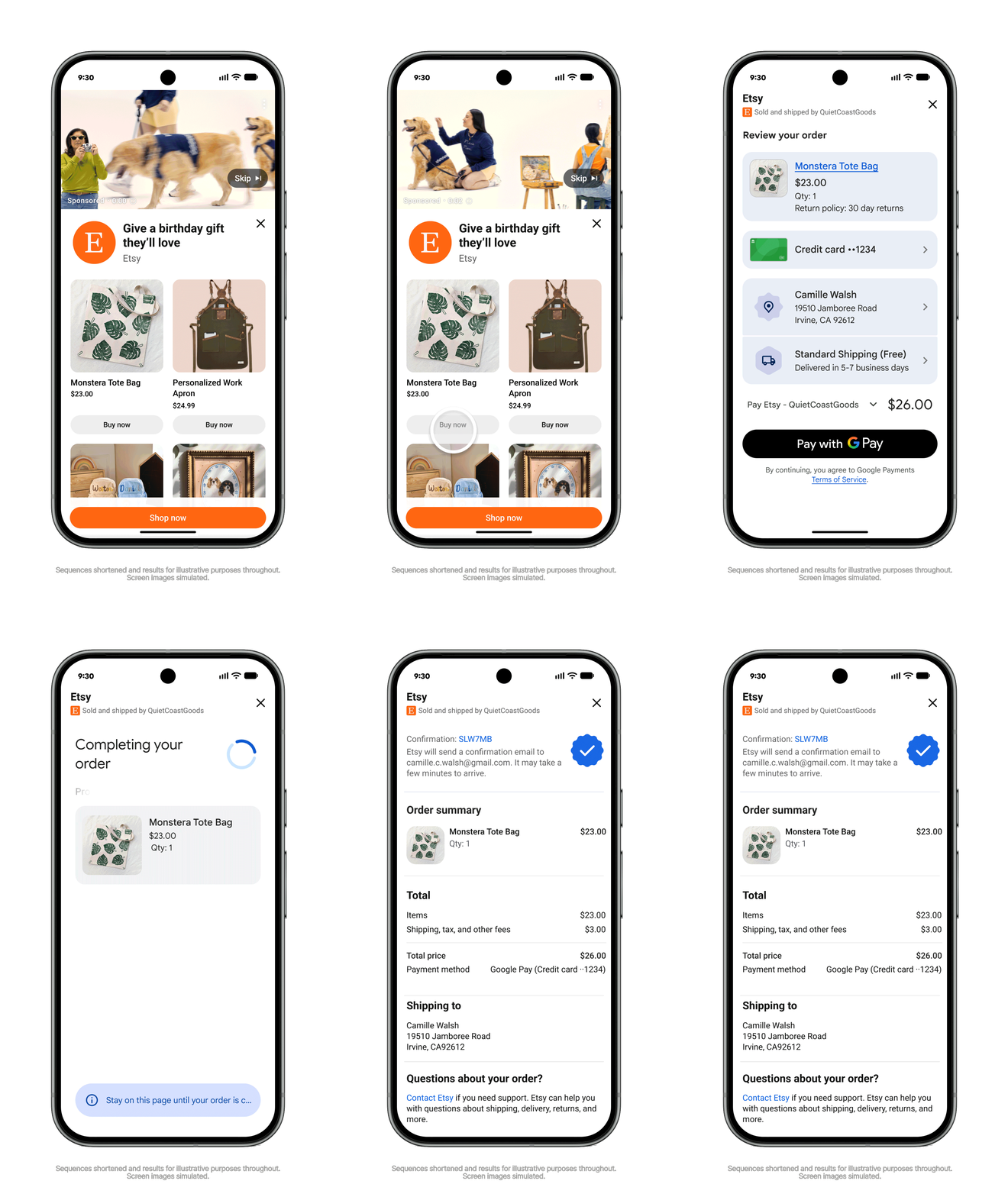
The combination of UCP checkout with YouTube Shopping ads is a notable integration. PPC Land has tracked how UCP checkout expanded out of AI Mode into standard Search results on May 5, 2026. Today's announcement adds YouTube as another surface where the same checkout infrastructure can activate, meaning that a shopper watching a video on YouTube can buy a product featured in a Shopping ad without leaving the platform.
According to Google, advertisers with large product selections typically see a 33% increase in conversions when adopting product feeds in their Demand Gen campaigns, based on internal data from May to June 2025 covering campaigns active since Q1 2024 with over 50 products in the merchant feed.
AI performance insights and conversational attributes
Two new tools announced today are aimed at helping merchants understand and improve their visibility on AI surfaces. The first is an AI performance insights tool in Merchant Center that shows a brand's share of voice against similar brands across AI surfaces like AI Mode and Gemini. The tool is rolling out in Australia, Canada, India, New Zealand, and the US in the coming months.

The second is conversational attributes - a new data attribute type that retailers can submit in Merchant Center to update product descriptions in a way that matches the more conversational search patterns typical of AI Mode. According to Google, AI Mode searches are on average three times as long as traditional searches, and one in six AI Mode queries use voice or images rather than text. Product descriptions optimized for keyword search may not perform as well in these longer, more natural-language contexts. Conversational attributes provide a structured way for retailers to supply richer contextual detail - ingredient lists, use-case descriptions, comparative language - that AI ranking and retrieval systems can draw on when constructing answers to complex shopping queries.
The distinction matters technically. Google's Shopping Graph currently contains more than 60 billion product listings, according to Google internal data from April 2026. As AI Mode query volumes grow - the feature surpassed 1 billion monthly users according to figures disclosed at Google I/O 2026 - the competition for AI-surface visibility is increasing. Conversational attributes represent one of the primary levers merchants have to influence how their products appear in AI-generated responses, separate from paid placements.
Ask Advisor comes to Merchant Center
Google also announced that Ask Advisor, the unified Gemini-powered agent that spans Google Ads, Google Analytics, and Google Marketing Platform, is coming to Merchant Center. Ask Advisor is currently in beta for English-language accounts across Google's ad products. Its extension into Merchant Center means retailers will be able to direct natural-language requests - such as setting up a new campaign for a product category - to an agent that can automatically pull product details from Merchant Center and configure campaign settings in Google Ads without requiring the user to navigate between platforms.
According to Google, Ask Advisor can surface helpful insights using data from both Google Ads and Google Analytics, understands the user's original goals, explains what has worked, and recommends next steps. The Merchant Center integration is listed as coming soon in today's disclosures rather than immediately available.
Context for the marketing community
The scale of today's UCP-related announcements reflects how much ground the protocol has covered since January. PPC Land's analysis at the time of the January 11 launch noted that the open-source standard threatened to commoditize the checkout infrastructure that e-commerce platforms had used as a competitive moat. The expansion into hotels, food delivery, and new markets deepens that dynamic. Travel booking platforms and food delivery aggregators now face the same structural question that Shopify, Wayfair, and Target faced in January: whether to integrate with UCP and accept that some transactions will complete on Google's surfaces, or remain outside the protocol and risk reduced visibility as AI Mode becomes a primary shopping interface.
The UCP Tech Council expanded significantly on April 24, 2026, when Amazon, Meta, Microsoft, Salesforce, and Stripe joined as new members - a development covered by PPC Land that signaled growing industry acceptance of the protocol as a genuine standard rather than a Google-proprietary feature. Today's verticals and geographic additions build on that broader coalition.
For practitioners, the most operationally immediate questions from today's disclosures are: whether existing Merchant Center product data is sufficient for conversational attribute submission, whether current PSP relationships support the FPAN payment flow required for UCP checkout, and how feed quality will determine visibility in AI Mode as competition intensifies across Google's rapidly growing AI surfaces.
Timeline
- November 13, 2025 - Google deploys agentic checkout and AI shopping tools for the holiday season, with Wayfair, Chewy, Quince, and select Shopify sellers as initial participants. Coverage on PPC Land
- January 8, 2026 - Microsoft launches Copilot Checkout with PayPal, Shopify, and Stripe.
- January 11, 2026 - Google announces the Universal Commerce Protocol at the National Retail Federation conference, co-developed with Shopify, Etsy, Wayfair, Target, and Walmart, endorsed by more than 20 companies including Adyen, Mastercard, Stripe, and Visa. Coverage on PPC Land
- January 11, 2026 - Target and Walmart announce UCP integrations, enabling checkout directly within Google's Gemini app and AI Mode. Coverage on PPC Land
- January 11, 2026 - Mastercard announces Agent Pay, establishing FPAN-based payment authentication infrastructure for agentic commerce in collaboration with Google's UCP. Coverage on PPC Land
- January 13, 2026 - Google faces controversy over surveillance pricing claims tied to UCP capabilities. Coverage on PPC Land
- February 11, 2026 - Google formally introduces shopping ads in AI Mode. Coverage on PPC Land
- March 2, 2026 - Google publishes official Merchant Center help page for UCP, providing the first detailed merchant-facing documentation including the native_commerce attribute and PSP requirements. Coverage on PPC Land
- April 8, 2026 - Google Ads Decoded episode outlines how product feeds power CTV, AI Mode, and agentic checkout. Coverage on PPC Land
- April 24, 2026 - Amazon, Meta, Microsoft, Salesforce, and Stripe join the UCP Tech Council, broadening protocol governance beyond its original Google-and-retail-partner structure.
- May 5, 2026 - Google expands UCP checkout from AI Mode into standard Search results, documented by SERP researcher Brodie Clark. Coverage on PPC Land
- May 20, 2026 - Google Marketing Live 2026: Google announces UCP expansion to hotel booking and food delivery, geographic rollout to Canada, Australia, and UK, multi-item cart and cart-transfer support, Affirm and Klarna integration, AI performance insights in Merchant Center, conversational attributes, and Ask Advisor for Merchant Center.
Summary
Who: Google, with retail partners Nike, Sephora, Target, Ulta Beauty, Walmart, Wayfair, and Shopify merchants; travel partners including Booking.com, Expedia Group, Hilton, Marriott International, IHG, Accor, Amadeus, Choice Hotels, Trip.com, and Wyndham; food delivery partners DoorDash, Square, Toast, and Uber Eats; and payment partners Affirm and Klarna.
What: A broad expansion of the Universal Commerce Protocol, adding hotel booking and food delivery as new verticals, multi-item cart and cart-transfer functionality, Affirm and Klarna buy-now-pay-later options inside Google Pay, geographic expansion to Canada, Australia, and the UK, a new AI performance insights tool in Merchant Center, conversational attributes for product descriptions, UCP integration with Direct Offers and YouTube Shopping ads in Demand Gen, and an upcoming Ask Advisor integration in Merchant Center.
When: Announced at Google Marketing Live on May 20, 2026. Geographic rollout to Canada and Australia is described as coming in the coming months; the UK follows afterward. Most features targeting existing US markets are described as rolling out soon or later in 2026.
Where: Google Search (including AI Mode), the Gemini app, YouTube (via Demand Gen Shopping ads), and Merchant Center. The checkout features are currently US-based, with Canada, Australia, and the UK in the near-term rollout sequence.
Why: Google is building the infrastructure for agentic commerce - a model in which AI systems can complete purchases across multiple surfaces on behalf of consumers - and expanding UCP to new verticals and markets is required for that model to function at meaningful scale. The extension into travel and food delivery also positions Google directly against vertical-specific booking platforms and delivery aggregators, while the conversational attributes and AI performance insights tools are designed to help merchants maintain visibility as AI Mode becomes an increasingly significant discovery surface.


Discussion