Google fires two algorithm updates in three days as NewFronts shift
Google's March 2026 spam and core updates hit within 72 hours while IAB NewFronts, Amazon AI prompts, and ChatGPT location data reshape digital advertising.


Google's March 2026 spam and core updates hit within 72 hours while IAB NewFronts, Amazon AI prompts, and ChatGPT location data reshape digital advertising.
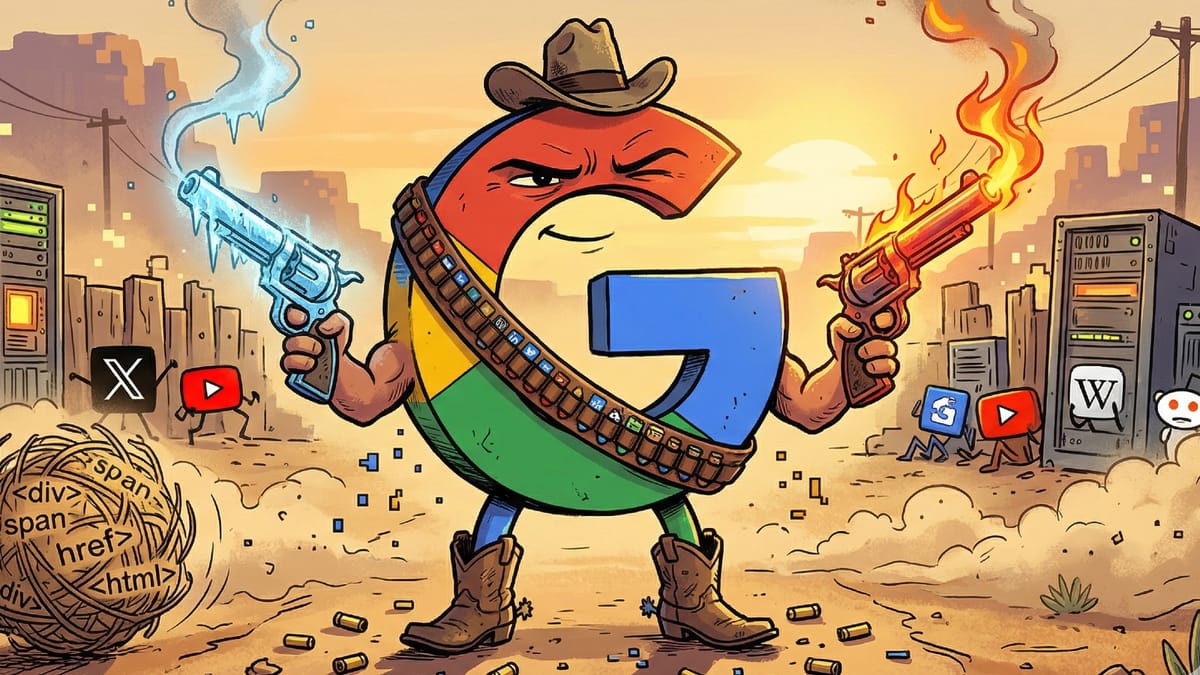
The last week of March 2026 compressed an unusual amount of structural change into seven days. Google released two separate algorithm updates within 72 hours. The IAB NewFronts moved to a new March slot and drew pitches from every major platform. Amazon started charging for AI-powered shopping prompts. OpenAI quietly added location sharing to ChatGPT. TikTok launched new premium ad bundles. And a Los Angeles jury found Meta liable for harming a child through negligent platform design. None of these stories exist in isolation. Together, they outline an industry where AI integration, measurement accountability, and platform power are shifting simultaneously - and fast.
Google did something unusual this week: it fired a spam update and a core update in rapid succession, compressing what would typically be weeks of algorithmic activity into a single chaotic window. The March 2026 spam update went live on March 24 at 12:18 PDT, applying globally across all languages. It was announced on Google Search Central's LinkedIn page with language describing it as "a normal spam update" - phrasing intended to signal routine enforcement rather than a thematic crackdown. What made this spam update remarkable was its speed. According to Search Engine Roundtable, the rollout completed by March 25 at 10:40 am ET - roughly 19.5 hours after launch. That makes it the fastest spam update on record, far shorter than the August 2025 spam update, which ran for 27 days before completing on September 22, 2025.
Then, just three days later, Google released the March 2026 core update on March 27 at 02:14 PDT. The core update may take up to two weeks to complete, with an expected finish around April 10. It is the first core update of 2026, though Google did issue a separate February 2026 Discover core update earlier. According to the Search Engine Roundtable's weekly recap, the simultaneous rollout of both updates creates significant analytical difficulty for webmasters trying to attribute ranking changes to one system or the other. SEO consultant Aleyda Solis joked on X about calling them "combo updates," while Google's John Mueller clarified that one targets spam and the other does not.
The timing matters for a specific reason. SE Ranking research published in January 2026 found that nearly 15% of pages ranking in the top 10 before the December 2025 core update had completely disappeared from the top 100 by early January - one in seven pages previously holding strong positions. Some news publishers reported the December update eliminated their Google Discover traffic entirely, with traffic losses of 70–85% at affected sites. For those publishers, the March core update carries existential weight.
The spam update's lack of thematic detail left practitioners with little to analyze immediately. Google did not disclose whether the update targeted link spam, AI-generated content spam, site reputation abuse, or expired domain manipulation. Daniel Foley Carter, an SEO specialist with over 25 years of experience, raised a pointed question on LinkedIn about whether Google's own AI Overviews constitute the same kind of derivative content that its spam systems are designed to penalize. The question remains unanswered.
Separately, Search Engine Roundtable reported this week that Google also released Ads API version 23.2, began testing large block citations beneath AI Overviews, required out-of-stock product pages to show a grayed-out buy button in Merchant Center, expanded Shopping Ads to additional regions, and introduced sponsored stores inside AI Mode. The pace of simultaneous product and algorithmic changes underscores the difficulty of operating in Google's ecosystem during an active update window.
The IAB's NewFronts moved from their traditional May slot to March 23–26, 2026, a calendar shift announced in October 2025 to better align with annual planning and investment cycles. The result was a concentrated burst of platform pitches - from Google, TikTok, Walmart/Vizio, Meta, Snapchat, Samsung, Tubi, and others - that spanned four days in New York.
Walmart and Vizio made their combined debut. During the first NewFronts event since Walmart completed its acquisition of the TV manufacturer, the two companies announced unified account logins coming to smart TVs using Vizio's operating system. The unified login establishes what Walmart described as a "secure identity framework across devices, connecting streaming engagement directly with retail interaction." The advertising implication is substantial: by centralizing streaming data within Vizio's OS under Walmart customer IDs, the retailer gains a closed-loop measurement advantage that mirrors Amazon's Fire TV model. Samsung's NewFronts presentation disclosed a partnership with Amazon bringing interactive video ad technology to Samsung TV Plus, allowing viewers to see "add to cart" buttons near products on screen that are sold on Amazon.
TikTok returned after a turbulent year. The platform made its first NewFronts appearance since surviving a potential US ban and emerging under new ownership after a court-ordered sale in January. TikTok introduced Logo Takeover, which allows advertisers to co-brand on the app's launch screen, and Prime Time, delivering up to three ads from the same brand within a 15-minute window. Warner Bros. was cited as an early Logo Takeover adopter, reporting double-digit improvements in brand awareness and purchase intent for the film Supergirl.
Meta pitched amid legal damage. Meta unveiled new ad products at its NewFront on Thursday, including an expansion of Reels Trending Ads with category lineups for tentpole events like Fashion Week and NFL games, a redesigned Partnership Ads Hub, and expanded audience-matching filters in Instagram's Creator Marketplace - now listing more than 1.5 million creators. But as AdExchanger framed it, the question hanging over Meta's NewFront was blunt: can a good sales presentation offset the impact of a very bad news week? On Wednesday, a Los Angeles jury found Meta and Google liable in a landmark social media addiction case, ruling that Instagram and YouTube were negligently designed in ways that harmed a young user's mental health. Meta was assigned 70% of $3 million in damages. The bellwether verdict could influence roughly 2,000 similar pending lawsuits.
Google's pitch centred on DV360. Google used its NewFronts slot to push advertisers toward centralizing streaming ad buys through Display & Video 360, which reaches 92% of all CTV viewing households in the US. Day 3 of the IAB Mainstage featured around 20 companies presenting, including Comcast Advertising, Cadent, and DoubleVerify, each positioning their platforms as one-stop solutions for agencies' CTV needs.
Amazon moved its AI-powered shopping prompts out of open beta on March 25, transitioning Sponsored Products prompts and Sponsored Brands prompts to general availability in the United States. The financial significance is the headline buried within the announcement: prompts are now billable under existing cost-per-click bidding parameters, ending a period of free access that began when both formats launched at Amazon's unBoxed conference on November 11, 2025.
The mechanism works by automatically surfacing contextual product information to shoppers at decision moments inside Rufus, Amazon's AI shopping assistant. The AI draws on product detail pages, reviews, and first-party signals to generate prompts that appear as sponsored questions. All US Sponsored Products and Sponsored Brands campaigns are automatically enrolled. Advertisers who want to opt out must navigate to the Prompts tab within specific ad groups in the Ads Console or use the API.
For advertisers who were monitoring ACOS and ROAS figures during the free beta period, the shift to paid clicks may distort performance metrics. Prompt-attributed orders appear in the 7-day orders column within the dedicated Prompts report - but only for advertisers who are actively monitoring that report type. The timing aligns with Amazon's broader pattern of layering AI-powered enhancements onto existing advertising infrastructure, a trajectory PPC Land has tracked across the Sponsored Brands product collections format change effective January 28, 2026, and the Amazon Ads MCP Server opening in public beta on February 2.
OpenAI rolled out location sharing for ChatGPT on March 26, allowing users to share their device's GPS coordinates so the platform can deliver local recommendations, weather, and news. The update was documented in OpenAI's release notes but attracted minimal industry attention. Glenn Gabe, President of G-Squared Interactive LLC, was among the first to flag its significance, noting that "Google dominates" local queries and that this update positions ChatGPT to compete in one of the most commercially valuable segments of search.
The location data arrives at a moment when OpenAI's advertising infrastructure is operational and expanding. OpenAI began testing ads inside ChatGPT on February 9, 2026, initially for free and Go tier users in the United States at a CPM of $60 - well above Meta's typical rates. Criteo became the first formal ad tech partner in the ChatGPT pilot on March 2, connecting approximately 17,000 advertisers. The minimum spend commitment for pilot participants is $200,000. Location-informed advertising in categories like restaurants, retail, and services represents some of the highest CPM potential in digital advertising. It is also, not coincidentally, the segment where Google has historically been most difficult to displace.
One data point complicates the optimism. Walmart disclosed in March 2026 that conversion rates for products sold directly inside ChatGPT were three times lower than those requiring users to click through to Walmart's website. Strong product design does not automatically translate to commercial performance. OpenAI now sits at 700 million weekly active users.
On March 26, Google expanded Search Live to every country and territory where AI Mode is available, bringing real-time voice and camera-based search to more than 200 locations. The expansion is powered by Gemini 3.1 Flash Live, a new audio and voice model described as inherently multilingual. Liza Ma, Director of Product Management for Search, authored the announcement on Google's official blog. Search Engine Roundtable also confirmed the global launch as part of its weekly recap.
Google reported a 65% year-over-year increase in visual searches as of July 2025, with users increasingly relying on cameras, screenshots, and voice input. A guide distributed to marketers in March 2026 described queries in AI Mode as three times longer than traditional searches, with a meaningful share generating follow-up questions within the same session. For publishers, the expansion of voice-delivered search responses raises unresolved questions about click-through rates and advertising visibility in spoken answers. Rather than returning ten blue links, Search Live synthesizes a spoken response and then provides links for deeper exploration. The impact on publisher traffic remains unmeasured at scale.
TikTok released three separate advertising product announcements during the week, collectively representing the most significant overhaul of its premium inventory structure in months.
TopReach, announced March 24, merges the TopView placement (the first content on app open) and TopFeed (the first in-feed ad in the For You feed) into a single purchase. A built-in frequency cap ensures each user sees a TopReach ad once within 24 hours. TikTok claims the combined format delivers 59% more unique reach than either placement purchased separately. A telecom brand case study, verified by iSpot, recorded a 47% higher video completion rate versus standalone TopView bookings.
The Pulse suite expansion, also announced March 24, detailed four contextual placement products. Pulse Mentions places ads next to content where users actively discuss a brand or category. Pulse Tastemakers, the newest addition, places ads immediately after videos from hand-selected creators. Pulse Tastemakers will be available to select US advertisers in Q2 2026 and Canadian advertisers in Q3. Generative AI is being used to curate Custom Lineups - identifying trending content within TikTok's top 4% that fits a marketer's brief.
Finally, TikTok and the Brand Safety Institute published a Creator Suitability Report on March 23, reporting that 78% of creators turned down at least one brand deal in 2025. The US creator economy ad spend reached $37 billion in 2025 and is projected to climb to $43.9 billion in 2026 - roughly 18.6% year-on-year growth.
Google on March 20 added Google-Agent to its official list of user-triggered fetchers, formalizing a new user agent string for AI-powered systems hosted on Google infrastructure that browse the web on behalf of users. The documentation explicitly states that user-triggered fetchers bypass robots.txt entirely. For SEO practitioners, this raises a practical question: if content is restricted from autonomous crawlers but accessible to user-triggered fetchers, what controls exist for AI agents acting on behalf of users? Currently, the documented answer is that no such granular controls exist.
The addition followed a pattern of accelerating documentation changes. Google added Google Messages to the user-triggered fetchers list on January 21. On February 3, it clarified that the 2MB file size crawling limit applies infrastructure-wide. On March 3, a new overview page about Google's web crawling was published. Google's Search Off the Record podcast from March 12 clarified that Googlebot is not a standalone program but a name used by one team within a shared crawling infrastructure serving NotebookLM, Gemini, AdSense, Shopping, and AI agents.
Independent media agency Butler/Till completed what Digiday described as the first real-world test of a programmatic media-buying agent on a campaign for brewer Geloso Beverage Group. The test used an AI agent built on Anthropic's Claude LLM communicating with PubMatic's AgenticOS system. The agency reported intermediary fees were cut by over 80% and CPMs reduced while hitting industry benchmarks on fraud and inventory standards.
The process worked through a sequence of messages between the agency's Claude agent and PubMatic's systems: the agent communicated targeting parameters based on a human-written client brief, PubMatic's agent retrieved curated ad inventory, human staff reviewed and approved selections, and the remaining purchase was handled by PubMatic's existing technology. PubMatic's Harry Tong said the firm is running tests with "upwards of 10" agency partners. Omnicom's tech boss Paolo Yuvienco confirmed at an investor event that the holding company's agencies are also experimenting with similar tools. FreeWheel unveiled an MCP server designed to provide infrastructure for agencies including launch partners PMG and Brkthru.
The significance extends beyond a single test campaign. WordPress.com expanded its MCP integration with write capabilities on March 20, allowing AI agents to create, edit, and delete content directly on WordPress-hosted sites through 19 new tools. The MCP standard has seen rapid adoption since its launch in November 2024 - Google Analytics launched its MCP server in July 2025, Amazon Ads opened its MCP Server in February 2026, and the expansion continues.
YouTube this week published a detailed analysis through Think with Google outlining measurable performance gaps between its creator marketing environment and rival social platforms. Research conducted between December 10, 2025 and January 12, 2026 by Google and Kantar surveyed 7,621 weekly video viewers aged 18–64 in the United States.
The headline numbers: 79% of Gen Z viewers (ages 18–28) said they trust recommendations from creators on YouTube. Among the same group, 89% said they intentionally seek out videos from specific creators. The study claims a 2.3X higher long-term ROAS for YouTube creator marketing compared to paid social. According to data from Agentio, approximately 40% of views and 30% of clicks on sponsored YouTube videos happen more than 30 days after publication.
Structurally, YouTube made two changes this week. Creator Partnerships unified BrandConnect and the Creator Partnerships Hub into a single platform on March 24. On March 27, YouTube expanded its Shopping affiliate program to all YouTube Partner Program creators, dropping the previous 10,000-subscriber threshold to 500. YouTube now lists more than 3 million vetted creators for brand partnerships.
RTL Deutschland on March 27 announced six AI initiatives spanning scripted drama, reality television, virtual set design, and broadcast interstitials. CEO Stephan Schmitter described the company as developing into "the leading Agentic AI media house in the German-speaking region." Among the projects: an AI Director tool for postproduction of reality formats, scheduled for deployment during the next production of "Are You The One?" in Thailand in April 2026; fully AI-generated advertising break separators set to air during the Easter holiday period; and an internal Agent Factory infrastructure for building and deploying AI agents across the organization. RTL's youth protection AI, Merm:ai:d, entered a formal test programme with Germany's Kommission für Jugendmedienschutz at the start of 2026 - a regulatory body formally evaluating the tool.
AdExchanger reported on March 27 that Pacers Sports & Entertainment debuted the Fieldhouse Media Network in partnership with Deloitte and Yieldmo, extending sponsorship marketing from the arena to ads around the web. The plan targets stories, videos, and searches with keywords tied to player names - Caitlin Clark and Tyrese Haliburton are the best-known stars of the Indiana Fever and Pacers - or timely basketball terms like "trade deadline." Meanwhile, Digiday reported that Genius Sports opened up real-time live sports targeting to brands, and the Guardian US grew its programmatic revenue by 44% year over year in February, with the lift driven by higher effective CPMs across both the open exchange and private marketplace deals.
Digiday reported this month that while The Trade Desk remains the dominant DSP, its advertisers are starting to shop around. Amazon and Google are actively courting media buyers, and the gap between The Trade Desk's public confidence and what advertisers describe privately has widened. Separately, Digiday noted that Publicis's dispute with The Trade Desk over transparency and margin allocation represents a structural power shift in programmatic advertising rather than a simple vendor disagreement. The company's stock has been under pressure as investors question its growth trajectory in an environment where walled gardens continue gaining share.