Google forces retailers to split product IDs by March 2026
Google Merchant Center will require separate product IDs for online versus in-store items starting March 2026, affecting Local Inventory Ads and feed management.


Google Merchant Center will require separate product IDs for online versus in-store items starting March 2026, affecting Local Inventory Ads and feed management.
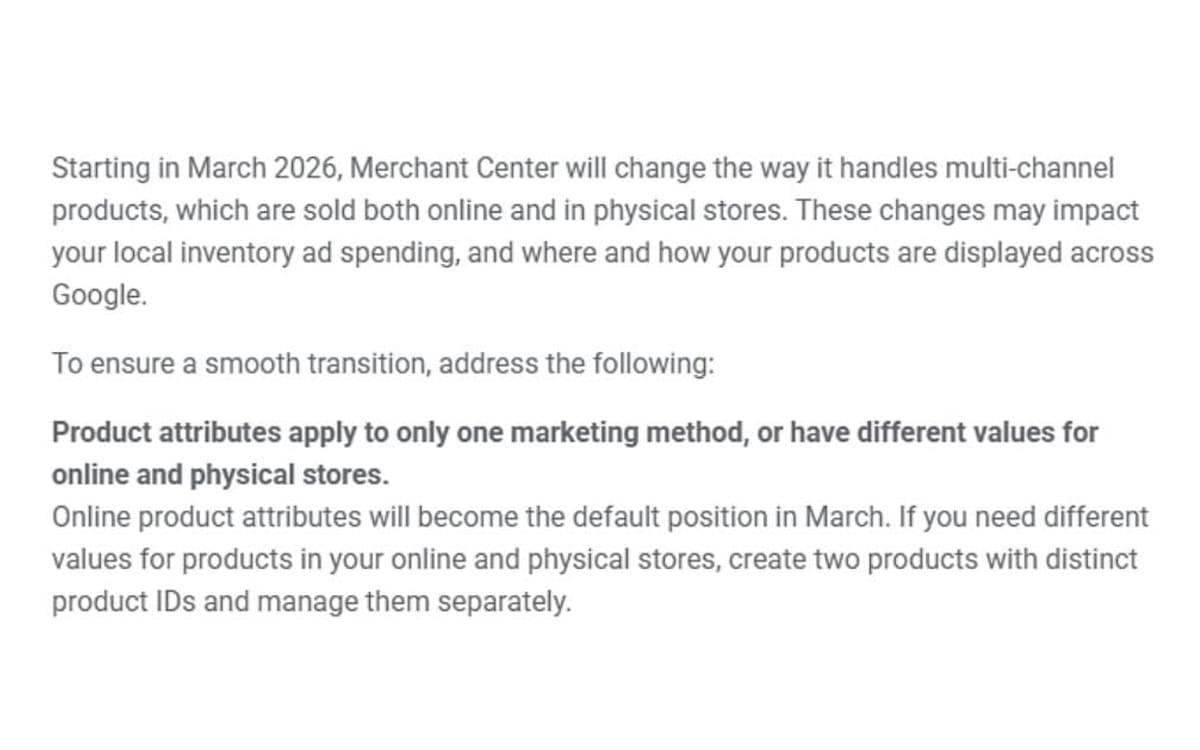
Google announced on January 6, 2026, that Merchant Center will fundamentally change how retailers manage products sold through multiple channels. Starting in March 2026, merchants must use separate product IDs when the same item differs between online and in-store versions in attributes like price, availability, or condition. This marks a departure from the current system where retailers could manage multi-channel products under a single identifier.
The change affects retailers using Local Inventory Ads and businesses selling products both online and in physical stores. According to Google's official documentation, "online product attributes will become the default position in March." Merchants needing different values for products in online and physical stores must create two products with distinct product IDs and manage them separately.
The announcement, spotted by Hana Kobzová, founder of PPC News Feed, represents a significant technical shift for how Google processes product data across Shopping ads, free listings, and local inventory programs. Google has begun notifying affected merchants via email, identifying accounts where product feeds require updates before the March deadline.
The technical rationale stems from Google's move toward unified product representation. Previously, when merchants submitted product information for both online and physical store sales using certain methods, the system created two separate internal records. These records could be modified independently, potentially leading to different information for online and in-store versions of the same product.
"With the updated multi-channel product system, we are moving towards a more consistent approach," according to Google's documentation. Product information for both online and in-store availability will be managed in a more unified way, reducing the chances of attribute differences between the online and in-store versions.
The change impacts how merchants structure their product data feeds. Retailers must review current feeds to identify instances where single product IDs represent items with varying attributes across channels. For products truly identical online and in-store—same price, same availability, same condition—merchants can continue using a single multi-channel product ID. However, when differences exist, the March 2026 deadline requires splitting these into separate entries.
This technical modification carries operational consequences. Feed management becomes more complex for retailers with significant online-offline attribute variations. Each unique product version requires its own product ID, content language specification, and feed label. Merchants must coordinate updates across multiple product entries rather than managing a single unified listing.
The policy specifically addresses products sold both online and in physical stores. "If you submit a product intended for multi-channel sales (online and local) and a separate local-only product using the same product ID, content language, and feed label, this may result in processing issues or errors," Google's documentation states.
Merchants already managing substantial product catalogs face particular challenges. Large retailers with thousands of SKUs must audit entire inventories to identify products requiring segmentation. This process involves analyzing pricing strategies, inventory allocation methods, and promotional calendars to determine where online-offline differences exist.
Google's documentation emphasizes the importance of supplemental data sources. "If you use supplemental data sources to provide additional product information, ensure they are kept up-to-date," according to the announcement. Outdated information in supplemental data sources can lead to inaccuracies in product listings under the new system.
The unified product representation approach affects API users differently than those managing feeds through the Merchant Center interface. For products managed as multi-channel, developers interact with a single product representation. The channel field within the ProductStatusDestinationStatus object in the Content API helps distinguish how a product performs across different programs like Shopping ads or local inventory ads.
However, Google notes that "the channel field is a part of ProductStatusDestinationStatus object of the Content API." Although channel fields in newer systems like Merchant API may be supported as legacy features, the field remains scoped to the soon-to-be-deprecated Content API.
The timing coincides with Google's broader transformation of its e-commerce infrastructure. The company announced Merchant API general availability in August 2025, marking a transition away from the Content API for Shopping. That announcement set August 18, 2026, as the shutdown date for the existing Content API, just five months after the multi-channel product changes take effect.
These parallel transitions indicate coordinated infrastructure modernization across Google's shopping ecosystem. The multi-channel product system update aligns with the Merchant API's modular design approach, which eliminated the channel component from product identifiers and shifted from "channel:contentLanguage:feedLabel:offerId" format to "contentLanguage~feedLabel~offerId" structure.
For merchants using attribute rules and supplemental feeds, the implications extend beyond simple product ID changes. Google introduced advanced data management tools in Merchant Center Next that allow automated rules to identify and rectify common product data errors. These systems must now accommodate the separate product structure mandated for multi-channel items with attribute differences.
Buy ads on PPC Land. PPC Land has standard and native ad formats via major DSPs and ad platforms like Google Ads. Via an auction CPM, you can reach industry professionals.
The change particularly affects retailers leveraging Local Inventory Ads to drive foot traffic to physical stores. These ads showcase in-store product availability alongside online shopping options. When a product appears in local inventory with different pricing or availability than its online counterpart, the March 2026 requirement mandates separate product IDs for each version.
Performance Max campaigns for store goals, which Google expanded to include Waze inventory in November 2025, rely on accurate local product data. The multi-channel product changes ensure that advertisements promoting in-store availability reflect actual store-specific attributes rather than defaulting to online values.
The enforcement addresses longstanding challenges with inconsistent product information. According to Google's explanation of benefits, using multi-channel products offers "a more streamlined and efficient way to manage your inventory, leading to a more consistent experience for your customers." The previous approach could lead to discrepancies that confused customers and affected product performance.
Simplified management represents one stated advantage. "Reduces the complexity and potential for errors that could arise from managing separate online and in-store listings for the same item," according to Google's documentation. However, this simplification comes at the cost of requiring separate management when meaningful differences exist.
Google emphasizes improved consistency as another benefit: "Helps prevent inconsistencies between your online and in-store product information, which could confuse customers and affect how your products perform." The system minimizes the risk of inventory discrepancies, leading to more accurate product availability for customers.
Early access provisions exist for API and automated product data sources. Google is gradually rolling out a feature allowing merchants to select local marketing methods on API and automated product data sources. Merchants without access who want to join the program can submit an interest form. This simplifies the setup for local inventory ads and free local listings for merchants using API or having products automatically added from online stores.
The BigQuery integration changes as part of this update. The products table now exports multi-channel products with an "online" channel designation. The local inventories table of BigQuery Data Transfer Service may contain product_id entries with the "online" channel, reflecting the unified product approach.
Merchant Center Next users encounter specific behavioral changes. By default, data sources become multi-channel under the new system. Multi-channel products require no channel specification and can use all marketing methods. Multi-channel products may block REST name usage with the "local" channel designation. Local inventory can be inserted to a multi-channel product, and ProductStatus contains status information for all marketing methods.
The changes affect how supplemental data sources function. Google's documentation notes that "previously, uploading products with the same ID, content language, and feed label through multiple data sources could lead to unexpected behavior, along with an 'item uploaded through multiple feeds' error." With multi-channel products, these instances now result in errors to ensure data accuracy and clarity.
Custom label attributes present particular considerations. According to Google's guidance, "if you need to maintain different attributes for ad targeting (like custom label [custom_label]) for the online versus the in-store version of a product, we recommend using 2 distinct products with unique product IDs." This recommendation extends the separate product requirement beyond core attributes to encompass campaign management elements.
The enforcement date provides merchants with approximately two months to implement required changes. This timeline compresses for large retailers with extensive product catalogs requiring systematic review and restructuring. Feed management systems, whether custom-built or third-party solutions, need configuration updates to handle the new requirements.
Google's product data specification has undergone continuous refinement throughout 2025. The company implemented changes affecting installment pricing, energy efficiency classifications, and shipping attributes in April 2025, with additional updates to member pricing and sales tax requirements in July. The March 2026 multi-channel product changes represent another step in this specification evolution.
The intersection with brand profile management adds complexity. Google launched brand profile management toolsenabling retailers to control how their business information appears in Search results. These profiles draw information from Merchant Center accounts among other sources, meaning the multi-channel product changes will affect how brand profiles represent product availability and pricing across channels.
Merchants managing omnichannel retail strategies must reconcile this technical requirement with their business operations. Merchant Center Next provides unified product lists allowing merchants to manage online and local versions in the same place, with integration extending to diagnostics, performance reporting, and local store management. The March 2026 changes mandate splitting these unified representations when attribute differences exist.
The practical implementation requires several steps. Merchants must first audit product catalogs to identify items sold both online and in stores. For each product, they must compare attributes including price, availability, condition, and any custom labels used for targeting. When differences exist, merchants create separate products with unique IDs—one representing the online version, another representing the in-store version.
Feed structure adjustments follow this identification process. Primary product feeds must include separate entries for online and in-store versions when attributes differ. Supplemental feeds providing additional product information require updates to reference the correct product IDs. Local inventory feeds must use in-store product IDs rather than shared multi-channel identifiers.
Campaign targeting receives similar scrutiny. Merchants using custom labels or other attributes to distinguish online from in-store targeting must implement the separate product structure to maintain this differentiation. Shopping campaigns, Performance Max campaigns, and local inventory ads require review to ensure proper product ID references.
The error handling system becomes more stringent under the new approach. Google's documentation confirms that submitting the same product through multiple primary data sources leads to processing errors. "We recommend ensuring each unique product is submitted using a single, authoritative primary data source to maintain data accuracy and clarity," according to the announcement.
For merchants without technical teams, the complexity escalates. Small and medium-sized businesses lacking dedicated e-commerce staff must navigate these requirements while maintaining day-to-day operations. The March deadline provides limited time for merchants to understand implications, identify affected products, restructure feeds, and test implementations.
Third-party feed management solutions face adaptation requirements. Software platforms that automate product feed creation and management for multiple merchants must update systems to accommodate the separate product ID requirement. These platforms typically serve hundreds or thousands of merchants, meaning updates must scale across diverse inventory structures and business models.
The change reflects broader industry movement toward precise product data management. Retail media networks, including Amazon, Walmart, and specialty retailers, increasingly emphasize accurate product information as foundation for advertising performance. Sponsored products coverage analysis demonstrates how major retailers achieve near-complete coverage through sophisticated product data systems.
The enforcement aligns with Google's emphasis on transparency in product listings. Brand usage restrictions in product titles, implemented in October 2025, required merchants to use manufacturer brand names rather than retailer names for resold products. The multi-channel product changes similarly prioritize accurate representation over convenience.
Documentation gaps remain a concern for merchants. Emmanuel Flossie, Google Shopping Specialist and Google Ads Diamond Product Expert who developed local inventory tracking solutions, has noted challenges with Google documentation clarity. His September 2025 announcement of Shopify conversion tracking code enhancements referenced documentation gaps that required months to clarify.
The March 2026 deadline arrives during a period of sustained platform change across the digital advertising ecosystem. Merchants simultaneously navigate Google's API transition, Meta's campaign structure consolidation, and evolving privacy regulations. The multi-channel product requirement adds technical complexity to an already demanding operational environment.
Google's rationale emphasizes customer experience benefits. Consistent product information reduces confusion when shoppers research online but purchase in-store, or vice versa. Accurate inventory prevents disappointment from discovering advertised products unavailable at preferred locations. Clear pricing avoids surprise when online-advertised prices differ from in-store stickers.
However, legitimate business reasons exist for maintaining different attributes across channels. Pricing strategies often vary between online and physical retail due to operational cost differences. Store-specific promotions may not apply to online purchases. Inventory allocation prioritizes different channels based on product characteristics and customer behavior.
The separate product ID requirement forces explicit declaration of these differences rather than allowing implicit variation within unified listings. This explicitness improves data quality for Google's systems while potentially constraining merchant flexibility in managing omnichannel strategies.
Implementation challenges vary by merchant size and technical sophistication. Enterprise retailers with dedicated e-commerce teams and custom integration approaches can systematically address the requirements through structured projects. Mid-market merchants using standard e-commerce platforms benefit from platform provider updates but must still audit and restructure product catalogs. Small merchants lacking technical resources face the steepest learning curve and implementation burden.
The timing relative to seasonal business cycles creates additional pressure. March falls during spring inventory planning for many retail categories. Merchants preparing for summer selling seasons must simultaneously restructure product feeds while forecasting demand, placing orders, and planning marketing campaigns.
Google's gradual rollout of related features provides some implementation path. The early access program for API and automated product data sources allows select merchants to preview the system before broad enforcement. However, the email notifications indicating which products require updates suggest Google has already identified affected accounts based on current feed structures.
The cost implications extend beyond technical implementation. Merchants using third-party feed management services may face increased fees for managing larger numbers of distinct product entries. Advertising spending efficiency could decline if proper product segmentation requires learning periods for campaign algorithms. Operational overhead increases when managing separate products for items previously handled through single listings.
The enforcement also affects how merchants approach inventory management systems. Internal databases and point-of-sale systems must support the distinction between online and in-store product versions. Reporting systems require updates to aggregate performance across related products representing the same physical item sold through different channels.
For merchants operating in multiple countries, the complexity multiplies. Product attribute differences across markets necessitate additional product ID variations. A single physical item might require separate product IDs for US online, US in-store, UK online, UK in-store, and so forth when pricing or availability varies across these combinations.
The integration with Google's measurement and reporting systems requires careful attention. Performance analysis must account for the fact that a single product's overall results now span multiple product IDs. Attribution for omnichannel customer journeys becomes more complex when online research and in-store purchase involve separate product identifiers.
Looking beyond the March 2026 deadline, the change sets a foundation for Google's future e-commerce infrastructure. The unified approach to multi-channel products with explicit online defaults positions the system for enhanced automation and AI-driven optimization. However, this foundation requires merchants to first implement the separate product structure where attribute differences exist.
The announcement arrives as Google faces broader antitrust scrutiny of its advertising business. While the multi-channel product changes address legitimate technical concerns about data consistency, the timing and scope add to merchant compliance burdens amid ongoing regulatory attention to platform power.
For marketing teams managing Google Shopping campaigns, the practical impact manifests in feed management workflows, campaign structure, and performance analysis. Campaign managers must verify that product IDs referenced in ad groups correspond to the correct online or in-store versions. Automated bidding strategies require evaluation to ensure they optimize across properly segmented products.
The requirement also affects how merchants think about product taxonomy and classification. Previously, a product existed as a single entity with optional attribute variations. Now, merchants must conceptualize online and in-store versions as distinct products when meaningful differences exist, despite representing the same physical item to consumers.
This conceptual shift has implications for how merchants organize internal processes. Pricing teams must coordinate to ensure both online and in-store product entries receive appropriate updates. Inventory teams must understand that availability changes require updates to the relevant product ID. Marketing teams must track which campaigns reference which product versions.
The March 2026 deadline represents not merely a technical specification change but a fundamental shift in how Google structures e-commerce data. Merchants have two months to understand implications, implement changes, and verify correct operation before enforcement begins. The compressed timeline and operational complexity suggest challenging months ahead for retailers managing multi-channel product strategies across Google's shopping ecosystem.
Subscribe PPC Land newsletter ✉️ for similar stories like this one
Subscribe PPC Land newsletter ✉️ for similar stories like this one
Who: Google announced changes affecting all merchants using Merchant Center to sell products both online and in physical stores, particularly impacting retailers using Local Inventory Ads and businesses with attribute differences between channels. Hana Kobzová, founder of PPC News Feed, first spotted and reported the announcement.
What: Google Merchant Center will require merchants to use separate product IDs for products sold both online and in-store when attributes differ between channels, including price, availability, or condition. Online product attributes will become the default, and merchants needing different values must create two products with distinct product IDs and manage them separately. The change affects how multi-channel products are processed, moving from a system that created separate internal records to a unified approach requiring explicit segmentation.
When: Google announced the changes on January 6, 2026, with enforcement beginning in March 2026. The company has begun notifying affected merchants via email to identify products requiring updates before the March deadline. The change occurs five months before the August 18, 2026, shutdown of Content API for Shopping.
Where: The changes apply to Google Merchant Center globally, affecting Shopping ads, free listings, Local Inventory Ads, and Performance Max campaigns across all markets where these programs operate. The policy impacts product feeds submitted through Merchant Center interface, Content API, Merchant API, and automated data sources.
Why: Google implemented the changes to achieve more consistent product data across channels, reduce inventory discrepancies, and prevent confusion from inconsistent information between online and in-store versions. The unified product representation approach aims to simplify management and improve accuracy, though it requires separate products when meaningful attribute differences exist between online and physical store versions of the same item.