Google phases out call-only ads by February 2027 in push toward automation
Google deprecates call-only ads starting February 2026, forcing advertisers to transition to responsive search ads with call assets by February 2027 deadline.


Google deprecates call-only ads starting February 2026, forcing advertisers to transition to responsive search ads with call assets by February 2027 deadline.
The notification from Adriaan Dekker, shared on January 3, 2026, confirmed details first announced by Google in October 2025 regarding the systematic elimination of call-only ads from the platform. Call-only ads, previously known as call ads, enable businesses to display phone numbers directly in search results without requiring landing page URLs. This specialized format prioritizes phone call generation over website visits, appealing particularly to local service businesses, healthcare providers, and high-consideration purchase categories where immediate contact facilitates conversion.
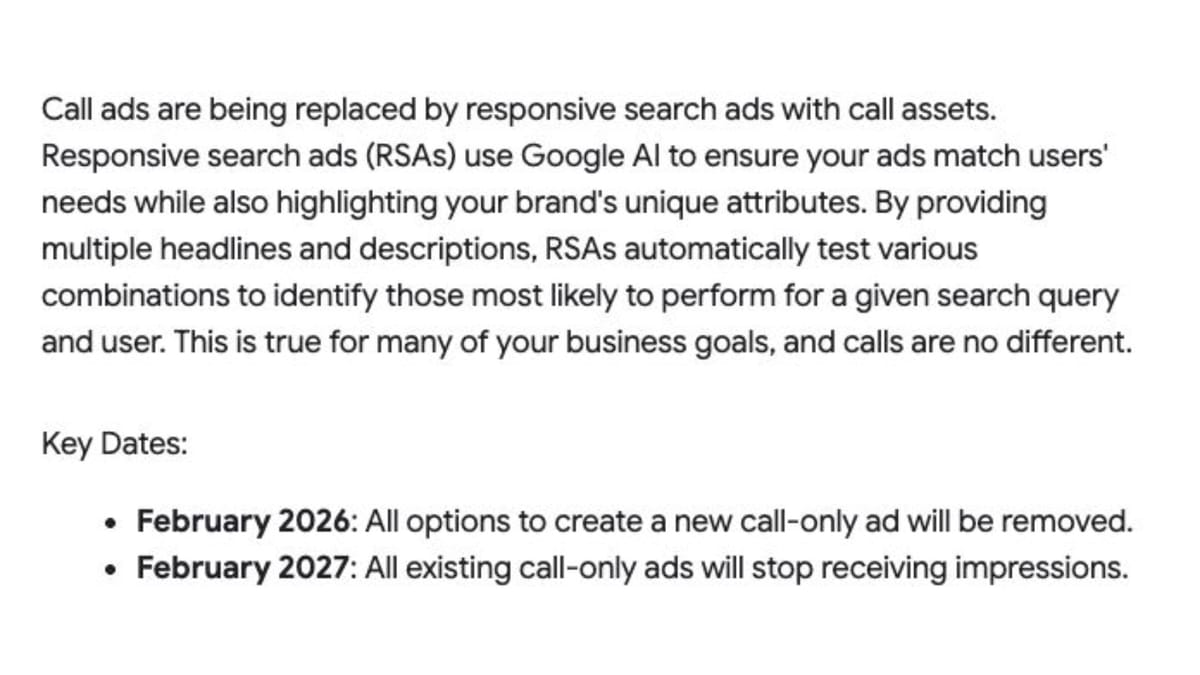
According to the LinkedIn post from Dekker, who scales companies with Google Ads, the deprecation follows a structured two-phase timeline that begins in February 2026 when all options to create new call-only ads will be removed from the platform. Existing call-only ads will continue operating for one additional year. By February 2027, all existing call ads will stop receiving impressions entirely.
The document attached to Dekker's post, titled "Transition from call ads to responsive search ads with call assets," clarifies that call ads are being replaced by responsive search ads with call assets. According to the document, "Responsive search ads (RSAs) use Google AI to ensure your ads match users' needs while also highlighting your brand's unique attributes."
Call assets function as extensions that can be added to responsive search ads. When users click these elements, they initiate phone calls to advertiser numbers rather than visiting websites. The feature supports multiple integration options, though the deprecation specifically targets standalone call ads rather than call extensions.
The rationale provided in the announcement centers on artificial intelligence capabilities. By providing multiple headlines and descriptions, responsive search ads automatically test various combinations to identify those most likely to perform for a given search query and user. "This is true for many of your business goals, and calls are no different," the document states.
The timeline grants advertisers over two years between the October 2025 announcement and the February 2027 cessation of impressions. This extended transition period exceeds typical Google deprecation timelines, which often provide 6-12 months of advance notice. The announcement document recommends that advertisers "proactively replace your call-only ads with responsive search ads with call assets now and continue receiving calls from ads."
For advertisers who already maintain an active call asset in their accounts and campaigns, along with at least one responsive search ad in each ad group, the transition should require minimal intervention. Those without this setup will need to proactively replace their call-only ads with responsive search ads featuring call assets.
Technical implementation varies based on existing account configuration. Advertisers can access call assets through the asset library within Google Ads interfaces. The system requires phone number entry, optional call reporting configuration, and designation of which campaigns or ad groups should display the call asset. When responsive search ads serve with call assets enabled, the phone number appears prominently alongside ad text, enabling users to initiate calls directly from search results.
The deprecation affects measurement and tracking workflows. Call-only ads historically provided straightforward attribution since every interaction represented a phone call. Responsive search ads with call assets introduce complexity because users can either click to visit landing pages or initiate calls, requiring advertisers to implement call tracking systems that distinguish between these interaction types. Conversion tracking must account for both web-based conversions and call-based conversions through separate measurement configurations.
Performance implications remain uncertain during the transition period. Responsive search ads employ artificial intelligence to dynamically generate advertisements through a three-phase process: analyzing search context, assembling asset combinations, and evaluating which variations show the most promise. According to technical documentation, the system requires substantial data volume to move beyond its initial learning phase. Individual assets need more than 500 impressions, while complete ads must accumulate over 2,000 impressions in the "Google Search: Top" segment across a 30-day period.
The transition creates operational challenges for businesses that have optimized specifically for call generation through dedicated call-only campaigns. These advertisers must now develop comprehensive asset libraries including headlines and descriptions that support both call-focused and click-focused user journeys. The shift from single-purpose call ads to multi-purpose responsive search ads requires creative development resources and potentially extended testing periods to identify effective messaging combinations.
Google included a step-by-step guide in its announcement documentation on how to transition from call-only ads to call assets within responsive search ads. The guide addresses campaign structure modifications, asset creation requirements, and measurement configuration updates necessary for successful migration.
The deprecation aligns with a systematic pattern of feature eliminations across Google's advertising platform. Google phased out Enhanced CPC bidding for Search and Display campaigns between October 2024 and March 2025, automatically migrating remaining campaigns to Manual CPC bidding. This reflected the broader industry trend toward sophisticated, AI-driven advertising solutions that reduce manual campaign management options in favor of machine learning-powered alternatives.
The broader automation push extends beyond bidding strategies into campaign creation interfaces. Campaign creation interface modifications shifted from format-first selection to channel-based setup that defaults to Performance Max when advertisers select all available channels. This fundamental workflow reversal occurred in September 2025, further demonstrating the platform's systematic effort to streamline campaign creation while reducing distinct campaign type selections.
Google introduced message asset requirements in September 2025 with verification enforcement beginning October 2025, affecting Search and Performance Max campaigns. The policy modification arrived amid escalating concerns about call-based advertising fraud, with industry professionals documenting thousands of fraudulent advertisements deployed using phone-based ad formats that circumvent URL authentication requirements.
The call ads deprecation specifically intersects with fraud prevention measures. Google announced on November 10, 2025, an update to the Unacceptable phone number section of its Destination requirements policy, introducing requirements that phone numbers found to be associated with fraudulent activity or with a history of policy violations will be deemed unacceptable for use in advertising. Enforcement began December 10, 2025, with gradual rollout over approximately eight weeks.
Buy ads on PPC Land. PPC Land has standard and native ad formats via major DSPs and ad platforms like Google Ads. Via an auction CPM, you can reach industry professionals.
These interconnected policy changes suggest coordinated efforts to simultaneously reduce fraudulent call-based advertising while consolidating legitimate call generation within responsive search ads that maintain URL authentication requirements. The combination of deprecating call-only ads—which don't require landing pages—with tightening phone number verification creates a more controlled environment for call-based advertising that aligns with platform fraud prevention objectives.
Industry professionals responding to Dekker's post acknowledged the forced transition with measured acceptance. One comment simply stated "Thanks!!" while the post generated 12 reactions from advertisers and marketing professionals, indicating awareness of the impending changes within practitioner communities.
The impact extends differentially across business categories. Local service businesses including plumbers, electricians, lawyers, and healthcare providers have historically relied heavily on call-only ads because their conversion funnels prioritize immediate phone contact over website navigation. Emergency services and time-sensitive businesses benefit from call-only formats that minimize friction between ad exposure and customer contact.
Responsive search ads with call assets introduce additional decision points for users. Rather than presenting only a phone number, the format displays headlines, descriptions, and URLs alongside call functionality. This expanded information density may benefit complex purchase decisions where users seek additional context before initiating contact, but potentially reduces effectiveness for businesses where immediate calls represent the optimal outcome.
Testing requirements intensify because responsive search ads support up to 15 headlines and 4 descriptions, creating thousands of potential combinations that Google's artificial intelligence systems select dynamically. Advertisers must develop varied messaging that performs effectively across multiple combination possibilities, contrasting with call-only ads where single sets of headlines and descriptions remained static.
The announcement document notes that if advertisers "have any questions regarding the transition, please reach out to your account management team or contact us at any time." This indicates Google's recognition that the transition requires support infrastructure to assist advertisers through technical implementation and strategic adjustments.
Campaign management workflows require revision to accommodate the new structure. Advertisers maintaining dedicated call generation campaigns must decide whether to continue separating call-focused and click-focused campaigns through different responsive search ad configurations, or consolidate these objectives within unified campaign structures that rely on artificial intelligence to optimize ad assembly for each auction.
Budget allocation implications emerge because responsive search ads with call assets generate both clicks to landing pages and phone calls, potentially distributing budgets across interaction types differently than call-only ads that exclusively generated calls. Advertisers may experience shifts in cost-per-acquisition metrics as the interaction mix changes during transition periods.
The extended transition timeline through February 2027 provides substantial adaptation periods, yet advertisers maintaining large portfolios of call-only ads face significant operational requirements. Bulk editing tools and API-based migration approaches become necessary for accounts with hundreds or thousands of individual call-only ads requiring conversion to responsive search ads with call assets.
Documentation requirements increase because advertisers must maintain comprehensive asset libraries supporting diverse responsive search ad combinations. Single headlines and descriptions from call-only ads expand into multiple variations across the 15 headline and 4 description slots available in responsive search ads. This content development burden particularly affects small businesses and agencies managing numerous client accounts simultaneously.
The deprecation reflects competitive dynamics within the search advertising market. Microsoft Advertising maintains distinct call ad formats, potentially creating differentiated capabilities that distinguish the platform from Google Ads. However, Microsoft has demonstrated parallel automation trends, consolidating bidding strategies in July 2025 by eliminating standalone Target CPA and Target ROAS options.
Performance Max campaigns serve over one million active advertisers across Google's advertising network. The automated campaign format utilizes machine learning algorithms to optimize ad placement, bidding, and audience targeting across Search, YouTube, Display, Discover, Gmail, and Maps properties simultaneously. This broader campaign type expansion demonstrates Google's sustained emphasis on automation and artificial intelligence as the platform's future direction.
The timing aligns with broader competitive pressures within the programmatic advertising sector, where user experience and platform adoption rates directly impact market share and revenue growth. Simplified campaign creation workflows and AI-driven optimization reduce technical barriers that might otherwise limit advertiser adoption of search advertising.
Google's systematic feature deprecations throughout 2024 and 2025 created an industry pattern where manual controls and specialized ad formats gave way to automation and consolidated campaign types. The Google Ads API infrastructure underwent significant changes with monthly releases beginning January 2026, increasing major releases from three to four annually while extending support to one full year. This acceleration responds to developer requests for faster access to features available in the Google Ads user interface.
The announcement arrives at a critical juncture for search advertising. Google faces regulatory scrutiny regarding market dominance in search and advertising technology, with antitrust proceedings examining competitive dynamics and advertiser restrictions. Feature deprecations that force transitions to specific campaign types potentially contribute to discussions about platform control and advertiser flexibility.
Advertisers must balance immediate transition planning with ongoing campaign performance requirements. The February 2026 deadline for new call-only ad creation necessitates near-term action, while the February 2027 complete deprecation permits gradual migration strategies that test responsive search ad performance before committing full campaign transitions.
The document concludes with attribution: "Sincerely, The Google Ads Team," indicating the announcement originated from official product management channels rather than external communications teams. This formality emphasizes the definitive nature of the deprecation decision and the expectation that advertisers will execute required transitions regardless of preference for existing call-only ad formats.
Subscribe PPC Land newsletter ✉️ for similar stories like this one
Subscribe PPC Land newsletter ✉️ for similar stories like this one
Who: Google Ads Team announced the deprecation decision affecting advertisers who utilize call-only ads for phone call generation campaigns. Adriaan Dekker, a Google Ads specialist who scales companies through paid search advertising, shared the announcement with marketing professionals on LinkedIn. Businesses particularly impacted include local service providers, healthcare practitioners, legal professionals, and emergency services that prioritize immediate phone contact over website visits.
What: Google is deprecating call-only ads, also known as call ads, which enable businesses to display phone numbers directly in search results without requiring landing page URLs. The specialized format will be replaced entirely by responsive search ads with call assets. Call assets function as extensions added to responsive search ads that initiate phone calls when users click them, maintaining call generation capabilities within the more versatile responsive search ad format that uses artificial intelligence to test multiple headline and description combinations.
When: The deprecation follows a two-phase timeline extending from February 2026 through February 2027. Starting February 2026, advertisers will lose the ability to create new call-only ads through Google Ads interfaces. Existing call-only ads will continue serving impressions until February 2027, when all call ads will stop receiving impressions completely. The announcement originated in October 2025, providing advertisers with over 15 months advance notice before creation capabilities are removed.
Where: The deprecation affects Google Ads platform globally across all markets where call-only ads currently operate. The transition requirement applies to Search campaigns utilizing call-only ad formats. Advertisers must implement responsive search ads with call assets through the Google Ads interface, Google Ads API, or Google Ads Editor. Call assets integrate into responsive search ads served across Google Search properties where paid search advertisements appear.
Why: Google stated that responsive search ads use artificial intelligence to ensure advertisements match user needs while highlighting brand attributes through dynamic combination testing of multiple headlines and descriptions. The deprecation aligns with systematic platform automation expansion throughout 2024 and 2025, reducing manual campaign management options in favor of machine learning-powered alternatives. The transition consolidates call generation within responsive search ads that maintain URL authentication requirements, potentially supporting fraud prevention objectives while standardizing campaign formats around AI-driven optimization systems.