Google quietly expands AI Overview ads to 11 countries without fanfare
Google expanded AI Overview ads to Australia, Canada, India and 8 more countries on December 19, targeting English speakers with text and shopping ads.


Google expanded AI Overview ads to Australia, Canada, India and 8 more countries on December 19, targeting English speakers with text and shopping ads.
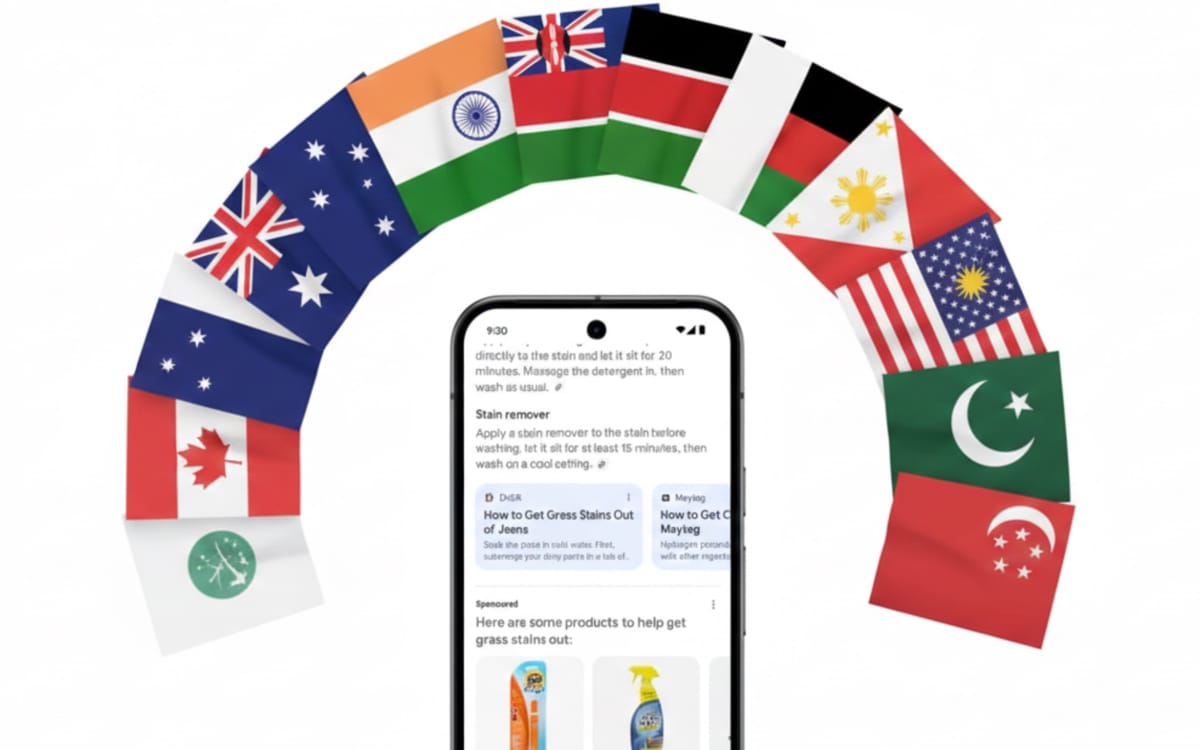
Google expanded advertising within its AI-powered search summaries to 11 countries beyond the United States on December 19, 2025. The placement now operates in English-language markets across Australia, Canada, India, Indonesia, Kenya, Malaysia, New Zealand, Nigeria, Pakistan, Philippines, and Singapore, according to an update to the company's official support documentation.
The expansion occurred without formal announcement. Advertisers discovered the change through modifications to Google's help page titled About ads and AI Overviews, which previously indicated the feature "will expand to select English speaking countries soon." The updated documentation confirms availability across both mobile and desktop devices in the newly added markets.
Subscribe PPC Land newsletter ✉️ for similar stories like this one
Text and Shopping ads from existing Search, Shopping, and Performance Max campaigns now qualify for placement within or adjacent to AI-generated responses. Google's systems consider both the user's original query and the content of the AI Overview itself when determining which advertisements to display, representing a departure from traditional keyword-based ad matching that relies solely on search terms.
The company maintains restrictions preventing ads from appearing in AI Overviews for searches classified as sensitive verticals. According to the documentation, Google currently blocks ads within AI summaries for queries related to adult content, alcohol, gambling, finance, healthcare, politics, and additional unspecified categories.
AI Overviews trigger primarily on queries characterized as having "no one right answer," such as complex questions or searches where information from multiple sources proves beneficial. The system generates ads on a subset of these queries when specific conditions align, including detection of commercial intent and availability of quality advertisements relevant to the user's question.
Search and shopping advertisements from campaigns already running in Search, Shopping, and Performance Max can win auction placement within AI Overviews if they address both the query and the information synthesized in the Overview. Google provided an example scenario in its documentation: a user searching for "why is my pool green and how do I clean it" might receive an AI Overview suggesting water testing or debris removal, alongside relevant Shopping ads for pool vacuum cleaners.
The matching process represents what Google terms "AI-powered targeting" that extends beyond traditional keyword selection. Advertisers cannot directly target placements within AI Overviews, nor can they opt out of having their ads appear in these positions. The company positions this as an automatic extension of existing campaign strategies rather than a distinct advertising product requiring separate management.
Performance reporting for ads served within AI Overviews currently lacks segmentation. Google Ads does not offer separate metrics showing when advertisements appeared inside AI-generated summaries versus traditional search result positions. The company categorizes ads within AI Overviews as "Top Ads" in reporting, grouping them with other premium placements without distinction.
Buy ads on PPC Land. PPC Land has standard and native ad formats via major DSPs and ad platforms like Google Ads. Via an auction CPM, you can reach industry professionals.
Google initially introduced ads within AI Overviews for mobile users in the United States in October 2024, following months of internal testing. The feature represented the company's first monetization of AI-generated search content, addressing investor concerns about maintaining advertising revenue as AI features transform traditional results pages.
Detection of these advertisements in production environments remained extremely limited during early deployment. Adthena became the first platform to observe ads inside AI Overviews on November 24, 2025, documenting just 13 instances across 25,000 monitored search engine results pages. That frequency of 0.052 percent suggested Google maintained cautious rollout policies despite having the technical capability for broader deployment.
The December 19 expansion to 11 additional English-language markets represents the most significant geographical increase since initial testing began. However, Google has not disclosed adoption metrics, impression volumes, or click-through rates for advertisements appearing within AI-generated summaries. The company's public statements emphasize user satisfaction rather than advertiser performance.
Shashi Thakur, VP and GM of Google Ads, stated in October 2024 that the company "carefully tested the integration of ads within AI Overviews over several months." Google's internal research claims users find ads within AI Overviews helpful because they facilitate quick connections with relevant businesses at moments of need, though the company has not published supporting data.
Google requires AI-powered targeting solutions for effective participation in ads within AI Overviews placements. The documentation specifically mandates broad match keywords for Search campaigns or keywordless targeting through Performance Max, AI Max for Search Campaigns, or Dynamic Search Ads. Traditional exact match or phrase match targeting strategies prove insufficient because AI Overviews trigger on complex, conversational queries that advertisers typically do not anticipate or bid on directly.
The company recommends prioritizing automated bidding strategies, particularly Smart Bidding, to ensure advertisements serve on relevant queries aligned with performance goals. For Shopping campaigns, Google advises retailers to maintain product feeds with comprehensive information including detailed descriptions, current pricing, promotional offers, shipping details, and multiple high-quality images or videos.
"AI Overviews trigger on complex answer seeking queries and advertisers are less likely to be targeting such keywords," according to the official documentation. "Ads in AI Overview are matched to our understanding of the user intent based on not just the user query but also the content of the AI Overview."
This matching methodology contrasts with traditional search advertising where keyword selection drives ad eligibility. The AI Overview system analyzes semantic relationships between queries, generated content, and available advertisements to determine relevance—a process requiring machine learning capabilities beyond manual keyword optimization.
The expansion arrives amid documented concerns about how AI features affect traditional advertising performance. Research from Seer Interactive published November 4, 2025, documented steep engagement declines, showing organic click-through rates for informational queries fell 61 percent since mid-2024, while paid click-through rates on the same queries dropped 68 percent.
Adthena's analysis revealed that paid search click-through rates declined 8 to 12 percentage points when AI Overviews appeared in results. The research examined 21 million search indexes across two four-week periods spanning April through September 2025, suggesting AI-generated summaries reduce the likelihood users click on traditional advertisement positions.
Google executives have consistently maintained that monetization rates remain stable despite these documented click reductions. During a Wall Street Journal interview in October 2025, Liz Reid, VP and head of Google Search, asserted that revenue with AI Overviews "has been relatively stable," explaining that reduced clicks on some queries get offset by increased overall search volume.
The company disclosed that AI Overviews drive 10 percent additional queries globally, encouraging users to conduct more searches even when individual queries generate fewer ad clicks. This volume increase creates what Google characterizes as "more opportunities for monetization" despite fundamental changes in how users interact with search results.
Philipp Schindler, Google's Chief Business Officer, stated during the company's Q3 2025 earnings call that "even at our current baseline of ads, whether above, below, and within the AI response, overall, we see the monetization at approximately the same rate." The statement addressed investor concerns about whether AI features would undermine advertising revenue that generated $54.2 billion in search advertising during Q2 2025 alone.
The December expansion forms part of Google's comprehensive AI advertising initiative unveiled at Think Week 2025 in September. That event introduced multiple AI-powered advertising capabilities including Asset Studio for creative generation, AI Max for Search campaigns, and "Ads in AI Mode" for Google's most advanced conversational search interface.
AI Mode represents a separate search experience from AI Overviews, utilizing custom Gemini 2.0 models with advanced reasoning capabilities. Google executives confirmed testing advertisements within AI Mode during Q3, though deployment remains limited to experimental phases in the United States.
The company faces pressure to maintain advertising revenue while transforming core search experiences around AI-generated content. ChatGPT, Perplexity, and other AI-powered alternatives continue gaining adoption, creating competitive dynamics that require Google to balance user experience, advertiser value, and publisher concerns about declining traffic.
Analysis tracking Google's revenue mix revealed that advertising on Google-owned properties reached 90 percent of total advertising revenue for the first time in August 2025, up from approximately 80 percent a decade earlier. The shift reflects how AI features increasingly retain users within Google's interface rather than directing traffic to external websites where network advertisements generate revenue.
Independent publishers have documented significant traffic declines attributed to AI Overviews. IAC's Dotdash Meredith reported during Q1 2025 earnings that AI Overviews "appear on roughly a third of search results related to DDM's content" and publishers "see a little performance decline on those pages." The company experienced a 3 percent year-over-year decline in core user sessions, partially attributed to weakening referral traffic from search platforms.
The current 12-country footprint represents Google's most extensive deployment of ads within AI Overviews since testing began in October 2024. The company has not disclosed plans for expansion to additional languages or markets, though the documentation's language suggesting availability will expand "to select English speaking countries" has been removed in favor of the definitive country list.
Google's AI Overview feature itself operates in more than 200 countries and territories across 40-plus languages following global rollout in October 2025. However, advertising integration remains limited to English-language markets where the company appears to be conducting extended evaluation of user reception and performance metrics.
The expansion to countries including Kenya, Nigeria, and Pakistan represents Google's first deployment of AI Overview advertising in developing markets. These countries demonstrate strong English language adoption and growing digital advertising markets, though economic conditions differ substantially from established markets like Australia, Canada, and the United States.
Google has not indicated whether the feature will extend to non-English languages or when additional markets might gain access. The company's approach reflects cautious expansion typical of advertising products affecting billions of dollars in revenue, particularly when introducing formats that fundamentally alter how users interact with search results.
The explicit exclusion of sensitive verticals from ads within AI Overviews represents a significant policy decision affecting substantial advertising categories. Financial services and healthcare together account for billions in annual search advertising spending, making their exclusion from this placement particularly notable for affected advertisers.
Google's documentation states the company "doesn't show ads in AI Overviews for sensitive verticals like adult, alcohol, gambling, finance, healthcare, politics, and more." The phrasing "and more" suggests additional restricted categories beyond those explicitly listed, though Google has not published comprehensive guidance about which verticals qualify as sensitive in this context.
These restrictions do not prevent ads from appearing above or below AI Overviews in traditional positions. Only placement within the AI-generated summary itself faces categorical exclusion for sensitive topics. Advertisers in affected verticals can continue targeting the same queries using standard search advertising approaches.
The policy likely reflects both regulatory considerations and Google's assessment of appropriate contexts for commercial messaging. Healthcare advertising faces particular scrutiny given potential health impacts of inappropriate product promotion. Financial services advertising similarly operates under extensive regulatory frameworks in most markets.
Google's approach to ad matching within AI Overviews represents fundamental departure from traditional search advertising mechanics. The system analyzes multiple signals including the original user query, the content synthesized within the AI Overview, detected commercial intent, and available advertisement inventory to determine which ads serve.
This multi-signal matching requires AI-powered bidding and targeting because the queries triggering AI Overviews frequently use natural language patterns that advertisers do not anticipate when building keyword lists. A query like "how should I remove grass stains from my daughter's soccer uniform after she slides in wet grass" might trigger AI Overview content about stain removal techniques, potentially serving ads for laundry products despite the advertiser never bidding on that specific phrase.
The matching process examines semantic relationships rather than literal keyword presence. Advertisements for pool vacuum cleaners might appear for queries about green pool water even when the advertiser's keyword list focuses on "pool cleaner," "pool vacuum," or similar product-focused terms rather than problem-focused queries about water color.
Google's requirement for broad match or keywordless targeting strategies ensures sufficient flexibility for the AI system to identify relevant advertisements. Exact match and phrase match restrictions prevent the matching engine from finding appropriate ads for the conversational, complex queries that generate AI Overviews.
Smart Bidding integration allows the system to evaluate expected performance for each potential ad serving opportunity. The bidding algorithms consider signals including user location, device, time of day, and historical conversion patterns to determine appropriate bid values for placements within AI-generated content.
Subscribe PPC Land newsletter ✉️ for similar stories like this one
Subscribe PPC Land newsletter ✉️ for similar stories like this one
Who: Google expanded advertising availability within AI Overviews to advertisers running Search, Shopping, and Performance Max campaigns targeting English-language users in 12 countries. The expansion affects millions of businesses advertising through Google's platforms while excluding sensitive verticals including finance, healthcare, gambling, alcohol, adult content, and politics.
What: The December 19, 2025 update enables text and shopping advertisements to appear within or adjacent to AI-generated search summaries in 11 new markets beyond the United States. Google's systems match ads based on both user queries and AI Overview content rather than keywords alone, requiring broad match or keywordless targeting strategies. Advertisers cannot directly target or opt out of these placements, and reporting does not segment performance for ads appearing within AI summaries.
When: The expansion occurred December 19, 2025, through an update to Google's official support documentation without formal announcement. The feature initially launched for mobile U.S. users in October 2024 following months of internal testing. Production detection remained extremely limited until November 2025, suggesting cautious rollout despite technical capability for broader deployment.
Where: Ads within AI Overviews now operate in Australia, Canada, India, Indonesia, Kenya, Malaysia, New Zealand, Nigeria, Pakistan, Philippines, Singapore, and the United States across both mobile and desktop devices. Availability remains limited to English-language searches while AI Overviews themselves operate in 200-plus countries across 40-plus languages.
Why: The expansion addresses Google's strategic imperative to monetize AI-generated search content while maintaining $54.2 billion quarterly search advertising revenue as user behaviors shift toward AI features. The company faces competitive pressure from ChatGPT and alternative platforms while balancing publisher concerns about declining traffic, advertiser demands for visibility, and documented click-through rate reductions of 8-12 percentage points when AI Overviews appear in results.