Google slashes audience targeting thresholds to 100 users across all networks
Google reduced minimum audience size requirements to 100 active users across Search, Display, and YouTube networks for all segment types, marking a substantial expansion of remarketing accessibility for smaller advertisers.
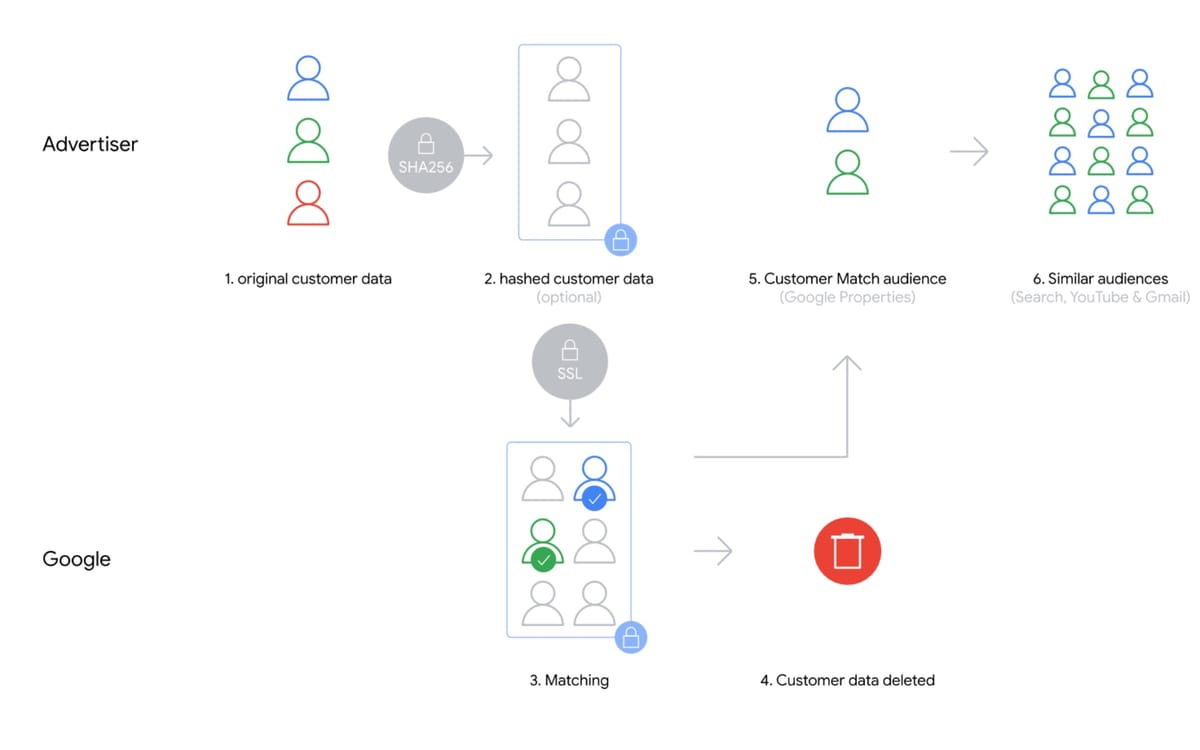
Customer Match workflow showing data hashing, Google matching process, and audience creation across networks
Customer Match workflow showing data hashing, Google matching process, and audience creation across networks
Google has quietly standardized minimum audience size requirements at 100 active users across its entire advertising ecosystem, according to recently updated support documentation discovered by industry professionals. The change affects all three major networks—Display, Search, and YouTube—and applies uniformly to all audience segment types, including remarketing lists and Customer Match audiences.
The adjustment represents a dramatic reduction from previous thresholds that required 1,000 active users for Search campaigns and varying minimums across different networks. According to Dario Zannoni, a web marketer based in Japan who documented the update through LinkedIn on December 17, 2024, Google appears to have been gradually lowering these size limits across different networks and audience types before implementing the comprehensive standardization.
The updated support page for audience segments in Audience manager now states explicitly that advertisers need "a minimum of 100 active visitors or users within the last 30 days" for all networks and all segment types. This unified threshold eliminates the complexity of managing different size requirements based on network selection or audience configuration.
The practical implications extend well beyond simplified campaign setup. Smaller businesses and advertisers with limited website traffic can now activate remarketing campaigns and Customer Match targeting across Google's premium inventory—including Search results and YouTube video placements—with substantially lower audience volumes than previously required. An advertiser with 150 engaged users on their email list can now target that segment across Search campaigns, a capability that would have been unavailable under the previous 1,000-user minimum.
PPC Land Newsletter
Subscribe PPC Land newsletter ✉️ for similar stories like this one
The standardization follows a pattern of incremental reductions throughout 2024. Google first reduced Customer Lists requirements for Search campaigns from 1,000 to 100 users in May 2024, according to industry observations documented by Zannoni. The company subsequently lowered limits for other networks and audience types, seemingly testing different configurations before implementing the final unified standard.
Google's approach demonstrates a methodical testing philosophy rather than an abrupt policy shift. The company appears to have monitored campaign performance and user behavior at lower thresholds before expanding the reduced minimums across the entire advertising platform. This gradual rollout likely enabled Google to assess whether 100-user audiences could generate sufficient signal for its automated bidding systems while maintaining advertiser performance standards.
The previous landscape presented advertisers with a confusing matrix of requirements. Search campaigns historically demanded 1,000 active users, while Display campaigns accepted audiences as small as 100 users. YouTube maintained separate thresholds for different targeting methodologies. Customer Match lists faced their own distinct requirements based on network selection. Advertisers constructing multi-network campaigns needed to understand and accommodate these varying standards, often building separate audience segments for different campaign types.
The May 2024 reduction for Search campaign Customer Lists represented a substantial departure from established norms. That initial change indicated Google's willingness to reconsider longstanding audience size requirements that had remained largely unchanged for years. The comprehensive standardization announced in December 2024 extends that philosophical shift across the entire audience targeting infrastructure.
The 100-user minimum applies specifically to "active" users within a 30-day window. Google defines active users as individuals who have engaged with advertiser properties—whether websites, apps, or uploaded customer lists—and can be matched to Google accounts for targeting purposes. This definition excludes passive list members who haven't demonstrated recent engagement signals.
Audience Insights, a reporting feature that provides demographic and behavioral information about audience segments, also saw its threshold reduced from 1,000 to 100 users. This alignment ensures that advertisers can access analytical tools for any audience segment large enough to serve ads, eliminating a previous gap where audiences could target campaigns without generating insights data.
According to the updated documentation, the system processes audiences through several technical filters before determining eligibility. First, the platform must match user identifiers from advertiser data sources to Google accounts. Then it evaluates recency, counting only users active within the trailing 30-day period. Finally, it applies the 100-user threshold to determine whether the audience qualifies for ad serving.
The matching process varies by data type. Customer Match lists undergo hashing validation to ensure proper SHA-256 encryption of email addresses, phone numbers, and physical addresses before matching against Google's user database. Website visitor lists rely on cookie and device identifier matching. App user segments depend on mobile advertising identifiers. Each methodology generates different match rates based on data quality and user behavior patterns.
Google's documentation notes that audience sizes may fluctuate based on user activity patterns. An audience might qualify for targeting one week and fall below the threshold the next if user engagement decreases. The platform evaluates eligibility continuously rather than at a single point in time, meaning campaigns can pause automatically when audiences shrink below minimum requirements.
Advertise on ppc land
Buy ads on PPC Land. PPC Land has standard and native ad formats via major DSPs and ad platforms like Google Ads. Via an auction CPM, you can reach industry professionals.
The threshold reduction fundamentally alters the economics of remarketing for smaller advertisers. Previously, businesses needed substantial web traffic or large customer databases to activate audience-based targeting across Google's full network suite. A local service provider with 500 monthly website visitors might have generated insufficient volume to target Search campaigns, limiting remarketing efforts to Display network placements.
Digital marketing experts have expressed strong reactions to the standardization. Gabriele Benedetti, a digital marketing professional who commented on Zannoni's LinkedIn post, characterized the change as providing "a new hope" for practitioners who had "lost faith in remarketing due to the lack of interesting lists able to really work because of the needed size."
The reduction arrives at a critical juncture for digital advertising. Third-party cookie deprecation, privacy regulation expansion, and platform policy changes have constrained targeting capabilities across the industry. First-party data activation through remarketing lists and Customer Match has emerged as a primary alternative to traditional behavioral targeting. Lower minimum thresholds increase the accessibility of these first-party data strategies for businesses with smaller customer bases.
Campaign performance at smaller audience sizes raises legitimate questions about statistical significance and algorithmic optimization. Google's automated bidding systems rely on conversion data to optimize bid adjustments in real-time auctions. A 100-user audience generating one or two conversions weekly provides substantially less optimization signal than a 10,000-user audience generating hundreds of conversions.
However, the reduction doesn't mandate that advertisers use minimum-size audiences. Larger businesses with substantial customer databases retain the option to build bigger segments for improved performance. The threshold change simply extends targeting capabilities to advertisers who previously couldn't access certain networks due to volume constraints.
The update particularly benefits businesses with long sales cycles or high customer lifetime values. A B2B software company might maintain highly valuable prospect lists numbering in the hundreds rather than thousands. Previously, those lists couldn't target Search campaigns where purchase intent signals are strongest. The reduced threshold enables that company to present targeted messaging to qualified prospects actively searching for relevant solutions.
Network-specific considerations and limitations
While the 100-user threshold applies uniformly across Display, Search, and YouTube networks, each platform maintains distinct operational characteristics that affect campaign execution. Search campaigns require keyword targeting alongside audience signals, meaning advertisers still need to identify relevant search queries beyond simply meeting audience size requirements. Display campaigns operate through contextual and placement targeting in addition to audience layers. YouTube campaigns benefit from video creative formats that may not suit all advertiser types.
The standardization doesn't eliminate all audience-related complexity. Google continues to enforce separate requirements for Customer Match eligibility based on account history, payment status, and policy compliance. According to earlier policy changes, advertisers need a good history of policy compliance, a good payment history, at least 90 days history in Google Ads, and more than 50,000 USD total lifetime spend to use Customer Match with the "Targeting" setting and bid adjustments.
Advertisers meeting only the basic compliance requirements can use Customer Match on the "Observation" setting without bid adjustments and for customer list exclusions. This tiered access structure means that audience size requirements represent only one dimension of targeting eligibility.
The documentation update occurred without formal announcement through Google's typical communication channels. Advertisers discovered the change by monitoring support page modifications rather than receiving direct notification. This quiet rollout suggests Google may have considered the standardization a technical simplification rather than a major feature launch requiring promotional attention.
Google's Display & Video 360 platform maintains parallel audience targeting capabilities with its own requirement structure. According to separate support documentation, Customer Match lists in DV360 have a maximum membership duration of 540 days, aligning with restrictions implemented across Google's advertising platforms in early 2025.
DV360 Customer Match audiences require minimum thresholds of 100 active visitors or users within the last 30 days for eligibility, matching the newly standardized Google Ads requirements. The platform specifies that users expire 540 days after addition, even if the audience size appears adequate in reporting interfaces.
The DV360 documentation notes several technical limitations specific to that platform. Contact information-based Customer Match lists only serve on Google Ad Manager and YouTube inventory, not through third-party exchanges. Creatives hosted by third-party ad servers or containing third-party ad trackers cannot target contact information-based Customer Match lists. HTML5 and rich media creatives remain incompatible with contact information-based Customer Match targeting.
Device ID-based Customer Match lists in DV360 face different constraints. These audiences require mobile device identifiers and cannot serve without valid IDs. The platform supports hashed email addresses, phone numbers, first names, and last names for contact-based matching, but does not support hashed mobile device IDs.
The parallel requirements across Google Ads and Display & Video 360 suggest coordinated policy development rather than independent platform evolution. Both systems now enforce 540-day maximum membership durations and 100-user minimum thresholds, creating consistent expectations for advertisers operating across Google's advertising ecosystem.
Data quality and match rate considerations
The effectiveness of reduced audience thresholds depends heavily on data quality and match rates. Customer Match lists require properly formatted and hashed user information to match against Google's database. According to platform documentation, email addresses must include domain names, phone numbers need country codes, and physical addresses require specific component formatting.
Google provides instant match rate visibility for Customer Match uploads, a feature introduced in March 2021 that enables advertisers to assess data quality immediately after upload. The match rate indicates the percentage of provided records that successfully matched to Google accounts, providing diagnostic information for troubleshooting low-performing audiences.
Match rates vary substantially based on data source and collection methodology. Email lists from recent customer transactions typically generate higher match rates than older promotional databases. Mobile phone numbers collected through account registration often match better than landline numbers from alternative sources. Geographic coverage affects matching, as Google's user base penetration differs across markets.
An advertiser uploading 150 customer email addresses might see only 75 matches if half the addresses are outdated, incorrectly formatted, or don't correspond to Google accounts. That 50% match rate would still meet the 100-user threshold, enabling campaign activation. However, lower match rates reduce the effective audience size for targeting, potentially limiting campaign performance.
The platform's continuous evaluation of audience eligibility means match rates can fluctuate over time. Users may delete Google accounts, change email addresses, or modify their advertising preferences. An audience segment qualifying today might fall below thresholds tomorrow if enough matches expire without replacement.
Broader context within Google's advertising strategy
The threshold reduction aligns with Google's documented emphasis on first-party data activation as third-party targeting methods face increasing restrictions. Privacy regulations including GDPR and CCPA limit behavioral tracking capabilities, while browser vendors have implemented cookie restrictions that prevent traditional remarketing methodologies.
Customer Match and remarketing lists represent Google's primary solutions for advertisers seeking to leverage their own customer data for targeting purposes. Lowering accessibility barriers for these features supports the platform's strategic positioning around privacy-centric advertising approaches.
The timing corresponds with competitive pressures from other advertising platforms that have implemented their own first-party data targeting solutions. Meta's Custom Audiences, Amazon's audience targeting, and retail media networks' customer matching capabilities all compete for advertiser attention and budget allocation. Google's threshold reduction improves its competitive positioning by extending access to smaller advertisers previously excluded by size requirements.
The change may also reflect technical confidence in Google's machine learning systems. The company's automated bidding algorithms have become increasingly sophisticated at generating performance from limited data signals. Smart Bidding systems might now deliver acceptable results with 100-user audiences where earlier algorithm generations required larger sample sizes for effective optimization.
Platform transparency remains limited regarding the specific performance implications of smaller audience sizes. Google has not published guidance on expected performance differentials between minimum-threshold audiences and larger segments. Advertisers must conduct their own testing to determine whether 100-user audiences generate sufficient returns for their specific business models and campaign objectives.
Implementation considerations for advertisers
Advertisers seeking to capitalize on the reduced thresholds should evaluate their existing audience strategies and identify previously ineligible segments that now qualify for targeting. Customer databases, email lists, and website visitor segments that fell below earlier minimums may now support Search and YouTube campaigns.
The standardization enables simplified campaign architecture. Advertisers can now apply the same audience segments consistently across all networks without maintaining separate lists for different platforms. This reduces operational complexity and ensures consistent messaging across customer touchpoints.
Testing methodologies should account for audience size effects on campaign performance. Advertisers might compare results from minimum-threshold audiences against larger segments to quantify performance differentials. These experiments would provide empirical data for making informed decisions about audience sizing strategies.
Budget allocation considerations become more complex with expanded targeting options. Smaller audiences may justify lower daily budgets to prevent rapid spend exhaustion. Advertisers should monitor frequency metrics to avoid over-exposing limited user pools to repeated ad impressions.
The reduced thresholds don't eliminate the fundamental challenge of building valuable audience segments. Advertisers still need effective data collection strategies, proper technical implementation of tracking tags, and compliant privacy practices. The 100-user minimum simply expands the pool of advertisers who can activate the audiences they've built.
Industry reactions and expert perspectives
Marketing professionals have responded positively to the standardization, viewing it as a democratizing force that extends sophisticated targeting capabilities to smaller businesses. The change particularly benefits agencies managing campaigns for small and medium-sized clients who previously couldn't meet audience size requirements.
The reduction addresses a longstanding frustration within the digital marketing community. Advertisers with legitimate, engaged customer bases sometimes couldn't activate those audiences for targeting due to arbitrary size thresholds. This created a disconnect between data quality (highly engaged, valuable customers) and targeting eligibility (insufficient volume).
Some observers note potential downsides. Smaller audiences may generate insufficient conversion volume for algorithmic optimization, leading to unstable performance and inefficient spending. Campaign managers accustomed to larger audience segments will need to adjust expectations and evaluation methodologies when working with minimum-threshold lists.
The lack of formal announcement has generated speculation about Google's motives for the quiet rollout. Some industry watchers suggest the company wanted to avoid drawing attention to a change that could raise questions about previous threshold justifications. Others view the understated approach as simply reflecting technical documentation updates that don't require promotional treatment.
Zannoni's discovery and LinkedIn documentation sparked discussions across digital marketing communities. His post noting the change received engagement from industry professionals who recognized the practical implications for their campaign management practices.
Future trajectory and ongoing developments
The standardization likely represents an intermediate step rather than a final state. Google continues to refine its audience targeting capabilities as the broader advertising ecosystem adapts to privacy regulation and technical constraints. Further threshold reductions, additional audience types, or alternative matching methodologies may emerge as the platform develops.
The company has signaled continued investment in audience solutions through recent product launches. The Data Manager API announced in December 2024 provides programmatic interfaces for audience list uploads and offline conversion tracking. Customer lifecycle targeting enhancements introduced in April 2025 enable more sophisticated segmentation based on customer relationship stages.
These parallel developments suggest Google views audience-based targeting as a strategic priority deserving ongoing product development attention. The threshold reduction fits within that broader strategic context as one component of expanding advertiser access to first-party data activation capabilities.
Monitoring audience size requirements across Google's advertising platforms will remain important for campaign managers and marketing professionals. The company has demonstrated willingness to modify longstanding policies when technical capabilities or strategic priorities shift. Advertisers should stay informed about documentation updates even when formal announcements don't occur.
The threshold change may influence advertiser behavior in unexpected ways. Businesses that previously invested in alternative targeting approaches due to audience size limitations might now shift budget toward remarketing and Customer Match campaigns. This reallocation could affect performance across Google's advertising inventory as audience-based targeting becomes more prevalent.
PPC Land Newsletter
Subscribe PPC Land newsletter ✉️ for similar stories like this one
Who: Google reduced audience size requirements for all advertisers using remarketing lists and Customer Match targeting across its advertising platforms, with the change documented by Dario Zannoni, a web marketer based in Japan.
What: Minimum audience size thresholds decreased to 100 active users within 30 days across all networks (Search, Display, YouTube) and all segment types, replacing previous requirements of 1,000 users for Search campaigns and varying minimums for other networks. The Audience Insights threshold similarly dropped from 1,000 to 100 users.
When: The standardization appeared in Google's support documentation by December 17, 2024, following gradual reductions throughout the year including a May 2024 change to Customer Lists for Search campaigns.
Where: The requirements apply to Google Ads across all geographic markets and affect audience targeting in Search campaigns, Display campaigns, YouTube campaigns, and Display & Video 360 line items with parallel requirements.
Why: The reduction expands remarketing accessibility for smaller advertisers who previously couldn't meet audience size thresholds, supports Google's strategic emphasis on first-party data activation amid privacy regulation constraints, and simplifies campaign management by standardizing requirements across networks rather than maintaining complex platform-specific minimums.
Share this article
The link has been copied!
Your link has expired. Please request a new one.
Your link has expired. Please request a new one.
Your link has expired. Please request a new one.
Great! You've successfully signed up.
Great! You've successfully signed up.
Welcome back! You've successfully signed in.
Success! You now have access to additional content.