Google tests AI article summaries for select publishers amid traffic concerns
Google launches AI-powered article overviews on December 10, 2025 for major publishers while smaller outlets face mounting traffic losses from AI features.


Google launches AI-powered article overviews on December 10, 2025 for major publishers while smaller outlets face mounting traffic losses from AI features.
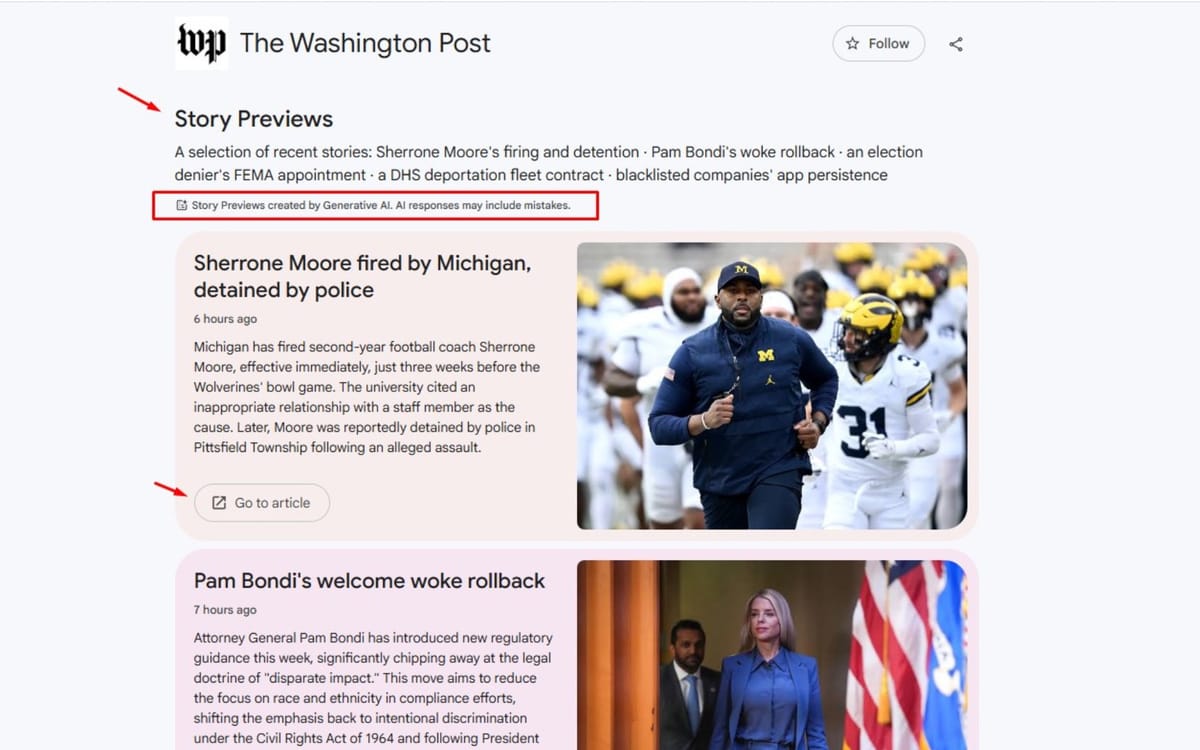
On December 10, 2025, Google announced it was piloting AI-powered article overviews with select major publishers, marking another step in the company's push to integrate artificial intelligence across its search ecosystem. The feature, identified by SEO consultant Glenn Gabe on December 11 for The Washington Post, generates story previews using generative AI to provide context before users click through to articles.
According to Google's announcement published December 10, the company partnered with Der Spiegel, El País, Folha de S. Paulo, Infobae, Kompas, The Guardian, The Times of India, The Washington Examiner, and The Washington Post, among others. The pilot program represents what Google describes as exploration into "how AI can help drive more engaged audiences."
Subscribe PPC Land newsletter ✉️ for similar stories like this one
The feature displays within Google News pages for participating publications. Gabe noted in a December 11 post that The Washington Post implementation includes an AI disclaimer at the top labeled "Story previews" followed by the AI-generated summary and a prominent link to the full article. Google stated the features "will include clear attribution and link to articles."
This development arrives as publishers navigate fundamental challenges from Google's AI integration. Research has documented substantial traffic losses, with studies showing AI Overviews reducing organic clicks by 34.5% to 54.6% when present in search results. The partnership program offers payments to participating publishers, though Google has not disclosed specific compensation amounts.
"But at least they are being paid. How much? We don't know, but there is payment involved," Gabe wrote in response to concerns that AI summaries might depress click-through rates.
The announcement coincided with Google's global expansion of Preferred Sources, a feature allowing users to customize Top Stories to prioritize content from selected outlets. According to Robby Stein, VP of Product for Google Search, and Jafer Zaidi, VP of Global News Partnerships, Preferred Sources will roll out to English-language users worldwide in coming days, with all supported languages following early next year.
Google disclosed that during limited testing beginning in August 2025, users selected nearly 90,000 unique sources ranging from local blogs to major news outlets. "When someone picks a preferred source, they click to that site twice as much on average," the company stated.
The partnership structure creates a two-tier system where major publishers receive compensation and experimental AI features while smaller outlets face traffic declines without similar financial arrangements. Independent publishers have expressed concern about this disparity as AI features reshape traffic distribution patterns.
Google also announced integration with organizations including Estadão, Antara, Yonhap, and The Associated Press to include real-time information in the Gemini app. These partnerships represent expanded content licensing agreements designed to enhance AI capabilities while providing attribution to source material.
The company introduced additional features aimed at increasing links from AI experiences. Google stated it was "increasing the number of inline links in AI Mode, and updating the design of those links to make them more useful." The announcement described plans to add contextual introductions explaining why specific links might be helpful to visit.
A new subscription integration feature will highlight content from news subscriptions, making it easier for paying subscribers to identify relevant content. "We'll also prioritize links from your subscribed publications, and show these links in a dedicated carousel," according to the announcement. The feature launches first in the Gemini app within coming weeks, followed by AI Overviews and AI Mode.
Web Guide, an AI-powered feature that organizes links into topic groups, received updates making it twice as fast. Google expanded Web Guide to appear on more searches in the "All" tab for users opted into the experiment. The feature aims to help users find links they may not have previously discovered through algorithmic organization.
The technical implementation of AI-powered article overviews raises questions about their impact on publisher traffic patterns. Research analyzing publisher experiences with similar AI features has documented measurable business impacts. Dotdash Meredith reported during first quarter 2025 earnings that "AI Overviews appear on roughly a third of search results related to DDM's content" with observable performance declines.
Greg Sterling questioned whether the new features would depress click-through rates to participating news sources. Google's assertion that participating publishers receive payments suggests the company recognizes potential traffic impacts that might require financial compensation.
The announcement arrives amid intensifying regulatory scrutiny of Google's AI content practices. The European Commission launched a formal antitrust investigation on December 9, examining whether Google violated EU competition rules by using publisher content for AI purposes without appropriate compensation or viable opt-out mechanisms.
Thomas Höppner, partner at Geradin Partners representing publishers in the investigation, drew parallels to historical competition concerns. "Already back in 2013, former EU Competition Commissioner Joaquin Almunía stressed that Google may not 'create a link between getting the right to use material from other sites on its specialised search services [such as Google News] and the appearance that these sites have on Google's general search results,'" Höppner stated.
The partnership program's selective nature creates concerns about market power concentration. Major publishers condemned Google AI Mode in May 2025, with the News/Media Alliance calling the technology "the definition of theft" that threatens fundamental economics of digital publishing. The current pilot offers financial arrangements to select major publishers while excluding smaller outlets facing similar or greater traffic challenges.
Publishers excluded from commercial partnerships must navigate automated publication page systems that eliminated manual customization controls in March 2025. Google transitioned to automatically generated publication pages, removing publisher ability to control custom sections, logos, publication titles, and geographic distribution settings previously available through Publisher Center.
Traffic distribution patterns increasingly favor larger platforms with existing audience relationships. Google Discover has become the dominant traffic source for news and media websites, accounting for two-thirds of Google referrals according to research published in August 2025. Traditional Google Search traffic dropped from approximately 16% to 10% of total referrals during the period examined.
The combination of automated systems and selective commercial partnerships creates asymmetric power relationships where publishers have limited control over traffic sources while facing unpredictable revenue impacts. Smaller publishers lacking the scale or prominence to secure partnership agreements must rely entirely on algorithmic selection without financial buffers against traffic declines.
Google emphasized its commitment to the web ecosystem in the announcement. "Search and many of our products connect people to the web, sending billions of clicks per day and driving revenue for websites and creators of all sizes," Stein and Zaidi wrote. The company stated it was working "in collaboration with websites and creators of all sizes, from major news publishers to new and emerging voices."
Buy ads on PPC Land. PPC Land has standard and native ad formats via major DSPs and ad platforms like Google Ads. Via an auction CPM, you can reach industry professionals.
However, traffic analysis suggests Google's AI features disproportionately impact smaller publishers. Independent Publishers Alliance filed a formal antitrust complaint with the European Commission on June 30, 2025, alleging abuse of market power in online search. The complaint cited "traffic, readership and revenue loss" affecting independent publishers.
The audio briefings component of Google's pilot program represents another layer of content transformation. Google stated it was "experimenting with audio briefings for those who prefer listening." These features allow users to consume article content without visiting publisher websites, potentially reducing traditional traffic patterns further.
Financial impacts extend beyond traffic metrics to advertising revenue. Google Network advertising revenue declined 1% to $7.4 billion during second quarter 2025, according to Alphabet's July earnings announcement. The Google Network includes AdSense, AdMob, and Google Ad Manager programs that place advertisements on publisher websites.
Teads, a major advertising technology platform working with thousands of premium publishers globally, reported 10-15% pageview declines during third quarter 2025. CEO Bertrand Quesada attributed the decline to "AI summaries and changes in discovery" that keep audiences within search interfaces rather than directing traffic to publisher websites.
The partnership program's payment structure remains opaque. Google has not disclosed compensation amounts, making it difficult for publishers to assess whether financial arrangements adequately offset potential traffic impacts. This lack of transparency complicates business planning for publishers considering whether to participate in similar programs if offered.
Publishers seeking to optimize for AI inclusion face challenges understanding algorithmic selection criteria. Google's systems identify and rank eligible content based on factors including relevance, prominence, authoritativeness, freshness, location, and language. Smaller publishers often lack the established track record of larger outlets that might influence these algorithmic assessments.
The announcement included examples of other features designed to connect users with sources. Google stated it was launching a feature highlighting links from news subscriptions to help subscribers get more value from their subscriptions. This capability launches first in the Gemini app, with AI Overviews and AI Mode implementation to follow.
Commercial relationships between Google and publishers have expanded significantly in recent years. The company stated it has "partnered with over 3,000 publications, platforms and content providers in more than 50 countries" through various programs. These partnerships involve what Google describes as "extended display rights and content delivery methods like APIs."
The pilot program tests whether AI-generated article overviews can increase user engagement with news content. Google's assertion that the features help "drive more engaged audiences" requires validation through measurable traffic and engagement data. Publishers participating in the pilot will need to assess whether AI overviews generate sufficient value to justify potential traffic trade-offs.
Publisher control limitations remain a persistent concern. Publishers have requested the ability to maintain presence in traditional Google search results while opting out of AI features, allowing them to test impact and make informed decisions about participation. Google has not provided this granular control mechanism.
The December 10 announcement builds upon AI integration efforts Google has pursued throughout 2025. AI Overviews now serve over 2 billion monthly users across more than 200 countries and territories, according to company disclosures. The expansion of AI features to include article overviews, audio briefings, and enhanced linking represents continued investment in AI-mediated information discovery.
Publishers must balance optimization for AI inclusion with strategies for direct user engagement. Traditional relationships between search engines and content creators face fundamental renegotiation as AI answers questions without requiring visits to source material. Revenue models based on attracting visitors to websites encounter disruption when AI summaries satisfy user intent within search interfaces.
The selective nature of Google's partnership program raises questions about access to commercial arrangements. Publishers excluded from current partnerships may lack recourse if traffic impacts prove substantial. The disparity between compensated major publishers and uncompensated smaller outlets could accelerate consolidation trends favoring established platforms.
Google framed the announcement as supporting the web ecosystem during technological transition. "It's clear that the web and technology are evolving; people want information faster, they want more context to help them sort through it, and they're looking for authentic connections with creators and sources they trust," Stein and Zaidi wrote.
However, the evolution Google describes involves fundamental changes to how users access information online. AI-powered summaries, article overviews, and audio briefings all represent consumption patterns that potentially reduce traditional website visits. Publishers participating in commercial partnerships receive financial compensation, but those excluded face the same traffic challenges without similar buffers.
The announcement's timing, just one day before Gabe identified the feature live on The Washington Post, suggests rapid deployment following partnership agreements. Google has demonstrated willingness to launch AI features at scale, with AI Mode expanding to all US users in May 2025 after limited testing periods.
Publishers monitoring these developments face strategic decisions about optimization approaches. Creating content suited to AI recommendation algorithms while maintaining journalistic quality represents a delicate balance. The unpredictability of algorithmic selection makes traffic forecasting and revenue planning increasingly difficult for outlets dependent on search visibility.
Subscribe PPC Land newsletter ✉️ for similar stories like this one
Subscribe PPC Land newsletter ✉️ for similar stories like this one
Who: Google announced partnerships with major publishers including Der Spiegel, El País, Folha de S. Paulo, Infobae, Kompas, The Guardian, The Times of India, The Washington Examiner, and The Washington Post. SEO consultant Glenn Gabe identified the feature's implementation. Google executives Robby Stein and Jafer Zaidi detailed the announcements.
What: Google launched a pilot program testing AI-powered article overviews on participating publications' Google News pages, providing AI-generated story previews before users click through to articles. The feature includes AI disclaimers, article previews, and prominent links to full articles. Google also announced global expansion of Preferred Sources, subscription integration features, and enhanced linking in AI Mode.
When: Google published the announcement on December 10, 2025. Glenn Gabe identified the feature live on The Washington Post on December 11, 2025. Preferred Sources will roll out to English-language users worldwide in coming days, with all supported languages following early next year.
Where: The features operate within Google News for participating publisher pages and across Google Search surfaces globally. Preferred Sources launches worldwide following limited testing in the United States and India beginning August 2025. The subscription integration feature launches first in the Gemini app, followed by AI Overviews and AI Mode.
Why: Google stated the pilot program explores how AI can help drive more engaged audiences while providing payments to participating publishers. The features arrive amid documented traffic declines from AI Overviews, with research showing 34.5% to 54.6% reductions in organic clicks. Publishers excluded from commercial partnerships face traffic challenges without financial compensation, creating concerns about market power concentration and asymmetric relationships between technology platforms and content creators.