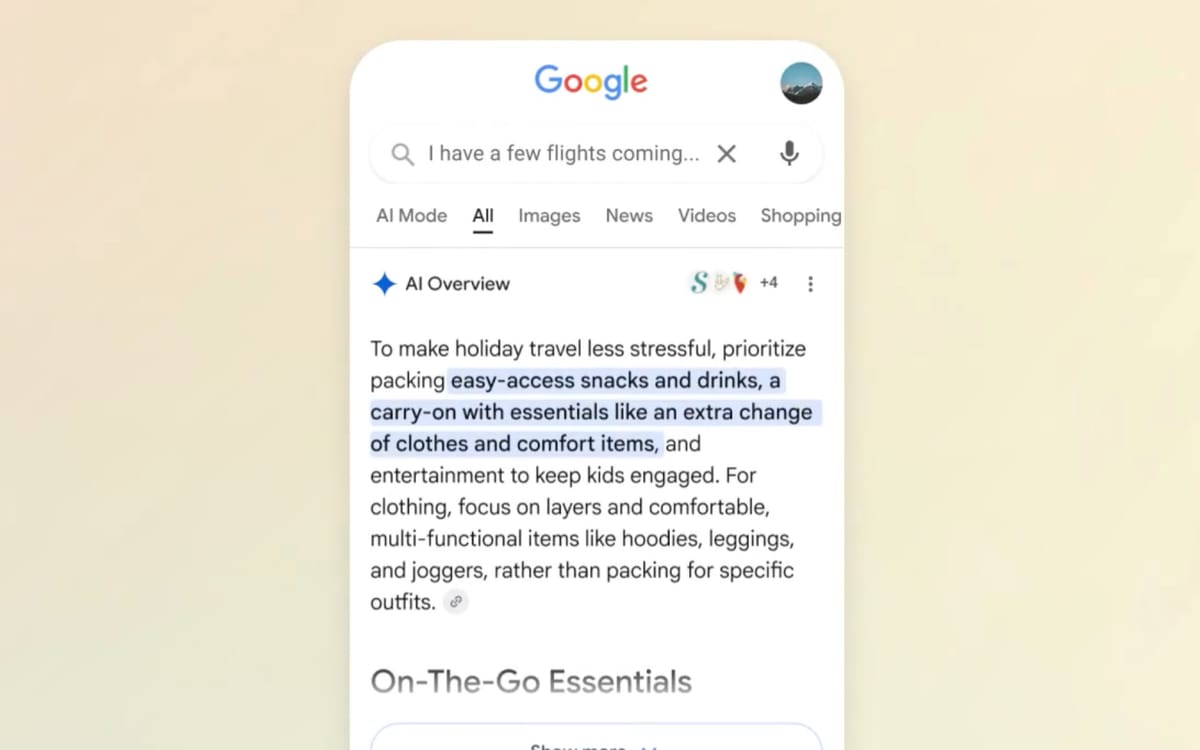
Google tests AI Mode access directly from search results page
Google begins testing seamless AI Mode integration through AI Overviews on mobile devices globally December 1, expanding conversational search capabilities beyond separate interfaces.

Google started testing December 1, 2025, a new method for users to access AI Mode directly from search results pages on mobile devices worldwide. The test enables users to transition from AI Overviews into conversational AI Mode without navigating to separate interfaces, marking a significant step toward integrating artificial intelligence more deeply into the core search experience.
Robby Stein, Vice President of Product for Google Search, announced the global mobile test through social media December 1 at 8:17 PM Eastern Time. "Today we're starting to test a new way to seamlessly go deeper in AI Mode directly from the Search results page on mobile, globally," Stein stated in his announcement. The functionality provides AI Overviews as initial starting points, then allows conversational follow-up questions through AI Mode within the same interface.
The technical implementation positions an "Ask Anything" button at the bottom of expanded AI Overview results after users tap "Show More" on initial summaries. This button directs users into AI Mode while maintaining context from their original search query. "This means you'll continue to get an AI Overview as a helpful starting point, and now you can also ask conversational follow-up questions in AI Mode – right from where you are," Stein explained in his December 1 announcement.
Subscribe PPC Land newsletter ✉️ for similar stories like this one
The integration eliminates friction between Google's two primary AI search products. AI Overviews generate concise summaries directly within traditional search results pages, while AI Mode provides dedicated conversational interfaces designed for extended multi-turn interactions requiring complex reasoning. The new test bridges these experiences by allowing users to escalate from quick summaries into deeper conversations without changing contexts or losing information continuity.
Industry observers noted potential confusion among users expecting traditional search results. Lily Ray, Vice President of SEO Strategy & Research, analyzed the implications through a LinkedIn post December 2. She argued that many users clicking "Ask Anything" will anticipate returning to conventional blue links rather than entering conversational AI interfaces. "I imagine many users will be a bit confused because they are expecting their search to take them back to Google's traditional search results," Ray stated in her analysis.
Ray's commentary expanded beyond immediate user experience concerns to broader strategic implications. She theorized that Google deliberately increased friction in traditional search interfaces to make AI Mode feel more streamlined by comparison. "TL;DR: I think they're making traditional search harder to use so AI Mode feels seamless," Ray wrote in her December 2 analysis.
The hypothesis centers on recent changes to search results page layouts. Sponsored results now occupy entire upper portions of mobile screens, requiring substantial scrolling to reach organic listings. Traditional blue links sit buried beneath multiple layers of advertisements, featured snippets, knowledge panels and other interface elements that have proliferated across search results pages throughout 2025.
This architectural complexity potentially frustrates users seeking straightforward information access. AI Mode provides immediate conversational responses without requiring navigation through crowded results pages. The contrast between interfaces could drive adoption of AI-powered search features by making them appear more efficient than traditional alternatives, despite fundamental differences in how each system operates.
Financial incentives align with this strategic direction. Google generates advertising revenue when users struggle through sponsored listings before reaching organic results. Simultaneously, steering users toward AI Mode establishes behavioral patterns favoring Google's artificial intelligence products over conventional search methodologies. The company has confirmed plans to introduce advertisements within AI Mode, creating monetization opportunities that parallel traditional search while capturing emerging interface paradigms.
The December 1 test builds on systematic global deployment of AI Mode throughout 2025. Google expanded AI Mode to over 40 countries and territories in October, adding more than 35 languages after initial United States launch in March. The platform reached India in June, United Kingdom in July, and extended to five additional languages including Hindi, Indonesian, Japanese, Korean and Portuguese in September.
AI Mode processed queries typically measuring two to three times longer than traditional keyword searches, reflecting conversational input patterns where users express complex information needs through natural language. The system employs "query fan-out technique" that breaks inquiries into multiple subtopics while simultaneously processing hundreds of related searches to generate comprehensive responses synthesizing information from numerous web sources.
Technical infrastructure relies on custom Gemini model architecture specifically designed for search applications. The system processes text, voice and image inputs through multimodal capabilities that enable users to formulate queries using methods most natural to their immediate contexts. Advanced reasoning functions handle analytical tasks requiring synthesis from diverse information sources rather than simple page ranking based on relevance signals.
Adoption metrics demonstrate substantial user engagement with AI-powered search features. Google executives disclosed during third quarter 2025 earnings calls that AI Mode reached more than 75 million daily active users following global rollout across 40 languages. Chief Executive Officer Sundar Pichai stated October 29 that AI Overviews drive meaningful query growth, with effects becoming "even stronger in Q3 as users continue to learn that Google can answer more of their questions."
The company reported October 29 that consolidated revenue reached $102.3 billion in third quarter 2025, representing 16 percent year-over-year growth. Philipp Schindler, Senior Vice President and Chief Business Officer, confirmed that "our investments in new AI experiences, such as AI Overviews and AI Mode, continue to drive growth in overall queries, including commercial queries, creating more opportunities for monetization."
Publishers have expressed concerns about traffic declines accompanying AI search expansion. Independent research documented that organic click-through rates for queries featuring AI Overviews dropped 54.6 percent year-over-year in 2025. Separate analysis examining 300,000 keywords found 34.5 percent reductions in clicks when AI summaries appear in search results.
Website operators reported severe impact from AI-generated summaries that provide complete answers without requiring clicks to source websites. Travel content creators Dave Bouskill and Debra Corbeil experienced 90 percent traffic reduction after AI Overviews began reproducing their specialized knowledge about Canadian slang. Their situation exemplifies how AI systems extract value from niche expertise while eliminating incentives for users to visit original websites.
Google maintains that clicks from AI Overviews deliver superior engagement quality despite reduced volume. Company representatives argue that users arriving from AI summaries demonstrate higher intent and spend more time on destination sites compared to traditional search visitors. John Mueller, Google Search Advocate, stated July 2025 that "when people click to a website from search results pages with AI Overviews, these clicks are of higher quality, where users are more likely to spend more time on the site."
The integration test arrives amid speculation about unified AI search interfaces. Industry analyst Tom Critchlow predicted November 5 that Google would "do something radical early next year, something that looks like merging AI Mode and AI Overviews and Web Guide together." His speculation referenced third quarter earnings disclosures about AI feature performance and executive statements about continued interface evolution.
Advertising integration within AI Mode entered testing phases during third quarter 2025. Schindler confirmed October 29 that "we're testing ads in AI Mode, and we'll continue to test and learn before we expand this any further." The company emphasized maintaining separate monetization approaches for AI Overviews versus AI Mode while exploring optimal placement strategies for each interface type.
Buy ads on PPC Land. PPC Land has standard and native ad formats via major DSPs and ad platforms like Google Ads. Via an auction CPM, you can reach industry professionals.
Adthena detected ads appearing inside AI Overviews November 24 at 0.052 percent frequency across 25,000 search engine results pages. The London-based AI search intelligence platform became first to document advertisements within AI-generated summaries outside Google's controlled testing environments. Detected ad placements featured blue headlines averaging 55 characters, descriptions around 85 characters, and thumbnail images similar to Shopping listings with "Sponsored" labels positioned directly beneath AI Overview summaries.
Marketing professionals face strategic adjustments as AI search features reshape visibility dynamics. Research published in July revealed that 96 percent of AI Overview links originate from top 10 organic search results, indicating strong correlation between traditional ranking factors and AI content selection. However, overall traffic volumes decline as users receive answers directly from AI-generated summaries rather than clicking through to external websites.
Content optimization strategies evolved from pursuing top organic rankings toward ensuring inclusion within AI-generated summaries. Publishers must create information-rich material focused on education and comprehensive analysis rather than click-optimized content designed primarily for traditional search algorithms. The shift represents fundamental transformation in search engine optimization methodologies that defined online marketing practices for more than two decades.
The December 1 test demonstrates Google's commitment to establishing AI Mode as mainstream search option rather than experimental feature limited to early adopters enrolled in Search Labs testing programs. The removal of interface barriers between AI Overviews and AI Mode suggests confidence in system stability and readiness for broader deployment, despite ongoing refinements and acknowledged limitations in response accuracy that Google continues addressing through user feedback mechanisms.
User behavior data reveals significant differences in how people interact with AI Mode compared to traditional search interfaces. Users engage in exploratory research through conversational exchanges, asking follow-up questions and refining information needs within single sessions rather than formulating new searches for each inquiry. Query length typically measures 2-3 times longer than conventional searches, reflecting comfort with expressing complex requests through natural language.
Multimodal capabilities expanded throughout 2025 as users increasingly employed voice, image and text inputs interchangeably. Visual searches surged 65 percent year-over-year as AI Mode drove adoption of camera-based queries, screenshot analysis and Circle to Search functionality on Android devices. The growth represented one of the most significant behavioral shifts in search patterns since Google's founding.
The seamless integration test underscores competitive pressures from AI-powered platforms that have accelerated artificial intelligence adoption across search products. Google faces challenges from ChatGPT, Perplexity and other conversational AI systems that captured user attention throughout 2024 and 2025. The company responded by embedding similar capabilities throughout its search infrastructure while leveraging distribution advantages from billions of existing daily users.
Implementation details remain limited as testing progresses. Google has not disclosed what proportion of mobile users will encounter the new integration, nor provided timelines for potential broader deployment based on test results. The company maintains experimental status for the feature, suggesting cautious approach to permanent interface modifications that could affect billions of daily search interactions worldwide.
Publishers monitoring the development expressed concerns about further traffic erosion as Google makes AI Mode more accessible through reduced friction. The integration eliminates one of few remaining barriers between users and AI-generated content that synthesizes information from multiple sources while potentially reducing clicks to original websites. Independent publishers filed formal antitrust complaints with European Commission June 30, 2025, alleging that Google's AI-powered search features caused "significant harm to publishers, including news publishers in the form of traffic, readership and revenue loss."
Subscribe PPC Land newsletter ✉️ for similar stories like this one
Subscribe PPC Land newsletter ✉️ for similar stories like this one
Who: Google, through Vice President of Product Robby Stein, announced the test. The development affects billions of mobile search users globally, marketing professionals adapting to AI search changes, and publishers concerned about traffic impacts.
What: Google started testing December 1, 2025, a new integration allowing users to access AI Mode conversational search directly from AI Overviews through an "Ask Anything" button positioned at the bottom of expanded search summaries on mobile devices. The functionality bridges Google's two primary AI search products by eliminating interface friction between initial AI-generated summaries and deeper conversational experiences.
When: The global mobile test began December 1, 2025, at 8:17 PM Eastern Time according to Robby Stein's social media announcement. The development arrives after systematic AI Mode expansion throughout 2025 that brought the feature to over 40 countries and 40 languages since initial United States launch in March.
Where: The test operates globally on mobile devices, extending AI Mode integration across all markets where the feature currently operates including United States, India, United Kingdom, and more than 40 countries across Europe, Asia-Pacific, Americas, Middle East and Africa added during October expansion.
Why: Google aims to reduce friction between different AI search interfaces while establishing behavioral patterns favoring conversational search over traditional results pages. The integration supports strategic objectives to make AI Mode mainstream rather than experimental, drive query growth through enhanced capabilities, and create monetization opportunities through planned advertising integration within conversational search experiences. Industry analysis suggests the move also increases pressure on traditional search results by making AI-powered alternatives appear more streamlined despite ongoing concerns from publishers about traffic declines and content attribution.