Google tightens grip on screen time as Shorts timer hits zero
Google announces parental controls for YouTube Shorts including zero-minute timers and School time mode for Android devices on Safer Internet Day 2026.


Google announces parental controls for YouTube Shorts including zero-minute timers and School time mode for Android devices on Safer Internet Day 2026.
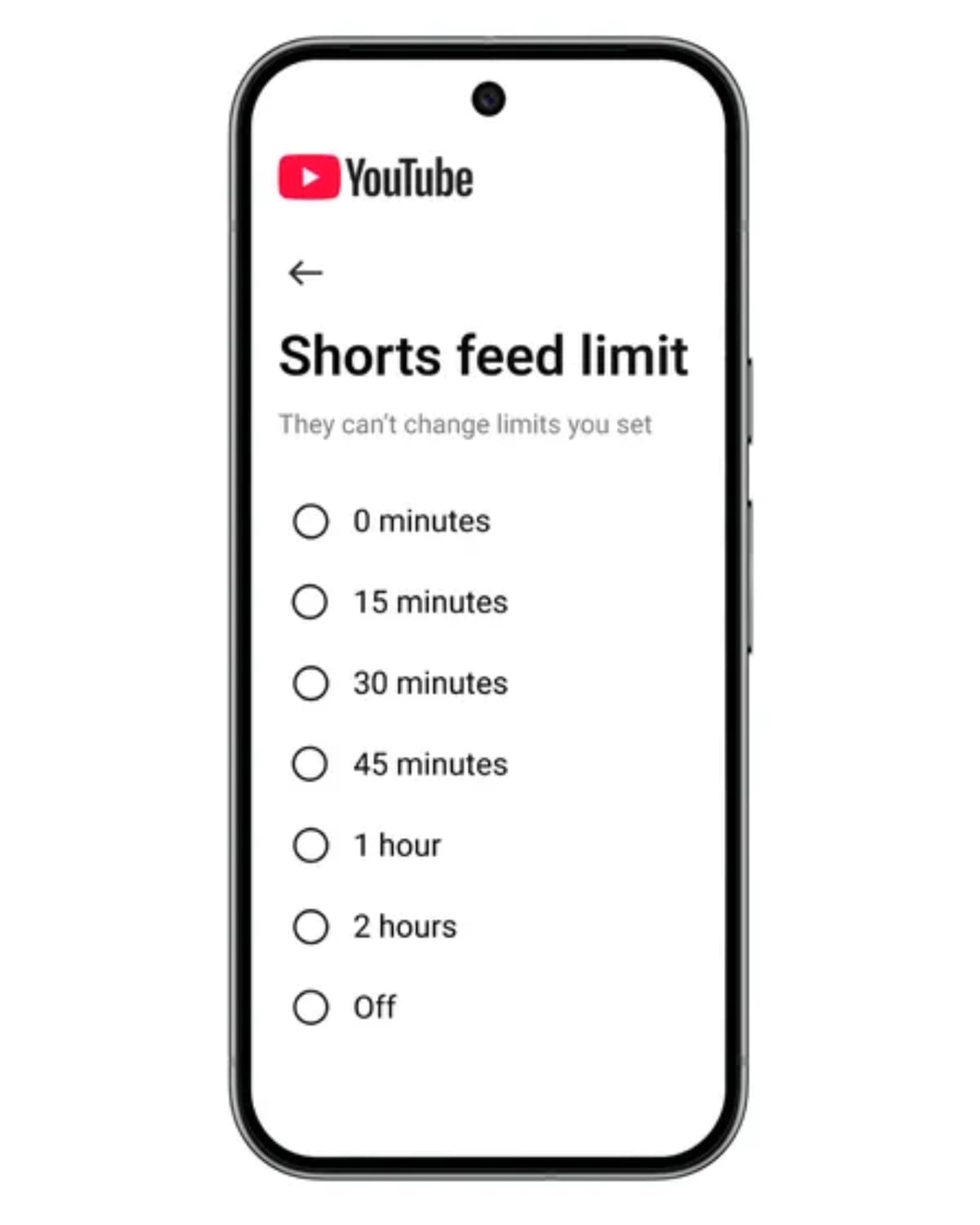
Google this month expanded parental controls across YouTube and Android devices with features designed to limit children's exposure to short-form video content. The announcement, timed to Safer Internet Day, introduces capabilities for parents to set Shorts viewing timers to zero minutes and implements School time functionality on Android phones and tablets.
The company released the updates through a blog post authored by Mindy Brooks, Vice President of Product Management at Google, and Jennifer Flannery O'Connor, Vice President of Product Management at YouTube. According to the announcement, parents can now control the amount of time children spend scrolling through Shorts, with the platform adding an option to set the timer to zero.
YouTube's Shorts format has become central to the platform's growth strategy. The service achieved revenue parity with traditional long-form video on a per-watch-hour basis in the United States during Q3 2025. However, concerns about content quality and creator sustainability have intensified as the platform prioritized short-form content in its recommendation algorithms throughout 2025.
The zero-timer option represents a significant departure from typical platform engagement strategies. Most social media services optimize for maximum time spent on platform, making screen time reduction features commercially counterintuitive. Yet regulatory pressure and public concern about youth mental health have pushed technology companies toward implementing stronger parental controls.
Google Family Link received a design overhaul that consolidates device management functions into a single page interface. Parents can now view device-specific usage summaries, set time limits, and adjust controls through a unified screen-time management tab. The redesign aims to reduce the complexity that previously required navigating multiple menus to configure restrictions.
The updated Family Link interface provides granular control over individual apps and services. Parents can customize which applications remain accessible during restricted periods and review which apps their children use both inside and outside designated limitation windows. The system generates usage reports showing time spent across different applications and categories.
YouTube's parental control enhancements extend beyond Shorts timers. An updated sign-up experience allows parents to create new kid accounts and switch between accounts within the mobile app depending on who is watching. The streamlined account switching addresses friction points that previously made it cumbersome for families sharing devices to maintain appropriate content restrictions.
Parents managing supervised kid and teen accounts gained the ability to set custom Bedtime and Take a Break reminders. These features build on existing default-on wellbeing protections that YouTube implemented for users under 18. Take a Break reminders trigger automatically every 60 minutes for teen users, while Bedtime reminders help establish viewing boundaries aligned with family schedules.
The announcement emphasized that uploads remain private by default for creators aged 13 to 17. This restriction prevents accidental public exposure of content created by minors while allowing them to participate in video creation. The policy reflects ongoing concerns about children's digital footprints and privacy protection.
School time support launched for Android phones and tablets, providing scheduled limitations on phone functionality during school hours. The feature silences notifications and restricts app access based on schedules set by parents. According to the announcement, parents can adjust settings to accommodate vacations, planned days off, lunches, and recess periods.
The implementation gives parents control over which specific apps face restrictions during School time. Children can still access permitted applications while restricted apps remain unavailable. The system tracks which apps children attempt to use during School time periods, providing parents with visibility into access patterns.
School time represents Google's response to growing concerns about smartphone distraction in educational settings. Multiple school districts across the United States have implemented phone-free policies during instructional time, with some requiring students to store devices in locked pouches or lockers. The software-based approach offers an alternative to physical confiscation while maintaining parental oversight.
The feature's flexibility accommodates varied school schedules and regional differences in educational calendars. Parents can create custom schedules that align with their children's specific attendance patterns rather than applying universal restrictions. This customization addresses criticism that one-size-fits-all digital wellbeing features often fail to match real-world family needs.
YouTube recently announced teen quality content principles and a creator guide designed to inform the platform's recommendation system. The principles outline characteristics of content deemed "fun, age appropriate, higher quality and more enriching" for teenage audiences. According to the announcement, YouTube uses these principles to educate its global creator community about their role in supporting teen users.
The principles inform YouTube's recommendation algorithms, allowing the platform to increase the frequency with which high-quality videos appear to teenage viewers. This approach mirrors the high-quality principles YouTube introduced for children's content five years ago, which aimed to make younger users' time on the platform focus on age-appropriate curiosity and exploration.
YouTube's content recommendation systems have faced scrutiny over concerns that algorithmic optimization for engagement can direct teenagers toward problematic content. The platform limits recommendations of content that could be harmful if viewed repetitively by teens, implementing safeguards designed to prevent recommendation rabbit holes.
The company partners with content creators including Sesame Street to bring enriching content to families. Sesame Street became YouTube's largest digital archive in January 2026, with more than 100 full episodes available for free across the main platform and YouTube Kids app.
Google announced plans to continue scaling AI literacy throughout the Be Internet Awesome program curriculum during 2026. In August 2025, the company launched a Be Internet Awesome AI literacy guide offering educators of grades 2 through 8 downloadable lesson plans and classroom activities. The materials aim to make foundational AI literacy concepts engaging for students through structured educational frameworks.
The AI literacy initiative extends through Online Safety Roadshows in Canada and the United States this year. These in-person events provide direct instruction for families and educators on digital safety concepts and AI technology fundamentals. The program represents Google's effort to address knowledge gaps as artificial intelligence capabilities become more prevalent in consumer applications.
The company introduced Guided Learning mode in Gemini, which functions as a personal AI learning companion for students. Rather than providing direct answers, Guided Learning encourages students to develop deeper understanding of complex subjects through probing and open-ended questions. The tool incorporates multimodal responses including images, videos, and interactive quizzes.
Guided Learning marks a shift from traditional AI assistance that simply provides solutions. The educational companion approach emphasizes critical thinking and problem-solving skills over answer retrieval. This methodology aligns with pedagogical research suggesting that struggle and exploration lead to better long-term learning outcomes than immediate solution provision.
Google announced expanded partnerships with organizations including the National Center for Families and Learning, Education for Sharing, the National Cybersecurity Alliance, UpEducators, Fundación ANAR, SaferNet, and the National PTA. According to the announcement, these collaborations will train 200,000 families and practitioners on tools for keeping kids safe online during 2026.
In 2025, Google's partners and collaborators trained more than 60,000 caregivers, educators, and parents across the United States, Brazil, India, Mexico, the United Kingdom, and Spain. The expanded 2026 goal represents more than triple the previous year's reach, indicating significant resource commitment to safety education programs.
The partnerships leverage local expertise and cultural knowledge to deliver safety education appropriate for different regional contexts. Organizations like Fundación ANAR in Spain and SaferNet in Brazil bring established relationships with families and educators in their respective markets, enabling more effective program delivery than centralized initiatives might achieve.
The National Cybersecurity Alliance partnership particularly reflects growing awareness of digital safety beyond content concerns. Cybersecurity threats targeting children have escalated as more young people engage in online commerce, social networking, and educational platforms requiring personal information. The organization's involvement suggests safety training will address technical security alongside content moderation.
Training 200,000 families represents substantial scale but remains a fraction of the billions of users across Google and YouTube platforms. The company faces ongoing criticism that its educational outreach programs, while valuable, cannot substitute for platform design choices that prioritize child safety by default rather than requiring parental configuration.
YouTube's announcement highlighted age estimation technology that uses machine learning to estimate user ages and ensure appropriate viewing experiences. The system operates automatically rather than requiring user-submitted verification, addressing privacy concerns about collecting government-issued identification from minors.
The platform limits recommendations of content that could be problematic for some teens if viewed repetitively. This restriction operates independently of explicit content policies, targeting material that might be individually permissible but harmful when consumed in concentrated patterns. The approach acknowledges that recommendation algorithms can create exposure patterns that differ from intentional search behavior.
Default-on protections include Take a Break and Bedtime reminders being automatically enabled for users under 18. The Take a Break reminder has a default trigger setting for every 60 minutes of continuous viewing. These interruptions aim to encourage periodic disengagement from extended viewing sessions that research has linked to negative wellbeing outcomes.
The automated safeguards reflect YouTube's recognition that optional features see limited adoption. Previous implementations of wellbeing tools as opt-in features demonstrated that most users never enable available protections. Default-on approaches increase the percentage of covered users but also generate friction for teenagers who perceive the interruptions as annoying restrictions rather than helpful boundaries.
The parental control enhancements carry significant implications for marketers targeting family audiences on Google and YouTube platforms. Restricted viewing windows and content limitations affect available inventory for advertisers seeking to reach young demographics through digital channels.
YouTube's Partner Program policies distinguish between long-form and short-form content monetization pathways. Creators focused on Shorts must accumulate 10 million views in 90 days to qualify for revenue sharing, compared to 4,000 watch hours for traditional videos. Parental controls that reduce Shorts consumption directly impact creator revenue potential and subsequently influence content production decisions.
The zero-timer option for Shorts presents a fundamental challenge to engagement-based advertising models. Platforms typically optimize recommendation algorithms to maximize time on platform, increasing advertisement exposure opportunities. Features that enable parents to completely eliminate Shorts access remove entire user segments from available advertising inventory during controlled periods.
School time restrictions similarly affect daypart targeting strategies. Advertisers accustomed to reaching teen audiences during traditional after-school hours may find reduced inventory availability as more families implement scheduled restrictions. The timing shift could concentrate available impressions into narrower windows, potentially increasing competition and cost-per-thousand-impression rates.
The teen quality content principles create new requirements for brand partnerships with YouTube creators. Marketers working with creators targeting teenage audiences must evaluate whether partnership content aligns with YouTube's quality framework to ensure algorithmic promotion. Content that fails to meet the elevated standards may receive reduced recommendation frequency regardless of viewership potential.
The safety feature announcements occur amid intensifying regulatory scrutiny of technology companies' impact on youth mental health and development. US Attorneys General from 44 jurisdictions signed a formal letter in August 2025 demanding enhanced protection of children from predatory AI products, specifically targeting Google among 12 major companies.
The bipartisan coalition expressed concerns about AI assistants that engage in romantic roleplay with children and systematic failures in content moderation systems. The enforcement action builds pressure on platforms to demonstrate proactive safety measures rather than reactive responses to documented harms.
Google's parental control expansion represents defensive positioning against potential regulation mandating specific safety features. By implementing voluntary controls that exceed current legal requirements in most jurisdictions, the company aims to shape regulatory discussions around industry self-governance rather than prescribed mandates.
The timing alignment with Safer Internet Day provides public relations cover for features that might otherwise appear as admissions of previous inadequacy. Annual safety announcements have become standard practice for major technology platforms, allowing companies to consolidate improvements into positive messaging frameworks rather than presenting features as reactions to criticism.
However, the effectiveness of parental controls depends on adoption rates. Optional features require parents to discover, understand, and configure settings - a process that research suggests many families never complete. Default-on protections like the automatic Take a Break reminders for users under 18 avoid this adoption gap but also reduce platform flexibility to accommodate family preferences.
Who: Google and YouTube announced updates through Mindy Brooks, Vice President of Product Management at Google, and Jennifer Flannery O'Connor, Vice President of Product Management at YouTube, targeting families with children and teenagers using Google services and YouTube platforms.
What: The companies released expanded parental controls including zero-minute Shorts timers, School time mode for Android devices, redesigned Family Link interface, custom Bedtime and Take a Break reminders, teen quality content principles, expanded AI literacy programs through Be Internet Awesome, and global safety training partnerships aiming to reach 200,000 families.
When: The announcement occurred on February 10, 2026, coinciding with Safer Internet Day, with features rolling out across Google and YouTube platforms for immediate implementation by families.
Where: The features deploy globally across YouTube's main platform, YouTube Kids app, Android phones and tablets, and Google Family Link services, with safety training partnerships operating in the United States, Canada, Brazil, India, Mexico, United Kingdom, and Spain.
Why: Google aims to address growing concerns about youth screen time, content exposure, and digital wellbeing while responding to regulatory pressure from government officials and maintaining competitive positioning as families increasingly demand stronger parental controls from technology platforms.