Google unveils shopping ads in AI Mode, doubling down on conversational commerce
Google introduces shopping ad format in AI Mode on February 11, 2026, as VP Vidhya Srinivasan positions agentic commerce and Gemini-powered tools as defining marketing trends.
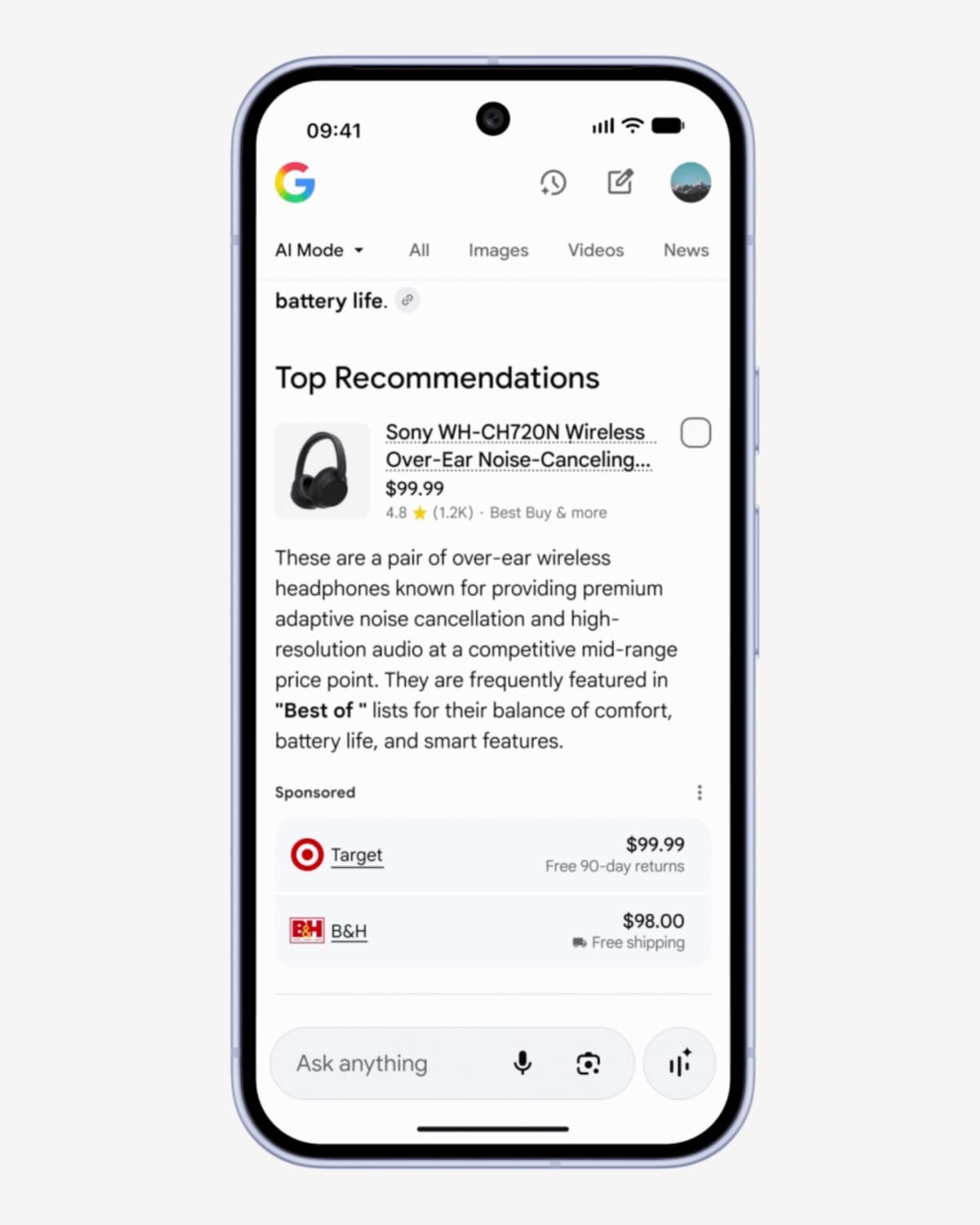
Google AI Mode displays sponsored shopping ads from Target and B&H beneath product recommendations for headphones.
Google AI Mode displays sponsored shopping ads from Target and B&H beneath product recommendations for headphones.
Google this week rolled out a shopping ad format designed for AI Mode, the conversational search experience that has reached over 75 million daily active users. The announcement, made on February 11, 2026, via the company's official X account, positions retailers to appear within AI-generated conversations during what Google characterizes as "key moments of discovery." The deployment coincides with the publication of Vidhya Srinivasan's third annual letter to the advertising industry, where the Vice President and General Manager of Google Ads outlined how artificial intelligence fundamentally reshapes commercial experiences through agentic commerce, reimagined search advertising, and creator partnerships.
The new shopping ad format operates within AI Mode, Google's advanced search interface that enables extended conversational interactions. According to research Google commissioned with 4,773 participants between October and December 2025, AI Mode provides "a more helpful shopping experience when users can easily compare a variety of brands and stores." The ads appear clearly labeled as sponsored, fitting what Google describes as "naturally into the conversation" rather than disrupting the research process.
Srinivasan's February 11 letter frames 2026 as the year when agentic commerce transitions from concept to operational reality. "For decades a person could either shop fast or shop smart," she stated in an interview published the same day. "And with agentic commerce you essentially don't have to choose because this trade-off that one has to make between speed and certainty is being reduced with AI."
The infrastructure enabling autonomous shopping agents relies on the Universal Commerce Protocol, which Google announced January 11, 2026, in partnership with Shopify, Etsy, Wayfair, Target, and Walmart. UCP establishes standardized interfaces allowing AI agents to discover products, negotiate checkout parameters, and complete transactions across different retail platforms without requiring custom integrations for each merchant. Target and Walmart launched integrations enabling checkout directly within Google's Gemini app and AI Mode on January 11, with additional retailers including Shopify merchants scheduled for deployment.
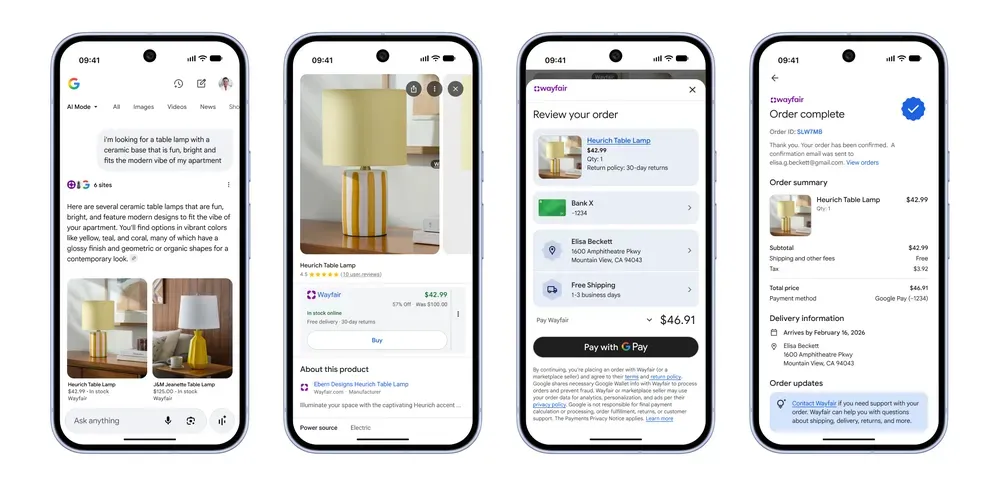
A step-by-step view of the UCP-powered shopping journey, illustrating how users can discover and purchase an item from Wayfair directly within AI Mode.
The protocol deployment triggered controversy when industry observers questioned whether combining search history, conversational AI data, and retailer information enables what critics characterized as "surveillance pricing." Google responded that merchant policies prohibit displaying prices higher than what appears on their websites, though the technical capabilities of personalized commerce systems remain debated.
Analysis published on PPC Land in January suggested UCP threatens to commoditize e-commerce platform value propositions by standardizing the interfaces that previously created competitive moats. The open-source specification establishes REST and JSON-RPC transport layers supporting complementary standards including Agent Payments Protocol for cryptographic transaction authorization and Model Context Protocol for tool calling from AI assistants.
Search advertising reimagined
The transformation of search extends beyond infrastructure to fundamentally alter how advertisements function within AI-generated responses. Srinivasan emphasized that Google isn't simply bringing ads to AI experiences but "reinventing what an ad is." The distinction matters for marketers whose targeting strategies evolved around keyword-based bidding rather than conversational context.
"Conceptually speaking, you get a lot more context into the user journey," Srinivasan explained in the February 11 interview. "So where they are and how deep they are in the funnel of going all the way from getting inspired to discovering a product to comparing products to actually wanting to buy." Users write queries two to three times longer in AI Mode compared to traditional search, providing enhanced intent signals that enable more sophisticated targeting.
The shopping ad format announced today builds on Direct Offers, an advertising feature Google introduced January 11 that enables retailers to present personalized discounts when shoppers approach purchase decisions. Direct Offers operates as a pilot with participating retailers including Petco, e.l.f. Cosmetics, Samsonite, Rugs USA, and Shopify merchants. The system evaluates search context, product relevance, and competitive dynamics to determine appropriate discount displays, initially focusing on percentage-based reductions before expanding to bundles, free shipping, and other value attributes.
Adthena detected ads appearing in AI Overviews at a frequency of 0.052% across 25,000 search engine results pages in November 2025, marking the earliest evidence of Google monetizing AI-generated answers. The company expanded AI Overview ads to 11 countries on December 19, 2025, targeting English-language users in Australia, Canada, India, Indonesia, Kenya, Malaysia, New Zealand, Nigeria, Pakistan, Philippines, and Singapore.
Creator partnerships as commerce drivers
YouTube's role in the commercial ecosystem receives substantial emphasis in Srinivasan's letter, reflecting the platform's position as what she describes as "today's most trusted tastemakers." The creator partnership infrastructure announced throughout 2025 enables brands to connect with communities through what Google characterizes as authentic influence rather than traditional advertising placements.
The company launched the Creator Partnerships Hub during YouTube's NewFront presentation in May 2025, providing advertisers tools to discover creators, manage collaborations, and measure campaign performance. Partnership Ads, introduced in August 2024, allow brands to utilize creator videos within marketing campaigns while maintaining the authentic voice that drives engagement.
YouTube expanded collaboration features in August 2025, enabling creators to tag partners on videos with shared monetization. The platform rolled out enhanced creator tools later that month, including granular brand tagging that improves campaign measurement by providing specific video performance data rather than entire channel analytics.
YouTube's infrastructure for creator monetization has distributed $70 billion to creators, media companies, and music partners over the past three years. The platform operates ten distinct revenue streams, including advertising revenue sharing, channel memberships, Super Chat, Super Thanks, YouTube Shopping, and BrandConnect partnerships.
Srinivasan emphasized that AI capabilities enhance creator discovery by using machine learning to "deeply understand content and audiences, and instantly matching brands with the creator communities that will love their products." The approach turns what she describes as creators' "organic influence into real business impact" by connecting brand partnerships with measurable conversion outcomes.
Gemini powers performance gains
The technical foundation enabling these developments relies on Gemini models that Google positions as delivering continuous improvement across advertising infrastructure. "We use Gemini everywhere," Srinivasan stated in the February 11 interview. "We use it for all the intent matching when we for the ads quality stuff we use it for of course generating the creatives itself but then we also use it to drive all our performance campaigns."
Google launched Gemini 3 on November 18, 2025, featuring state-of-the-art reasoning capabilities that topped the LMArena Leaderboard with a score of 1501 Elo. The model demonstrates PhD-level reasoning with scores of 37.5% on Humanity's Last Exam without tool usage and 91.9% on GPQA Diamond. Gemini 3 integration into search on December 18 enabled dynamic interface generation and real-time simulations for complex queries.
Nano Banana Pro, built on Gemini 3 Pro foundations, launched November 20, 2025, bringing advanced image generation to Google Ads. The system maintains consistency across up to 14 input images while preserving resemblance for up to five distinct individuals, addressing brand consistency requirements across campaign materials. Advertisers using Gemini-generated assets increased 3x in 2025, with nearly 70 million creative assets generated in Q4 2025 alone across AI Max and Performance Max campaigns.
Google launched Ads Advisor and Analytics Advisor to all English-language accounts in December 2025, providing campaign optimization recommendations, performance diagnostics, and policy troubleshooting through conversational interfaces powered by Gemini models. The tools represent what Google characterizes as agentic AI systems capable of accelerating data analysis and campaign management.
AI Max, the performance campaign format Google introduced at Think Week 2025 in September, unlocks what the company describes as "billions of net-new searches that these advertisers weren't reaching before." The system operates by expanding Search campaign reach through AI-powered optimization that adapts to evolving search behaviors including longer conversational queries.
Measurement and trust foundations
Srinivasan positioned measurement infrastructure as critical to validating advertising effectiveness in AI-driven environments. "Campaign tooling is only as powerful as the data and measurement fueling it," she wrote in the February 11 letter. "But with disjointed data and conflicting industry solutions, it's hard for businesses to know which data they're missing and where to invest."
Google announced it is "re-engineering the measurement stack to serve as a one-stop-shop for advertisers, ensuring every decision is driving real, measurable growth." The approach reflects industry challenges where attribution across AI-powered discovery, creator partnerships, and traditional search creates complexity for marketers attempting to allocate budgets.
Trust emerged as a recurring theme throughout Srinivasan's interview and letter. "Any sort of speed or innovation nothing is useful without safety and trust as a foundation," she stated. "We have a very strong legacy of building products that are highly trusted by consumers for the last 25 years." The emphasis addresses concerns that autonomous commerce systems and AI-mediated shopping require robust verification of transaction authorization and merchant authenticity.
The convergence of these capabilities positions what Srinivasan describes as achieving "the holy grail of marketing" - delivering the right ad at the right moment for the right person. "I think we are closer to achieving that for real than we've ever been in the past," she stated in the February 11 interview, framing the transition as moving "from a era of wow, that'll be exciting to here's how you actually do it."
February 11, 2026: Google announces new shopping ad format in AI Mode
February 11, 2026: Vidhya Srinivasan publishes third annual letter to advertising industry
Summary
Who: Vidhya Srinivasan, Vice President and General Manager of Google Ads and Commerce, announced the new shopping ad format and published her third annual letter to the advertising industry. Google's official X account revealed the AI Mode shopping ads on February 11, 2026.
What: Google introduced a shopping ad format designed for AI Mode, the conversational search experience. The ads appear clearly labeled as sponsored within AI-generated conversations during product discovery moments. Srinivasan's letter outlined how agentic commerce, reimagined search advertising, creator partnerships, and Gemini-powered tools define 2026's commercial landscape. The announcement builds on the Universal Commerce Protocol launched January 11, Direct Offers advertising format, and continuous Gemini model improvements.
When: Google announced the new shopping ad format on February 11, 2026. Srinivasan published her letter and participated in an interview released the same day. The developments follow systematic AI advertising expansion throughout 2025, including AI Overview ads in October 2024, Think Week announcements in September 2025, and Universal Commerce Protocol launch in January 2026.
Where: The shopping ads operate within AI Mode, Google's conversational search interface available to users in markets where the feature has deployed. AI Mode reached over 75 million daily active users. Universal Commerce Protocol integrations enable checkout within Google Search and Gemini app for United States markets, with participating retailers including Target, Walmart, Shopify, Etsy, and Wayfair.
Why: The integration addresses how conversational AI search fundamentally alters advertising opportunities. Users write queries two to three times longer in AI Mode compared to traditional search, providing enhanced intent signals. Google positions the development as enabling retailers to appear during key discovery moments when shoppers compare brands and stores. Srinivasan frames the transition as achieving what she describes as marketing's "holy grail" - the right ad at the right moment for the right person - through AI capabilities that eliminate trade-offs between shopping speed and certainty.
Share this article
The link has been copied!
Your link has expired. Please request a new one.
Your link has expired. Please request a new one.
Your link has expired. Please request a new one.
Great! You've successfully signed up.
Great! You've successfully signed up.
Welcome back! You've successfully signed in.
Success! You now have access to additional content.