
Google's 2026 retail ad playbook: product data, CTV, and agentic commerce
Google Ads Decoded April 8 episode details how product feeds now power CTV, AI Mode, and agentic checkout - with conversion uplift data for retail advertisers.

Google Ads Decoded April 8 episode details how product feeds now power CTV, AI Mode, and agentic checkout - with conversion uplift data for retail advertisers.
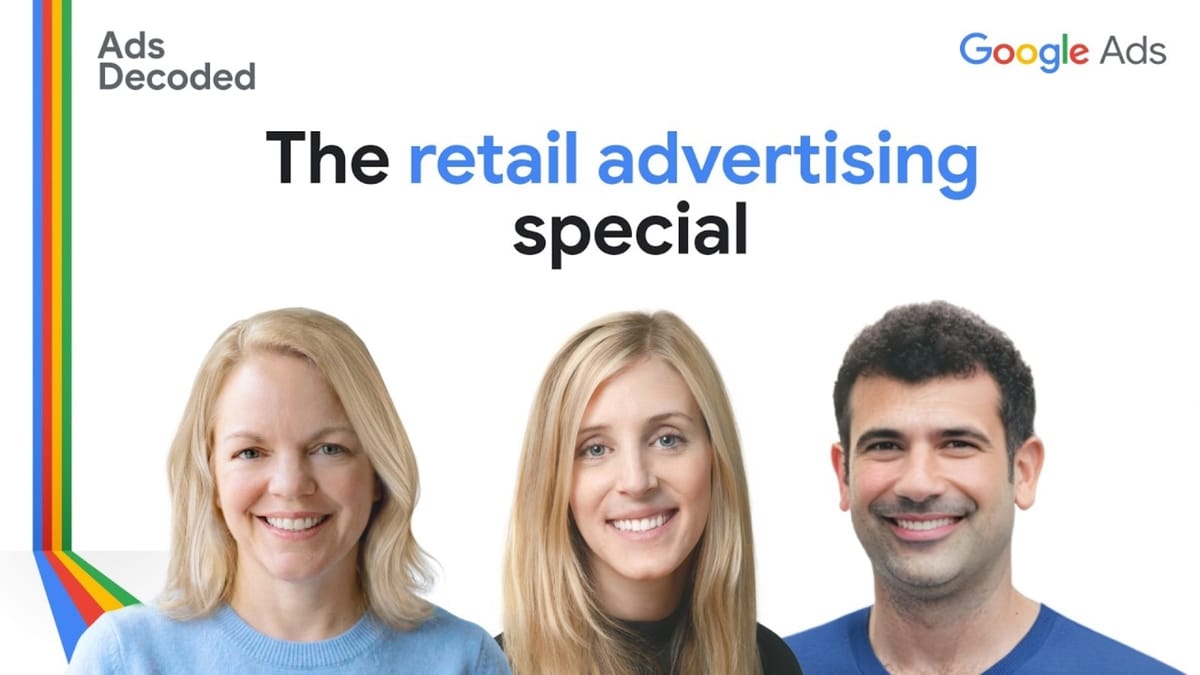
Google published a new episode of its Ads Decoded video series on April 8, 2026, walking retail advertisers through the current state of its shopping ad infrastructure - from product feed optimization and campaign portfolio strategy to shoppable connected television and the early stages of agentic commerce. The episode, titled "How to build a retail growth engine in 2026," runs approximately 40 minutes and features Ginny Marvin, Google's Ads Product Liaison, in conversation with Firas Yaghi, Global Product Lead for Retail Solutions, and Nadja Bissinger, Group Product Director for Retail on YouTube.
The conversation covers a wide sweep of changes that have accumulated across Google's retail ad stack over the past year - some already live, others in limited pilots - and offers a structured account of how advertisers are expected to think about data, campaign types, and measurement as AI-driven surfaces become a more prominent part of where products are discovered and purchased.
The central argument running through the episode is that Google Merchant Center product data has expanded well beyond its original function of powering shopping ads in search results. According to Yaghi, the feed currently supplies product information to free listings, the Gemini shopping experience, AI Mode, virtual try-on in Google Lens, Business Agent, and brand profiles. The list is longer than most practitioners are likely tracking.
Bissinger added a dimension that often goes unexamined in feed management discussions: resolution and link quality. Advertisers who originally built their Merchant Center feeds for desktop search may be supplying assets that degrade visibly when displayed on large-screen CTV formats. According to Bissinger, a product image that looks acceptable on a mobile screen may not hold up on a 65-inch television - a practical issue that becomes relevant as shoppable CTV inventory scales. She also highlighted checkout links as an emerging attribute: some surfaces already support direct links to a merchant's checkout or cart experience, reducing the number of steps between an ad impression and a completed transaction.
On feed quality basics, Yaghi pointed to disapproval clearance and GTIN submission as the most common areas where merchants underinvest, noting these remain the biggest structural hurdles before more advanced optimization becomes meaningful. Beyond those fundamentals, enrichment priorities include lifestyle images, rich product titles, descriptions, product type attributes, product highlights, ratings, shipping speed information, and exclusive pricing signals. The reasoning is straightforward: every additional attribute is potential input for the multi-modal AI systems Google is running across its ad surfaces.
A practical note on what Google is calling conversational attributes - a new category of product data fields currently in pilot. Marvin mentioned during the episode that dozens of new attributes are coming to Merchant Center, designed specifically for how products are described and retrieved in conversational interfaces like AI Mode and Gemini. The implication is that feed schema will keep changing as the surfaces consuming that data continue to shift.
Firas Yaghi laid out three portfolio configurations depending on advertiser objectives. For organizations focused on maximizing cross-channel performance, he described a "performance first" approach centered on Performance Max, AI Max for Search, and Demand Gen. Where more granular control is needed - for example, managing brand versus non-brand traffic separately or prioritizing specific placement channels - the recommendation was AI Max paired with standard shopping, and Demand Gen with channel controls enabled. The third configuration, described as balancing scale and stability, blends campaign types to create what Yaghi called a "complementary surround sound strategy."
Bissinger's framing was more direct: stop treating campaign types as competing, and instead view them as an integrated ecosystem calibrated to a compounding loop of awareness, intent, and conversion goals. The practical implication is that budget allocation decisions should be evaluated at the account level rather than per campaign, particularly given that Google changed the ad rank trumping logic between Performance Max and standard shopping last year. Previously, Performance Max was always prioritized when both campaign types targeted the same product inventory. Now the campaign with the highest ad rank serves - meaning bidding targets (tROAS, tCPA) become the primary routing mechanism between campaigns. Yaghi recommended ensuring no product inventory overlap between campaigns when precise control over which campaign serves is required, otherwise evaluating total performance at the account level.
Demand Gen campaigns, which run across YouTube, Gmail, Discover, and the Google Display Network, can now incorporate product feeds from Merchant Center, pulling rich product assets directly into ad formats served on those surfaces. According to Yaghi, advertisers who have added product feeds to Demand Gen have seen, on average, a 33% uplift in conversions compared to running without product feeds. That figure has been communicated publicly before, but the episode frames it in the context of a broader shift: product feeds turn Demand Gen ads into what Yaghi described as "a digital storefront."
The campaign type also saw a measurement expansion last year. In 2025, conversions with cart data - which allow advertisers to see which products were actually purchased rather than just which product was advertised - were extended to Demand Gen. This matters specifically for cross-sell scenarios, where the product that draws a user in is not the product ultimately purchased. Product-level reporting in Demand Gen has also been updated, and according to Bissinger, further changes are forthcoming that will add new metrics and dimensions tailored to format-specific performance - acknowledging that how a product listing ad looks on Google.com is structurally different from how the same product appears in a YouTube in-stream ad.
One of the more technically significant changes discussed in the episode is the shift in how lookalike audiences function within Demand Gen. Previously, lookalike audiences operated as a hard target - a defined population boundary that the campaign would serve within. They now function as a signal that the algorithm uses alongside other contextual and behavioral data to find high-probability converters.
According to Yaghi, the rationale is that users are multi-dimensional. A strict lookalike cutoff would exclude users who fall just outside the defined similarity threshold but are still highly likely to convert - for example, someone watching a YouTube video about travel and luggage at the moment a suitcase ad could be most relevant, even if that person does not closely resemble the advertiser's existing customer profile. Lookalike data remains valuable as an input, but it is now one signal among many rather than the sole determinant of audience eligibility.
This change is consistent with a broader pattern across Google's ad products, visible in Performance Max's audience signal model and in the evolution of keyword matching from exact and phrase toward broad match with AI guidance. The shift transfers optimization authority to Google's systems while changing the nature of the control inputs advertisers provide - away from rigid targeting definitions and toward data quality, conversion tracking completeness, and goal specification.
Marvin introduced a metric called attributed branded searches, described as an always-on measurement capability announced at Google Marketing Live last year. The metric counts how many searches for an advertiser's brand were conducted by users who had previously seen that advertiser's video ad on YouTube. It requires no additional setup and relies on the direct integration between Google's video and search platforms.
The practical purpose is to make visible a causal chain that the industry has long suspected exists but has struggled to quantify: YouTube video exposure driving downstream organic search behavior. According to Bissinger, demand gen campaigns saw more than a 26% year-on-year increase in conversions per dollar spent. Attributed branded searches gives advertisers a way to show cross-channel influence to stakeholders and clients, without requiring custom measurement infrastructure.
Shoppable CTV is now available in both Demand Gen and Performance Max campaigns. Once a product feed is connected, product information is automatically surfaced within CTV ad placements. The format has been updated to support user interaction - viewers can scroll through products, and QR codes are automatically generated without any setup required from the advertiser. According to Marvin, specifying where the QR code should land requires only filling in the correct product link in the Merchant Center feed or the final URL in the Google Ads account.
The expansion of product-linked formats to the television screen adds a new consideration to feed management. Image resolution for CTV surfaces requires higher quality than standard web or mobile placements, and tracking infrastructure needs to account for the different click and conversion paths that large-screen viewing generates compared to mobile or desktop.
Yaghi noted that the majority of global retail sales - more than 80% in most markets - still occur in physical stores. The episode presented offline conversion measurement as a prerequisite for meaningful optimization. The recommended approach combines omnichannel bidding across Search, Performance Max, and Demand Gen with local inventory ads that surface in-store availability to nearby shoppers. A second product, PMax for store goals, is designed specifically for advertisers targeting in-store traffic across Search, YouTube, Google Display Network, and Maps.
A newer variant called PMax on the go runs exclusively on local formats across Google Maps, Waze, and Search. The figures cited to contextualize the opportunity: over a billion people visit Google Maps and Search each month to find businesses, plan trips, or locate destinations mid-journey.
On new customer acquisition, Yaghi described two specific levers: activating new customer acquisition goals in Google Ads (with options to bid higher for new customers or bid exclusively for new customers), and uploading existing customer lists so Google's AI can build lookalike profiles of the best buyers and exclude current customers from acquisition-focused placements. The new customer acquisition reporting has been updated with a new column to show the incremental contribution from these goals.
Two tooling announcements were flagged during the episode. Merchant Center for Agencies, which went generally available in the United States and Canada in March 2026, provides a single-login interface for agencies to monitor account health, item-level issues, and optimization opportunities across a full client portfolio. A global pilot is running for agencies outside those two markets.
The second tool, Merchant Advisor, is described as an AI-powered chatbot integrated directly into the Merchant Center user interface. According to Yaghi, it functions as a personalized growth assistant that provides proactive help for merchants navigating feed issues and platform decisions. As of the episode's publication, it is available to only a limited group of users. Google announced Ads Advisor and Analytics Advisor at Gmail last year, positioning Merchant Advisor as the commerce-specific equivalent of those earlier tools.
The episode's closing section addressed the emerging agentic commerce infrastructure - a topic that has featured prominently in Google's recent product announcements. Google launched the Universal Commerce Protocol on January 11, 2026, establishing open-source standards for AI agents to execute purchases across retail platforms, with Shopify, Etsy, Wayfair, Target, and Walmart as co-developers.
Yaghi framed preparation in three stages. In the current phase: ensure the feed contains rich product information with high-quality text and images, connect first-party data, update tags and data managers, and implement conversions with cart data. In the next phase: upgrade to the Merchant API for real-time inventory - described as critical for agentic commerce scenarios where inventory status must be current to the moment - and prototype using the Universal Commerce Protocol (UCP), with documentation available at ucp.dev. In a future phase: deploy Gemini Enterprise for consumer experiences to activate agentic commerce on the merchant's own surfaces, and develop an AI governance framework for evaluating performance.
Marvin noted that Google is also introducing "direct offers" - a format currently in pilot within AI Mode that allows merchants to surface a specific controlled offer when a user is actively researching a relevant product. Shopping ads in AI Mode were introduced in February 2026, as the surface reached over 75 million daily active users according to Google-commissioned research.
The broader context for the retail advertising community is that the data infrastructure decisions made now - feed quality, conversion tracking comprehensiveness, first-party data connectivity - will determine how visible a merchant's products are across a rapidly expanding set of AI-powered surfaces. Botify's Agentic Feeds product, launched March 24, 2026, addresses exactly this problem, noting that legacy product feeds built for a keyword search world may not carry the structural depth that AI agents now require to surface and transact products.
Who: Google's Ads Decoded series, hosted by Ginny Marvin (Ads Product Liaison), featuring Firas Yaghi (Global Product Lead for Retail Solutions) and Nadja Bissinger (Group Product Director for Retail on YouTube).
What: A ~40-minute video published April 8, 2026, covering how retail advertisers should approach product feed quality, campaign portfolio structure (Performance Max, Demand Gen, standard shopping, AI Max), the shift of lookalike audiences from hard targets to signals, shoppable CTV in Demand Gen and PMax, new measurement capabilities including attributed branded searches and conversions with cart data, and a staged framework for preparing for agentic commerce infrastructure including the Merchant API and Universal Commerce Protocol.
When: The episode was published on April 8, 2026, two days before today's date.
Where: Published on the Google Ads YouTube channel, which has approximately 864,000 subscribers at the time of publication. The content addresses Google's advertising ecosystem globally, covering Search, YouTube, Gmail, Discover, Google Display Network, Maps, Waze, and CTV surfaces.
Why: The episode matters because it documents a structural shift in how Google's retail ad products are integrated - product data from Merchant Center now flows to a wider set of surfaces than most advertisers actively manage, and the measurement and optimization decisions made at the feed and campaign level have downstream consequences for visibility on AI Mode, Gemini, Business Agent, and future agentic commerce infrastructure. The timing comes as Google has rolled out several significant platform changes in Q1 2026 - Merchant Center for Agencies, loyalty program expansions, UCP documentation, and shopping ads in AI Mode - making the episode a useful map of where those changes connect to day-to-day campaign management.