Google's AI voice-over is coming to your Performance Max videos - opt out by March 20
Google is adding AI-generated voice-over to Performance Max video ads using advertiser headlines and descriptions, with an opt-out deadline of March 20, 2026.


Google is adding AI-generated voice-over to Performance Max video ads using advertiser headlines and descriptions, with an opt-out deadline of March 20, 2026.

Google yesterday began notifying advertisers that Performance Max campaigns will soon receive a new asset optimization feature that automatically layers AI-generated voice-over onto existing video ads - whether they asked for it or not. The notification, surfaced publicly through a LinkedIn post by Georgi Zayakov, a PPC influencer who bills himself as "The Google Ads Detective," included the full text of an email originally shared by Jordan Fry. The feature is scheduled to activate automatically on March 20, 2026, giving advertisers just ten days from today to take action if they wish to remain outside the program.
The announcement arrives at a moment when Google has been accelerating AI-powered automation across its advertising ecosystem. Performance Max, which became available to all advertisers in November 2021, now serves over one million active advertisers globally. The campaign type distributes budgets dynamically across Search, YouTube, Display, Discover, Gmail, and Maps - and has, over the past several years, progressively incorporated AI features that modify creative assets without requiring manual input from advertisers.
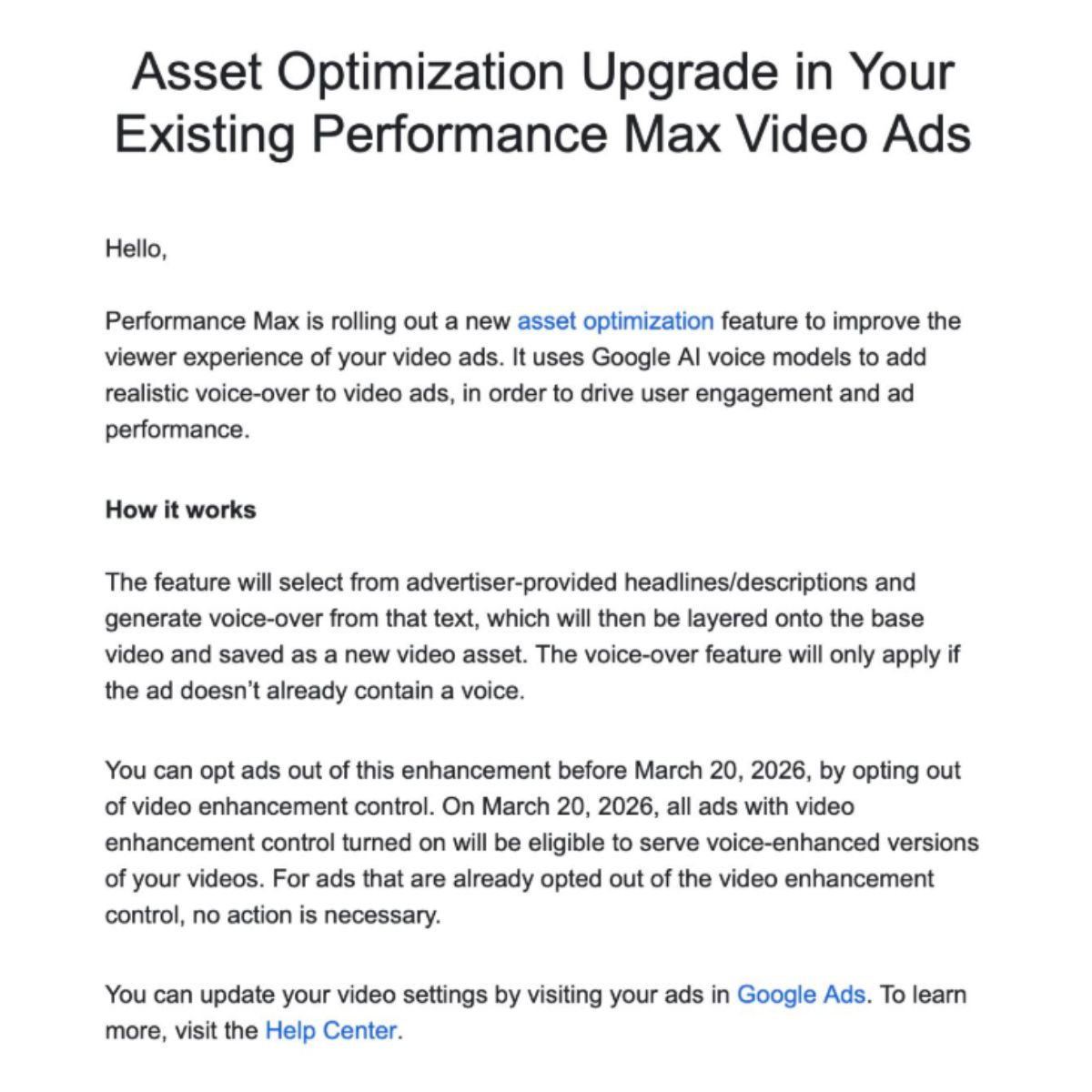
According to the email shared with advertisers, the mechanism is straightforward in design but consequential in scope. The system selects from text that advertisers have already provided - specifically, the headlines and descriptions within their Performance Max asset groups. It then generates a voice-over from that text using Google AI voice models. The resulting audio is layered on top of the advertiser's base video and saved as an entirely new video asset within the campaign.
There is one narrow condition that limits the feature's scope: according to the email, "The voice-over feature will only apply if the ad doesn't already contain a voice." Videos that already carry a voice track - whether a human narrator, branded audio, or any other spoken element - are not affected. The feature targets silent or music-only videos.
The new asset is stored alongside the original video in the advertiser's asset library. It does not overwrite the original. However, the voice-enhanced version becomes eligible to serve in ad auctions once the March 20 activation date passes for accounts with video enhancement control turned on.
The timeline is tight. According to the notification, advertisers have until March 20, 2026, to disable the feature through the video enhancement control settings within their Google Ads accounts. On that date, the system will begin serving voice-enhanced versions for all ads in accounts where video enhancement control remains active. For ads already opted out of video enhancement control prior to the announcement, no additional steps are required - those placements remain unaffected.
Google directs advertisers to update settings by visiting their ads directly in the Google Ads interface. Additional documentation is available through the Help Center. The opt-out mechanism is a campaign-level toggle rather than an ad-by-ad decision, meaning advertisers managing large portfolios with dozens of Performance Max campaigns would need to audit each individually.
This structure - an automatic opt-in that requires deliberate action to exit - has become a recurring pattern for Google's AI creative features. In October 2024, when Google introduced video format adaptation and automated video shortening as part of a broader set of Performance Max enhancements, the platform offered similar campaign-level, feature-level, and ad-level controls for opting out of enhanced videos. The logic has remained consistent: Google argues that AI enhancements improve performance metrics, while advertisers retain control only if they proactively exercise it.
The process described in Google's announcement follows a specific generation pipeline. First, the system reads the headline and description text fields associated with the relevant Performance Max asset group. These are the same text assets that advertisers have already supplied for use in Search and Display placements. Second, it passes that text to Google AI voice models, which synthesize realistic spoken audio. Third, the audio track is combined with the video in a rendering step and saved as a distinct asset with a new identifier.
The phrase "realistic voice-over" appears in the official communication, citing Google AI voice models as the underlying technology. No specific voice model name or technical specification is provided in the public-facing email. The output is described as targeting "user engagement and ad performance," which are the two stated objectives of the broader asset optimization feature.
One detail worth noting is that the system draws on advertiser-provided text rather than generating novel copy. This means the spoken content should - in principle - reflect the advertiser's approved messaging. In practice, though, headline and description text is often written for text display rather than spoken delivery. Short, punctuation-heavy ad headlines can sound stilted or unnatural when read aloud by a text-to-speech system. Manuel Arrufat, a Google Ads performance consultant who commented on the LinkedIn thread, raised the homogeneity concern more directly: "if all advertisers run with the same voice, it won't be good."
The LinkedIn post from Zayakov attracted immediate attention in PPC and search engine advertising circles. Jonny Golding noted that "reviewing video enhancement settings in Google Ads keeps advertisers in control of AI voice assets appearing in their videos" - a framing that acknowledged the feature's default-on design without treating it as inherently problematic. For agencies managing large portfolios, the concern is operational as much as creative. Auditing video enhancement settings across dozens of accounts before a ten-day deadline requires prioritization.
Arrufat's comment points to a longer-term creative risk. Voice is a deeply brand-specific element in advertising. Tone, pacing, accent, and style all carry signals about brand identity that advertisers typically control carefully. A generic AI voice applied uniformly across campaigns from many different advertisers risks flattening those distinctions, particularly in competitive categories where differentiation matters.
The feature also raises practical questions for regulated industries. Financial services, healthcare, and pharmaceutical advertisers, for example, carry strict requirements about the precise language used in spoken advertising - requirements that may not translate cleanly from a character-limited text field written for display.
The voice-over announcement is one step in a much longer sequence of AI creative features added to Performance Max over the past 18 months. In February 2024, Google emphasized the importance of video in Performance Max campaigns, citing an average 12% conversion uplift for advertisers who include at least one video asset. That data point forms part of the commercial rationale for adding voice to silent videos - if video drives conversions, enhanced video might drive more.
In October 2024, Google introduced Imagen 3 integration for Performance Max alongside video format adaptation for different aspect ratios and automated video shortening. Those features also defaulted to enabled, with opt-out available through campaign settings. The pattern - rolling out AI creative tools with opt-in framing for advertisers who want out, rather than opt-in framing for those who want in - has been consistent throughout this period.
Google's Think Week 2025 announcements in September positioned Performance Max as the anchor of what the company calls the "Power Pack" - a strategy combining AI Max for Search, Performance Max, and Demand Gen campaigns. According to Sylvanus Bent of Google's search ads automation team, Performance Max received more than 90 quality improvements in the past year, driving conversion increases exceeding 10%. Voice-over generation fits within this continuous improvement framing.
Asset Studio, announced at Google Marketing Live in May 2025, consolidated the company's creative AI tools into a single workspace within Google Ads. The platform uses Google's Veo and Imagen models for video enhancement, image generation, and asset variation creation. The voice-over feature announced today appears to operate through a related but distinct pipeline - drawing on voice models rather than generative video models - though Google's email does not specify the technical lineage.
In January 2026, Google expanded asset-level A/B testing capabilities to all Performance Max campaigns, allowing advertisers to compare two distinct asset sets within single asset groups. That feature gave advertisers more control over creative testing. The voice-over announcement moves in a different direction: it adds a new asset variant automatically, without first requiring a testing decision from the advertiser.
For search marketers managing Performance Max campaigns, the immediate practical task is auditing video enhancement settings before March 20. The setting is accessible through the Google Ads interface at the campaign level. Advertisers who have already disabled video enhancement control in previous rounds - when format adaptation and video shortening were rolled out - are not required to take additional action, as those accounts are already opted out.
For advertisers who choose to remain in the program, the voice-over version of each eligible video will begin serving on March 20. Performance data for AI-enhanced assets is accessible through the asset reporting tools within Google Ads, though the depth of voice-specific reporting is not detailed in the announcement.
For agencies, the challenge is procedural. Managing opt-out across multiple client accounts within a ten-day window requires a clear workflow. The Google Ads account-level placement exclusions feature rolled out in January 2026illustrates the direction of travel: Google is adding more centralized controls, but the video enhancement setting operates at the campaign level and does not benefit from account-wide toggle functionality.
The broader trajectory reflects what PPC Land has tracked across multiple Google Ads releases: a steady migration from manual advertiser control toward AI-managed creative variation. Whether voice-over proves to be a genuine performance lever or a source of brand friction will depend on implementation quality - and on how many advertisers decide that a March 20 deadline is worth acting on.
Who: Google, affecting all advertisers running Performance Max campaigns in Google Ads globally. The announcement was surfaced publicly by Georgi Zayakov (PPC influencer, "The Google Ads Detective") via a LinkedIn post, sharing an email originally received by Jordan Fry.
What: Google is rolling out an AI voice-over asset optimization feature for Performance Max video ads. The system selects from advertiser-provided headlines and descriptions, generates spoken audio using Google AI voice models, layers it onto existing silent or music-only videos, and saves the result as a new video asset. The feature activates automatically for all eligible accounts on March 20, 2026.
When: The notification was sent today, March 10, 2026. The opt-out deadline is March 20, 2026. Advertisers who wish to remain outside the program must disable video enhancement control before that date. Accounts already opted out require no further action.
Where: The feature operates within Google Ads across all campaigns using Performance Max. Video settings are managed through the Google Ads interface at the campaign level. The resulting voice-enhanced video assets serve across Google's advertising network wherever video ads are eligible, including YouTube, Display, and Discover.
Why: Google states the feature is designed to drive user engagement and ad performance by improving the viewer experience of video ads. The company's stated rationale is consistent with prior communications emphasizing video as a performance driver in Performance Max - including data citing a 12% average conversion uplift for campaigns that include at least one video. The automated opt-in approach reflects Google's broader strategy of using AI to optimize creative assets at scale without requiring manual intervention from advertisers, a pattern visible across multiple Performance Max feature releases since 2024.